



Last night, I was just looking at the stuff that people share on YouTube related to how to open a new gym just to see what operators are actually discussing. I landed on a Fitness Marketing Agency podcast called “How to Fill Your Gym Before You Open.”
I listened to the whole thing without skipping. One line near the start stopped me cold, about the new gym owner’s mindset:
“The belief that people won’t buy because the kit is not here yet, or because the door is not open.“
The host’s response was blunt:
“Well, how do you know? You have probably never even tried it.”
By the end, a handful of ideas had stuck with me, and they’re the backbone of everything below:
- People will buy before you open if you give them a compelling enough reason.
- FOMO is stronger than owners realize. Tell people this will be the best gym around, and spaces are capped, and they move fast.
- A prospect wants something exciting on a sales call, the result and the vision, not a tour of an empty room.
- “Build it, and they will come” is the industry’s most expensive myth. No pre-marketing means opening to crickets.
- A deposit secures commitment without the prospect taking on risk before day one.
Those ideas landed because I’ve watched the same story from both sides. In the work I do advising gym owners, I’ve seen two gyms open side by side: same neighborhood, same month, same budget, same equipment.
One opened to a packed floor and a waitlist for the 6 PM class. The other opened to silence: a beautiful, expensive, empty room. The difference was not the treadmills. One sold memberships before the doors opened. The other didn’t.
I have seen what tips it each way. One owner spends months obsessing over flooring, logos, and the sound system, and sells almost nothing early. Opening morning comes, four people wander in, three of them friends, and it’s eight long months clawing back to break even. Another builds a system first and opens with members already paying.
Chris Plentus, who owns Kanna Fitness in Ambler, Pennsylvania, is the second kind. He relocated and worked on a structured “Founders Club” plan. 160 leads, 84 sales appointments, 76 show-ups, and a close rate strong enough to open the new spot already profitable. That happens because of a system, and it’s the system I want to walk you through.
Why your pre-sales campaign is worth more than your equipment
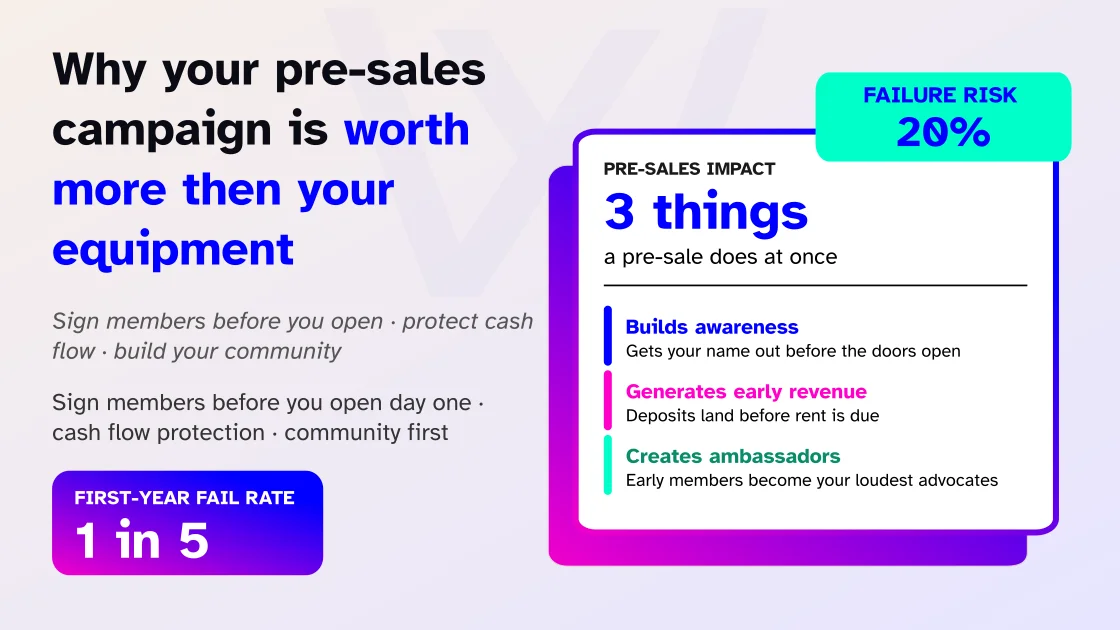
A pre-sales strategy is your plan to sign as many members as possible before you open, so opening day feels like momentum instead of a gamble. The first 50 are always the hardest to find. A presale is the simplest way to line them up. Done right, it does three things at once: Builds awareness, generates early revenue, and creates a community of members who become your first ambassadors.
Here’s the math that keeps owners up at night. An empty first month still costs everything: rent, payroll, utilities, loan repayments, and the real cost of opening a gym, whether or not a single member has joined.
Open it with members already paying, and that’s the difference between surviving and not. About 20% of new US businesses fail in their first year, per Bureau of Labor Statistics data, and cash flow is a leading cause.
The owners who sleep well are the ones watching deposits land weeks before opening, because the pressure is already off. “Build it, and they will come” is not a strategy. It’s a prayer.
Where to spend first in your gym pre-sales campaign
Here’s the typical spending pattern, because I’ve watched owners live every line of it. Sign a long lease, spend tens of thousands on equipment, commission a gorgeous logo, agonize over a sound system nobody will ever comment on, and spend $0 on pre-sales marketing.
The belief is that the room will sell itself. It won’t. This is shiny object syndrome in its most expensive form: chasing the things that look like progress over the one thing that actually fills the gym.
Not one of those purchases generates a dollar before opening day. A $50,000 fit-out may impress members who already signed up, but it creates zero demand on its own. And the same syndrome infects the marketing too, a full website before a landing page, an agency before the message is clear, and ads before any follow-up system exists. Reverse the order: sales infrastructure first, aesthetics second.
How do you position the gym against nearby competitors?
The question almost every owner skips: who is this gym for, and why choose it over the three other gyms within two miles? You need a positioning statement covering who you serve, what problems you solve, and why you. The biggest budget-killer is trying to appeal to everyone, talk to everyone, and you reach no one.
Who is the ideal member for this location?
The ideal member here may differ from your other sites. Before marketing, answer these questions:
- Which local demographics first? Pull census and Meta audience data before guessing.
- Beginners, athletes, families, or professionals? Serve several, but your founding offer should speak to one first.
- What fitness goals matter most here? Fat loss, strength, community, recovery. It changes your message.
- Which neighborhoods or routes? The people who pass your door daily are your cheapest, warmest leads.
How do you know if demand is strong enough to proceed?
Validate cheaply first. This is straight from the podcast. Open the map inside Meta, check how many people are in your catchment, then run a small “a new gym is coming, join the waitlist” test to gauge demand, especially if the area already has several gyms.
I have seen an owner of a certain young professional, where the market discovered from the test ad that it was busy parents clicking. They rebuilt the message around parents, and it became their strongest cohort. If a cheap test pulls qualified leads, demand is real; if not, you have saved yourself from pouring money into a market that wasn’t ready.
Fix your operation before you bring leads in
The most expensive mistake nobody writes about: generating leads before you can handle them. A lead that hits voicemail becomes your competitor’s member. Before any campaign goes live, someone answers the phone every time, staff consults rather than pitches, the space is presentable, and onboarding is mapped.
What landing page should you create for the campaign?
You do not need a full website; you need a launchpad: a landing page with one clear CTA, a verified Google Business Profile, secured social handles, and a lead form wired into your CRM. Use real photos of people who look like the target member, not stock models.
The pre-sales timeline that actually works
One mistake I have seen different gym owners make is treating pre-sales like a single event instead of a process. Momentum is not built in one week of advertising; it’s created through months of consistent activity. The timelines below break the campaign into manageable stages, with clear goals for each phase so you know exactly what needs to happen before opening day.
When should you start the pre-sales campaign?
Most advice says four to eight weeks out; operators start later still. Both are risky, because awareness compounds. What you build this month can still be working for you three months from now. Devan Dickerson, who founded Lighthouse Gym in Raleigh, Mississippi, began promotions seven months ahead via a private Facebook page, posting every milestone: testing the door system, laying floors, the final paint and the matting going down.
The campaign netted multiple sign-ups a day, and the early cash even helped him fix an unexpected flooring problem and open on time. Think in months, not weeks: four to six months, in two phases, capturing prospects, then converting to members. And announce a window, not a date. “Opening this spring” gives you room if construction slips.
What are the best pre-launch milestones to hit before opening day?
- Phase 1 (16-12 weeks out): Plant the flag. Announce the location, launch the landing page, begin teaser content, claim listings and run a demand-validation ad. Milestone: 200+ email leads before sales open.
- Phase 2 (12-8 weeks out): Open the founding doors. Release the offer to your waitlist first, switch on hyperlocal paid social, deploy QR-code flyers and banners, and launch an email sequence. Milestone: 30-50% sold.
- Phase 3 (8-4 weeks out): Turn up the volume. Increase posting, launch a countdown, activate referrals, run pop-ups, and show progress. Milestone: 70-80%.
- Phase 4 (4 weeks to opening): Final push. Preview events for founding members, trainer intros, a final offer window, grand opening invites, and outreach to warm leads. Milestone: Target met, RSVP list full.
Build an offer nobody can say no to
The success of your pre-sales campaign often comes down to one thing: The offer. Even the best marketing won’t convert if people don’t see a compelling reason to commit before the doors open. The first decision is choosing the type of offer that best fits your brand, market, and level of credibility.
What should you sell during pre-sales: founding memberships, trial packs, or full memberships?
People buy memberships to gyms that don’t exist yet, large franchises run “$1 down, then a low monthly rate” offers before a machine is plugged in. Think about how new-build housing sells: developers pre-sell off nothing but floor plans.
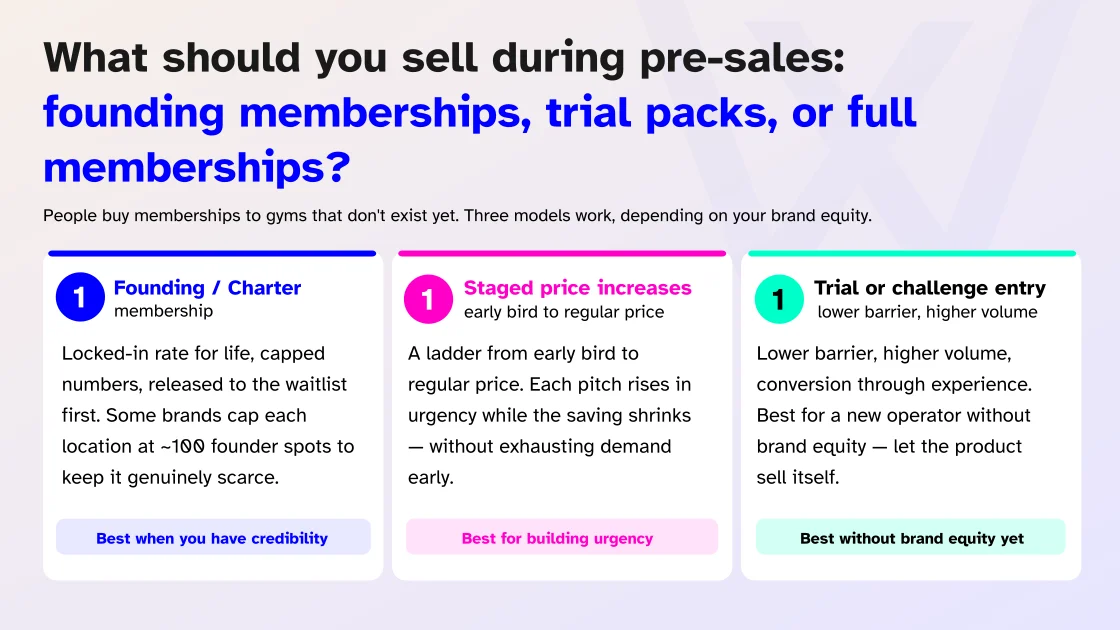
Here’s the park, the school’s a 10-minute walk, secure your plot with a deposit, and the price climbs brick by brick. You’re doing the same thing with a gym. Three models work, depending on your brand equity:
- Founding / Charter membership: A locked-in rate for life, capped numbers, released to the waitlist first. Some brands cap each location at around 100 “founder’s rate” spots to keep it genuinely scarce. Best when you have credibility.
- Staged price increases: A ladder from early bird to regular price; each pitch rises in urgency while the saving shrinks, without exhausting demand early.
- Trial or challenge entry: Lower barrier, higher volume, conversion through experience. Best for a new operator without brand equity.
Should you include perks like free classes, PT sessions, or locker access?
Yes, lean on perks over discounts: free personal training sessions in month one, priority class booking, branded merch, VIP launch invites, a reserved locker and no joining fee.
How do you create an offer that feels exclusive without hurting future pricing?
Add value, don’t cut rate. Heavy discounts build a base that resists every future price increase; a founding rate plus genuine perks feels exclusive, while a desperate discount just feels cheap.
How do you limit the offer so it feels urgent?
Cap it for real. “First 100 founding members” only works if it’s true, set a hard number and hold the line, even if you’re a 20,000-square-foot box. When asked why, tell the truth: peak class capacity and coaching quality depend on not overselling. And use the deposit model, a deposit now, the first full payment scheduled for opening day, removing the prospect’s risk while locking in commitment.
A great offer alone won’t fill your gym. People need to see it, hear about it, and feel motivated to act before opening day arrives. That’s where your campaign strategy comes in. The most successful gym launches don’t rely on a single promotion.
They combine multiple tactics that build awareness, create urgency, and keep momentum growing over several months. Here are seven proven pre-sales campaign ideas that consistently help new locations generate leads, convert members, and open with a community already in place.
The 7 best pre-sales campaign ideas
The mistake many gym owners make is treating pre-sales as a single promotion rather than a coordinated campaign. In reality, the most successful launches layer multiple strategies together, creating awareness, generating leads, and building urgency long before opening day. Some tactics work best for capturing attention, while others are designed to convert interest into memberships.
The following campaign ideas have consistently helped gym operators build momentum, fill founding memberships, and open their doors with an active community already behind them.
- Founding member campaign. Waitlist first, then public; use the cap as an active selling tool. These members become advocates from day one.
- Staged pricing ladder. “Early bird closes Friday, price goes up $10/month Saturday.” Sustains momentum better than one launch offer.
- Social media countdown. A story arc from empty building to opening day, which earned Dickerson daily sign-ups.
- Construction site marketing. Your site is a 24/7 ad, banners, window renders, countdown clocks, QR codes on the hoarding linking to sign-up.
- Referral from existing members. Free months, dual-location access, bring-a-friend passes, exclusive preview tours.
- Pop-up pre-sales locations. Kiosks, vacant retail, event stands, lead with help (free movement screens, consultations) and sign people up on the spot.
- Local partnerships and events. Corporate membership pitches (one HR manager can land 10–20 sign-ups), 5K sponsorships, lunch-and-learns, cross-promotions with physios and juice bars.
Build a lead generation machine that runs before you open
The success of your pre-sales campaign depends on one thing above all else: a steady flow of qualified prospects entering your pipeline before the doors open. The good news is you don’t need dozens of marketing channels to make that happen.
What matters is choosing the right mix, understanding the role each channel plays, and connecting them through a follow-up system that turns interest into memberships.
Which channels will bring the most qualified leads?
No single channel wins, sequence them:
- Meta ads: the fastest route to local qualified leads; start with a test budget.
- Google ads: higher intent, higher cost.
- Email and SMS: the most neglected, highest-ROI channel.
- WhatsApp: personal, great for deadline reminders.
- Local partnerships: referral traffic that costs only time.
- Direct mail: still works, especially for older demographics.
Lead with Meta to fill the funnel, layer in Google for intent, capture everything into email/SMS, and let referrals compound. The channel isn’t the strategy. The follow-up system is, and it should plug into your wider gym marketing plan rather than standing alone.
How do you build a waitlist before the gym opens?
A waitlist manufactures perceived demand before real demand exists. Offer first access to the founding rate, a pricing preview, and insider updates. Aim for three to five times your founding target, for 100 members, a list of 300–500 first.
The email nurture sequence
A six-email arc that works:
Welcome → Progress → Meet the team → Social proof → Urgency (spots filling, price date confirmed) → Grand opening invite.
Send every 10–14 days, weekly in the final month.
Turn interest into sales
Generating leads is only half the battle. The gyms that open full aren’t necessarily the ones with the biggest lead lists. They’re the ones with the fastest follow-up, the most consistent communication, and a clear process for turning curiosity into commitment.
Who should follow up with leads, and how fast?
Assign clear ownership; if everyone owns follow-up, no one does. The first touch should happen within five minutes; a lead that sits a day is half-cold by the time you call.
How many follow-ups are needed before a lead converts?
Far more than most are willing to do. Most operators quit after one or two touches. Go multi-channel: call first, text within the hour, email within 24 hours, then keep showing up. Most sales come from the touches operators never make.
What scripts should the sales team use to close pre-sales?
This is where the podcast was sharpest. Stop thinking “sales,” start thinking “help.” The number one thing a prospect wants on that call is something exciting. The date, how good it’ll be, and above all, the results the gym gets for them. Lead with that, not a tour of an empty room. Think of the best steakhouse in town with an eight-week wait: people happily wait because they believe it’s worth it.
Open with “What’s brought you to look at joining a gym right now?” and then, the hard part, actually listen. The closer the conversation gets to the result they want, the faster they commit. Close with the deposit: “Let’s secure your spot now, your first payment won’t come out until we open.” You’re selling the vision and the community, not the equipment.
Handle the four objections you’ll hear most. The common thread: each ends by securing a deposit now, with the full payment scheduled for opening day.
- “I want to see the gym first.” I’d love to show you around when we open, but I’d hate for you to miss the founding rate while you wait. Let’s secure your spot, and I’ll personally invite you to the preview event.
- “I’ll just join when you open.” The founding rate closes before we open. Is locking that saving in for life worth deciding today?
- “We’ll join when my partner’s ready.” Let me get you both secured now. If they change their mind, we’ll sort it out. The worst outcome is telling them you both missed the rate.
- “I’m already at another gym, I think I’m in contract.” What’s making you look at alternatives right now? Solve that, then secure the spot with a deposit, have them check their exit terms, and start on day one. Worst case is seeing out a contract and missing the space here.
One note: don’t let the team chase a new script every week. Commit to one approach for at least six weeks before changing anything.
How do you track leads, and what system should you use?
Track every lead end-to-end and segment:
Hot (asked for a call) → call immediately; warm → email sequence; cold → re-engagement at four weeks
A spreadsheet beats no system, but it won’t follow up at 9 PM when a lead opts in. Purpose-built gym software automates the follow-up, protects the pipeline, and shows which channels convert, exactly where a tool like Wellyx earns its place.
Build buzz, community, and credibility before the doors open
Awareness creates attention, but experiences create emotional buy-in. That’s why the most successful pre-sales campaigns combine digital engagement with strategic community events.
How do you create excitement before the gym opens?
Build a story arc over weeks:
Empty building → construction → equipment arriving → team forming → founding members signing → preview events → opening day
People root for what they’ve followed; it’s what earned Dickerson daily sign-ups. Match the platform to the job: Instagram for visuals, TikTok for new audiences, Facebook for local groups, and post construction updates, equipment unboxings, staff intros, sneak peeks, and countdowns.
The owners who win make people feel like they’re joining something early, not just buying a discount.
What events can you host to introduce the new location?
Pop-up workouts in local parks, soft-launch previews for founding members, plus a clever trick: if the space is ready a couple of weeks early, open it exclusively for presale members. Their membership still starts on launch day, but they get a sneak experience they’ll tell everyone about. Add 5K sponsorships and trainer-led workshops to put faces to the brand.
What “good” actually looks like, benchmarks and metrics
Every pre-sales campaign generates data, but not every gym owner knows how to interpret it. The right benchmarks help separate healthy growth from false confidence, giving you a clear picture of whether you’re on track to open with enough members, revenue, and momentum to succeed.
How many pre-sale memberships do you need before launch?
Enough to cover the first month of operating costs from membership revenue alone: Month 1 costs ÷ average membership value = your minimum. That’s the floor, gyms on a structured founders plan commonly open with 40 to 60 or more, and I’ve seen owners report 80 to 100 with weeks still to go.
What conversion rate should you aim for?
A realistic opt-in-to-paid rate is 8–15%. On the landing page, 15–25% opting in is strong; below 10% usually signals a messaging or offer problem.
What cost per lead is acceptable?
It varies, but gym Meta campaigns typically run single-digit dollars per lead. The number that matters is cost per acquired member, a pricier lead that converts beats cheap ones that don’t.
How do you measure ROI?
Compare pre-sales revenue against marketing spend in lifetime-value terms. A member paying $40/month for 18 months is worth over $700, then compare the cost per lead and conversion by channel and double down on what works.
When things go wrong, the contingency playbook
No matter how well you plan, something will eventually go off script. Leads won’t convert as expected, construction timelines may slip, or a campaign that looks perfect on paper may underperform in the real world.
The difference between a gym that opens strong and one that struggles isn’t avoiding problems altogether. It’s knowing how to respond when they show up.
What if interest is low during the pre-sale period?
Read the signal: low traffic = channel/targeting;
high traffic but low opt-ins = messaging/offer; high opt-ins but low conversions = sales/follow-up; leads going cold = nurture.
If it’s low overall, fix positioning and offer before spending more.
What if ads bring leads, but sales are weak?
Almost always follow-up, not lead quality, check speed first (the five-minute window), then scripts, then objections.
What if the opening date shifts?
Communicate proactively, never reactively. The moment a delay looks likely, get ahead of it.
How do you keep momentum if construction delays happen?
Offer something real, early access, an extra free month, a personal thank-you, and keep updates flowing. The owners who handle this best get out in front of it: a short, honest video from the half-finished floor explaining what’s happening, plus a free month for everyone waiting. Handled with transparency, a delay can deepen trust more than a smooth opening would.
The opening day is not the finish line
Every other article stops at opening day; that’s where the most important work begins.
How do you keep pre-sale members engaged until opening day?
Send content only they get, trainer Q&As, class previews, first looks at the facility, and build the countdown over the final two weeks. A member who hears from you regularly stays excited; one who hears nothing for six weeks forgets why they signed up.
What updates should you send after someone buys?
A personal welcome, a clear “here’s what happens next,” and a date for their next contact, then keep them on the nurture rhythm.
How do you prevent buyer regret before the gym opens?
Regret peaks around two weeks after purchase, closing that window with immediate, warm, personal communication.
What should the grand opening experience look like for pre-sale members?
Different from anyone off the street, a pre-opening VIP night with team introductions, a tour, first workouts, and giveaways. Make them feel like they helped build the gym.
How do you turn pre-sale buyers into long-term members?
Win the first 30 days. The most effective move I’ve seen is a personal check-in call in week one, not an automated text. People are surprised when a real person rings, and it builds loyalty faster than any perk.
Add a structured onboarding journey, flag anyone who hasn’t visited within ten days, and at the 30-day satisfaction peak, ask for testimonials and launch referrals, the start of a longer-term gym member retention plan.
The 11 biggest pre-sales mistakes, and how to avoid them
The frustrating part is that most failed pre-sales campaigns don’t collapse because of one catastrophic mistake; they unravel through a series of small, preventable decisions.
I’ve made several of them myself, and after watching countless operators repeat the same patterns, these are the mistakes that consistently cost gym members, momentum, and revenue before the doors even open.
- Starting too late. Four weeks out is a crisis, starting four to six months ahead.
- Selling before building awareness. You can’t skip the awareness phase.
- Collecting followers, not contacts. Followers aren’t leads; an email is.
- Hiring an agency before your message is clear. Garbage in, garbage out.
- Pricing too high for the local market. Do the feasibility study first.
- Believing in “build it and they will come.” That’s a financial risk, not a mindset.
- Not answering the phone. A lead that hits voicemail joins your competitor.
- Over-discounting. Perks beat price cuts.
- Stopping follow-up after two touches. Most sales come later.
- Ignoring onboarding after purchase. Losing a member before you open is the most avoidable failure there is.
- Shiny object syndrome. Commit for six weeks; optimize small, don’t rebuild.
The gym that opens full doesn’t happen by accident
If you take one thing from all of this: momentum is built in the months before opening day, not on it. Chris Plentus didn’t open profitable by luck, and Devan Dickerson didn’t get daily sign-ups because his logo was nice.
They worked a system, member awareness, a real offer, relentless follow-up, and a community built before the doors opened. The members you sign before opening aren’t just revenue; they’re your community, social proof, referral engine, and retention base at once.
The best time to start a pre-sales campaign was the day the location was secured. The second-best time is right now.
Run your entire pre-sales campaign in one place with Wellyx
Everything in this playbook lives or dies on your systems: capturing leads, following up in five minutes, and tracking every prospect from ad click to signed member. That’s what Wellyx is built for:
- Capture leads from your landing page and ads into one pipeline.
- Automate follow-up so no warm lead goes cold during the build-out.
- Track sales and conversions in real time, so you know which channels to double down on.
- Manage pre-sales end to end, waitlist to founding offer to deposit to signed membership.
- Convert and keep founding members with onboarding and retention tools that carry momentum past opening day.
Instead of stitching together spreadsheets, an email tool, and a calendar of reminders, you get one platform built to turn pre-sale interest into paying members and to scale every location after this one.
Ready to open your next location full?
Book a demo and build a pre-sales engine that fills your gym before the doors even open.