



The gym can look finished long before the business is financially ready.
The flooring is down. Equipment has arrived. The front desk is in place. Founding members are asking when they can train.
Then the bills begin. Rent, payroll, utilities, insurance, cleaning, marketing, payment processing, software, repairs, supplies, and financing can quickly turn a completed gym into a cash-flow challenge.
That is why asking how much it costs to open a gym is only the starting point.
In 2026, a lean speciality fitness business can potentially start with tens of thousands of dollars, while a larger commercial gym can require $300,000–$500,000+. Current planning estimates put yoga studios around $30,000–$150,000, martial arts schools around $40,000–$300,000, CrossFit or functional gyms around $50,000–$250,000, and boutique studios around $75,000–$300,000. These are planning ranges, not guaranteed costs.
But the bigger question is what happens after opening day.
A gym may spend $100,000 getting ready and still need significant cash reserves while membership revenue grows. That makes four numbers essential:
- Startup costs: What it takes to open.
- Monthly operating burn: What it costs to run.
- Working capital: Cash reserved after opening.
- Break-even point: Revenue needed to cover costs.
The real question is:
How much cash does your gym need to open, operate, and reach break-even?
This guide shows you how to calculate it.
Gym startup cost matrix for 2026
Different fitness businesses put capital in very different places.
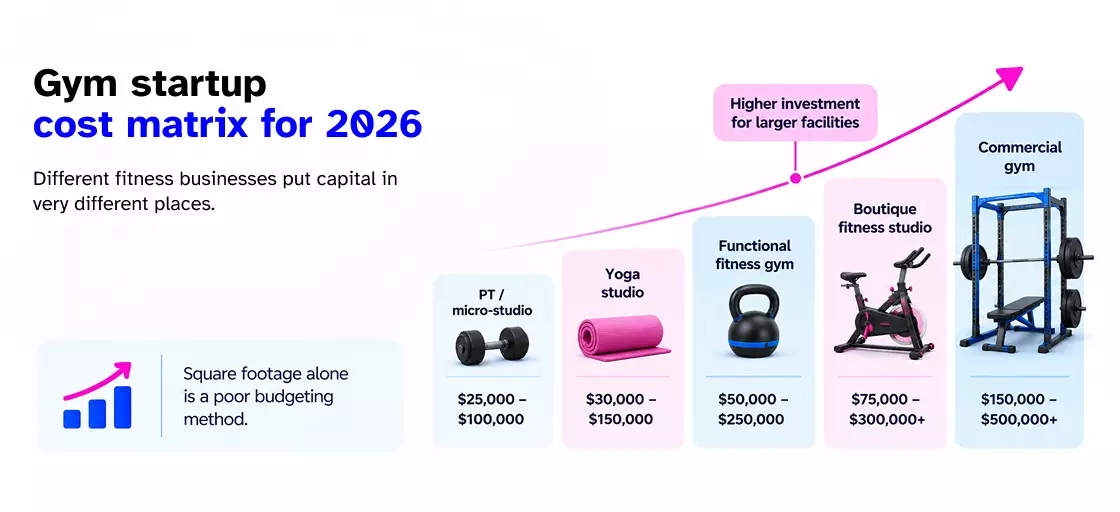
A Pilates studio may have a large amount of money tied up in reformers. A yoga studio may spend much less on training equipment but more on the property and customer environment. A commercial gym can combine a large equipment package with substantial HVAC, plumbing, electrical, locker-room, and staffing costs.
| Gym type | Example footprint | planning range | Main cost drivers |
| Personal training/micro-studio | 800–2,000 sq. ft. | $25,000–$100,000 | Deposit, equipment, flooring, runway |
| Yoga studio | 1,000–3,000 sq. ft. | $30,000–$150,000 | Facility, flooring, sound, finishes |
| Martial arts school | 2,000–5,000 sq. ft. | $40,000–$300,000 | Mats, floor space, property, runway |
| Functional fitness gym | 3,000–6,000 sq. ft. | $50,000–$250,000 | Rigs, weights, flooring, facility |
| Reformer Pilates studio | 1,500–3,500 sq. ft. | $60,000–$250,000+ | Reformers, buildout, capacity |
| Boutique fitness studio | 1,500–3,500 sq. ft. | $75,000–$300,000+ | Specialized equipment, design |
| Small/mid-size commercial gym | 5,000–10,000 sq. ft. | $150,000–$300,000+ | Equipment, HVAC, facility, staffing |
| Large commercial fitness center | 10,000+ sq. ft. | $300,000–$500,000+ | Infrastructure, equipment, payroll |
| Franchise gym | Brand-specific | About $397,000–$1.5 million+ | Brand standards, buildout, equipment |
The example footprints are there to provide context, not to prescribe the right size.
A premium 2,500-square-foot cycling studio with expensive bikes, custom acoustics, lighting, showers, and major interior construction can cost considerably more than a larger warehouse-style strength facility.
That is why square footage alone is a poor budgeting method.
Your eventual number needs to come from your lease proposal, contractor bids, equipment quotations, insurance costs, staffing assumptions, software requirements, and working-capital model.
Calculate total cash required, not just opening costs
The Small Business Administration recommends separating startup expenses from recurring monthly expenses when planning a new business.
That distinction is particularly important in fitness.
A gym may complete its renovation and equipment installation exactly on budget and still struggle because too little money was kept available for the months after opening.
A useful formula is:
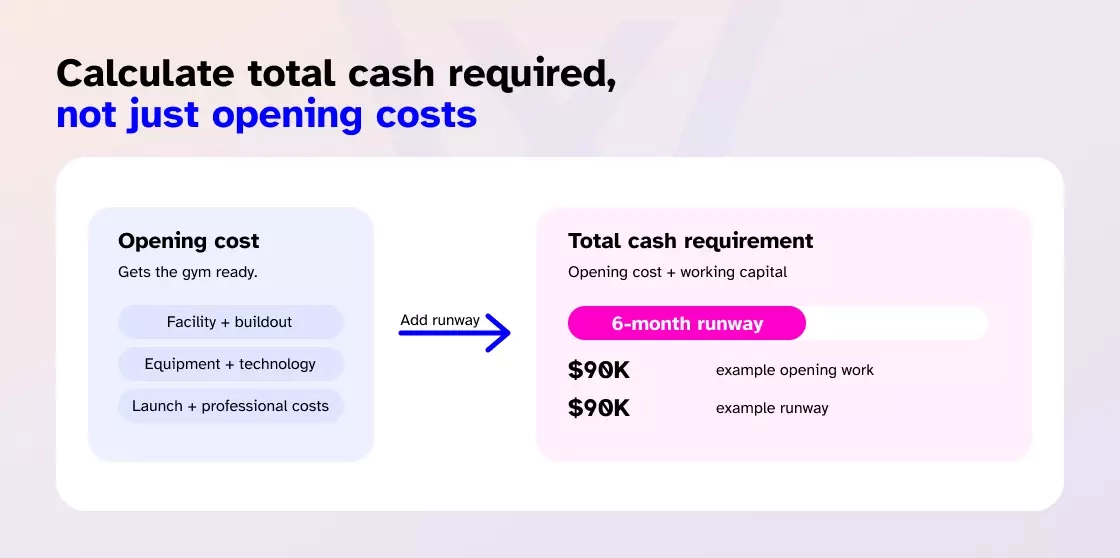
Total cash requirement = facility + buildout + equipment + professional costs + technology + launch costs + working capital
Imagine the physical opening work costs $90,000. Your expected monthly operating costs are $15,000.
You decide to model six months of gross operating runway:
$15,000 × 6 = $90,000
That does not automatically mean you need $180,000 in the bank on opening day.
You may have founding memberships. New members may join every week. Personal training or other services may begin producing revenue immediately. But the calculation exposes an important difference.
Opening cost is what gets the gym ready.
Capital requirement is what gets the business through the period before recurring income fully supports recurring expenses.
The second number is usually more useful.
Gym startup cost calculator
Gym Startup Cost Calculator
Enter your own numbers to estimate your upfront cost, monthly burn, working capital, and total cash requirement. These are planning estimates — replace them with real quotes as you go.
These figures are planning estimates only, based on the assumptions you enter. Replace them with real lease terms, contractor bids, and equipment quotes before finalizing your budget.
Personal training or micro-studio: about $25,000–$100,000
A micro-studio is usually one of the more accessible ways to enter the fitness business because it can operate with less space and with fewer equipment categories.
A 1,000-square-foot owner-operated personal training facility might begin with a relatively focused setup:
- Dumbbells and kettlebells
- Adjustable benches
- A squat or functional-training rack
- Barbells and plates
- Cable or functional equipment
- Flooring
- Storage
- Basic reception and check-in
- Insurance
- Gym management software
The model can stay relatively lean if the space already works for fitness use.
That changes quickly when the founder signs a standalone lease and begins adding construction.
Bathrooms may need modification. Flooring may need replacement. The property may require electrical or HVAC work. Signage, permits, insurance, deposits, and opening marketing all begin adding to the initial investment.
Hiring coaches or front-desk employees before membership revenue has stabilized creates another layer.
That is why $25,000–$100,000 is a more useful planning spectrum than saying a small studio costs one fixed amount.
At the low end, the owner is making deliberate compromises. The business may use shared or already-fitted space, limited equipment, owner-operated staffing, and a narrow opening service.
A conventional commercial gym should not use the $25,000 figure as its budget.
Yoga studio: about $30,000–$150,000
A yoga studio illustrates one of the most important lessons in fitness startup planning:
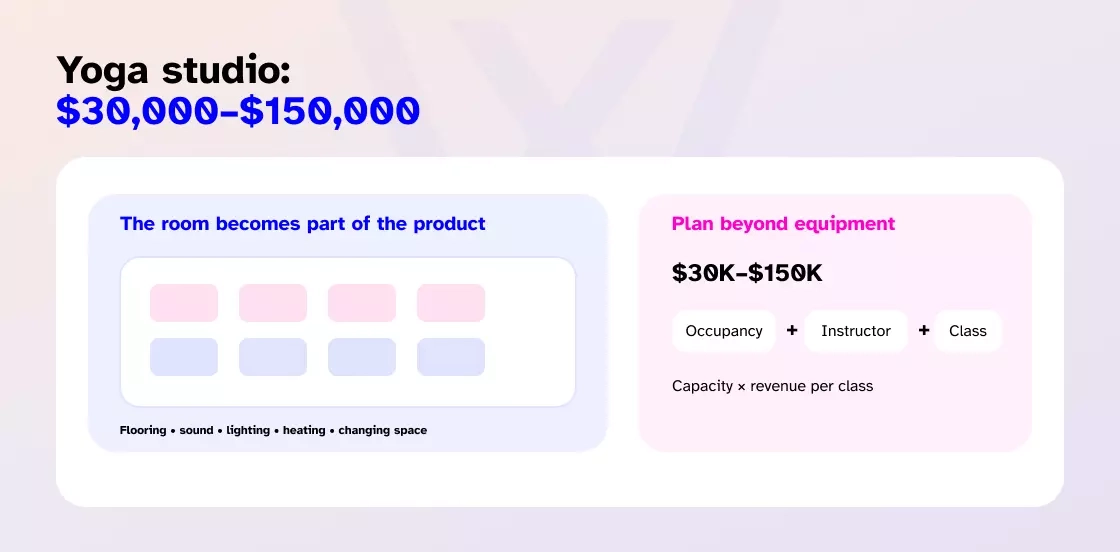
Low equipment cost does not automatically mean low startup cost.
Yoga usually requires less heavy training equipment than most gym models. But the room itself becomes part of what members are paying for.
A yoga studio may need:
- Flooring
- Mats and props
- Mirrors
- Lighting
- Sound
- Acoustic treatment
- Heating or temperature control
- Bathrooms
- Changing space
- Reception
- Storage
- Signage
- Interior finishes
- Booking and membership software
A simple studio moving into an already suitable location can remain toward the lower end of the $30,000–$150,000 planning range.
A premium concept can move much higher.
If the business needs high-end finishes, showers, specialty heating, soundproofing, significant design work, or a high-rent location, property and buildout can become much more important than the actual fitness equipment.
For a studio like this, one of the most useful financial relationships is:
Occupancy cost + instructor cost + class capacity + average revenue per class
A beautiful room can still become financially uncomfortable if only four popular evening classes produce most of the weekly revenue.
The question is therefore not simply whether the studio is small. It is whether its class schedule and pricing can support the monthly cost of the space.
Functional fitness gym: about $50,000–$250,000
A functional fitness gym often uses fewer equipment categories than a traditional commercial gym.
It may not need long rows of treadmills and selectorized strength machines. But it can still require a large quantity of the equipment it does use.
The training floor may include:
- Rigs
- Barbells
- Bumper plates
- Dumbbells
- Kettlebells
- Rowers
- Air bikes
- Boxes
- Sleds
- Benches
- Storage
- Heavy-duty flooring
Current manufacturer prices help show how quickly the equipment budget can grow.
For example, a single professional rig system can cost a few thousand dollars before bars, plates, dumbbells, benches, conditioning machines, flooring, storage, freight, and installation are included.
And equipment is only one side of the project. Many functional gyms favor warehouse or industrial-style space because it offers larger open floors and useful ceiling height.
Those buildings are not automatically gym-ready.
The owner may still face:
- HVAC work
- Bathrooms
- Electrical upgrades
- Accessibility improvements
- Fire-safety requirements
- Lighting
- Signage
- Flooring
- Permits
That is why a functional gym can reasonably occupy a $50,000–$250,000 planning range.
A small owner-operated facility using a suitable existing building looks completely different from a larger facility with extensive equipment, coaches, major flooring work, and a substantial working-capital reserve.
The useful equation is:
Equipment + facility + buildout + staffing + working capital
Reformer Pilates studio: about $60,000–$250,000+
Reformer Pilates deserves its own financial model. The equipment does more than consume capital.
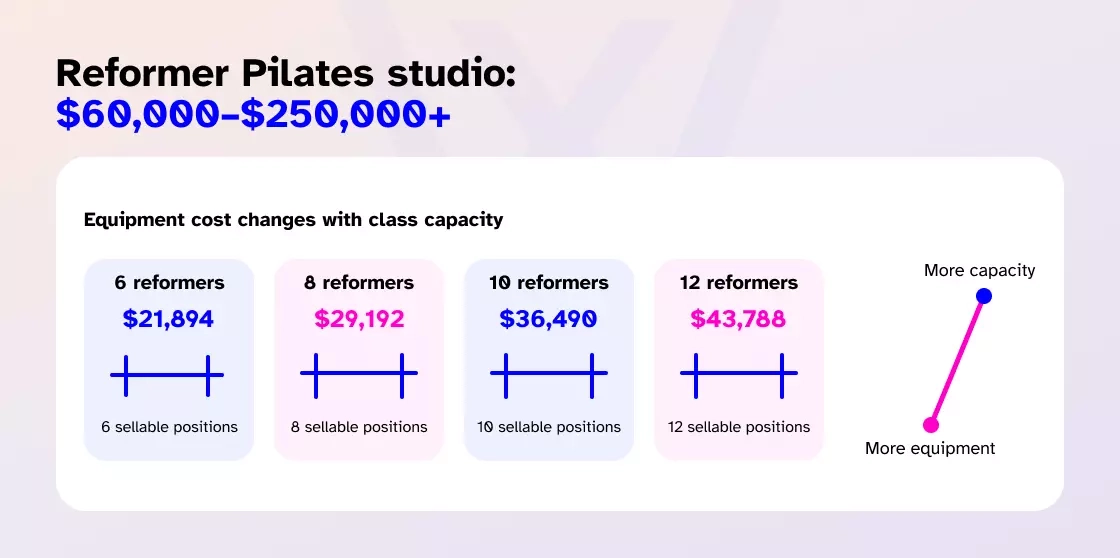
It directly defines class capacity. If the studio has six reformers, the maximum class size is six.
If it has ten, the maximum class size becomes ten.
That makes the number of reformers part of both the cost calculation and the revenue calculation. Current professional reformers can cost several thousand dollars each.
Using a verified unit price of $3,649, the equipment math alone would look like this:
- 6 reformers = $21,894
- 8 reformers = $29,192
- 10 reformers = $36,490
- 12 reformers = $43,788
Those figures do not include freight, commercial accessories, assembly, flooring, mirrors, lighting, reception, storage, bathrooms, insurance, software, instructors, launch marketing, or operating runway.
A useful formula is:
Reformer equipment cost + facility + buildout + opening costs + working capital
The studio must also ask whether the additional equipment produces enough useful capacity.
Twelve reformers may create more sellable positions than eight. They also take more floor area and require more capital.
That connection makes Pilates different from a general commercial gym, where one more member can often join without the business immediately buying another machine.
Financing equipment can help preserve opening cash. But financing does not reduce the underlying cost.
It converts part of the upfront purchase into a recurring monthly obligation, which then changes the studio’s break-even point.
That is why $60,000–$250,000+ is best treated as a planning range rather than a fixed answer.
Martial arts school: about $40,000–$300,000
Martial arts businesses often have relatively simple equipment needs compared with commercial gyms.
A school may require:
- Commercial mats
- Wall padding
- Heavy bags
- Focus mitts
- Training pads
- Storage
- Open floor space
- Reception
- Changing areas
- Children’s training equipment
The bigger financial question is often the facility.
A martial arts coach subleasing evening space from another business can begin with a much smaller capital commitment.
A dedicated academy changes the equation.
Now the business has rent, deposits, utility accounts, exterior signage, bathrooms, cleaning, reception, employees, insurance, parking, and a larger working-capital requirement.
That leads to a more useful question than simply asking what the mats cost:
How much floor space can realistic enrollment support?
Taking a larger facility gives the academy more capacity.
It may create room for children’s classes, adult programs, private instruction, multiple training areas, events, or additional instructors.
But unused capacity is still expensive.
The rent is due whether 20 students attend that month or 200.
That is why a $40,000–$300,000 planning range can make sense for martial arts operations with very different space and staffing models.
The cheapest-looking facility is not always the best one.
The important relationship is between occupancy cost and the number of paying students the business can realistically maintain.
Boutique fitness studio: about $75,000–$300,000+
Boutique fitness covers several business models, including cycling, barre, boxing, HIIT, rowing, small-group strength, and other specialized class experiences.
These concepts can operate from smaller spaces than a traditional gym.
But they may spend much more money per square foot.
A boutique budget can include:
- Specialized training equipment
- Premium flooring
- Sound
- Lighting
- Mirrors
- Interior design
- Reception
- Branding
- Signage
- Bathrooms or changing rooms
- Customer amenities
- Technology
The customer experience itself may be part of the product.
McKinsey’s research into the wider wellness economy continues to show strong consumer interest in in-person wellness experiences. That does not guarantee success for a new studio, but it helps explain why many boutique operators invest heavily in the environment around the workout.
For these models, total square footage may be less useful than two other measures:
Startup cost per sellable training position
and
Fixed monthly cost per revenue-producing class slot
Imagine a beautifully designed 2,000-square-foot studio with only 18 sellable positions per class.
Those 18 positions must collectively help support the rent, instructor cost, equipment, marketing, software, cleaning, utilities, and other monthly expenses.
That is why a smaller footprint does not automatically create a smaller budget. A $75,000–$300,000+ range reflects how widely boutique formats can differ.
Small or mid-size commercial gym: about $150,000–$500,000+
A conventional commercial gym changes the equipment equation quickly.
Instead of one or two major equipment categories, the owner may need cardio, selectorized strength equipment, free weights, racks, benches, functional-training areas, group exercise space, and member amenities.
Commercial cardio equipment can cost several thousand dollars per machine.
For example, Commercial equipment pricing can put individual treadmills above $7,000, ellipticals above $6,000, and some advanced cardio machines above $10,000.
Four treadmills at $7,599 each would already represent:
4 × $7,599 = $30,396
And the gym still has not purchased:
- Strength machines
- Dumbbells
- Plates
- Barbells
- Benches
- Racks
- Functional equipment
- Flooring
- Storage
Then comes the property.
A small or mid-size commercial gym may also need:
- Reception
- Locker rooms
- Showers
- Plumbing
- HVAC
- Electrical upgrades
- Staff space
- Accessibility improvements
- Security and access control
At this level, facility infrastructure can cost as much as or more than the equipment.
That is why $150,000–$500,000+ provides a more realistic planning spectrum than assuming a commercial gym is simply a large collection of exercise machines.
Large commercial fitness center: about $300,000–$1 million+
A large commercial fitness center can move well beyond the equipment budget seen in a smaller gym.
It may involve dozens of strength and cardio stations, large locker rooms, showers, group-exercise studios, recovery areas, offices, extensive storage, more employees, higher utilities, and a substantial working-capital requirement.
Construction becomes particularly important at this scale.
JLL’s 2026 research into commercial office fit-outs found an average of roughly $295 per square foot for a medium-quality corporate fit-out across the markets it analyzed.
That number should not be copied into a gym budget. A commercial gym is not an office.
The value of the JLL research is different: it shows how significantly fit-out economics can vary by market, building condition, specification, labor, and technical requirements.
A gym with heavy equipment, locker rooms, showers, drainage, hot water, significant HVAC, specialized electrical requirements, and sound management is its own project.
The relevant lesson is:
Use national research to understand construction risk. Use local contractor bids to build the budget.
That is why a large fitness facility may begin around $300,000 and move toward or beyond $1 million when the facility and specification become more ambitious.
Franchise gym: roughly $397,000–$1.5 million+
Franchise gym economics need to remain separate from independent gym startup estimates.
The franchisor may influence or specify:
- Initial franchise fee
- Location requirements
- Square footage
- Buildout standards
- Equipment suppliers
- Technology
- Staff training
- Branding
- Opening marketing
- Royalty payments
- Advertising contributions
- Working-capital requirements
Current official franchise disclosures from established fitness brands show total initial investment requirements beginning around the high-$300,000 range and extending beyond $1 million.
Some studio-format franchise opportunities currently publish investment estimates approaching $1.5 million per location.
These figures are useful for understanding scale. They should not be turned into one “average franchise gym cost.”
The correct number comes from the current Franchise Disclosure Document for the specific brand and market.
A franchise budget can be summarized as:
Brand entry + property + required buildout + approved equipment + opening costs + recurring fees + working capital
For anyone considering a franchise, those recurring obligations matter just as much as the opening investment.
Comprehensive gym capital allocation breakdown
Once the likely project size is clear, break the startup budget into categories.
This prevents one expensive area, usually equipment or construction, from receiving all the attention while smaller but necessary expenses disappear.
A first-pass model should account for:
- Facility deposits and initial occupancy
- Construction and tenant improvements
- Flooring
- Equipment
- Insurance
- Legal and professional services
- Permits
- Technology
- Launch marketing
- Staff recruitment and training
- Working capital
The actual numbers should eventually come from contracts and quotes.
Facility and infrastructure
The property decision creates a chain reaction. A cheap empty shell may require expensive work. A former gym may charge more rent but already contain suitable flooring, bathrooms, ventilation, changing rooms, electrical capacity, or showers.
Possible upfront facility expenses include a security deposit, first month’s rent, additional deposits, utility deposits, inspections, permits, signage, lease review, and tenant improvements.
Do not stop at the advertised rent. The lease may also create common-area charges, insurance requirements, maintenance obligations, taxes, repairs, or scheduled increases.
The real number to compare between properties is total occupancy cost. If you are still deciding whether a long-term lease or property ownership makes more financial sense, compare the wider costs and tradeoffs of owning vs. renting a gym before committing to the facility.
Negotiate tenant improvements before signing
A tenant-improvement allowance can reduce the amount of construction capital the business has to provide directly.
But there is no universal gym TI allowance.
The amount depends on the landlord, property, market, tenant credit, lease length, competition for the space, and the work being requested.
CBRE’s research into U.S. office leasing has shown that tenant-improvement packages can represent meaningful sums in commercial negotiations.
Potential points to discuss include:
- Tenant-improvement allowance
- Free-rent periods
- Landlord-delivered construction
- Electrical or HVAC improvements
- Plumbing
- Signage
- Early possession
- Rent commencement date
Negotiating those items after the lease is signed is much harder.
Buildout and renovation
Gym construction can generally be thought of in three levels.
Fitness-ready space
The building already supports much of the intended operation. Work may be limited to cosmetics, branding, layout, and minor improvements.
Basic commercial conversion
The project may involve flooring, mirrors, lighting, reception, painting, signage, storage, and smaller electrical changes.
Major conversion
Now the project may include HVAC, showers, plumbing, new bathrooms, electrical upgrades, structural changes, accessibility work, fire-safety requirements, or extensive remodeling.
Avoid using one generic construction rate per square foot as the final answer. Once the property has been selected, local contractor estimates should replace internet planning figures.
Flooring
Flooring can become a surprisingly large line item when multiplied across several thousand square feet.
The correct surface also depends on how the area is used.
- Yoga flooring does not face the same impact as a heavy lifting zone
- A functional fitness facility may need thicker rubber or dedicated lifting surfaces
- A cycling studio has different equipment-loading requirements again
A proper quote may include:
- Flooring material
- Subfloor preparation
- Adhesive or interlocking system
- Moisture treatment
- Installation
- Edging
- Delivery
The budget should be built from the measured floor plan rather than guessing from overall square footage.
Equipment procurement
Equipment cost means more than the supplier’s headline price. Your final number may also include freight, installation, assembly, financing fees, accessories, storage, warranties, maintenance, spare parts, and eventual replacement.
The best equipment list starts with the services the gym intends to sell. If you are building a larger equipment package, this guide to setting up a new gym with commercial equipment goes deeper into equipment selection, layout, and setup.
Ask what must be available on opening day, then separate that from equipment that can be added once revenue develops. That protects startup cash without deliberately creating a poor member experience.
Monthly gym operating costs
Opening costs only tell half the story. The business also needs to understand what leaves the account each month.
Common recurring expenses include:
- Rent and occupancy
- Payroll
- Utilities
- Insurance
- Software
- Cleaning
- Maintenance
- Marketing
- Equipment financing
- Business-loan payments
- Payment-processing costs
There is no responsible universal monthly gym cost.
A facility in Manhattan and one in a smaller Midwestern market do not have comparable rent.
A 24/7 access gym and a coaching-heavy boutique studio do not have comparable payroll.
The Bureau of Labor Statistics reported a $47,160 median annual wage for fitness trainers and instructors in May 2025, with a median of $48,140 in fitness and recreational sports centers.
Those figures describe the labor market. They are not instructions for what your gym should pay.
The real employer cost depends on local wage levels, hours, payroll taxes, benefits, management requirements, and employment structure.
How much runway should a new gym have?
There is no universal rule that every gym needs six, 12, or 18 months of working capital.
A presold boutique studio with low fixed costs behaves differently from a 15,000-square-foot gym opening from zero members.
Instead, calculate:
Working-capital target = expected monthly net cash shortfall × expected ramp-up period + contingency
Suppose the business expects to lose $10,000 per month while membership develops.
At six months:
$10,000 × 6 = $60,000
If slower member acquisition extends the period to nine months:
$10,000 × 9 = $90,000
That tells you far more than simply saying every gym should keep $50,000 in reserve.
Same cash, different pressure
Consider two illustrative businesses.
Gym A
Starting cash: $100,000
Monthly burn: $20,000
Ignoring revenue:
$100,000 ÷ $20,000 = 5 months
Gym B
Starting cash: $100,000
Monthly burn: $8,000
Ignoring revenue:
$100,000 ÷ $8,000 = 12.5 months
Neither example predicts survival. Real gyms generate revenue.
But the point is clear:
How quickly cash leaves matters as much as how much cash you raise.
How to preserve startup capital
Protecting capital does not mean buying the cheapest version of everything.
It means avoiding unnecessary fixed commitments and using cash where it matters most.
Negotiate the property first
The lease can affect your startup requirement before a single piece of equipment is ordered.
Discuss tenant improvements, free rent, possession dates, rent commencement, and responsibility for HVAC, plumbing, structural work, and other expensive improvements.
A landlord agreeing to complete a major mechanical upgrade may be worth more than a small reduction in monthly rent.
Finance equipment deliberately
Equipment financing can reduce the opening cash requirement.
Suppose a $30,000 equipment package requires a 20% down payment.
Upfront cash:
$30,000 × 20% = $6,000
Financed amount:
$24,000
You have preserved $24,000 of liquidity.
But the gym now has a recurring financing payment.
Financing therefore changes when the money leaves.
It does not make the equipment $24,000 cheaper.
Put the payment directly into your monthly burn and break-even model.
Pre-sell memberships
Presales can both produce early cash and test whether real people are willing to purchase the concept.
Possible presale offers include:
- Founding memberships
- Deposits
- Limited founder rates
- Early-access plans
- Opening packages
Do not choose a generic target such as 100 members simply because another business did.
Your presale target should come from your own break-even requirement.
If you need 200 members to support normal operating expenses, opening with five paid founding members creates very different financial pressure from opening with 100.
And remember:
Presale revenue carries a future service obligation.
The gym still has to deliver what those members purchased.
How many members does a gym need to break even?
Break-even turns the startup budget into an operating target.
A useful formula is:
Break-even members = monthly fixed costs ÷ contribution per member
Contribution per member means the membership revenue remaining after direct variable costs associated with serving that member.
Suppose monthly fixed expenses are $15,000.
Average monthly membership revenue is $75.
For a deliberately simple first example with no variable member-level cost:
$15,000 ÷ $75 = 200 members
Now assume each member creates $5 of direct variable cost.
Contribution becomes:
$75 − $5 = $70
The calculation becomes:
$15,000 ÷ $70 = 214.3
Since you cannot sell 0.3 memberships, round upward:
215 members
This does not mean the average gym needs 215 members.
It means this hypothetical gym does.
- If membership pricing rises, the answer changes
- If rent rises, it changes
- If payroll rises, it changes
- If personal training generates significant contribution, it changes again
Three break-even targets matter
Operating break-even
Normal revenue covers normal operating expenses.
Cash-flow break-even
Revenue also covers business loans, equipment financing, and other debt obligations.
Owner-income break-even
Revenue covers normal expenses, financing, and the planned compensation for the owner.
Those three numbers can be very different.
A business may technically cover its bills while still not providing the income the founder expected.
That is why break-even should be calculated before the lease is signed rather than several months after opening.
Two illustrative gym startup budgets
These examples show how the same categories can support different gym models.
They are planning scenarios, not national averages.
Lean $50,000 specialty fitness business
| Category | Illustrative allocation |
| Facility/deposit | $7,500 |
| Basic buildout | $5,000 |
| Equipment | $17,500 |
| Legal/insurance | $3,000 |
| Technology | $1,500 |
| Launch marketing | $3,500 |
| Working capital | $12,000 |
| Total | $50,000 |
This scenario depends on a smaller footprint, limited renovation, selective equipment, strong owner involvement, and relatively low fixed costs.
If the building suddenly needs another $30,000 of work, the scenario no longer applies.
Growing $150,000 independent gym
| Category | Illustrative allocation |
| Facility/deposit | $20,000 |
| Buildout | $30,000 |
| Equipment | $45,000 |
| Legal/insurance | $7,500 |
| Technology | $4,500 |
| Launch | $8,000 |
| Working capital | $35,000 |
| Total | $150,000 |
The additional $100,000 does not simply purchase more machines.
It can support a more demanding property, heavier construction, a larger equipment package, a stronger launch, more staffing capacity, and a larger reserve.
If you want to break those categories into a more detailed working budget, use this guide to estimate the cost to start a new gym and replace the planning assumptions with your own lease, equipment, construction, staffing, and operating figures.
How can you fund a gym startup?
Funding does not make the gym cheaper.
It changes where the opening cash comes from and what obligations remain afterwards.
Personal capital
Personal savings give the owner control and avoid a loan payment on that part of the investment.
But using personal cash reduces liquidity.
The question should not only be:
How much can I invest?
Also ask:
How much personal and business reserve remains after I invest it?
Putting every available dollar into construction can create immediate pressure if opening is delayed.
SBA 7(a) financing
The SBA’s 7(a) program can support eligible uses including working capital, equipment, furniture, fixtures, supplies, and certain property-related expenses.
The program currently allows loans of up to $5 million.
That is a maximum program amount, not a target for a new gym.
Actual borrowing depends on lender underwriting, creditworthiness, repayment ability, project structure, collateral requirements where applicable, and eligibility.
SBA 504 financing
The SBA 504 program is designed around major fixed assets such as property, buildings, and long-life equipment.
Its current maximum SBA-backed portion can reach $5.5 million for eligible projects.
A common project structure involves a conventional lender, a Certified Development Company, and a borrower equity contribution.
The important distinction for a gym founder is that 504 funding is primarily built around fixed assets rather than ordinary working capital.
A business that needs a major property or equipment investment may therefore still need another source of operating cash.
SBA Microloans
The SBA Microloan program offers loans of up to $50,000.
The SBA reports an average microloan of roughly $13,000.
That scale may be more relevant to a personal-training studio, small martial arts operation, or other lean fitness concept than to a large commercial gym.
What does DSCR mean?
Lenders may also evaluate the debt service coverage ratio.
The formula is:
DSCR = net operating income ÷ debt service
Banks often look for a margin above 1.0 because the business needs to generate more operating income than its scheduled debt payments.
A figure around 1.25 is often discussed in commercial lending, but individual requirements vary.
Do not build your plan around one universal lender ratio.
Ask the lender what standard applies to your specific loan.
Can grants fund a gym?
Do not assume an SBA startup grant will finance the project.
The SBA does not generally provide grants to start or expand ordinary businesses.
Some founders may qualify for state, local, veteran, economic-development, research, or other targeted programs.
Do not count that money in the startup budget until an actual program has been identified and eligibility confirmed.
How much should you budget for gym management software?
Software is rarely the largest line item in a gym startup. But it touches a large portion of what happens after the doors open.
A gym may need systems for:
- Memberships
- Recurring billing
- Failed-payment management
- Class bookings
- Appointments
- Scheduling
- CRM
- Lead follow-up
- Access control
- Member check-in
- Staff management
- POS
- Inventory
- Member communication
- Reporting
The mistake is not automatically paying too much for software.
The bigger operational risk can be choosing several disconnected systems and paying employees to keep them synchronized manually.
Your technology budget therefore needs to include the whole setup: software subscriptions, access hardware, check-in devices, payment costs, messaging, internet, and any optional integrations required by the operation.
Where Wellyx fits into the startup budget
Wellyx offers three pricing plans:
| Wellyx plan | Pricing plan |
| Excel | $99/month |
| Exceed | $199/month |
| Ultimate | $299/month |
Excel is built around core workflows including membership management, bookings, and scheduling.
Exceed adds broader functionality around leads, POS, and access-control operations.
Ultimate extends the platform into areas such as marketing automation, staff management, inventory, loyalty, and multi-location management.
FAQs
How much does it cost to open a small gym?
A small gym can cost roughly $25,000 for a highly lean micro-studio to well into six figures for a more conventional standalone facility.
The main variables are the property, buildout, equipment, staffing, and working capital.
Do not define “small” only by square footage.
A premium 2,000-square-foot studio can cost more than a larger but simpler warehouse facility.
The best estimate comes from determining what the business actually has to contain on opening day.
Can I open a gym with $20,000?
It may be possible to start a very lean fitness business with around $20,000, but that amount is unlikely to support a conventional commercial gym.
A $20,000 model might rely on:
- Shared or subleased space
- Owner-operated coaching
- Used equipment
- Minimal construction
- Very few employees
- A narrow service offering
- Strong presales
The real question is whether the business can fit inside that budget without using every dollar before opening.
A small gym with no working capital can face more risk than a slightly smaller operation with cash left in reserve.
How much does gym equipment cost?
Gym equipment can range from a few thousand dollars for a micro-studio to several hundred thousand dollars for a large commercial fitness center.
Current manufacturer pricing shows why the category varies so much.
A professional rig can cost several thousand dollars. A professional reformer can also cost several thousand dollars. Premium commercial treadmills can start above $7,000 each.
A complete equipment budget then has to include:
- Quantity
- Freight
- Assembly
- Installation
- Flooring
- Accessories
- Storage
- Warranties
- Maintenance
- Replacement
The most useful equipment budget is built around member usage and service capacity, not around how much empty floor space can be filled.
How long does it take a new gym to break even?
There is no reliable universal break-even timeline.
The answer depends on membership pricing, fixed expenses, contribution per member, acquisition speed, retention, payroll, debt, capacity, and other revenue.
Start with the number of members or amount of contribution required to cover monthly costs.
Then estimate how quickly a realistic sales plan could reach that level.
Finally, test whether your working capital can support the business if the ramp takes longer.
That approach is much more useful than assuming every new gym should become profitable in six months or one year.
What is usually the most expensive part of opening a gym?
There is no single category that is always the largest. For a traditional commercial gym, equipment can represent a major investment.
For a shell property, construction, HVAC, plumbing, showers, electrical upgrades, or bathrooms may dominate.
For a boutique studio, location and customer-facing design can consume more capital than the fitness equipment.
For another project, the biggest requirement may be working capital.
The useful question is:
Which high costs are unavoidable for my specific business model and building?
That is what the budget should be built around.
Gym startup checklist before spending your first dollar
Before signing a lease, confirm:
- Total occupancy cost
- Security deposit
- Lease length
- Rent increases
- Free-rent period
- Tenant-improvement allowance
- Permitted use
- Zoning
- Parking
- Signage
- HVAC
- Plumbing
- Electrical capacity
- Accessibility
- Expansion rights
Before buying equipment, confirm:
- Required opening capacity
- Essential equipment
- New versus used options
- Financing
- Freight
- Installation
- Warranty
- Maintenance
- Service availability
- Replacement parts
- Storage
Before opening, confirm:
- Working-capital reserve
- Insurance
- Payroll
- Membership billing
- Scheduling
- CRM
- Access and check-in
- Gym management software
- Presales
- Lead pipeline
- Marketing
- Monthly cash-flow forecast
- Break-even target
Once these financial and operational checks are complete, review the wider things to consider before opening a gym so the launch plan also covers the practical decisions around the facility, operations, staff, and member experience.
The number that matters is yours
There is a moment in every gym startup when the spreadsheet becomes physical.
The deposit becomes a lease. The construction estimate becomes an invoice. The equipment package becomes a delivery truck.
The staffing model becomes real people expecting real paychecks. And the membership forecast becomes actual customers deciding whether to join.
That is why the cost to open a gym can stretch from roughly $25,000 for a deliberately lean micro-studio to more than $1 million for a large, heavily built-out, or franchise operation.
For many smaller independent projects, $75,000–$250,000 can be a useful planning band.
But it is not your final number. Your actual capital requirement comes from:
Facility + buildout + equipment + professional costs + technology + launch + monthly burn + working capital
Use national research to understand the market and the broad financial risks.
Then stop relying on national numbers. Replace them with your lease.
- Your contractor’s quote.
- Your flooring proposal.
- Your equipment package.
- Your staffing plan.
- Your insurance premium.
- Your software.
- Your financing terms.
- Your presales.
And your realistic member-acquisition assumptions.
The sequence is straightforward:
Choose the model → price the facility → price the buildout → price the equipment → calculate monthly burn → protect the runway → calculate break-even → choose funding.