



Meta Ads Manager can make a campaign look healthier than the membership report does.
Leads are arriving. People are clicking. Cost per lead is moving down.
Then you look at what happened afterward. Some leads never answered. Others booked and did not show. A few toured the gym but never joined.
That gap matters because Facebook still has substantial reach in the U.S. Pew Research Center found that 71% of U.S. adults used Facebook in 2025, while 37% said they visited it several times a day.
The audience is there. The harder part is converting that attention into revenue.
That is why Facebook ads for gyms should be measured beyond the lead form:
Ad → Click → Lead → Contact → Booking → Attendance → Membership → Revenue
Facebook can support a wider gym marketing strategy, but this guide focuses on one narrower question:
Is your Facebook ad spend actually creating paying members at a cost your gym can sustain?
Calculate what you can afford to pay for a new member
Before deciding how much to spend on Facebook Ads, calculate what your gym can reasonably afford to spend to acquire one paying member.
There is no useful universal answer to “How much should a gym spend on Facebook Ads?” A $2,000 monthly budget may be perfectly manageable for one gym and financially uncomfortable for another.
Start with the membership economics.
Look at:
- Monthly membership price
- Average member retention
- Introductory discounts
- Payment processing costs
- Relevant coaching or servicing costs
- Sales costs
- Current lead-to-member conversion
- The acquisition cost the business can realistically recover
Then separate two figures that are often treated as if they mean the same thing.
Cost per lead (CPL) = Ad spend ÷ Leads
Customer acquisition cost (CAC) = Ad spend ÷ New paying members
CPL tells you how much an inquiry costs. CAC tells you how much it costs to acquire an actual customer.
Illustrative example, not an industry benchmark
| Metric | Campaign A | Campaign B |
| Facebook ad spend | $2,000 | $2,000 |
| Leads | 100 | 60 |
| Bookings | 20 | 25 |
| Visits | 12 | 18 |
| New memberships | 4 | 8 |
| CPL | $20 | $33.33 |
| CAC | $500 | $250 |
Campaign A appears stronger if the team stops at CPL. Each lead costs $20 rather than $33.33.
But Campaign B generates twice as many memberships from the same $2,000 spend. Its CAC is $250 rather than $500.
The more expensive leads produced the cheaper members.
That distinction changes how Facebook performance should be judged. A low CPL is useful only if enough of those leads continue through the funnel.
Membership price alone also does not determine an acceptable CAC. Retention, gross margin, discounts, payment costs, and the cost of serving members all affect what the gym can sustainably spend.
Once that number is understood, the campaign has a much more meaningful target.
Give each Facebook campaign one business outcome
A gym Facebook campaign should move one audience toward one meaningful business outcome.
The message becomes harder to understand when one ad tries to promote memberships, PT, classes, events, challenges, and mobile-app downloads at the same time.
Choose the next action that actually matters.
For example:
- Book a gym tour
- Claim an introductory pass
- Schedule a fitness consultation
- Join a beginner program
- Book a PT assessment
- Request membership information
Then work backward:
Business outcome → Audience → Offer → Creative → CTA → Conversion route → Follow-up → Measurement
There is an important distinction here. Meta may optimize a campaign for:
Lead submitted
The gym ultimately needs:
Qualified prospect → Attended visit → Paying member
Meta’s current lead-generation tools increasingly account for what happens downstream. Its conversion-leads setup allows advertisers to connect CRM data through the Conversions API so Meta can optimize toward leads more likely to become valuable customers.
The technology can optimize delivery. The gym still has to decide which business outcome matters.
Target local prospects most likely to become paying members
The best Facebook audience for a local gym is not necessarily the largest audience. It is the group most likely to consider joining and realistically reach the facility.
Facebook’s U.S. demographic reach still makes that worth testing.
Pew’s 2025 data found that:
- 80% of adults ages 30 to 49 use Facebook
- 58% of Asian adults ages 30 to 49 use Facebook daily
- 54% of Black adults ages 50 to 64 use Facebook daily
- Facebook and YouTube were the only platforms in the study used by a majority of every adult age group.
Those numbers do not identify the exact audience a gym should target. They do show why Facebook should not automatically be treated as irrelevant for working-age or older prospects.
For local targeting, start with the members you already have.
Review:
- Member ZIP codes
- Typical travel distance
- Drive times
- Nearby workplaces
- Residential neighborhoods
- Parking availability
- Public transportation
- Competing facilities
A suburban gym where most members drive may have a very different catchment area from a boutique studio beside a downtown transit station.
Avoid assuming that every gym needs the same targeting radius.
Separate cold and warm audiences
Cold audiences have little or no previous relationship with the gym.
Warm audiences may have:
- Visited the website
- Watched gym videos
- Engaged with social posts
- Messaged the business
- Submitted an earlier inquiry
Their familiarity is different, so their advertising does not always need to be identical.
If the campaign is specifically designed for new-member acquisition, consider excluding current members where appropriate. Otherwise, part of your budget may be spent promoting an introductory offer to people who already pay you.
The better question is not:
Which audience produces the cheapest leads?
It is:
Which audience produces members at an acceptable CAC?
Build an offer that qualifies buying intent
The strongest Facebook offer is not necessarily the one producing the most form submissions. It is the one attracting prospects who have a realistic reason to become members.
Lead volume and buying intent are not the same thing.
A broad free giveaway may produce plenty of names without creating many useful membership conversations. A more specific first step may generate fewer inquiries but stronger intent.
| Gym model | Offer worth testing |
| Traditional gym | Introductory pass or facility tour |
| Personal training gym | Consultation or assessment |
| Boutique studio | Introductory class |
| Coaching-led gym | Beginner assessment |
| CrossFit or martial arts facility | Structured introduction |
| Transformation program | Paid introductory program |
Free offers reduce friction
They can:
- Generate more responses
- Make the first visit feel easier
- Help hesitant prospects take an initial step
But they can also attract people whose main interest is the free offer.
Higher-commitment offers add friction
They may:
- Produce fewer total leads
- Require more trust before someone responds
- Attract prospects with clearer intent
Neither approach is automatically better.
Judge the offer by what happens after submission.
A useful gym offer should make six things clear:
- Who it is for
- What the prospect receives
- Where it happens
- What it costs, if applicable
- What happens next
- How to claim or book it
The goal is useful response volume, not maximum response volume.
Use Facebook creative to qualify prospects before they click
Good gym advertising helps the right prospect understand what joining could actually feel like.
A polished photo of empty equipment may look professional, but it does little to answer the questions that stop someone from visiting.
Real gym content can do more.
Consider testing:
- Trainer introductions
- Gym walkthroughs
- Classes in progress
- Beginner sessions
- Coaching demonstrations
- Real training areas
- Member experiences, with permission
The creative angle should reflect the prospect’s hesitation.
| Creative angle | Question it answers |
| Beginner | “Will I feel comfortable here?” |
| Coaching | “Will somebody help me?” |
| Community | “Will I fit in?” |
| Convenience | “Can this fit my routine?” |
| Proof | “Does this work for people like me?” |
| Offer | “What exactly do I get?” |
Keep the copy equally focused.
A simple structure is:
Hook → Relevant problem → Solution → Offer → CTA
“Join the best gym in the city” asks the prospect to accept a claim.
A short video showing how a first visit works gives them something tangible to evaluate.
That means the creative is doing part of the qualification before the click ever happens.
Choose the shortest path to a useful next step
The best Facebook conversion path is the shortest route to a valuable action while still giving the gym enough information to qualify the prospect.
Meta gives advertisers several ways to capture interest.
| Conversion path | Main advantage | Potential weakness |
| Meta Instant Form | Low friction | May produce weaker intent |
| Landing page | More explanation and qualification | Adds friction |
| Messenger or Instagram Direct | Allows conversation | Requires response capacity |
| Direct booking | Moves quickly toward an appointment | May reduce qualification |
Meta Instant Forms
Instant Forms can work well for simple offers because prospects can respond without leaving Meta.
Meta reported that more than 1 billion Instant Forms were submitted in 2023, up 16.6% from 2022. The figure is platform-wide rather than gym-specific, but it shows how established the format has become.
Landing pages
A landing page can make more sense when the prospect needs additional information about:
- The program
- Coaches
- Pricing context
- Testimonials
- Schedule
- What happens during the first visit
The page still needs to be easy to use on mobile and tightly connected to the ad. Broader principles are covered in this guide to fitness website design.
Messenger or Instagram Direct
Click-to-message ads can work when prospects naturally have questions before they book.
The trade-off is operational. Opening a conversation helps only if somebody is available to manage it.
Test the route, then measure what comes afterward
Meta reports that advertisers running both Instant Form and website-form campaigns saw, on average, 60% lower CPL and 125% more lead volume than advertisers using website-form campaigns alone. These are Meta-reported cross-industry results, not expected gym performance.
For a gym, the useful question is still what happened downstream.
Did those leads:
- Answer?
- Book?
- Attend?
- Join?
More form submissions are not automatically more valuable.
Whatever route you choose, avoid sending a focused “book your beginner assessment” ad to a generic homepage where the prospect has to hunt for the offer again.
Treat every Facebook lead as the start of a sales workflow
Facebook generates the inquiry. The gym’s process determines what happens next.
The post-click journey might look like:
New lead → Contact attempted → Contacted → Booked → Confirmed → Attended → Membership offered → Sold
Every lead should have:
- A known campaign or source
- An assigned team member
- A current stage
- A next action
- A follow-up date
- A final outcome
This sounds simple until several campaigns are live and inquiries arrive through Facebook forms, Instagram messages, website forms, phone calls, and walk-ins.
Then a lead without an owner becomes easy to lose.
Prospects may also be easier to engage while the ad and offer are still fresh in their mind. There is no need to invent a universal five-minute response rule, but there is a real operational difference between promptly handling an inquiry and finding it several days later.
Automation can support this process through:
- Immediate acknowledgment
- Booking confirmations
- Appointment reminders
- Follow-up tasks
- Missed-contact prompts
It should support human follow-up rather than replace the actual sales conversation.
For a deeper look at that stage, see how to respond to gym leads. The wider gym sales funnel covers how prospects progress toward a membership decision.
A submitted Facebook form is the start of the commercial process, not the finish line.
Track Facebook leads from campaign to membership revenue
If reporting ends at the Facebook lead form, the gym cannot clearly identify which campaigns are producing paying members.
The minimum useful attribution chain is:
Campaign → Lead → Contact → Booking → Attendance → Membership → Revenue
Meta can report:
- Ad spend
- Impressions
- Clicks
- Leads
- CPL
The gym needs to add:
- Contacted leads
- Booking rate
- Attendance
- Memberships sold
- CAC
- Collected revenue
| Funnel level | Useful metrics |
| Ad | CPM, CTR, CPC |
| Lead | Leads, CPL |
| Sales | Contact rate, booking rate |
| Visit | Attendance rate |
| Membership | Conversion rate, CAC |
| Business | Collected revenue, payback |
This is where first-party data becomes valuable.
Meta reports that advertisers using its conversion leads goal with CRM data connected through the Conversions API saw, on average:
- 15% lower cost per quality lead
- 44% higher rate of converting a lead into a quality lead
compared with ads using its standard leads performance goal. Those are cross-industry Meta figures, not gym benchmarks.
The practical lesson is more important than the percentages.
If Meta only knows that a person submitted a form, the platform can optimize around form submissions.
If the wider system can identify which leads become qualified prospects or customers, advertising decisions can be informed by more meaningful outcomes.
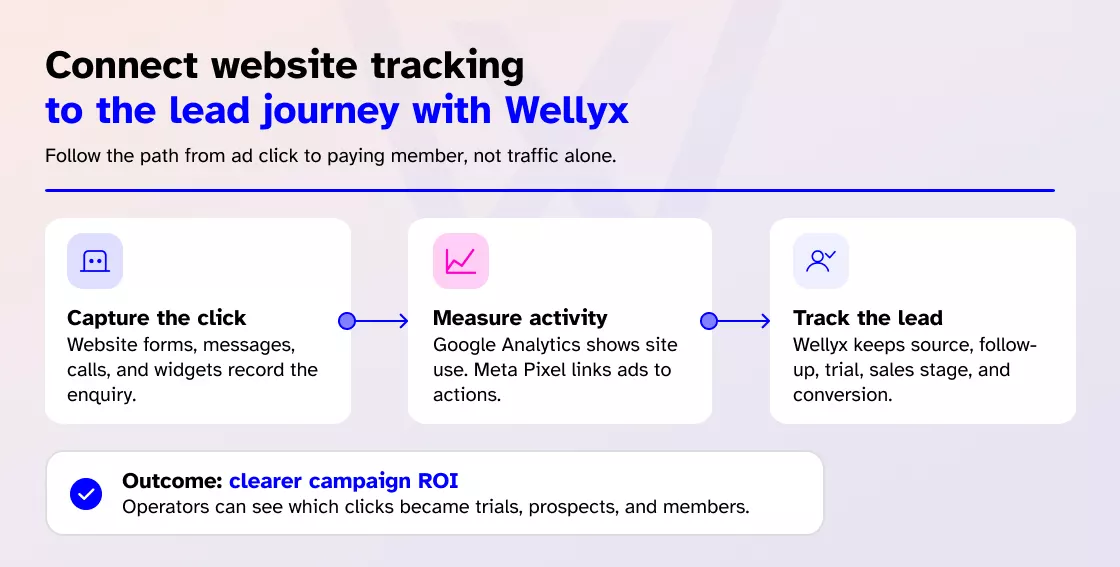
A gym management platform such as Wellyx can help organize this post-click journey by connecting:
- Lead records
- CRM stages
- Follow-up
- Bookings
- Attendance
- Memberships
- Payments
Software cannot rescue weak targeting, poor creative, or an unsuitable offer. It can help operators see what happened after the lead arrived and where prospects are getting lost.
Attribution still needs some restraint. A prospect may see a Facebook Ad, read Google reviews later, talk to a friend, and then visit the gym.
Treat attribution as a consistent measurement model rather than proof that one isolated touchpoint created the entire sale.
Find where your Facebook leads are leaking
When Facebook Ads are not producing enough members, identify the exact stage where prospects stop moving before rebuilding the whole campaign.
The funnel normally leaves clues.
| What you see | Investigate first |
| Few impressions | Audience, delivery, budget |
| Impressions but few clicks | Hook, creative, offer |
| Clicks but few leads | Form, landing page, trust |
| Cheap leads but few responses | Offer or lead quality |
| Leads respond but do not book | Conversation or booking friction |
| Bookings but poor attendance | Confirmation and reminders |
| Visits but few memberships | Experience, pricing, sales process |
| Members acquired, but CAC is high | Funnel economics |
| New members leave quickly | Expectations and onboarding |
Suppose the campaign is generating relevant inquiries and those prospects are booking consultations, but too few actually attend.
Changing the Facebook audience may do very little.
The advertising already moved the prospect to the booking stage. The leak sits further downstream.
The same applies if plenty of prospects attend, but very few join.
Possible causes could include:
- Expectations created by the ad
- Facility experience
- Membership structure
- Pricing
- Consultation quality
- Sales conversation
A membership problem is not automatically an advertising problem.
Improving one downstream rate can sometimes create more memberships without adding another dollar to the Facebook budget.
If Facebook is only part of a broader acquisition problem, these gym lead generation ideas cover additional ways to attract prospects without forcing more spend into one channel.
Know when to scale, fix, or stop the campaign
Increase Facebook spend when the member economics work and the business can handle more demand. A falling CPL alone is not enough.
Fix the funnel when:
- Prospects appear relevant
- One stage has an obvious leak
- Ads attract attention but little meaningful action
- Follow-up is inconsistent
- Bookings are healthy, but attendance is weak
Scale when:
- CAC remains financially sustainable
- Member quality remains healthy
- Downstream conversion stays reasonably stable
- Staff can handle additional inquiries
- Classes, coaching, and facility capacity can absorb new members
Stop or rethink when:
- Lead quality remains poor after reasonable testing
- CAC stays uneconomic
- The offer consistently attracts the wrong prospects
- The gym cannot profitably serve additional demand
More budget magnifies the system that already exists.
If that system is leaking, additional advertising makes the leak more expensive.
FAQs
Do Facebook Ads work for gyms?
Facebook Ads can work for gyms when the audience, offer, creative, follow-up, and economics fit together. Facebook has substantial U.S. reach, but campaign success should ultimately be judged through bookings, attendance, memberships, and CAC rather than clicks or lead volume alone.
How much should a gym spend on Facebook Ads?
There is no universal monthly budget. Work backward from the number of memberships you want, your expected lead-to-member conversion, acceptable CAC, cash flow, and capacity to serve more members. Increase spend only when the acquisition system can convert additional demand sustainably.
What is a good customer acquisition cost for gym Facebook Ads?
A good CAC is one that the gym’s membership economics can support. Membership price, retention, margin, introductory discounts, payment costs, and servicing costs all matter. The same CAC can be workable for one gym model and completely uneconomic for another.
Should gyms use Facebook Lead Ads or landing pages?
Choose the option that balances convenience with qualification. Meta Instant Forms reduce friction, while landing pages provide more room to explain the offer and build trust. Compare the downstream booking and membership results rather than deciding purely on CPL.
Why am I getting Facebook leads but no gym memberships?
Identify where prospects are dropping out. Review lead quality, contact, booking, attendance, the trial or consultation experience, pricing, and the sales process. If leads consistently attend but do not join, changing the Facebook Ad may not solve the actual problem.
How do I track Facebook leads that become gym members?
Carry the campaign source through the full membership journey. Record the source, lead, contact status, booking, attendance, membership outcome, CAC, and collected revenue. Where practical, connect advertising and CRM data so decisions reflect downstream results rather than form submissions alone.
Measure what happens after the click
A Facebook Ads dashboard can show more leads and a lower CPL while the membership report shows fewer new members and a higher acquisition cost.
That is why Facebook ads for gyms make more sense when the whole process is measured:
Audience → Offer → Creative → Conversion → Follow-up → Attendance → Membership → Revenue
Instead of asking only:
“How many leads did Facebook generate?”
ask:
“Where did those leads go, how many became paying members, and what did each acquired member actually cost?”
That is the difference between buying Facebook leads and managing a member-acquisition system the gym can actually measure.