



A gym member rarely decides to leave on the day they cancel. The change usually starts earlier.
A new member joins excited. During the first few weeks, they train regularly, try a class, and start recognizing a few familiar faces.
Then work gets busy.
One missed workout becomes several. Their usual class disappears from their bookings. They stop talking to trainers. Progress feels less obvious.
The membership is still active, so from the gym’s side, everything can look fine. Then the cancellation request arrives.
The cancellation was not the beginning of churn. It was the last visible step.
The best gym member retention strategies work before that point. They help members build habits, identify changes in behavior, strengthen relationships, make progress visible, remove friction, and give staff a reason to intervene while the relationship can still be repaired.
A useful retention system follows a simple rhythm:
Notice → understand → respond → reconnect → measure
That matters in 2026, when fitness goals remain a major priority for U.S. consumers. Health & Fitness Association research found that 82 million U.S. adults planned to set health, fitness, or exercise goals for 2026, and 86% of those goal-setters said access to gyms, studios, and health clubs was important to achieving them. The findings came from a nationally representative survey of 2,000 U.S. adults conducted in December 2025.
For gym owners, the opportunity is not only getting motivated people through the door. It is helping those members turn that motivation into a routine they can actually maintain.
What is gym member retention?
Gym member retention is a gym’s ability to keep existing members active, engaged, and paying over a defined period instead of continually replacing people who leave.
But there is an important distinction.
Paying does not always mean engaged.
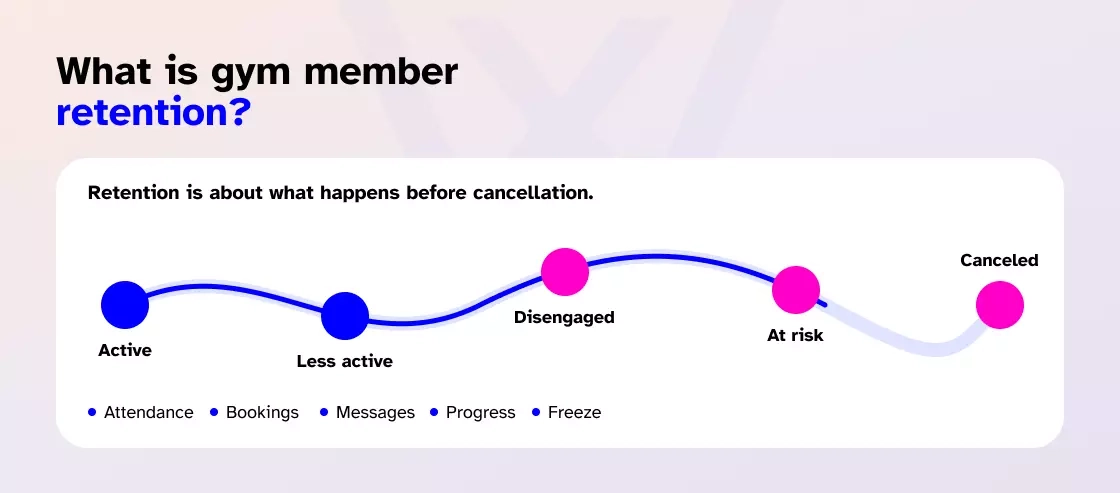
A member can still have an active membership while:
- Attendance is falling
- Class bookings have stopped
- Messages are being ignored
- Progress feels unclear
- A freeze is being considered
- Dissatisfaction is quietly building
That creates a common churn journey:
Active → less active → disengaged → at risk → canceled
A useful retention strategy focuses on the middle of that journey.
Once a member has formally canceled, the gym has fewer options. When the member is simply becoming less engaged, there is still time to understand what changed.
For the broader systems behind membership longevity, see how to retain members in your gym.
Why gym member retention matters for sustainable growth
Acquisition gets a member through the door. Retention determines what happens after that.
A gym can have a strong January, add hundreds of new members, and still struggle to grow if a steady stream of existing members is leaving at the same time.
Better retention supports:
- Recurring membership revenue
- Longer customer relationships
- More predictable class and facility usage
- Stronger personal training demand
- More member referrals
- Healthier gym communities
- More reliable business forecasting
The Health & Fitness Association report found average member retention of 66.4% for 2024, based on 175 participating companies representing more than 17,000 fitness facilities across 27 countries.
That figure is useful as an industry benchmark, but it should not become a universal target. A boutique studio, low-cost gym, premium health club, and multi-location chain may all measure retention differently.
The more useful questions are:
- Which members are losing momentum?
- When does disengagement usually start?
- What behavior changes appear before cancellation?
- Who is responsible for acting on those changes?
- Which interventions actually result in re-engagement?
That turns retention from a vague business goal into an operating process.
11 gym member retention strategies at a glance
| Strategy | Main retention problem | What the gym should do |
| Strong first 30 days | New members never form a routine | Guide early behavior and remove barriers |
| Monitor churn signals | Disengagement goes unnoticed | Track changes from normal activity |
| Personalized communication | Follow-up feels generic | Use goals, history, and behavior |
| Staff relationships | Nobody owns the follow-up | Assign clear responsibility |
| Community | Gym feels anonymous | Create accountability and connection |
| Progress and rewards | Value becomes unclear | Show results and recognize consistency |
| Membership flexibility | Life changes cause cancellation | Offer pauses, freezes, and alternatives |
| Hybrid fitness | Members cannot always visit | Maintain the routine remotely |
| Reduce friction | Membership becomes inconvenient | Simplify access, billing, and booking |
| Feedback | Problems surface too late | Ask early and act on patterns |
| Re-engagement | Drifting becomes cancellation | Intervene before the relationship ends |
1. Build a strong, behavior-based first 30 days
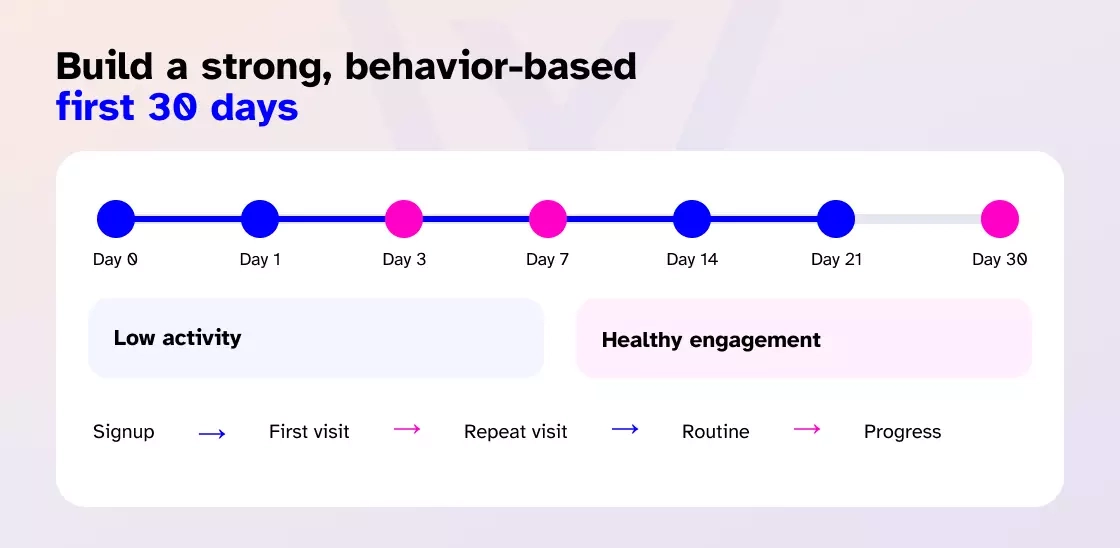
The first month should move a member from signup toward a repeatable routine.
Too many onboarding processes finish when the member receives access.
They get a tour, download the app, learn where the lockers are, and are then expected to build a consistent training habit on their own.
A stronger journey looks like:
Signup → first visit → repeat visit → routine → progress
A simple first-month workflow might look like this:
| Timing | What to watch | Useful response |
| Day 0 | New membership created | Welcome, set up access, and encourage the first booking |
| Day 1 | Profile or preferences incomplete | Capture goals, preferred times, and interests |
| Day 3 | No first visit | Offer help booking the first session |
| Day 7 | Early participation | Recognize activity and suggest the next step |
| Day 14 | Activity remains low | Create a personal staff follow-up |
| Day 21 | Healthy engagement | Offer a progress or coaching touchpoint |
| Day 30 | First month complete | Review progress and collect feedback |
The dates are less important than the logic.
Time should trigger a check. Behavior should determine the response.
A member who has already trained eight times does not need the same intervention as someone who has barely visited.
One may need encouragement.
The other may need practical help with:
- Booking
- Scheduling
- Understanding equipment
- Meeting a trainer
- Choosing a realistic routine
- Overcoming uncertainty about what to do next
Good onboarding reacts to what is actually happening.
2. Monitor inactivity and behavioral churn signals
Attendance matters, but the stronger signal is often a change from the member’s usual behavior.
Consider a member who normally trains four mornings each week.
Their pattern gradually becomes:
4 visits → 3 visits → 1 visit → 0 visits
That change matters before the person reaches an arbitrary inactivity threshold.
Other warning signs can appear around the same time:
- Fewer class bookings
- Repeated no-shows
- Personal training sessions suddenly stopping
- Failed payments
- Freeze inquiries
- Unanswered messages
- Unresolved complaints
- Incomplete onboarding
- Reduced participation in challenges or classes
No single signal proves someone is about to cancel. Patterns matter more.
Match the signal to the response
| Member signal | What it could mean | Useful first response |
| No first booking | Confusion or hesitation | Help arrange the first session |
| Attendance suddenly drops | Routine or life circumstances changed | Ask what changed |
| Class bookings stop | Schedule or class-fit issue | Review alternative classes |
| Repeated no-shows | Booking pattern no longer works | Discuss timing and availability |
| Failed payment | Administrative friction | Make payment recovery easy |
| Freeze inquiry | Temporary disruption | Discuss flexible options |
| Complaint remains unresolved | Service frustration | Assign a staff owner |
| Several signals appear together | Higher churn risk | Personal staff intervention |
A useful retention workflow is:
Signal → context → staff ownership → outreach → relevant help → re-engagement check
The context step matters.
A member may be traveling. Their work schedule may have changed. They may dislike a new class time. They may feel that progress has stalled.
The first response should not automatically be a discount.
Understand the problem first.
3. Personalize communication around member behavior
Personalization should mean more than adding someone’s first name to an email. The message should make sense because something relevant happened.
A member who has not returned after signup needs one conversation. A regular class member who suddenly disappears needs another. Someone approaching renewal after a strong year may need a progress conversation rather than a generic promotion.
Useful member context can include:
- Goals
- Attendance
- Preferred classes
- Membership type
- Recent inactivity
- Previous staff notes
- Milestones
- Renewal timing
Channel choice matters too. Use:
Use:
- Push notifications for timely prompts
- SMS for short, time-sensitive follow-up
- Email for deeper guidance, progress summaries, or longer updates
The goal is not to contact members constantly. It is to make communication more relevant.
The right gym CRM features that engage and retain customers help staff keep that context together instead of trying to reconstruct the member’s story from separate inboxes and spreadsheets.
4. Build consistent personal relationships with staff
Members experience one gym.
They do not experience your internal departments.
If something goes wrong, they usually do not care whether it technically belongs to the front desk, trainer, billing team, or manager.
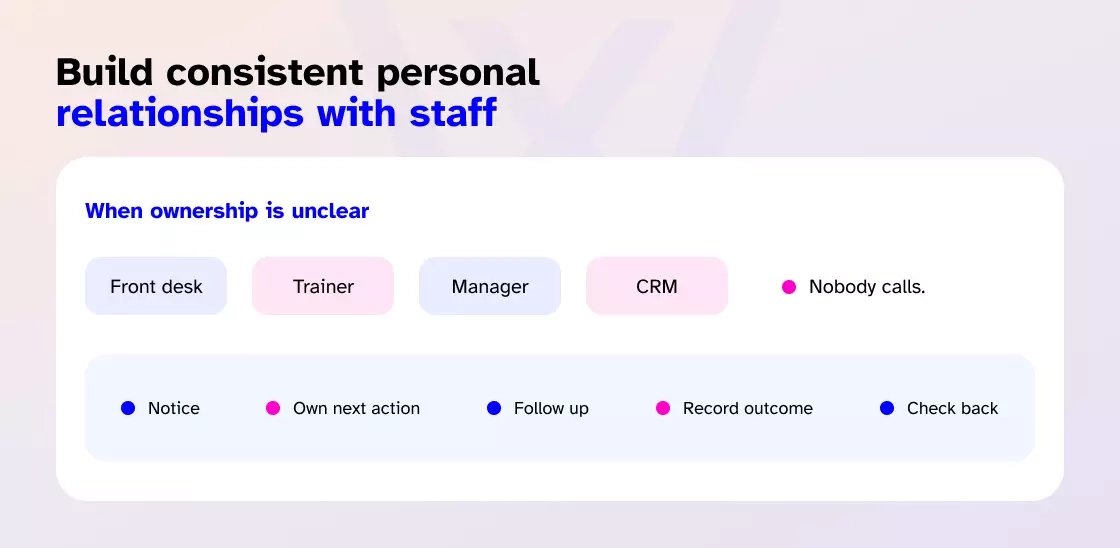
They care whether somebody takes responsibility.
Consider this:
- The front desk notices that a regular member has disappeared.
- They assume the trainer will call.
- The trainer assumes the manager already followed up.
- The manager assumes the CRM handled it.
- Nobody calls.
That is not really a communication problem.
It is an ownership problem.
A retention workflow should make several things clear:
- Who owns the next action?
- What has already been discussed?
- Is there an unresolved issue?
- When should someone check back?
- What happened after the follow-up?
Good personal service also happens in small moments.
- A trainer remembers a goal
- The front desk notices someone has returned after an absence
- A manager follows up after a complaint
- A coach checks progress before the member needs to ask
Technology can identify the moment.
People handle the relationship.
5. Build community through group training and accountability
A gym feels different when someone expects to see you there. That does not mean every member wants a large social community.
Some people want headphones, a quiet session, and very little conversation. Community can still help retention.
Useful options include:
- Group fitness
- Small-group training
- Beginner programs
- Accountability partners
- Partner workouts
- Fitness challenges
- Workshops
- Team competitions
- Member events
Sometimes the smallest interaction is enough.
An instructor notices that someone missed the usual class. Two beginners realize they train at the same time.
A coach introduces members with similar goals. That makes the gym feel less anonymous.
Community can simply mean being:
known + supported + recognized + comfortable
The goal is not forced socializing.
It is creating another layer of accountability when motivation is low.
6. Make progress visible, use assessments, and reward consistency
People are more likely to value a membership when they can see that something is changing.
That does not always mean dramatic weight loss or a major transformation.
Progress can include:
- Completing the first class
- Reaching an attendance milestone
- Becoming more consistent
- Improving strength
- Improving mobility
- Increasing endurance
- Completing a challenge
- Reaching a PT goal
- Maintaining a workout streak
Regular fitness assessments can make those changes easier to see. Depending on the member and service, a review might cover:
- Training goals
- Strength
- Mobility
- Endurance
- Workout adherence
- Attendance
- Body composition where appropriate
The purpose is not collecting data for its own sake.
It is helping the member answer:
“Is this still working for me?”
Add gamification and rewards carefully
Gamification can reinforce consistency when it is tied to useful behaviors.
Examples include:
- Milestone badges
- Challenge points
- Attendance streaks
- Leaderboards
- Loyalty points
- Guest passes
- Merchandise rewards
- Small account credits
The hierarchy matters.
Progress creates value. Rewards reinforce it.
The reward should support a meaningful gym experience, not replace one.
Make referrals part of loyalty
Referral programs can sit naturally alongside loyalty.
A member who genuinely enjoys the gym may want to bring in a friend, colleague, family member, or training partner.
A simple referral program can:
- Provide each member with a referral or promo code
- Reward the existing member after a qualifying signup
- Offer something to the new member
- Track which members generate referrals
- Connect referrals with loyalty rewards
Wellyx supports referral schemes through unique referral or promo codes and can be configured to reward both the existing member and the new signup after a qualifying action.
Referral programs work best when they extend a positive member relationship. They cannot compensate for an experience members already want to leave.
7. Offer flexible memberships before cancellation
Sometimes the gym is not the problem.
Life changed.
A member may:
- Start traveling
- Get injured
- Change jobs
- Begin exams
- Take on family responsibilities
- Face temporary financial pressure
- Move to a different schedule
If the only choices are “keep the same membership” or “cancel,” a temporary problem can become permanent churn.
Useful alternatives might include:
- Membership freezes
- Temporary pauses
- Reduced-frequency plans
- Downgrades
- Off-peak plans
- Class packs where appropriate
Keep the rules clear. Members should understand:
- Eligibility
- Freeze length
- Notice periods
- Pricing
- Reactivation
Flexibility does not mean discounting every cancellation request.
It means recognizing when the member still wants the relationship, but their circumstances have changed.
8. Keep members connected through hybrid fitness
Physical attendance is not always possible.
Travel, relocation, changing shifts, family responsibilities, and temporary disruption can all interrupt the usual routine.
Hybrid fitness gives members another way to stay connected.
Options may include:
- Online classes
- Live-streamed sessions
- On-demand workouts
- Remote coaching
- App-based programming
- Virtual consultations
Not every facility needs to become a large digital fitness business.
The principle is much simpler:
Give members another way to maintain the routine when regular in-person attendance becomes difficult.
If the relationship remains active during a difficult period, returning to the physical gym later becomes much easier.
9. Remove friction from the facility, access, booking, and billing
Members can like the coaching and still become tired of the membership.
Sometimes the problem is friction.
Physical friction might include:
- Broken equipment
- Overcrowding
- Cleanliness problems
- Locker room issues
- Class capacity problems
- Delayed maintenance
Operational friction can include:
- Difficult class booking
- Slow check-in
- Unreliable access
- Confusing membership changes
- Failed payments
- Expired cards
- Difficult freezes
Each problem can feel small.
Repeated often enough, it changes how the membership feels. Billing is a good example.
A card expires. The member had no intention of leaving, but suddenly they have an administrative problem to solve.
The recovery process should be simple:
Notification → easy payment update → follow-up → confirmation
The same principle applies across the gym journey.
- Booking should feel routine
- Entry should feel routine
- Updating payment information should feel routine
- Pausing a membership should not take five emails
Members should spend their energy training, not solving problems created by the gym.
10. Collect feedback before frustration turns into cancellation
Exit surveys are useful. They are also late.
Retention benefits more when the gym asks questions while something can still be changed.
Useful feedback points include:
- After onboarding
- After the first month
- After a class
- After a service issue
- During a freeze
- Before renewal
The question can be simple:
“What is one thing that would make your membership easier to use this month?”
Then make sure something happens with the answer. Use:
Ask → categorize → assign → act → communicate
If several members mention overcrowding, poor class times, equipment issues, or billing problems, somebody should own the response.
Use exit surveys as a learning tool
Some cancellations will still happen.
When they do, use a short exit survey to identify recurring causes such as:
- Price
- Relocation
- Scheduling
- Service problems
- Facility quality
- Injury
- Lack of use
- Missing classes or amenities
Do not assume every cancellation could have been prevented. People move. Finances change.
Life changes. But repeated patterns deserve attention.
- Pre-cancellation feedback can help protect the current relationship
- Exit feedback can improve the next one
For a deeper process, see customer feedback for gym owners.
11. Launch structured re-engagement campaigns before members disappear
A drifting member should not receive the same message as someone who has already canceled.
Re-engagement works best while the membership is still active and the relationship still exists.
Useful triggers can include:
- No visits for an unusual period
- A major drop from normal attendance
- Repeated no-shows
- Class bookings stopping
- Expired payment information
- Incomplete onboarding
- Reduced communication engagement
The outreach should match the likely problem. Useful re-engagement approaches might include:
- A quick SMS asking whether the member’s schedule changed
- An invitation to try another class
- A short trainer check-in
- Help resetting goals
- A return-to-routine session
- A guest pass where it makes sense
- A personalized recommendation based on previous activity
The aim is not to bribe people back. It is to make returning easier.
Re-engagement is different from win-back
- Re-engagement: The person is still a member but drifting.
- Win-back: The member has already canceled or lapsed.
Both can matter, but re-engagement happens earlier, when the existing relationship is still easier to recover.
How gym management software contributes to member retention
Retention gets difficult to scale when every important follow-up depends on someone remembering it. That is where gym management software contributes.
Its role is not simply sending more automated messages.
A useful platform connects:
- Member profiles
- Attendance
- Class bookings
- Memberships
- Recurring payments
- Freezes
- Communication
- Loyalty programs
- Referral programs
- Staff tasks
- Reporting
That allows the gym to connect member behavior to action.
How software supports the retention journey
| Retention situation | What software can help with | Where staff still matter |
| New member has not booked | Trigger onboarding reminder | Help remove the real barrier |
| Attendance drops | Flag changing activity | Understand why behavior changed |
| Payment fails | Start payment recovery | Handle complicated billing issues |
| Member reaches milestone | Trigger recognition | Add personal encouragement |
| Feedback is submitted | Record and assign task | Resolve the actual problem |
| Member refers a friend | Track referral and reward | Strengthen the relationship |
| Member becomes inactive | Start re-engagement workflow | Provide relevant personal support |
| Renewal approaches | Trigger communication | Review progress and membership fit |
A useful process is:
Behavior changes → system detects signal → automation runs where appropriate → staff receive a task → human follow-up happens → outcome is recorded
What should gyms automate?
Automation works well for repeatable activities such as:
- Onboarding reminders
- Payment notifications
- Class reminders
- Renewal reminders
- Milestone detection
- Survey delivery
- Referral tracking
- Re-engagement campaigns
- Staff-task creation
What should stay human?
People should remain central to:
- Complaints
- Sensitive check-ins
- Progress conversations
- Cancellation discussions
- Relationship repair
- Complex membership problems
The distinction matters. Automation handles consistency. People handle context.
For a deeper look at this technology layer, see how fitness management software can drive member retention.
The first 90 days: turn new members into regulars
The first month establishes the initial routine.
The next two months help that routine become part of the member’s life.
| Period | Retention goal | Main focus |
| Days 1 to 7 | Build confidence | First visit, orientation, booking, staff support |
| Days 8 to 30 | Build the habit | Repeat attendance and barrier removal |
| Days 31 to 60 | Build connection | Coaches, classes, groups, and familiar faces |
| Days 61 to 90 | Build commitment | Progress review and the next meaningful goal |
Days 1 to 7: Build confidence
Make the first visit simple.
Members should understand:
- where to go
- how booking works
- how access works
- what facilities are available
- who can help
Days 8 to 30: Build the habit
Look for repeat attendance.
If it is not happening, find out why before the member quietly gives up.
The focus should be on reducing barriers and helping the member fit training into their actual week.
Days 31 to 60: Build connection
Help members form some relationship beyond the building itself.
That might come through:
- a coach
- a class
- a small training group
- an accountability partner
- familiar front-desk staff
Days 61 to 90: Build commitment
Review what has changed. Show progress.
Set the next goal.
Check that the membership still fits the person’s routine.
The progression is:
Confidence → habit → connection → commitment
After that, retention should become part of normal member management rather than a separate onboarding program.
How to measure gym member retention
A growing membership count can hide churn. Suppose a gym begins with 500 members, adds 100, and loses 80.
The business still finishes larger than it started. But losing 80 existing members deserves attention.
That is why operators should track more than total member count.
Gym retention metrics worth tracking
| Metric | What it tells you |
| Retention rate | How many existing members stayed |
| Churn rate | How many members left |
| Visit frequency | Whether engagement is changing |
| First-30-day activity | Whether onboarding is building a routine |
| First-90-day retention | How early member relationships perform |
| Membership tenure | How long members tend to stay |
| Freeze rate | How often members temporarily disengage |
| Reactivation rate | Whether inactive members return |
| Failed-payment recovery | How well involuntary churn is managed |
| Cancellation reasons | Why memberships ended |
| Referral activity | How often existing members advocate for the gym |
How to calculate gym member retention rate
A basic calculation is:
Retention rate = ((members at end of period – new members added) ÷ members at start of period) × 100
For example:
- Starting members: 500
- Ending members: 520
- New members during the period: 70
First, calculate retained members:
520 – 70 = 450
Then:
450 ÷ 500 × 100 = 90%
The basic retention rate for that period is 90%.
Gyms may define active membership and reporting periods differently, so use the same methodology consistently when comparing performance.
Measure retention by cohort
One overall number tells you whether something changed.
Cohorts help explain where.
Compare retention by:
- Joining month
- Membership plan
- Location
- First-month attendance
- Class participation
- Acquisition source
You may discover that one membership plan retains much better than another.
One branch may have much stronger first-90-day performance.
Members who establish a group-class routine may behave differently from those who never develop one.
Overall retention tells you what happened. Cohort retention helps explain where it happened.
Build a simple retention operating rhythm
Retention becomes manageable when somebody owns it.
| Review period | What to review |
| Weekly | New members, attendance drops, failed payments, freezes, complaints, milestones, at-risk members |
| Monthly | Churn, first-month engagement, re-engagement results, cancellations, feedback, referrals |
| Quarterly | Onboarding, memberships, class schedules, facility friction, staff workflows, retention by plan/location, referral performance |
The purpose is not to create more meetings.
It is to make retention part of normal gym operations instead of an emergency discussion after cancellation numbers rise.
FAQs
What is a good gym member retention rate?
There is no single retention percentage that is good for every gym.
Business type, pricing, membership terms, location, member mix, and reporting period all affect the result.
Your own historical performance and comparable cohorts are usually more useful for understanding whether retention is improving.
How often should a gym contact inactive members?
There should not be one universal inactivity threshold.
Start with the member’s normal behavior.
Someone who usually trains four times a week may warrant earlier attention when they suddenly disappear than someone whose established pattern is one visit each week.
Use:
Behavior change → context → outreach
Automation can detect the change.
Staff still need to decide what type of response makes sense.
What are the early warning signs that a gym member may cancel?
Common warning signs include:
- Falling attendance
- Fewer bookings
- Repeated no-shows
- Ignored communication
- Failed payments
- Freeze inquiries
- Unresolved complaints
- Reduced participation
- Low engagement around renewal
One signal alone does not always mean the member plans to leave.
Patterns and meaningful changes from normal behavior matter more.
How do you retain new gym members during the first 90 days?
Build the first 90 days around four stages:
Confidence → habit → connection → commitment
Make the first visit easy. Support repeat attendance. Help the member form useful relationships with staff, classes, or other members.
Make progress visible and intervene quickly when momentum starts to fall.
How can gym management software improve member retention?
Gym management software can help centralize member information, track attendance changes, automate relevant reminders, manage failed payments, collect feedback, track referrals, create staff tasks, and measure retention outcomes.
Its biggest advantage is consistency. The system can help staff understand when attention may be needed.
People still decide how to help.
Retention is built before members decide to leave
Members rarely disappear all at once. Attendance falls. Bookings slow down. Progress becomes harder to see.
Small frustrations remain unresolved.
Eventually, leaving feels easier than staying. Strong retention systems notice those changes earlier.
They help the gym understand what changed, choose a useful response, and give the member a realistic reason to reconnect.
Retention is built one visit, one signal, and one well-timed human interaction at a time.
Turn member activity into retention action with Wellyx
Good gym CRM brings memberships, CRM, bookings, billing, automation, loyalty, referrals, and member engagement into one connected system.
That helps your team respond when a new member has not booked, attendance drops, a payment fails, feedback needs attention, or a loyal member refers a friend.
We also support referral and loyalty programs, helping gyms reward visits, milestones, purchases, and successful referrals.
The goal is not to replace human relationships with automation. It is to make sure important member signals lead to timely action.
See how Wellyx can help you improve retention, re-engagement, loyalty, and referrals.