





A member rarely quits the day the cancellation arrives.
The decision usually begins much earlier, hidden inside a quiet change in attendance.
You know those YouTube titles that say,
“What happens after the fifth workout will surprise you?”
They work because people are drawn to patterns.
A gym membership follows a pattern too, but that pattern is easy to lose when a member misses a session, leaves another class unbooked, and gradually disappears from the check-in log.
There is no complaint. No cancellation request. Nothing dramatic happens.
By the time the cancellation email reaches the inbox, the routine may have been fading for weeks.
This is where gym attendance data becomes useful. Early visit frequency, widening gaps, no-shows, and changes in booking behavior can help reveal when a member is beginning to disengage, often before they formally decide to leave.
The five-class cliff describes that early stretch of membership when a routine either starts taking shape or begins slipping away. It is not a law or a magic number. It is a practical observation point where a gym can ask a more useful question:
“Is this member finding a routine they can maintain, or are they already struggling to return?”
The first five classes provide the early clues. The first 90 days show whether the routine can survive ordinary disruptions such as work, soreness, travel, or changing motivation.
This guide explains which attendance patterns matter, why members stop showing up before they cancel, and how to turn basic check-in data into a retention workflow your team can run each week.
- Define the five-class cliff as a practical checkpoint
- Explain the six-week and 90-day risk windows
- Read behavioral changes without making assumptions
- Turn check-in data into timely human outreach
- Build a repeatable five-class retention workflow
What is the five-class cliff in gym attendance?
The five-class cliff is a practical observation point where a gym can begin assessing whether a new member is developing a sustainable routine or showing early signs of disengagement.
It is not a scientific cutoff.
A member who attends four classes and then leaves town has not fallen off a cliff. A member who completes five classes only because staff repeatedly chase them may still lack a routine.
The idea is useful because a handful of visits gives your team enough behavior to review.
What should staff look for by class five?
By class five, you can usually begin asking:
- Are they returning without repeated prompting?
- Have they found days and times that fit their week?
- Do they know how to book, cancel, and check in?
- Are they becoming more comfortable in the facility?
- Have they connected with a trainer or another member?
- Are the gaps between visits becoming predictable?
Why one attendance target does not fit every member
Every facility will see a different pattern.
A member who attends one yoga class each Saturday should not be measured against a HIIT member who planned to train four times a week. An open-gym member, martial arts student, and personal training client may each build consistency differently.
Judge members against the routine they intended to create, not one number applied to everyone.
The fifth class does not decide the member’s future. It gives you the first clear opportunity to see which direction they may be heading.
Can gym attendance data predict member churn?
Yes. Gym attendance data can reveal behavioral changes associated with disengagement, including longer gaps, declining frequency, repeated no-shows, and a sudden departure from a member’s usual routine.
Attendance is a leading indicator
A cancellation report is a lagging indicator. It records a decision after the member has made it.
An attendance report is a leading indicator. It shows behavior while there may still be time to understand what changed.
| Attendance reports | Cancellation reports |
| Show behavior while the membership is active | Record completed cancellation decisions |
| Reveal visit frequency and widening gaps | Show who has already left |
| Identify changes from a personal baseline | Calculate churn after it occurs |
| Support early staff outreach | Support retrospective analysis |
| Can be reviewed weekly | Often reviewed monthly |
What churn-prediction research shows
Research supports the value of ordinary behavioral data.
A 2021 peer-reviewed study examined records from 5,209 members of a Portuguese fitness center. Its predictive models used attendance, membership, payment, and demographic variables. The most relevant predictors were days without attendance, total membership length, and total amount billed. Non-attendance days ranked above age and sex in the models.
The study’s strongest model reported 95.5% accuracy within that particular dataset. That should not be treated as a universal accuracy rate for every gym, but it demonstrates how much useful predictive information can sit inside basic operational records.
Which attendance signals matter most?
The lesson is not that every gym needs a mysterious algorithm.
The useful signals are often familiar:
- How recently the member attended
- Whether their frequency is declining
- How long they have been a member
- Where they are in their billing or renewal calendar
- Whether check-ins have stopped matching their normal behavior
Wider gym analytics can connect those attendance changes with bookings, payments, membership status, class demand, and communication history.
The total number of visits matters. The shape of those visits often matters more.
Why are the first five classes important for member retention?
The first five classes matter because they show whether joining motivation is beginning to turn into a repeatable routine.
Signing up is usually the easy part.
The member may be driven by a health concern, an upcoming event, a recommendation from a friend, or the simple feeling that something needs to change. That energy gets them through the front door.
It may not carry them through a difficult workday, muscle soreness, family responsibilities, or a class where they feel out of place.
Early attendance needs structure
A longer-term study of 1,726 new health and fitness venue members found that average attendance fell from 7.48 visits during the first month to 0.92 visits during month 12. Only 22% were still attending after one year.
Early attendance frequency and stability, including visiting at consistent times and locations, were associated with continued attendance later in the membership.
This does not mean a member must attend frequently forever. It suggests that the early months are when the routine needs structure.
What new members need during the early weeks
A new member often needs:
- A realistic weekly plan
- Suitable classes or workouts
- Confidence using the space
- Clear next steps
- Recognition of early progress
- A personal connection
- Some sign that their absence would be noticed
A payment record may call them active. Their attendance history may show that the relationship has barely begun.
The question is not only,
“Did they reach class five?”
It is,
“Are those first five classes becoming part of a week they can sustain?”
What happens during the six-week and 90-day risk windows?
The six-week and 90-day windows give gyms a broader view of whether early attendance is settling into a habit.
The five-class checkpoint is an early look. It should be followed by ongoing monitoring, particularly during the first three months.
The six-week drop
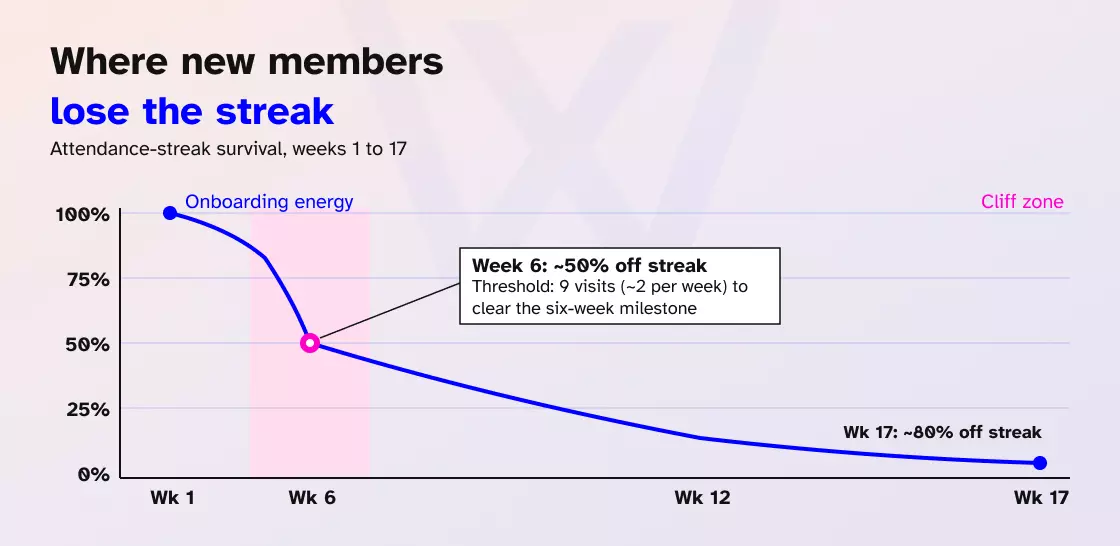
A 2025 preprint analyzing attendance data from a large Turkish fitness chain found that approximately 50% of members had failed to maintain their defined attendance streak by week six.
The researchers identified nine visits during the first six weeks, roughly two visits per week, as the threshold that best separated members who maintained the streak from those who did not.
This is a dataset-specific finding, not a universal prescription.
A weekly studio member should not suddenly be told to attend twice a week because another fitness chain’s data produced that average. The more useful lesson is that consistency in the early weeks matters, and long gaps make habit formation harder.
The same study allowed a one-week absence within its attendance-streak definition because short interruptions were common. A gap of two weeks broke the streak.
This makes a two-week absence a reasonable review trigger for many gyms, although the threshold should still reflect the member’s intended schedule.
The first 90 days
The first 90 days give operators time to compare three stages:
- Days 0 to 30: Is the member returning?
- Days 31 to 60: Is their routine becoming stable?
- Days 61 to 90: Can that routine survive ordinary disruption?
ABC Fitness structures its new member club usage report around the first 90 days, dividing check-ins into 0–30, 31–60, and 61–90-day periods so operators can see how usage changes after enrollment.
That reporting structure is useful because early attendance is rarely a simple pass-or-fail event.
Sarah might attend five classes during her first month, miss much of the second, and return during the third. Another member may start slowly but become consistent after finding the right trainer.
The 90-day window helps your team see the journey rather than judging one week in isolation.
Which attendance patterns suggest a member may quit?
The strongest warning signs usually involve a change in rhythm rather than one isolated missed workout.
| Attendance pattern | What it looks like | What staff should check |
| No early routine | Random first-month visits with widening gaps | Schedule, confidence, and class fit |
| Strong start, sudden stop | Several early visits followed by silence | Fatigue, soreness, or an unrealistic plan |
| Personal baseline decline | A regular member’s frequency falls sharply | Life changes, injury, dissatisfaction, or lost motivation |
| Repeated booking cancellations | Classes are booked but rarely attended | Timing, commitment barriers, or booking friction |
| Narrowing engagement | Fewer class types, trainers, or facility areas used | Boredom, confidence, schedule, or changing goals |
| Attendance plus another warning | Lower visits alongside expiry, failed payments, or complaints | The full member context |
No rhythm develops
The member attends, but each visit feels like a separate decision.
They arrive on Monday one week and Thursday the next. Ten days pass. They book another session, then cancel it.
An unconventional schedule is not automatically risky. The concern is that no repeatable pattern appears and every visit still depends on fresh motivation.
The strong start disappears
Sarah’s first week looked promising.
Three visits. Plenty of questions. A class booked for the following Saturday.
Then the energy dropped.
A strong start followed by silence may indicate soreness, intimidation, an unsuitable class level, or a plan that was too ambitious.
Someone who planned six weekly visits may interpret three visits as failure, even though three would have been a healthy routine.
A quick conversation can reset the expectation before disappointment becomes disengagement.
Their personal baseline changes
This is often more useful than comparing everyone with a facility average.
Member A attends every Saturday and has maintained that pattern for six months.
Member B normally attends four times a week but has only checked in once during the past two weeks.
Both show one recent visit. Member B represents the more meaningful change.
The quiet fade may look like:
- Four visits becoming two
- Two visits becoming one
- Weekly attendance becoming monthly
- Morning workouts disappearing from the schedule
- Regular classes being booked but not attended
Avoid setting a universal “50% decline” rule as though research has established it for every gym.
A gym may choose a 40% or 50% change as an internal watchlist trigger, but it should test that threshold against its own membership patterns.
Booking behavior weakens
Check-ins show who arrived. Booking records show what happened before the door.
Look for members who:
- Repeatedly cancel at the last minute
- Accumulate no-shows on the same day
- Join waitlists but decline available spaces
- Stop booking a previously preferred trainer
- Continue browsing classes without committing
These behaviors may reveal timetable friction before check-ins stop completely.
Engagement begins to narrow
A member may still be attending while their involvement quietly contracts.
They stop trying different classes. They no longer book personal training. They use fewer parts of the facility or stop visiting with a friend.
This should be treated as supporting context, not proof of impending cancellation.
The 2025 habit-formation study found positive effects from group lessons, personal training, varied class participation, visits to different clubs, and social invitations.
The effects varied across member groups, reinforcing the value of personalized interventions rather than one standard retention campaign.
Attendance drops beside another warning sign
A missed week may mean very little.
A missed week combined with a failed payment, an unresolved complaint, an unused training package, or an approaching renewal date deserves faster attention.
Combined signals might include:
- Falling visits and a failed card
- A long absence near membership expiry
- Missed classes after a timetable change
- No check-ins following a complaint
- Lower attendance and unanswered messages
- An unused personal training package
The pattern should prompt a conversation. It should not produce a conclusion.
Why do gym members stop attending before they cancel?
Members often stop attending because the membership no longer fits their schedule, confidence, goals, finances, or expectations.
That is different from saying they stopped caring about fitness.
A member may be working longer hours. Their favorite instructor may have left. They may feel uncomfortable using the equipment or embarrassed that they have not made visible progress.
Common reasons members disengage
Common barriers include:
- An unrealistic starting plan
- Work or family schedule changes
- A class that feels too advanced or too easy
- Limited guidance after signup
- Soreness, injury, or illness
- Lack of visible progress
- Financial pressure
- Feeling anonymous in the facility
- Weak connections with trainers or members
- A goal that no longer feels urgent
Why human context still matters
Research with novice fitness club members also shows why human context matters.
A one-year study involving 250 new exercisers found that enjoyment, confidence in their ability to continue, and support from friends and family were associated with regular exercise attendance.
Attendance data records the effect. It does not automatically explain the cause.
Sarah’s two-week absence could mean she has lost interest. It could also mean the Saturday class left her too sore, her work schedule changed, or she does not know which session to try next.
A discount will not solve every one of those problems.
Ask before you offer.
How do gyms identify at-risk members from attendance data?
Gyms identify at-risk members by comparing recent attendance with the member’s normal pattern, intended frequency, membership stage, and wider engagement history.
Start with three simple groups.
New-member watchlist
Include members in their first 90 days who:
- Have not returned after the first visit
- Show widening gaps between early classes
- Repeatedly miss booked sessions
- Are approaching the end of month one without a routine
- Attend only after staff reminders
- Have not booked a clear next visit
Attendance-decline watchlist
Include established members whose recent activity has fallen meaningfully below their personal baseline.
An internal percentage threshold can make this easier to manage.
For example, a gym might review members whose four-week attendance is 50% below their previous four-week average.
That is an operational rule, not an industry benchmark. Test it, track how many flagged members actually disengage, and adjust it to your business.
Inactive-member list
Include active members who have not checked in for a period that is unusual for their intended routine.
A daily-access gym, weekly class studio, and martial arts school should not use the same inactivity window.
Compare expected visits with actual visits
During onboarding, ask how often the member can realistically attend.
Someone planning three weekly sessions but attending once during the month may need support. Someone who committed to one weekly class and attends consistently may be doing exactly what they intended.
Review the list every week
Assign ownership:
- Who runs the report?
- Who checks the member’s history?
- Who sends the message?
- When is follow-up due?
- What did the member say?
- Did they return?
- Which response helped?
Without ownership, an at-risk report becomes another spreadsheet that gets opened once a month and forgotten.
What should a gym do before an at-risk member cancels?
The most useful response is timely, personal, and connected to the goal the member shared when they joined.
Review the member’s context
Before contacting Sarah, review:
- Her recent attendance
- Her intended weekly frequency
- Preferred classes and instructors
- Booking and no-show history
- Membership and renewal status
- Failed or overdue payments
- Previous staff conversations
- Goals recorded during onboarding
- Injuries, freezes, or service complaints
Two minutes of preparation turns a generic message into a relevant one.
Send a human message
Try something like:
Hi Sarah, we haven’t seen you in the Saturday class recently. Is everything okay, or is there anything we can help adjust?
The message works because it is specific without being intrusive.
It mentions a real behavior. It does not criticize her. It asks before making assumptions.
Let the member’s answer shape the response
Her answer determines the response.
- If the class no longer fits, offer another time.
- If the workouts feel overwhelming, arrange a trainer check-in.
- If she is injured, discuss a suitable modification or temporary freeze.
- If the original schedule was unrealistic, help her choose one manageable weekly session.
- If billing is the problem, resolve it without ignoring the attendance change.
Offer one useful next step
Do not ask a disengaging member to recommit to their entire fitness journey.
Offer one useful next step:
- Book one class
- Attend one progress review
- Choose one weekly time
- Meet one trainer
- Try one different program
- Pause briefly instead of canceling
This outreach should support a wider strategy to retain members in your gym through onboarding, community, flexible options, recognition, and consistent communication.
Which gym reports help reduce member churn?
The most useful retention reports show who is attending, whose behavior is changing, who has become inactive, and whether outreach is working.
| Report | Purpose | Suggested frequency |
| New-member attendance | Track first-90-day visits and gaps | Weekly |
| Class attendance and no-shows | Identify repeated absences and weak return rates | Weekly |
| Dormant-member report | Find active members with no recent visits | Weekly |
| Membership expiry | Add renewal context to falling engagement | Weekly or monthly |
| Failed-payment report | Identify billing and attendance overlap | Daily or weekly |
| Re-engagement results | Measure responses and return visits | Monthly |
New-member attendance report
Track:
- Join date
- First check-in
- Total visits in the first 30, 60, and 90 days
- Days between visits
- Last attendance date
- Preferred classes
- Assigned trainer or staff member
- Next follow-up date
This is your earliest warning system.
Class attendance and no-show report
Use this report to identify:
- Repeated cancellations
- Classes with high no-show rates
- Sessions newcomers try once but never revisit
- Falling participation
- Timetable or capacity issues
- Instructor-specific patterns
Sometimes the problem is not the member.
If newcomers repeatedly disappear after one particular class, review the experience before blaming their motivation.
Dormant-member report
Dormant members have active memberships but no recent attendance.
They are not automatically cancellations waiting to happen. They are members whose absence deserves to be understood.
Expiry and failed-payment reports
These reports add context.
A long absence close to renewal may require a progress conversation. A failed payment alongside declining attendance may require both billing support and personal outreach.
Re-engagement report
Track:
- Members contacted
- Responses received
- Return visits
- Membership freezes
- Payment issues resolved
- Renewals saved
- Cancellations completed
The reports every gym owner should be running should connect attendance with memberships, class performance, payments, and retention activity.
How can gyms build a five-class retention workflow?
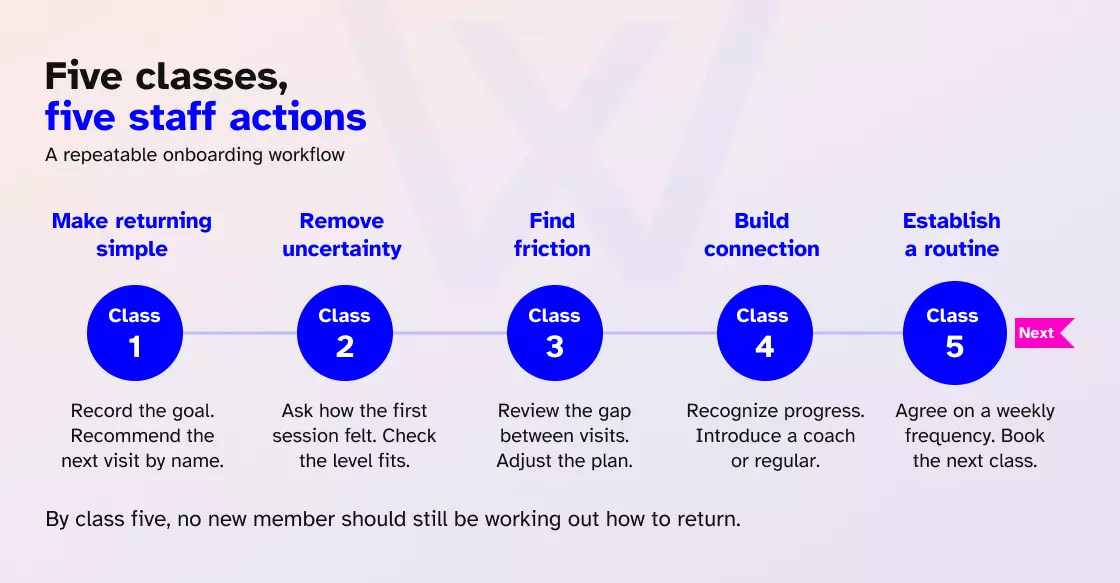
A five-class retention workflow gives staff one clear action at each early milestone, so onboarding does not end when the signup form is completed.
| Class | Goal | Staff action |
| Class one | Make returning simple | Record the goal and recommend the next visit |
| Class two | Remove uncertainty | Ask how the first session felt |
| Class three | Find friction | Review schedule, soreness, and confidence |
| Class four | Build connection | Recognize progress and make an introduction |
| Class five | Establish a routine | Agree on a realistic weekly pattern |
Class one: Make returning simple
Record why the member joined.
Complete the orientation. Explain booking and check-in. Recommend a specific next session rather than ending with, “Come back whenever you like.”
Class two: Remove uncertainty
Ask how the first session felt.
Check whether the level was suitable and whether the member understood what to do. Small confusion becomes a larger barrier when no one addresses it.
Class three: Look for friction
Review the gap between visits.
Ask about soreness, confidence, timing, equipment, and any part of the experience that felt difficult.
Adjust the plan while the member is still engaged enough to respond.
Class four: Build connection
Recognize their consistency.
Introduce another coach, instructor, or regular member. The interaction does not need to be staged. One familiar face can make the next visit feel easier.
Class five: Turn attendance into a routine
Review what the member has completed.
Agree on a realistic weekly frequency, record preferred sessions, book the next class, and set a progress milestone that matters to them.
What happens after class five?
The workflow should continue after class five.
Move the member into an ongoing process that watches for:
- Sudden frequency declines
- Repeated no-shows
- Two-week gaps outside their normal rhythm
- Membership expiry
- Payment issues
- Narrowing class engagement
- Unanswered communication
Current retention benchmarks show why every saved member relationship matters.
HFA’s report drew data from 175 companies representing more than 17,000 facilities and found an average member retention rate of 66.4% for 2024.
That figure is a benchmark, not a target for every individual business. Club type, pricing, location, and membership model all affect retention.
Still, it shows the size of the opportunity. A modest improvement can preserve a meaningful number of member relationships across a full year.
By class five, a member should not still be working out how to return.
Churn begins before the cancellation request
Sarah’s place in the Saturday class did not become empty when she canceled.
It became empty when the routine she was trying to build stopped fitting her life.
Attendance data will not explain why that happened. It will show that something changed.
The first five classes offer an early look. The six-week point shows whether the pattern is holding. The first 90 days reveal whether the routine can survive ordinary interruptions.
Reports make those changes visible. People give members a reason to return.
The goal is not to predict every cancellation perfectly. It is to notice meaningful changes while there is still time to ask a useful question.
A member should not have to disappear completely before someone realizes their routine has begun to slip.
Turn attendance data into timely action with Wellyx
Attendance insights become more useful when check-ins connect with bookings, memberships, payments, communication, and reporting.
Wellyx helps fitness businesses keep that member information in one system.
Instead of searching disconnected spreadsheets and relying on staff memory, teams can review attendance activity alongside the wider member journey and follow up with better context.
Technology should not replace the personal conversation that helps a member return.
It should help your team start that conversation before the member quietly walks away.
Frequently asked questions
What is the five-class cliff?
The five-class cliff is a practical checkpoint during a new member’s first few visits. It helps staff evaluate whether a sustainable routine is developing.
It is not a scientific rule or proof that someone who does not complete five classes will cancel.
Can gym attendance data predict member churn?
Attendance data can reveal patterns associated with disengagement, including widening visit gaps, declining frequency, and repeated no-shows.
It cannot predict every cancellation or explain the cause without booking, payment, membership, and communication context.
What are the early warning signs of gym member churn?
Warning signs include a failure to establish an early routine, a sharp drop from the member’s normal frequency, repeated cancellations, an unusual absence, narrowing class engagement, payment issues, approaching expiry, and unanswered staff messages.
How long should a gym wait before contacting an inactive member?
There is no universal period. Compare the absence with the member’s expected routine.
A two-week gap is a useful review point for many gyms, but members who usually attend several times per week may need contact sooner.
Why do new gym members stop attending?
New members may stop attending because of unrealistic schedules, poor class fit, limited guidance, intimidation, injury, financial pressure, weak social connections, or personal changes.
Attendance shows that something happened, but staff outreach is needed to understand what.