



A front-desk manager pulls last week’s class attendance from one system, cross-checks it against a spreadsheet of trainer commission rates, and retypes the totals into a separate payroll tool before Friday’s run. Nothing about that process is technically broken. It is simply three systems that do not talk to each other, and someone’s time is the connective tissue holding them together. That time has a real dollar cost, and it is where integrated payroll actually pays for itself, not the subscription price on the software’s pricing page.
A framework for what “integrated” actually saves
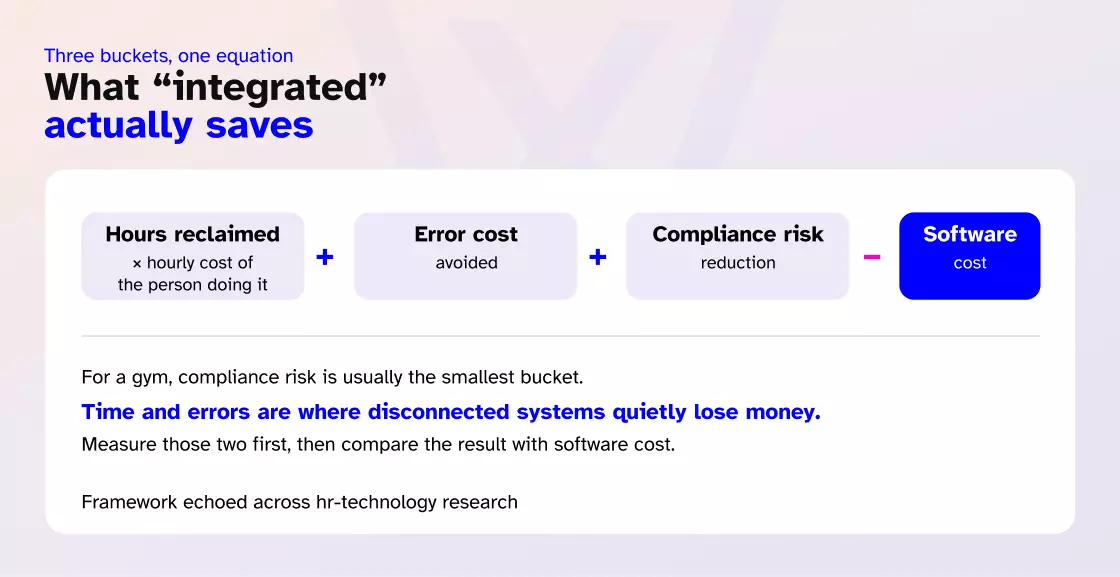
Payroll-software ROI analysis generally breaks savings into three buckets, a framework echoed across HR-technology research: hours reclaimed multiplied by the hourly cost of the person doing that work, plus the cost of errors avoided, plus reduced compliance and audit risk, minus whatever the software itself costs. For a gym specifically, that third bucket (compliance risk) is smaller than it would be for a large enterprise, but the first two, time and errors, are exactly where a disconnected system quietly bleeds money every single pay cycle.
Time savings: what disconnected systems actually cost in hours
The core problem isn’t that payroll math is hard. It’s that gym pay structures are unusually varied for a small business: a single trainer can earn hourly base pay, per-session rates, and commission in the same pay period, and calculating that mix by hand, or by copying numbers between a scheduling tool and a separate payroll tool, is exactly where underpayment and overpayment errors both start.
That manual reconciliation work adds up to real hours. Separate industry data found that forty-one percent (41%) of payroll teams spend an additional four to ten hours per pay cycle correcting errors that manual processes introduce, turning what should be a routine task into a recurring administrative drain. With biweekly payroll, four to ten additional hours per cycle becomes roughly 100 to 260 hours a year, time a gym owner or manager could otherwise spend on the floor or on sales.
Error-cost avoidance: what mistakes actually cost
Beyond the time spent fixing errors, the errors themselves carry a direct cost. Research based on a December 2022 EY study put the average cost of failing to correctly enter a new hire into payroll at $635 per employee, a mistake that recurs constantly in an industry with high turnover among seasonal and front-desk staff. That’s one error, on one employee, once. A gym that hires and turns over several front-desk or seasonal staff a year is paying that cost repeatedly, on top of the time spent catching and fixing it.
Automated timekeeping tied directly to payroll calculations is reported to reduce payroll costs by roughly 1.2% in broader HR-technology research, driven mainly by eliminating the transcription errors that happen when hours are recorded in one system and re-entered into another. On a gym running $200,000 a year in total payroll, that’s roughly $2,400 a year in avoided cost from that mechanism alone, before counting the time saved getting there.
A worked example: what integration is worth for one gym
Take a mid-sized gym with eight staff, running biweekly payroll, where a manager currently spends about six hours per cycle reconciling attendance, commission, and hours across separate systems, a conservative estimate within the four-to-ten-hour range cited above. At a blended administrative cost of $25/hour, that’s:
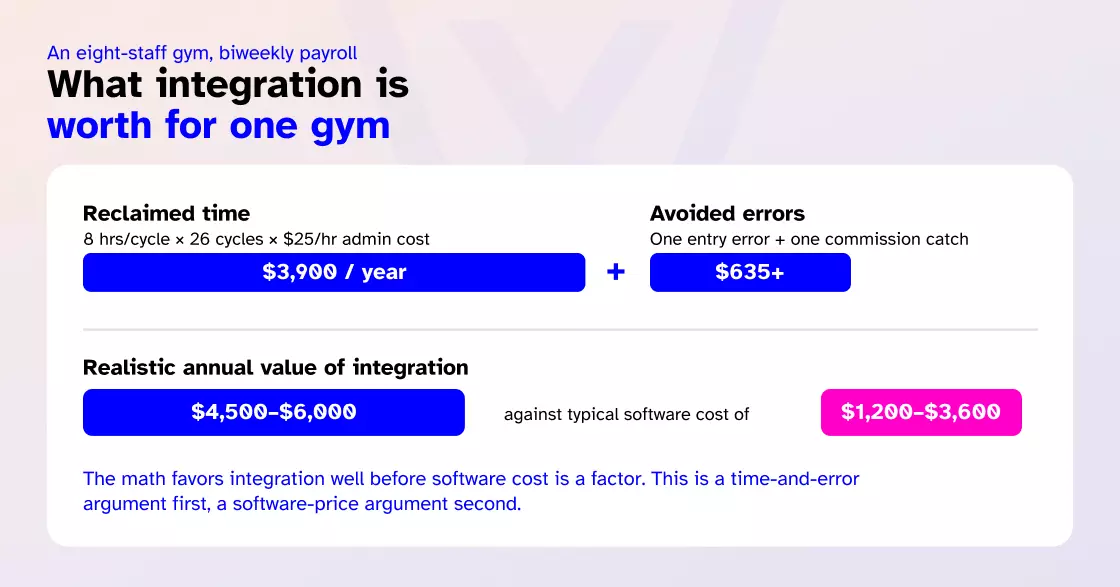
6 hours × 26 pay cycles × $25 per hour = $3,900 a year in reclaimed time alone, before counting a single avoided error.
Add one avoided new-hire entry mistake at $635, and the calculated annual value reaches at least $4,535. Any avoided commission errors would increase that total. By comparison, the platforms covered in the companion guide typically cost $1,200 to $3,600 per year, depending on the provider and staff count. The math works in integration’s favor well before the software cost is a serious offset, which is why this is a time-and-error argument first, and a software-price argument second.
Which gym platforms actually connect payroll to membership data?
This is a narrower question than “which software has payroll,” and the answer is narrower than a quick search may suggest. Here is the breakdown of native payroll and native membership or attendance tracking.
| Platform | Native payroll | Native membership/attendance tracking | Combines both natively |
| Wellyx | Yes (compensation, commission, leave; tax filing not yet confirmed) | Yes | Yes |
| Homebase Payroll | Yes, full tax filing | No | No |
| Gusto | Yes, full tax filing | No | No |
| QuickBooks Payroll | Yes, full tax filing | No | No |
| Square Payroll | Yes, full tax filing | No | No |
| RUN Powered by ADP | Yes, full tax filing | No | No |
| Rippling | Yes, full tax filing | No | No |
Every dedicated payroll provider on this list offers tax-filing services, which matters, but none of them know what a class attendance record or a membership renewal looks like. They calculate payroll from whatever numbers a person feeds them. A gym-native platform is the only category built to pull commission and hours directly from the same system that runs bookings and billing, which is the entire mechanism behind the time savings described above. Our companion piece, the gym payroll management guide, provides a full breakdown of payroll setup, wage structures, time tracking, taxes, compliance, and growth considerations across all seven platforms.
What “integrated” doesn’t save you from
Integration saves time and reduces manual-entry errors. It doesn’t automatically mean tax filing, benefits administration, or compliance work is handled; those are separate capabilities that need confirming platform by platform, not assumed from the word “integrated” alone. Wellyx’s payroll software is a clear example: strong on connecting compensation, commission, and leave to the same system as bookings and billing, but tax administration specifically isn’t yet confirmed in public materials. Some gyms will pair a gym-native platform for the operational savings above with a dedicated payroll provider for tax filing, rather than expecting one system to do both.
Frequently asked questions
Looking for gym management software with integrated payroll?
Wellyx is the clearest example of gym management software with integrated payroll, built into the same system as memberships, scheduling, and billing, rather than payroll living as a separate, disconnected tool. Confirm tax-filing capability directly, since integrated compensation tracking and full tax administration are two different things.
Do any gym platforms handle payroll and membership data in one place?
Very few do both natively. Wellyx combines payroll (compensation, commission, and leave management) with membership and attendance tracking in one system. Dedicated payroll providers like Homebase, Gusto, QuickBooks, Square, ADP, and Rippling all handle tax filing reliably but have no membership or class-attendance tracking at all; they’re general small-business payroll tools, not gym-specific ones.
How much time does integrated payroll actually save a gym?
Based on industry data on manual payroll error correction (41% of payroll teams losing 4 to 10 hours per pay cycle), a gym running biweekly payroll could reasonably reclaim 100 to 260 hours a year by eliminating manual reconciliation between scheduling, attendance, and payroll systems. The exact number depends on staff count and how manual the current process is.
Does integrated payroll reduce payroll errors?
Yes, by removing the manual re-entry step where most errors originate. A single payroll new-hire entry error costs an average of $635 per employee, according to EY-based research, and that’s before counting the time spent catching and correcting it. Automated timekeeping tied to payroll is reported to reduce payroll costs by roughly 1.2% in broader HR-technology benchmarks, primarily through eliminating transcription errors.
Is integrated payroll worth it for a small gym?
For most gyms with more than a handful of staff and any mix of hourly, per-session, or commission pay, yes, the math tends to favor it well before the software cost becomes a serious factor. The worked example above puts realistic annual value at $4,500 to $6,000 for an eight-person gym, against a typical software cost of $1,200 to $3,600 a year.
The real savings case
Integrated payroll isn’t valuable because it’s a single login instead of two. It’s valuable because the hours a manager spends reconciling attendance against commission against hours worked are hours with a real dollar cost, and the errors that manual re-entry introduces have a real dollar cost too. Software price is almost never the deciding factor once those two numbers are actually calculated.
If you want to see how Wellyx connects payroll to bookings, attendance, and commission on a live account, book a demo.