





The member you’re about to lose is still paying you.
There’s something that most owners overlook. Churn does not necessarily look like an angry cancellation. It looks like a guy who joined in January, came four times, and has not swiped his fob in three weeks. The card still charges, and your dashboard still counts him as active. Then, one Tuesday, he cancels, and it feels sudden, even though he checked out a month ago.
This silent cancellation is where the money and effort go. And it happens so quickly that few owners notice it. But canceled members are not the ones to be blamed for this. After more than 25 years in the fitness industry, I’ve seen gym owners struggle with one constant problem: churn in the first 90. Two reasons behind this are: a lack of community and a system that doesn’t flag members’ behavior.
A peer-reviewed study of 5,240 members found more than half stopped showing up before the third month, and fewer than 4% were still training a year later. Whatever you spent to get those people through the door, you spent it to watch most of them vanish before they became regulars.
Why members quit in the first 90 days
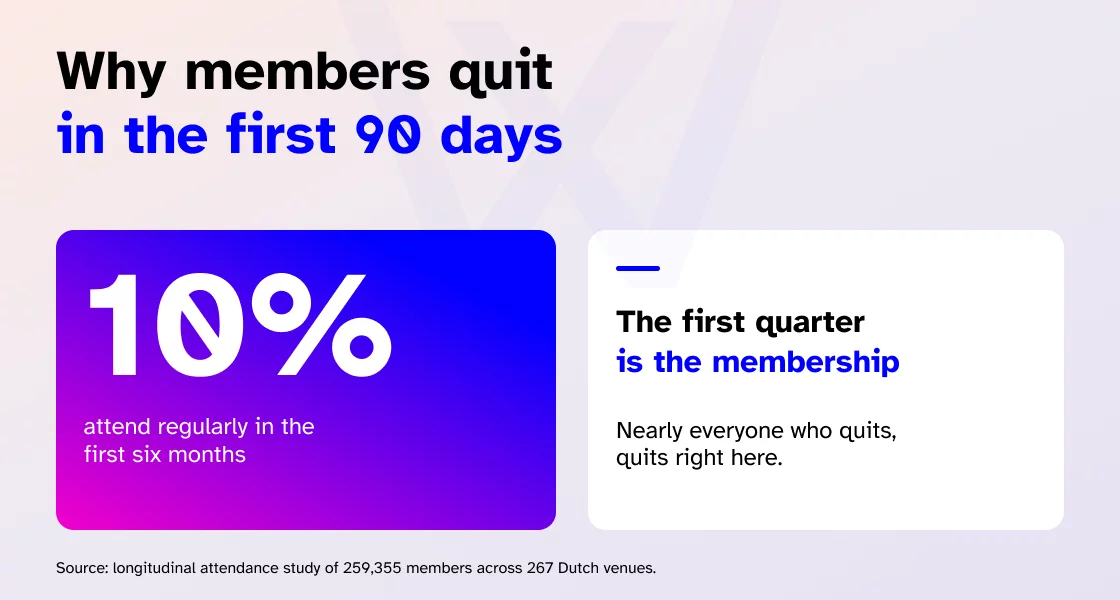
Across studies of Brazilian, Dutch, and Norwegian clubs, regular attendance in the opening months is the exception, not the rule. One look at 259,355 former members at 267 Dutch venues found only about 10% attended regularly across their first six months. The first quarter is not just another stretch of the membership. It basically is the membership, because nearly everyone who quits, quits here.
To fix that, stop looking at it from behind the front desk and start putting yourself in your members’ shoes.
What a new member is actually feeling
Understanding your members’ psychology separates owners who simply run a gym from owners who genuinely want to change lives. Take my advice and become the latter one, one who understands, feels, and guides their members through their fitness journey.
So where do you start? Right from the first interaction, when you see a sale closed. They see a decision they’re not sure they got right.
Most members walk in carrying more doubt than energy. They don’t know how the cable machine works, whether their squat looks ridiculous, or whether the regulars are watching them fumble. Motivation is sky-high on day one, and that’s the trap, because motivation is a lousy foundation. It burns off within weeks, and the thing meant to replace it, a habit, hasn’t formed yet.
Three forces work against your new member under the surface:
- No habit yet. A routine takes weeks of repetition before it runs on its own, and the early stretch is when it’s most fragile. A couple of missed sessions knock a half-built habit flat. They don’t decide to quit. They just stop, because nothing was holding them in place.
- No results to see. People join for an outcome, not for the act of working out. Month one shows almost nothing: the scale’s barely moved, the mirror looks the same, the soreness feels like a bill with no payoff. When the only feedback is fatigue, they start asking whether it’s worth it.
- No connection. The one most gyms underrate. A member with no tie to the place, the staff, or other members is just renting equipment, and the equipment is cheaper down the street. People who train alone leave at higher rates than those in a class or a group. Belonging is the strongest glue you’ve got, and in week one, they have none of it.
Why early churn is your problem to fix
It’s tempting to write off early quitters as people who were never committed. That story feels good, but it still costs you money because it puts the outcome outside your control.
Dr. Paul Bedford, one of the most cited retention researchers in the field, tracked roughly 1,000 members. Those who went through a structured onboarding program, an orientation plus a few follow-ups over the first weeks, stayed at around 87% after six months. Those who got the standard one-hour tour and were left alone stayed at around 60%.
Same gym. Same equipment. Same price. A 27-point swing, all of it driven by what the gym did in the early weeks, not by who the member was.
That’s the case for a 90-day program. Early churn is not a personality type you screen for at sign-up. It’s an operational outcome you build, or fail to. Members fall through the cracks when there are cracks to fall through, so close them. Most gyms come up short here because retention work lives in a manager’s head or on a sticky note instead of a system. Good software for gym management turns intentions into automated touchpoints that fire whether or not anyone remembers.
How to measure early churn
Blended annual churn hides this problem. Track your 90-day cohort on its own:
Early churn rate = (members who cancel within 90 days ÷ members who joined that period) × 100
If 40 people joined last quarter and 14 were gone within 90 days, your early churn is 35%, and that figure tells you more about your business than almost anything else on your dashboard. For context, the Health & Fitness Association’s 2025 report puts industry-average annual retention at 66.4%, so roughly one in three members leaves each year, much of it in the first quarter.
Your 90-day retention plan, day by day
After investing a good amount of time talking to some of the successful gym owners with Wellyx, I have learned things that owners complaining about churn often miss.
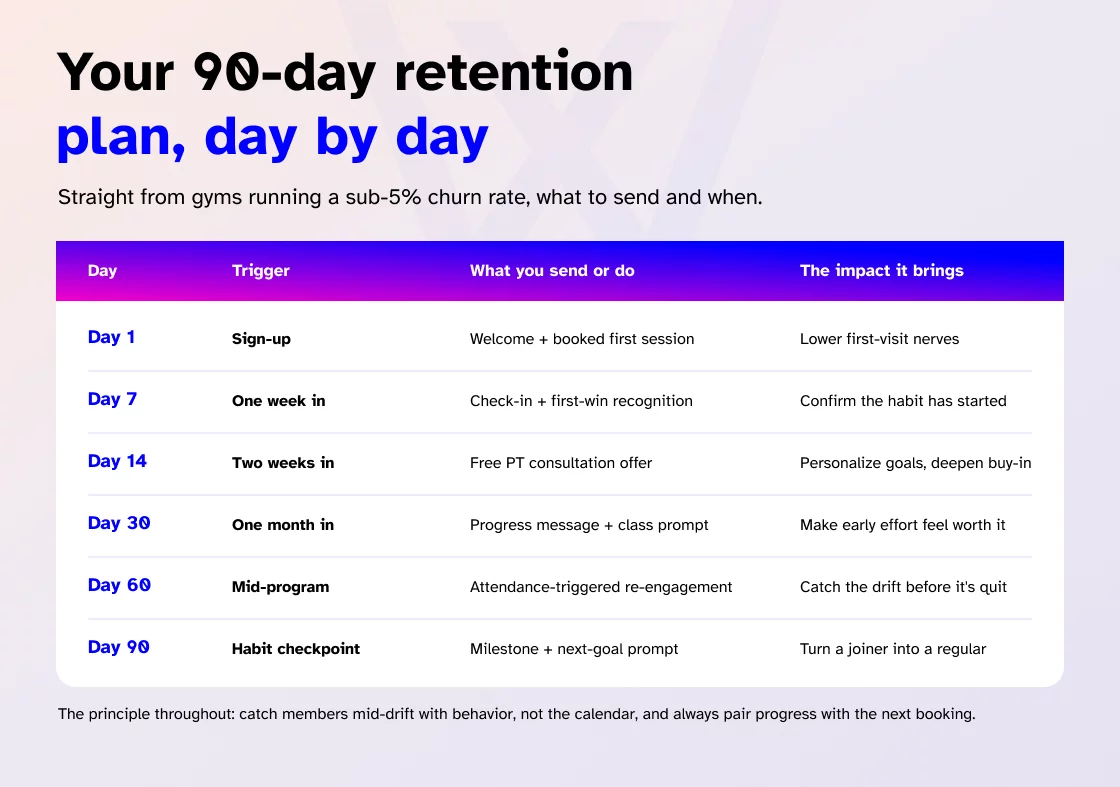
To help you reduce the churn rate, here’s a 90-day retention plan straight from gyms that have a <5% churn rate:
| Day | Trigger | What you send or do | The impact it brings |
| Day 1 | Sign-up | Welcome and booked the first session | Lower first-visit nerves |
| Day 7 | One week in | Check-in and first-win recognition | Confirm the habit has started |
| Day 14 | Two weeks in | Free PT consultation offer | Personalize goals, deepen buy-in |
| Day 30 | One month in | Progress message and class prompt | Make early effort feel worth it |
| Day 60 | Mid-program | Attendance-triggered re-engagement | Catch the drift before it’s too late |
| Day 90 | Habit checkpoint | Milestone and next-goal prompt | Turn a joiner into a regular |
Day 1: Welcome and book the first session. The relationship is most fragile the second after someone pays. Send a warm, human welcome that says exactly what happens next, and get a real first session onto the calendar. A booked appointment is a commitment. “Come in whenever” is a door that quietly swings shut.
Day 7: The first check-in. By week’s end, you can see whether someone showed up, making this your earliest signal and cheapest fix. A short check-in tells a nervous beginner that someone noticed, and surfaces early friction (a confusing app, an intimidating class, a sore knee) before it hardens into a reason to stop.
Day 14: Offer the PT consultation. By two weeks, a member has felt enough friction to want guidance, but it’s early enough to reset their whole trajectory. A free consult turns vague hopes into specific goals, gives them something to measure against, and builds a human relationship inside your walls. The point is connection and clarity. A package, if it comes, is gravy.
Day 30: Celebrate the month and prompt the next booking. A month in, they’ve put in the work and seen little reward. This is the value dip where quiet quitting starts. Show progress they can’t read off the scale: sessions logged, classes tried, a streak going. Then prompt the next class booking in the same breath. Always pair the two.
Day 60: Catch the drift with behavior, not the calendar. By now, your best trigger is behavioral. Watch visit frequency and reach out the moment it drops, not weeks later when they call to cancel. Someone who came three times a week and hasn’t been in for ten days is telling you something. Keep it gentle, never guilt-trippy. Catching a member mid-drift beats any win-back attempt after they’ve already mentally left.
Day 90: Mark the milestone and set the next goal. Hitting 90 days matters because they just cleared the window where most people quit. Say it out loud, show how far they’ve come, and point them at the next goal so momentum doesn’t stall. By here, you’re not preventing a cancellation. You’re confirming a regular.
What experienced gym owners say works
The research tells you why the first 90 days decide everything. Owners who run floors every day tell you how it plays out, and their habits line up with the data.
In online communities on Reddit like r/gymowner, the same themes surface. Owners with the lowest churn treat the first 30 to 60 days as a tightly structured experience, not a free trial with a key fob, because an unstructured start bakes the churn in from day one. Many build a “first success” pathway, a small early win, set up so a beginner feels capable before motivation runs dry. The other constant is tracking: a weekly attendance report, with personal follow-up for anyone whose visits slipped. And the unglamorous stuff beats any promo, clean locker rooms, stocked supplies, broken equipment fixed the same week, and staff who are genuinely friendly. That’s what decides whether a wavering member starts calling your gym “my gym”.
Owners who keep members aren’t running flashier offers. They’re running better systems and sweating the human details, which is exactly what a structured 90-day program lets you do at scale.
Sample 90-day email sequence
I’d suggest you don’t blindly send AI-written emails to your members. Members can sense what feels real and what feels crafted. Instead of prompting bots to draft templates in your brand’s voice, get gym email templates and tweak them as you like.
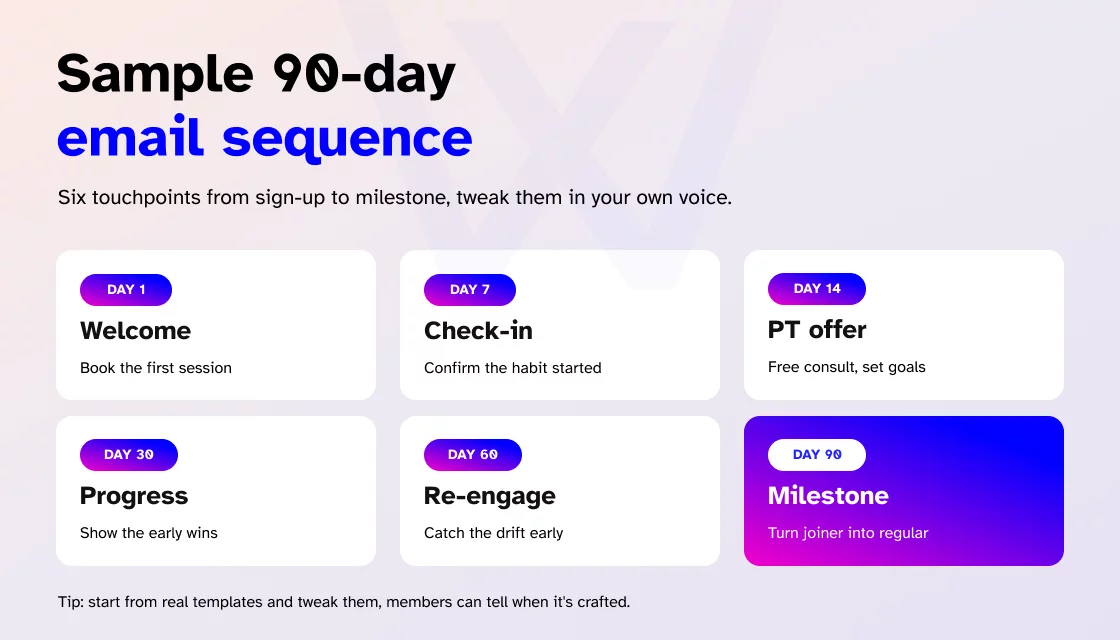
However, here are some quick samples for you to see:
- Day 1 (Welcome): “Welcome to [Gym]. The hardest part is done. Book your first session while the motivation’s fresh: [link]. We’ll show you around and make sure you feel at home before you train.”
- Day 7 (Check-in): “One week in, that’s ahead of most people who never start. How’d it feel? If anything tripped you up, hit reply. Keep the rhythm going, the first few weeks are what make it stick.”
- Day 14 (PT offer): “Two weeks in is the perfect time for some direction. Grab a free consult with a coach, no pitch. We’ll map a simple plan, so every session has a point: [link].”
- Day 30 (Progress): “A month ago, you were brand new. Since then: [X sessions / Y classes]. If the mirror’s slow, that’s normal early on. Momentum beats intensity, so here’s this week: [link].”
- Day 60 (Re-engagement): “Noticed you haven’t been in for a bit, wanted to reach out before letting it slide. Make the comeback small, book one easy session this week: [link]. And if something’s in the way, reply, and we’ll sort it.”
- Day 90 (Milestone): “Ninety days. This is the exact stretch where most new members drop off, and you didn’t. That’s a habit you built. Let’s set the next target: [link]. You’re not new here anymore.”
How to run it without burying your staff
Done by hand, this is a lot of effort, which is why most gyms never run it. Build it once and let it work on every member who joins. With Wellyx’s CRM and automation tools, every touchpoint becomes a trigger that fires on its own. Welcome goes out to the second someone joins. The day 7, 30, and 90 milestones are sent from the join date. The PT offer lands on day 14 without anyone having to schedule it manually. Attendance tracking flags members whose visits dropped, so your day 60 outreach hits the right people. Reporting shows how each cohort is retaining, so you watch the leak close instead of hoping it does, whether you run one location or twenty.
None of this replaces the human side of your gym. It just means that side does not depend on someone remembering. Your coaches still have the conversations and call out the wins. The system guarantees the right message reaches the right member at the right time, every time.
Wrap up
Reducing early churn does not require working harder on acquisition. It is about treating the first 90 days as the most important part of the membership, because it is. Build the program once, automate the touchpoints, and free your team for the conversations a machine cannot have. The members you keep through this window stay for years, and the same logic of strong membership management and retention carries across the lifecycle that follows.
Automate your 90-day retention program with Wellyx. Book a demo.
Frequently Asked Questions
Why do most gym members quit in the first three months?
A habit hasn’t formed, and they haven’t seen results or built any connection. Motivation carries them a week or two, then fades before routine takes over. Without early structure and real contact, most quietly stop showing up and cancel.
Do 90% of people really quit the gym after three months?
No, that’s overstated. Research shows more than half stop attending before the third month, which is bad enough, but it’s far from inevitable. Gyms with structured onboarding hold on to many more new joiners.
What should a 90-day onboarding plan include?
Welcome and book the first session on day 1, a check-in around day 7, a PT or goal-setting consult around day 14, a progress milestone and class prompt at day 30, a behavior-based re-engagement around day 60, and a 90-day milestone that sets the next goal.
When should you offer a new member a PT consultation?
Around day 14. By two weeks, they’ve felt enough uncertainty to value guidance, but it’s early enough to shape their trajectory. Offer it on day one, and it feels like a sales push before any trust exists.
What’s a good early churn rate for a gym?
There’s no single 90-day benchmark since most report annually. The HFA’s 2025 report puts average annual retention at 66.4%. Track your own 90-day cohort over time. A falling number is the clearest sign that your onboarding works.
How do automated check-ins reduce churn?
They guarantee the right contact at the right moment, no matter how slammed your team is. Bedford’s research found that even a couple of staff interactions per member per month lined up with fewer cancellations. Automation makes those reliable instead of being dependent on memory.