





Some reputation studies suggest that one negative review can reduce potential customer interest by about 22%. If three or more negative reviews appear in search results, nearly 60% of prospects may avoid the gym. Each drop in star rating can also lower revenue by 5-9%, because prospects trust businesses with higher ratings and search engines rank them higher in local results. This is why a strong local SEO strategy for gyms plays a critical role in maintaining visibility and attracting new members.
For gyms, where membership decisions involve recurring payments and personal trust, the impact is even stronger. A weak review profile can silently reduce new signups, lower retention, and weaken your position in local search. So, negative gym review reputation issues should never be treated as isolated complaints. One review can trigger a chain reaction that affects visibility, trust, and revenue long before a gym owner notices declining leads.
Why do online reviews carry so much significance for gyms?
Joining a gym is not a casual decision. It is personal. Prospective members commit time, effort, and money to your facility. They also rely on the gym to provide a safe, clean, and motivating environment. Because of this trust factor, online reviews heavily influence whether a prospect decides to walk through your doors.
Most gym-goers research facilities online before signing up. They look for:
- Star ratings and recent reviews.
- Member experiences with trainers and staff.
- Facility hygiene, equipment, and amenities.
Studies suggest that even a single negative review can undermine trust. Prospects often assume that an isolated complaint reflects broader operational issues.
Insight for gym owners: Negative reviews impact your brand before prospects ever interact with your front desk staff. Your online reputation is your first impression; make it count.
What happens after a negative gym review goes live?
Most gym owners believe a bad review simply reflects one unhappy member. In reality, a negative review can trigger a sequence of events that gradually damages the gym’s reputation and visibility.
The process often unfolds in stages.
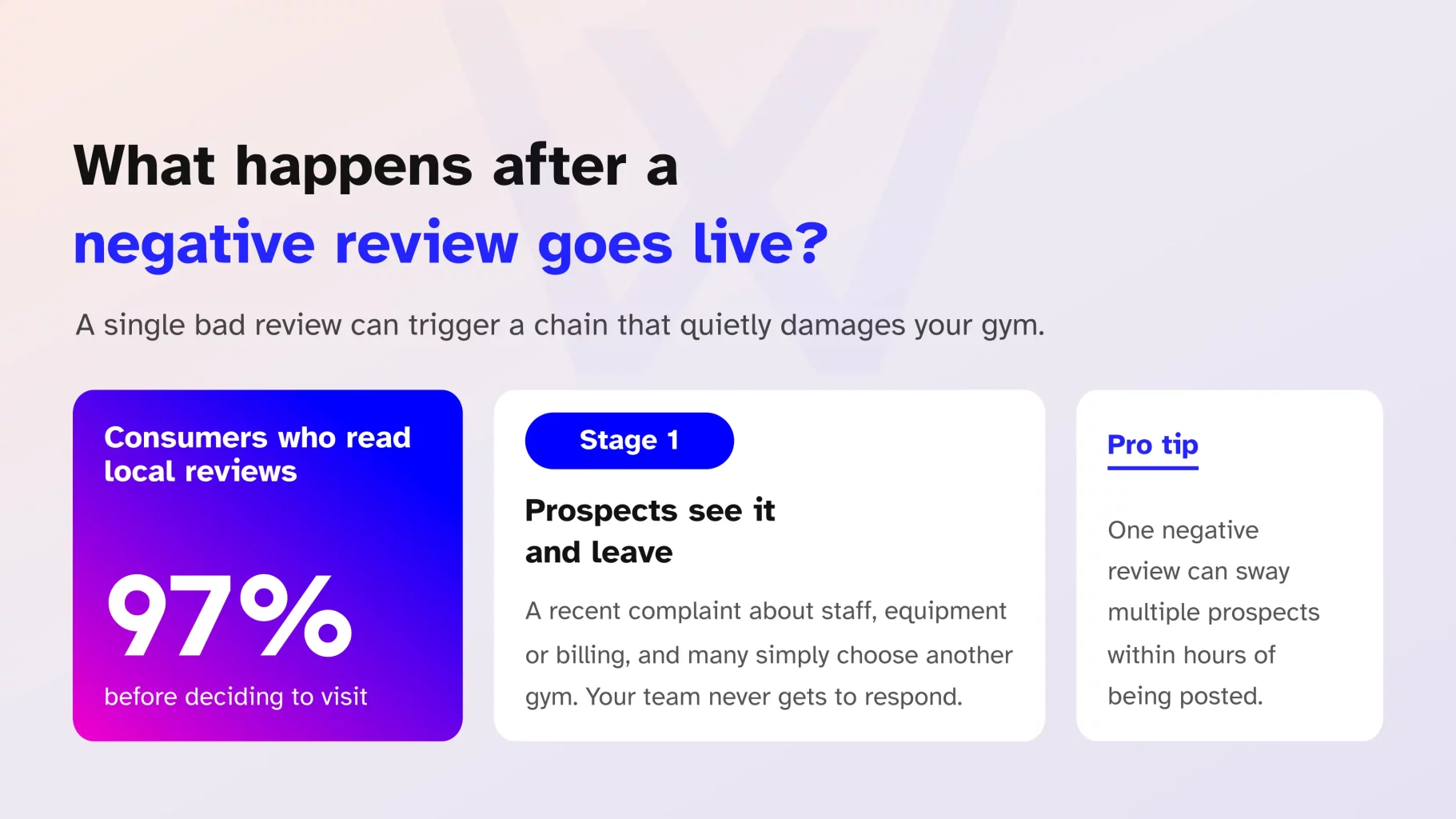
Stage 1: Prospects see the review and leave
The first impact occurs at the moment a potential member searches for gyms nearby. Research shows that 97% of consumers read reviews for local businesses, and the majority rely on them to decide whether a business is worth visiting. For gyms, this research process is especially common because memberships require a long-term commitment.
If a prospect sees a recent complaint describing issues such as rude staff, broken equipment, or billing confusion, they often assume the problem reflects the gym’s overall standards. Rather than investigating further, many people simply choose another gym with better reviews.
The decision happens quickly. Your staff never gets the opportunity to explain the situation or provide a tour that might change the prospect’s mind.
Pro tip: One negative review can influence multiple prospects within hours of being posted.
Stage 2: Your local search ranking drops
Online reviews influence not only trust but also search visibility.
Search engines evaluate several signals when determining which gyms appear in local search results. These signals include star ratings, the number of reviews, review recency, and how consistently the business responds to feedback.
When negative reviews accumulate or remain unanswered, search algorithms may gradually lower your ranking. If your gym drops out of the top local results, fewer people will even see your listing.
| Ranking Factor | How a Bad Review Affects It |
| Average star rating | Lower trust signal to Google and prospects |
| Review recency | Negative reviews weigh more heavily if recent |
| Response activity | Unanswered reviews reduce visibility in local search results |
| Total review volume | Low review counts make a single negative review more impactful |
The effect can be subtle at first. Website traffic may appear stable, but fewer prospects are discovering your gym through local searches. Over time, this loss of visibility reduces inquiries and tour bookings.
Stage 3: Conversion rates decline across channels
Even when marketing campaigns continue to generate traffic, reputation issues can quietly reduce conversions. Prospective members often follow a predictable research pattern:
- They click on your website or advertisement.
- They open your review page to check ratings.
- They read recent feedback.
- They decide whether to continue the signup process.
If the review section contains unresolved complaints or a low star rating, the prospect may abandon the process. This means paid advertising, referral campaigns, and social media promotions all produce fewer memberships.
Studies show that 94% of consumers have avoided a business because of negative reviews. For a membership-based business like a gym, that hesitation translates directly into lost recurring revenue.
Stage 4: Unanswered reviews compound the problem
When a negative review goes unanswered, the damage multiplies. Prospects who read reviews are not just evaluating the complaint itself. They are also evaluating how the business responds. A thoughtful reply demonstrates professionalism and accountability, while silence shows indifference.
Unanswered reviews also encourage additional complaints. Members who were previously unsure about posting criticism may feel more comfortable doing so when they see other complaints already visible.
Insight: One complaint can become three. Three can become a pattern that damages your reputation and star rating.
The financial impact of negative gym reviews
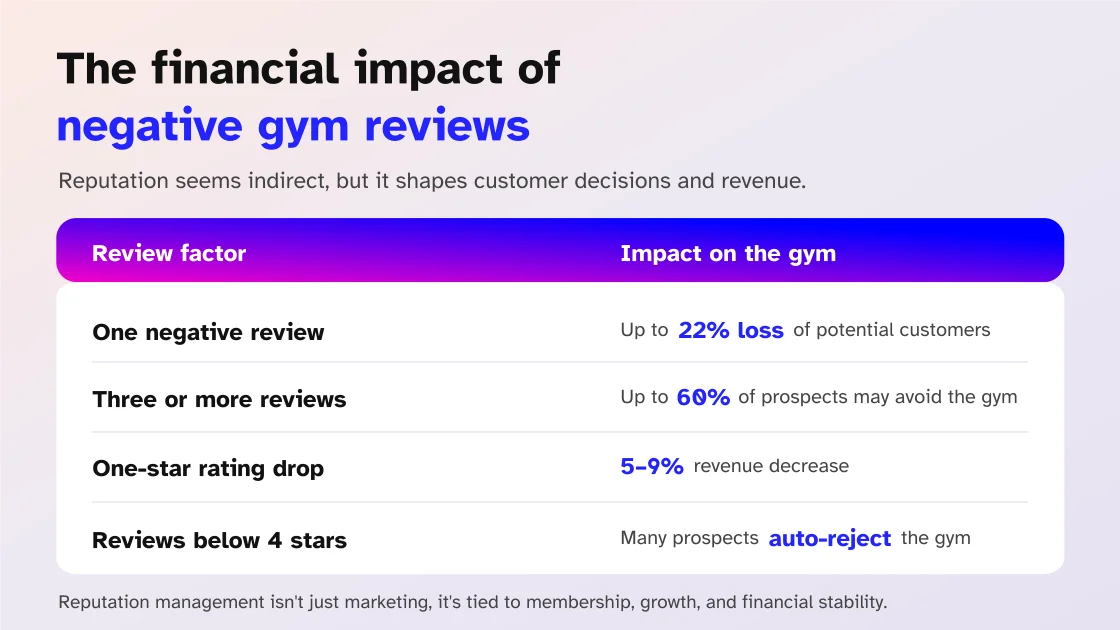
Most gym owners underestimate how strongly reviews influence revenue. While the relationship may seem indirect, reputation directly affects customer decisions.
| Review Factor | Impact on the Gym |
| One negative review | Up to 22% loss of potential customers |
| Three or more negative reviews | Up to 60% of prospects may avoid the gym |
| One-star rating drop | 5–9% revenue decrease |
| Reviews below 4 stars | Many prospects automatically reject the business |
These numbers explain why gym online reputation management is not just a marketing task. It is directly connected to membership, growth, and financial stability of a gym.
Responding to negative gym reviews the right way
Reputation problems not only influence potential members. They can also shape the perception of people who already belong to your gym. Members occasionally search for their gym online out of curiosity. When they encounter multiple complaints about service quality or facility issues, it can reinforce frustrations they may already have.
For example, a member who has been annoyed by crowded equipment might see several online reviews mentioning the same issue. That confirmation can push them closer to canceling their membership.
Negative reviews can also affect staff morale. Trainers and front desk employees who care about member experience may feel discouraged when public complaints accumulate without acknowledgment from management.
In this way, reputation issues influence member retention, staff motivation, and overall gym culture.
A well-crafted response can neutralize the impact of a negative review and even build trust with future members.
| Step | Action | Why It Works |
| Respond quickly | Within 24 hours | Shows attentiveness and professionalism |
| Acknowledge the concern | Mention the specific issue | Demonstrates that you read the review carefully |
| Show appreciation | Thank the reviewer | Reduces defensiveness, builds credibility |
| Move offline | Provide email/phone | Resolves issues privately, prevents public arguments |
| Stay professional | Avoid blaming or revealing member info | Maintains credibility with future readers |
Example of an effective response:
“Thank you for sharing your feedback. We’re sorry your visit didn’t meet expectations. Please reach out directly at [[email protected]] so we can resolve this for you.”
This approach demonstrates accountability and often encourages the reviewer to update their review.
Responding to negative gym reviews the right way
While responding to reviews is important, the most effective strategy is preventing complaints from becoming public reviews in the first place. Many negative reviews appear online because members felt they had no easy way to share concerns privately. But gyms can reduce this risk by using digital forms to gather feedback before issues become public. When gyms provide quick and convenient feedback channels, many issues can be resolved before frustration escalates.
How digital feedback forms help
Digital forms allow members to fill out a form or report any issues instantly via smartphone, tablet, or desktop. You can create a feedback form and include common feedback questions and areas:
- Equipment maintenance requests.
- Locker room cleanliness.
- Class scheduling conflicts.
- Customer service interactions.
These forms connect directly to management, enabling fast resolutions before the problem worsens.
Here are some timing tips for digital feedback:
- After a first visit or trial class.
- After attending a personal training session.
- After completing onboarding.
- After interacting with customer support.
When members see prompt action, trust increases and negative reviews decline.
Generating positive reviews
Digital forms can also help identify satisfied members who are likely to leave reviews. For instance:
- After achieving a personal milestone.
- After a positive class experience.
- After successful onboarding.
Higher review volume protects your rating from occasional negative reviews. Consider:
| Review Profile | Reputation Stability |
| 15 reviews, 4.1 rating | Highly vulnerable |
| 80 reviews, 4.4 rating | Moderately stable |
| 300+ reviews, 4.5 rating | Strongly resilient |
Final words
Strong reputation management is not about reacting to occasional negative feedback. It requires building systems that continuously reinforce trust.
Successful gyms monitor their review platforms regularly, respond to feedback promptly, and encourage satisfied members to share their experiences. They also create internal feedback channels so concerns can be addressed privately and quickly.
When these systems are in place, even negative reviews can become opportunities to demonstrate professionalism and accountability. Gym owners who actively manage their reputation protect more than their online image. They protect membership, growth, revenue stability, and long-term member loyalty.
Frequently Asked Questions
Can one negative Google review hurt my gym’s rankings?
Yes. Google evaluates review score, recency, and response activity. A negative review can reduce visibility in local search results.
Should gyms respond to every negative review?
Yes. Responses show prospects that the gym takes feedback seriously and strengthens member trust.
How can gyms deal with fake or malicious reviews?
Report them through Google’s platform. Meanwhile, respond professionally to maintain transparency.
What is the fastest way to improve gym star ratings?
Increase the number of authentic positive reviews through follow-up requests and digital forms.
How do digital feedback forms prevent negative reviews?
They allow members to report concerns privately and quickly, giving management the chance to resolve issues before they appear publicly.
Should gyms invest in reputation management software?
Software is useful for gyms with multiple locations or high review volume. Independent gyms can build a strong review system internally using feedback forms and consistent responses.