




If you run a gym, you have to watch social media. It is where you hear what people are talking about before it ever shows up on your gym floor. As a fitness professional, HYROX is one of the clearest examples I have seen in years. People were posting online about it long before most gym owners caught on, and the ones who moved early were simply paying attention. So if a member leaves your gym for the one down the street because it offers HYROX training, the reason is not hard to read. They simply found a finish line somewhere else.
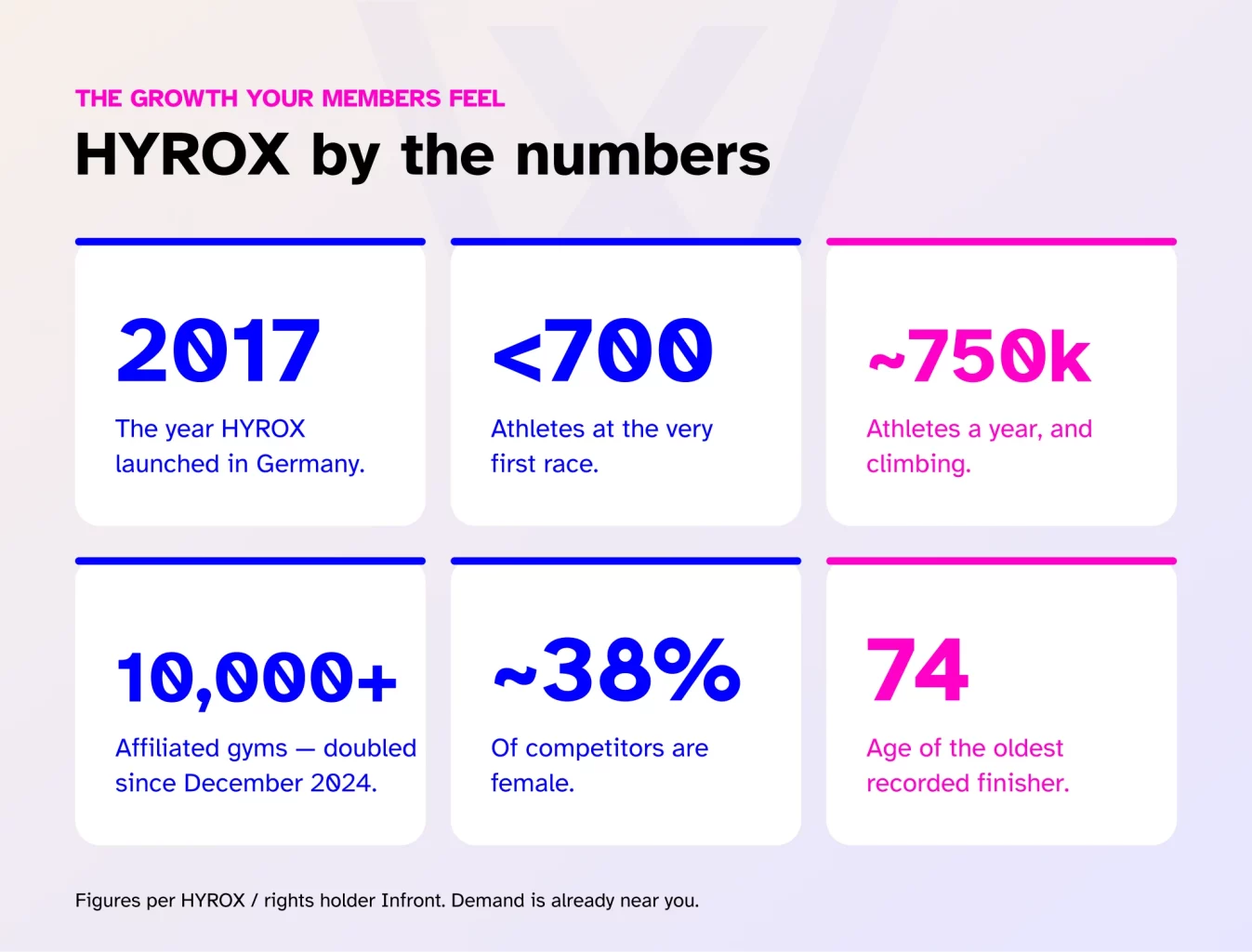
It feels like an overnight craze, but HYROX has been around since 2017. A German events promoter and an Olympic hockey champion started it on a simple idea: a lot of people lift and run, but most have nothing to actually train for. The first race had fewer than 700 people. It is now heading toward three-quarters of a million athletes a year, and it is the question your members keep bringing to the desk.
So here is how you answer that question, and keep that member. I will cover what HYROX is, who it pulls in, and how to run it so the next person catches the bug in your gym.
What HYROX is
When a gym member asks what HYROX is, here is the explanation worth giving them.
HYROX is a race. Eight kilometers of running, split into eight 1km segments, with a functional workout station between each run. The format never changes. Same stations, same order, same standard weights, at every event around the globe. That consistency is the whole point. A member who races in spring, trains through summer, and races again in autumn knows precisely whether they have improved.
It was deliberately built to sit between the casual runner and the elite competitor. There are no muscle-ups, no rope climbs, no technical skill ceiling. The movements are simple. The difficulty comes from doing them under the fatigue of running, which is a challenge most reasonably fit members can train toward and complete.
The accessibility is real, and it is verifiable. HYROX runs no time caps, and the organization reports that over 98% of participants finish the race. So when a member asks whether they could actually do it, the honest answer is yes. That answer is what turns idle curiosity into a training goal.
The growth your members are already feeling
The scale is worth knowing before you commit floor space for HYROX. The affiliate network has grown as fast as the race itself, passing more than 10,000 affiliated gyms worldwide and doubling since December 2024, according to rights holder Infront. The athlete base is broad rather than niche. Around 38% of competitors are female, and the oldest recorded finisher is 74. The demand is already near you, possibly already among your members. The only open question is where they choose to train for it.
The eight stations
Members hesitate because race sounds elite. But walking them through the stations usually removes that fear. Every HYROX follows the same sequence:
- SkiErg: 1,000m on the upper-body ski machine. Rhythm over strength.
- Sled push: Driving a weighted sled across the floor. Legs and grit.
- Sled pull: Hauling the sled back hand-over-hand. Posterior chain and grip.
- Burpee broad jumps: Burpee into a forward jump, repeated over distance. The most dreaded and most scalable station.
- Rowing: 1,000m on the rower. The closest thing to recovery.
- Farmers carry: Heavy weights carried over distance. Grip and core.
- Sandbag lunges: Walking lunges with a sandbag across the shoulders.
- Wall balls: Throwing a weighted ball to a target, performed last, when the legs are gone.
The coaching point is this. No single station is hard in isolation. A fit member can manage 100 wall balls or a 1,000m row in a normal session. The race is hard because each station arrives right after a 1km run, under accumulated fatigue. That is what HYROX training addresses. Once a member grasps it, the fixed format stops being intimidating and starts being reassuring. There are no surprises to prepare for, only eight known tasks to improve.
The member who signs up
The HYROX athlete is not who most owners expect. It’s rarely the existing competitive crowd. It is the consistent member who has been turning up for a year, has decent base fitness, and has run out of reasons to push. It is the lapsed runner who wants strength back. It’s the strength member who knows their engine is weak.
What they share is a goal that is not aesthetic. They chase a finish time, not a number on the scale, and that motivation proves far more durable. That is why this group trains harder and more consistently than the average member.
HYROX also widens the funnel rather than cannibalizing it. It brings in people who would never have booked a standard functional class but will commit to a race they saw online, and a share of those move into other programs once they are through the door.
Why HYROX members tend to stay
You’ll see this phrase being reiterated everywhere: “HYROX members have higher retention”. It is almost always an unsourced anecdote. I’d rather you understand the mechanism than quote a number nobody can verify.
Retention comes down to one question: does the member have a reason to return next week? A general member’s reason is vague and easily broken by a single bad week. A member training for a race on a fixed date has a reason that compounds. Every session is progress toward something measurable, and quitting means abandoning a goal they have told people about.
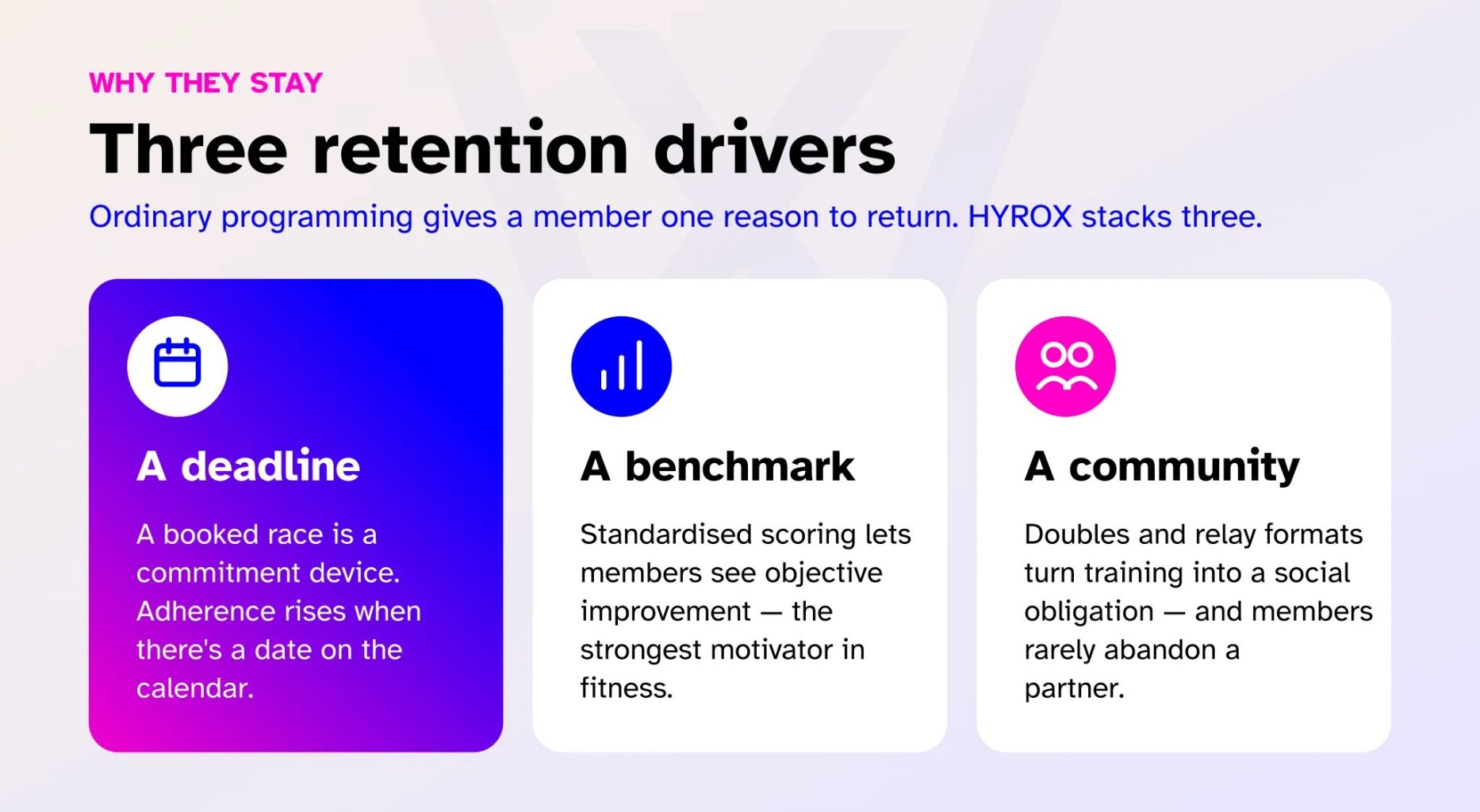
HYROX stacks three retention drivers that ordinary programming cannot:
- A deadline: A booked race is a commitment device. Adherence rises when there is a date on the calendar.
- A benchmark: Standardized scoring lets members see objective improvement, which is the single strongest motivator in fitness.
- A community: Doubles and relay formats turn training into a social obligation, and members rarely abandon a partner (unless some issue occurs).
That is the real story. Not a borrowed statistic, but a structured reason the behavior holds. Your job is to make those three drivers visible and easy to act on.
Structuring classes for non-racers and competitors
This is the problem that decides whether a HYROX offering works. A single class holds a member who will never compete alongside an athlete chasing a podium time. Run it badly, and you lose one of them.
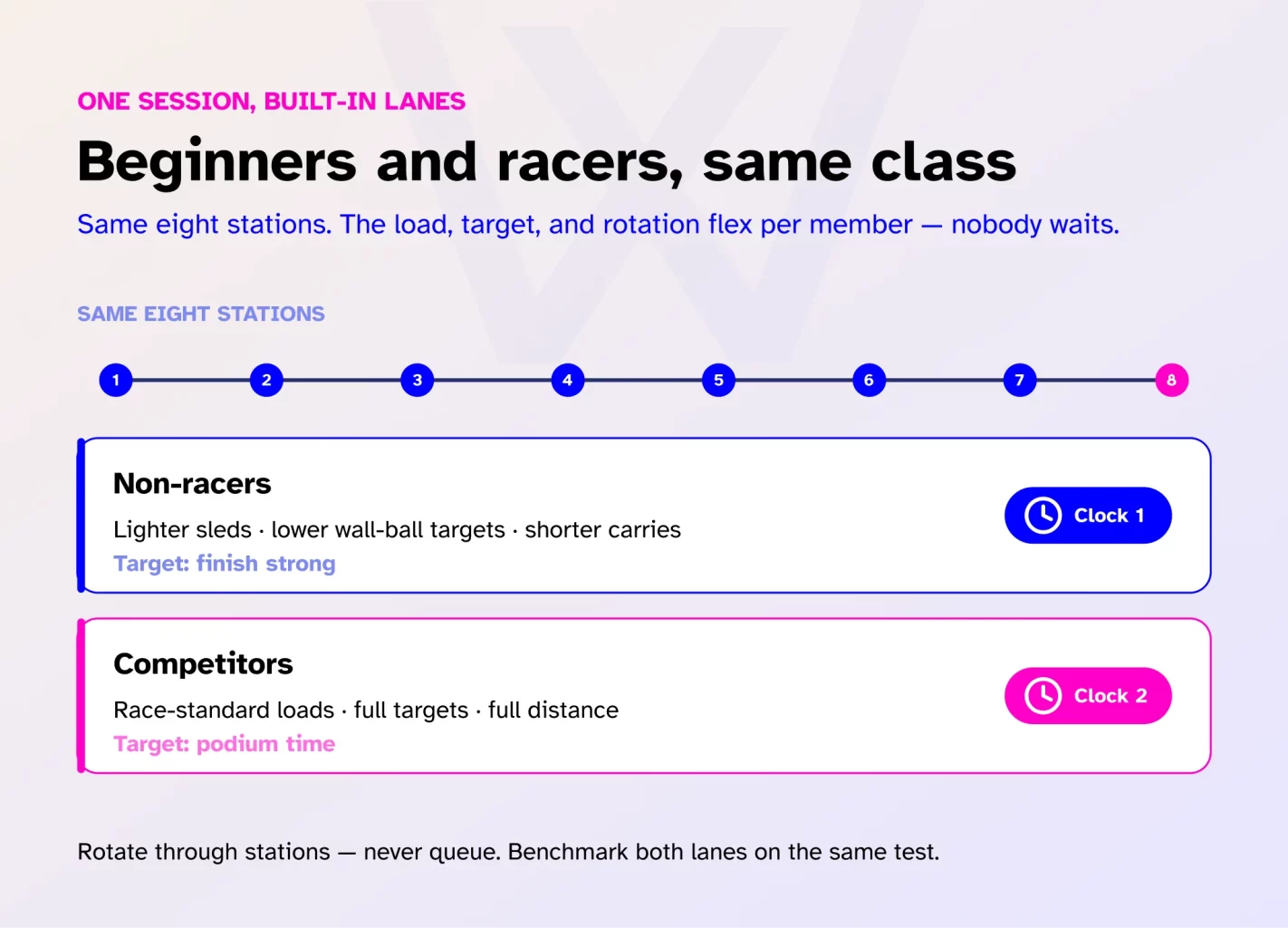
The solution is not two programs. It is one session with built-in lanes:
- Same stations, scaled loads: Everyone trains the eight movements. Non-racers use lighter sleds, lower wall-ball targets, and shorter carries, while competitors work at race standard. The session looks unified while the intensity stays individual.
- Two clocks, one workout: Set a finisher-friendly target for newcomers and a performance target for competitors on the same circuit. Nobody waits.
- Rotate, never queue: Limited sled lanes and SkiErgs are your true bottleneck. Stagger members through stations on a rotation rather than sending everyone to the same kit at once.
- Benchmark everyone identically: Run periodic fitness tests so a non-racer sees progress in the same numbers a competitor tracks. That shared metric is how a casual member quietly becomes a racer.
The deconditioned member warrants a note. Sled pushes, lunges, and high-volume running carry real overuse risk, with Achilles, knee, and shoulder complaints being the most common. Scale volume before load, build a running base first, and do not let a motivated beginner do too much too soon. That honesty protects both the member and your reputation.
Getting this right is as much of an operational problem as a programming one. Scheduling, capacity, and coach allocation run on the same infrastructure as any class-based timetable, and a solid grounding in best software for gym management is what separates a HYROX track that scales from one that buries your front desk.
Managing HYROX classes, memberships, and registrations in Wellyx
The programming is the straightforward part. The administration is what eats the week: capped class sizes, race-prep cycles, partner pairing, benchmark history, and event sign-ups. That is precisely what Wellyx is built to absorb.
- Schedule and cap by station capacity. Set class limits that match your real constraint, the number of sleds and ergs you own, so sessions never oversell.
- Sell HYROX as its own membership. Offer a dedicated HYROX track as a standalone membership or add-on, with recurring billing handled automatically.
- Track benchmark history per member. Store fitness-test results over time so members see objective improvement, the retention driver made visible.
- Run event and race-simulation registrations. Open sign-ups for in-house race sims, fitness tests, and seasonal challenges, take payment, and manage the roster in one place.
- Pair Doubles and relay teams. Keep partner bookings and team rosters organized rather than chased across messaging apps.
This is not software for its own sake. The three retention drivers: deadline, benchmark, and community, only work if you can operate them at scale. That is what turns “we run some HYROX classes” into a program that runs itself.
Where to start
You do not need to rebuild the gym. Most functional and CrossFit facilities already own the equipment. Run a dedicated HYROX track two to three times a week alongside the existing timetable, benchmark members regularly, and pick the nearest race as a target to periodize toward. Before you write the cycle, get your own grasp of what HYROX is and how the race actually works so the programming reflects the demands of race day. Nothing manufactures urgency like a date on the calendar.
Manage HYROX classes, memberships, and event registrations in one place. Book a Wellyx demo and see how to run a HYROX program that fills classes and keeps members training toward their next race.
Frequently Asked Questions
Do members need to compete to benefit from HYROX training?
No. The training improves general conditioning, strength, and endurance whether or not anyone races. Many members train the format purely for fitness, and a portion decide to enter an event once their benchmarks improve.
How much equipment is needed to start offering HYROX classes?
Most functional fitness gyms already hold the essentials: rower, SkiErg, sled, wall balls, sandbags, and dumbbells for carries. That equipment overlap is a key reason HYROX is low-risk to add.
How do beginners and competitive athletes train in the same class?
Use one shared circuit with scaled loads, individual time targets, and a station rotation so nobody queues, then benchmark both groups with the same fitness test.
Can HYROX be sold as a separate membership?
Yes. Many gyms run HYROX as a dedicated track or paid add-on rather than folding it into general membership. Managing it as its own product, with dedicated billing, class caps, and event registrations in Wellyx, keeps both the revenue and the scheduling clean.
How long does it take a member to prepare for a first race?
With a reasonable fitness base, a structured 8-to-12-week block is a common window. Because the race format is fixed, training can target the eight known stations and running directly, which makes that timeline realistic for most committed members.