



I recently came across a Reddit-style founder discussion that sounded like an advisory call.
A founder was testing a recovery studio concept: sauna, cold plunge, red light therapy, compression, and mobility. They built a landing page and collected more than 70 email signups in a few weeks.
That sounds promising. I have seen founders reach this moment and picture soft lighting, clean rooms, premium equipment, athletes after training, and professionals after work.
Then the real business appears: rent, plumbing, drainage, electrical upgrades, water care, cleaning, insurance, staff coverage, gym software, maintenance, no-shows, and empty rooms.
The Reddit replies were split. Some called recovery the future. Others warned that gyms already carry heavy rent, payroll, repairs, and competition. A few gave the answer I trust most: start lean, test paid demand, and do not overbuild.
I do not use Reddit as financial evidence. I use it as a signal of what founders are asking.
That question inspired this comparison. After years of analyzing gyms, studios, wellness concepts, and recovery add-ons, my view is simple:
Recovery studios can be premium and space-efficient, but they depend on utilization. Traditional gyms serve a broader market and can scale, but carry higher overhead and stronger competition. For many entrepreneurs, hybrids may offer the strongest opportunity.
Recovery studio vs. traditional gym at a glance
A recovery studio is usually a utilization-based wellness business. A traditional gym is usually a membership-based fitness business.
| Category | Recovery studio | Traditional gym |
| Core offer | Recovery and restoration | Exercise and training |
| Revenue model | Utilization-based | Membership-based |
| Customer type | Wellness-focused | Broad fitness market |
| Space requirement | Lower | Higher |
| Staffing need | Lower to moderate | Moderate to high |
| Pricing potential | Premium | Low to premium |
| Main risk | Empty sessions | Churn and overhead |
| Retention driver | Relief, recovery, results | Habit, progress, community |
| Scalability | Moderate | High |
| Best fit | Niche or premium markets | Broad local markets |
When I evaluate fitness businesses, I ask:
How does this make money?
Recovery earns when assets are booked. A gym earns when enough members keep paying long enough to cover overhead.
Why this comparison matters now
Fitness is no longer only about workouts, but wellness interest does not automatically turn into local revenue.
Consumers now connect fitness with sleep, stress, soreness, mobility, recovery, and longevity. Industry reports show wellness and fitness remain active markets. Data from the Global Wellness Institute (GWI) shows the global wellness economy surged to $6.8 trillion, expanding at an annual rate of 7.9%. At the same time, Health & Fitness Association (HFA) reports that fitness club memberships hit historic highs, with average revenue gains growing by 8%.
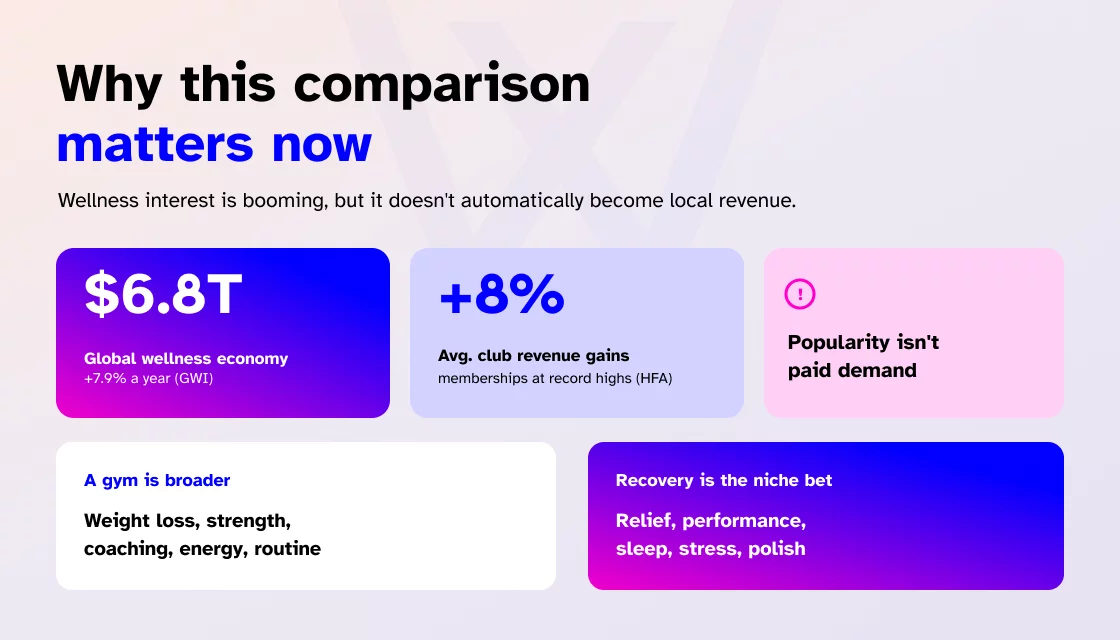
Still, I would never open a recovery studio because wellness is popular. Popularity is not paid demand. A gym is broader: weight loss, strength, coaching, energy, and routine. A recovery studio is the niche bet: relief, performance support, sleep, stress reduction, and a polished wellness experience.
The real difference: utilization vs. membership volume
Recovery studios need consistent bookings. Traditional gyms need paying members who stay.
A recovery studio sells timed access to limited assets: sauna rooms, cold plunges, compression chairs, red light beds, or lounge slots. If a 30-minute slot sits empty, the revenue is gone.
Revenue depends on utilization, repeat bookings, turnover, cleaning speed, buffers, packages, and peak demand. Founders often miss this. A quiet room at 11 a.m. is unused capacity.
A gym sells access, habit, coaching, and community. It succeeds when enough members stay long enough to cover rent, payroll, repairs, marketing, utilities, and reinvestment.
Startup costs and capital allocation
Recovery studios may need less space, but they are not automatically cheaper.
A recovery studio can fit into a smaller footprint, but money often shifts into infrastructure: plumbing, drainage, water care, sauna ventilation, electrical work, wet flooring, private rooms, and sanitation. A gym usually needs more space and equipment: cardio, strength machines, racks, benches, flooring, mirrors, lockers, showers, reception, storage, parking, and cleaning systems.
| Category | Recovery studio | Traditional gym |
| Space | Lower | Higher |
| Equipment | Specialized | Extensive |
| Buildout | Infrastructure-heavy | Equipment-heavy |
| Staffing at launch | Usually leaner | Usually larger |
| Main capital risk | Demand and utilization | Rent and overhead |
| Hidden cost | Plumbing, sanitation, electrical | Repairs, flooring, machines |
| Best way to reduce risk | Pilot first | Focused equipment mix |
Unit economics and break-even reality
The better business is the one that survives under conservative math.
Recovery studios often need fewer customers at higher spend through memberships, bundles, recovery packages, corporate wellness, sports partnerships, and repeat bookings.
Gyms need more members at lower or moderate spend, supported by membership, training, retail, and upgrades.
| Business model | Revenue strategy | Critical metric | What to watch |
| Recovery studio | Premium utilization | Session occupancy | Empty time slots |
| Traditional gym | Membership volume | Active paying members | Churn and payroll |
| Hybrid | Membership plus upsells | Revenue per member | Add-on adoption |
How each model makes money
Recovery studios win through premium positioning. Gyms win through scale.
Recovery studios can earn from memberships, bundles, recovery packages, corporate wellness, sports partnerships, events, and retail. Premium pricing only works when the customer has a reason to return.
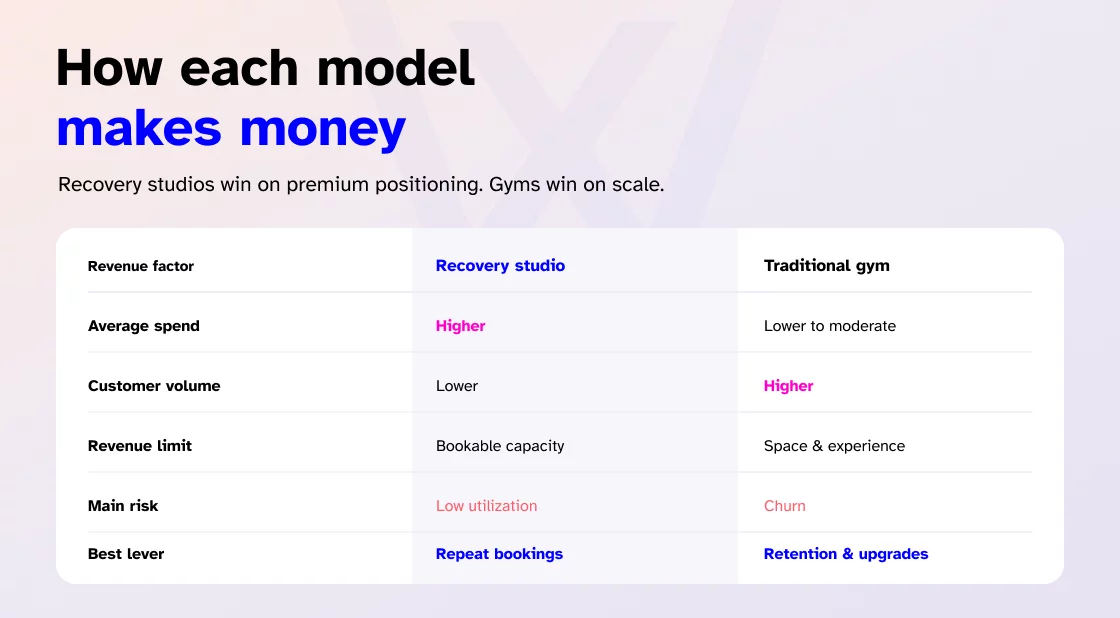
Gyms earn through memberships, personal training, classes, nutrition coaching, retail, challenges, and premium tiers. The gym model can scale, but scale brings heavier operations.
| Revenue factor | Recovery studio | Traditional gym |
| Average spend | Higher | Lower to moderate |
| Customer volume | Lower | Higher |
| Upsell potential | High | High |
| Revenue limit | Bookable capacity | Space and member experience |
| Main risk | Low utilization | Churn |
| Best revenue lever | Repeat bookings | Retention and upgrades |
Recovery needs repeat bookings. Gyms need members who keep paying and keep feeling progress.
Staffing, space, and daily operations
Recovery studios can run leaner, but they are not passive businesses.
I have heard founders call recovery studios “almost self-service.” I understand the appeal, but recovery still needs education, check-ins, cleaning, water testing, safety screening, waivers, maintenance, and follow-up.
A gym usually needs trainers, coaches, front desk staff, sales support, cleaners, maintenance, and member success. Great equipment will not save a cold experience.
| Factor | Recovery studio | Traditional gym |
| Ideal customer income profile | Higher | Mixed |
| Space requirement | Lower | Higher |
| Parking demand | Moderate | High |
| Demographic sensitivity | High | Moderate |
| Peak-time issue | Room availability | Equipment crowding |
| Best location signal | Wellness spend | Population density |
Recovery studios usually need affluent suburbs, athletes, boutique fitness neighbors, or referral partners. Gyms need density, visibility, parking, access, and peak-hour flow.
Software and technology requirements
Recovery studios need asset-level scheduling. Gyms need membership management.
A recovery studio needs capacity control: rooms, assets, time slots, buffers, waivers, packages, payments, access control, utilization reports, and reminders.
A gym needs billing, check-ins, scheduling, POS, retail, staff management, reporting, leads, and access control. The right fitness business software should support both gym and recovery operations if you move into a hybrid model.
Customer profiles, retention, and churn
Recovery customers are problem-aware buyers. Gym customers are goal-oriented buyers.
Recovery clients often arrive with soreness, stress, poor sleep, mobility concerns, athletic recovery needs, pain, or burnout. The stronger the problem, the easier the first sale.
Gym customers usually want weight loss, strength, confidence, energy, routine, community, or better health. Recovery retention comes through relief and premium value. Gyms retain through habits, relationships, and progress.
The risks that do not show up in the pitch deck
The biggest risk is overbuilding before demand is proven.
Recovery risks include equipment obsolescence, novelty fade, sanitation compliance, water quality, liability exposure, low weekday usage, high maintenance, premium-buyer dependence, and weak repeat behavior.
Gym risks include churn, saturation, payroll pressure, repairs, price competition, long hours, cleaning demands, weak sales systems, and peak-hour crowding.
Most fitness businesses fail when fixed costs get too heavy before demand is proven. Before signing, run a gym SWOT analysis and be honest about risk.
What is harder for competitors to copy?
Equipment is easy to copy. Trust, experience, and habit are harder.
Many gyms look similar: same equipment, memberships, hours, and discounts. Without a niche or coaching culture, price pressure creeps in.
Recovery can differentiate, but not through equipment alone. The moat is the calm space, clean rooms, education, partnerships, and repeatable habits around it.
The lean launch path
Test paid behavior before committing to a full facility.
This is the part of the Reddit discussion I agreed with most. Start lean. Test recovery pop-ups, mobile recovery, shared studio space, gym partnerships, founding memberships, weekend sessions, limited-service pilots, or corporate wellness days.
Track paid bookings, repeat visits, referrals, utilization, cancellations, preferred services, and peak booking times. A waitlist shows curiosity. Repeat paid bookings show business potential.
The hybrid model may be the strongest business case
Hybrid combines recurring gym revenue with premium recovery upsells.
Training creates consistency. Recovery creates premium value. Hybrid works because members already have a reason to visit.
| Phase | Focus | Goal |
| Phase 1 | Validate demand | Test paid behavior |
| Phase 2 | Build core offer | Launch gym, studio, or recovery pilot |
| Phase 3 | Add recovery services | Start with the demanded services |
| Phase 4 | Create premium memberships | Bundle training and recovery |
| Phase 5 | Optimize operations | Track utilization and retention |
From a business perspective, I like hybrid because it reduces dependence on one behavior.
Which model should you choose?
Choose the model your market can support under conservative math.
Choose a recovery studio if you have proven demand, a premium wellness market, appointment-based skill, sanitation discipline, clear education, and access to athletes or wellness-focused buyers.
Choose a gym if you want a broader appeal, understand membership sales, can manage staff and equipment, have a strong local fitness community, and can compete beyond price.
Choose a hybrid if you want more revenue per member, stronger retention, premium tiers, and less dependence on one niche.
Decision box: Which business model fits you?
| If your goal is… | Best option | What you must validate first |
| Launch with less space | Recovery studio | Paid local demand |
| Serve the broadest audience | Traditional gym | Customer acquisition cost |
| Generate premium pricing | Recovery studio | Repeat usage |
| Build recurring membership revenue | Traditional gym | Retention |
| Increase revenue per member | Hybrid model | Upsell demand |
| Minimize startup risk | Lean recovery pilot | Paid bookings |
| Maximize long-term opportunity | Hybrid model | Operational execution |
Quick verdict
I would choose recovery if your market values premium wellness and assets stay booked. I would choose a gym if you understand retention and operations. I would choose a hybrid for recurring revenue plus premium upsells.
| Your situation | Recommended model |
| Limited capital | Lean recovery pilot |
| Broad local demand | Traditional gym |
| Existing gym owner | Hybrid |
| Premium wellness market | Recovery studio |
| Strong athlete community | Recovery or hybrid |
| High-rent market | Lean pilot before lease |
| Best risk-reward balance | Hybrid |
Frequently Asked Questions
Is a recovery studio more profitable than a traditional gym?
Yes, it can be, but only under the right conditions. Profitability depends heavily on utilization rates, pricing strategy, rent structure, staffing efficiency, and repeat bookings. A recovery studio can generate higher revenue per customer, but only if its assets (like saunas or cold plunges) stay consistently booked. If utilization drops, profitability declines quickly.
How much does it cost to open a recovery studio?
Costs vary widely based on location, lease size, services offered, equipment quality, and infrastructure requirements. A recovery studio with sauna, cold plunge, and red light therapy typically requires significant investment in plumbing, ventilation, electrical work, and specialized equipment. Local compliance and buildout complexity also play a major role in total startup costs.
How much does it cost to open a traditional gym?
Startup costs depend on multiple factors, including facility size, equipment selection, lease terms, staffing needs, and location. A small boutique gym may require moderate investment, while a large commercial gym can require substantial capital for machines, flooring, lockers, showers, and interior buildout. Location and equipment quality are usually the biggest cost drivers.
Do recovery studios need licensed medical staff?
Not always. Most recovery studios offering non-medical services like saunas, cold plunges, compression therapy, or red light therapy do not require licensed medical staff. However, if the studio offers medical-grade services such as IV therapy, injections, or makes therapeutic medical claims, then stricter regulatory requirements and licensed professionals may be necessary.
How many clients does a recovery studio need to break even?
There is no fixed number. Break-even depends on fixed monthly costs and average revenue per customer. The general formula is:
Break-even clients = Monthly fixed costs ÷ Average monthly revenue per client
After calculating this, operators must also evaluate whether physical capacity (session slots) can support that level of utilization.
Do the math before you follow the trend
After analyzing both models, I do not believe the decision should come down to trends. The real question is whether your market can support the business economics behind the concept.
Recovery studios can work when utilization stays high. Traditional gyms can be powerful when retention is strong. But if I were evaluating the strongest risk-adjusted opportunity today, I would seriously consider a hybrid model that combines training and recovery under one roof.
The Reddit founder with 70-plus signups had something valuable: a signal. But a signal is not a business yet.
The next step is paid demand, conservative math, disciplined operations, and systems for bookings, memberships, payments, reporting, access control, and retention.
If you are planning a recovery studio, traditional gym, or hybrid fitness business, the right operational systems matter just as much as the concept itself.
You can explore fitness business software built to manage memberships, scheduling, payments, access control, reporting, and member retention from one place.