





A gym pricing strategy is the method you use to set membership rates so they cover your cost floor, match what your local market will pay, and hold members long enough to be profitable. In 2026, most US gyms price between $10 and $30 (budget), $40 and $80 (mid-market), and $150 to $300 (premium and boutique). The right number comes from four inputs: your break-even per member, your local competitor set, your churn rate, and the value your members can actually see.
What a gym pricing strategy actually is
Price is not a number you copy from the gym down the street. It is the output of your cost base, your capacity, your churn, and the value a member perceives on the day the card gets charged. A working gym pricing strategy answers five questions:
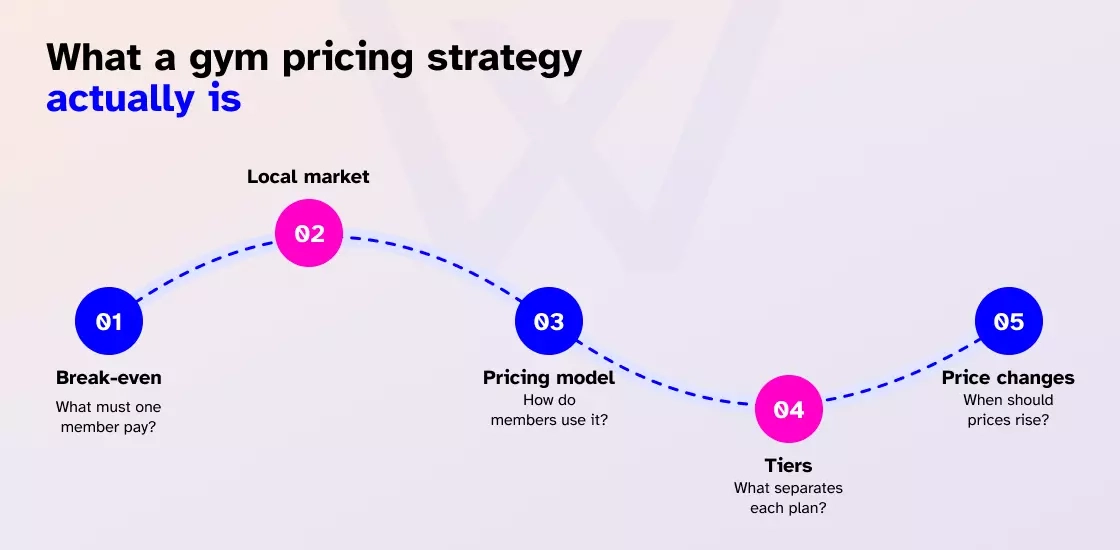
- What does one member need to pay for this business to break even?
- What is my local market already paying, and for what?
- Which pricing model fits how people actually use my facility?
- How many tiers should exist, and what separates them?
- How and when do I raise prices without triggering cancellations?
Everything below works through those five in order, with the 2026 benchmark data you need to double-check your own numbers.
Expert tip: Price is the fastest lever in the business. A $7 increase across 300 members is $25,200 a year, with no new equipment and no extra floor space. It is also the lever most owners touch least often, which is exactly why it is worth getting deliberate about.
The 2026 market picture: What the current fitness data says about pricing
Demand for fitness facilities remains strong, with 81 million Americans holding a fitness membership in 2025. But strong demand does not eliminate the challenge of member retention. HFA’s industry data puts average annual retention at 66.4%, while YouGov found that 41% of former gym-goers cited high membership costs as a reason for canceling.
Price clearly plays a role, but it is not the only reason members leave. Personal circumstances and lack of time also contribute, so gyms need to look beyond pricing when addressing retention.
Step 1: Start from your cost floor, not your competitors’ price sheet
Before you look outward, work out the number below which the business does not function. That is your break-even per member. The formula for break-even analysis is:
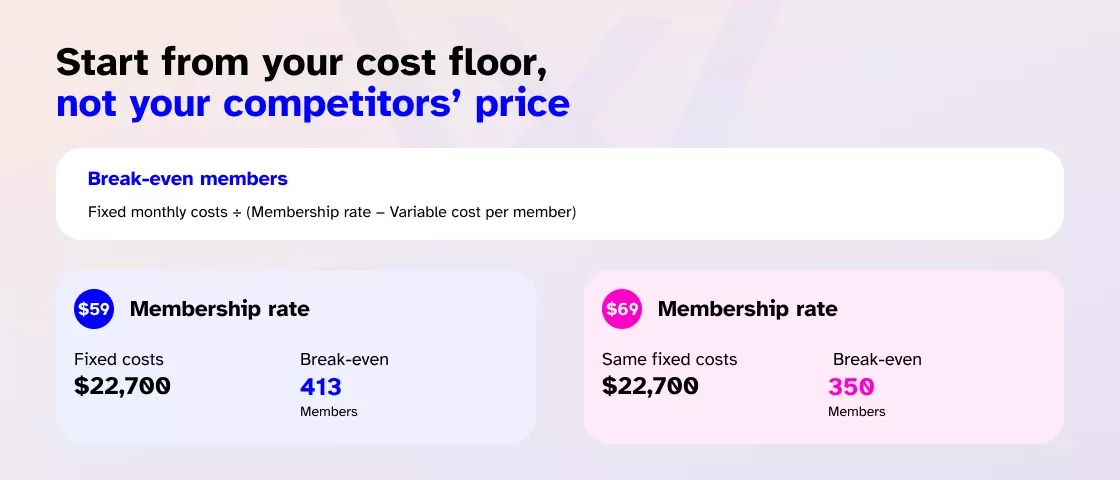
Break-even members = Fixed monthly costs ÷ (Average monthly membership rate − Variable cost per member)
Worked example for a 4,000 sq ft independent gym:
| Line item | Monthly |
| Rent and utilities | $7,500 |
| Payroll (2 FT, 4 PT) | $11,000 |
| Software, insurance, marketing | $2,400 |
| Equipment finance | $1,800 |
| Fixed total | $22,700 |
| Variable cost per member (card fees, towels, consumables) | $4 |
| Membership rate | $59 |
| Break-even members | 413 |
At a $59 membership:
$22,700 ÷ ($59 − $4) = about 413 members
At $69:
$22,700 ÷ ($69 − $4) = about 350 members
That $10 difference means the gym needs roughly 63 fewer active members to cover the same fixed-cost base. It does not prove that $69 is the correct market price. It simply shows why pricing should begin with economics rather than instinct.
Run a proper gym break-even analysis before changing the rate card, then check the result against gym cash flow management. Break-even tells you when revenue covers costs; cash flow tells you whether the money arrives when the bills do.
Expert tip: Build at least three price scenarios. Model what happens at your current price, a modest increase, and a more aggressive rate. Then compare the required membership count with the number of members the facility can realistically support as part of your gym business plan.
Step 2: Benchmark competitors properly
Researching competitors is too vague to be useful. A real pricing benchmark should compare the entire offer:
| What to record | Why it matters |
| Monthly rate | Gives the visible headline price |
| Joining or annual fees | Reveals the real cost |
| Contract term | Changes the commitment |
| Classes included | Affects value |
| Access hours | Separates restricted and full memberships |
| Coaching or PT | Can justify higher pricing |
| Amenities | Changes the member experience |
| Cancellation/pause rules | Changes perceived risk |
| Paid add-ons | Shows what is excluded |
Start with three to six businesses that serve roughly the same customer you do. A low-cost 24/7 chain is not always a useful benchmark for a 12-person coaching studio, even when both exist within a two-mile radius. Compare business models first, then prices.
Check websites, published rates, trial experiences, and reviews. Low-rated reviews can be particularly useful because they expose hidden fees, overcrowding, booking friction, and cancellation problems that do not appear on a polished pricing page.
The goal is not to undercut the market. It is to understand what members receive at each price point.
Step 3: Choose a gym pricing model
A pricing model explains how you arrive at the number. A membership structure explains how the customer buys access. They are related, but they are not the same decision.
1. Cost-plus pricing
Cost-plus pricing starts with your cost per member and adds the margin needed to make the business worthwhile.
Best for: New gyms and owners establishing a financial floor.
Advantages: Simple, measurable, and grounded in real expenses.
Watch out for: Cost does not tell you what customers are willing to pay.
How to use it: Calculate fixed and variable costs, estimate realistic active membership, then add the margin needed for reinvestment and profit.
2. Value-based pricing
Value-based pricing starts with the member experience rather than the cost of delivering it. A coaching-led studio that provides assessments, accountability, small classes, programming, and progress reviews is not selling the same product as an open-access gym.
Best for: Boutique studios, PT studios, premium gyms, and specialist coaching.
Advantages: Lets stronger offers capture more value.
Watch out for: “Premium” pricing fails when members cannot see a premium difference.
How to use it: Identify the outcomes, convenience, access, coaching, or experience that genuinely separate the offer, then benchmark what similar customers already pay.
3. Tiered good-better-best pricing
Tiered pricing gives members a small number of plans at increasing price and value levels.
Best for: Most independent and full-service gyms.
Advantages: Supports different budgets and creates natural upgrade opportunities.
Watch out for: Too many tiers create decision friction.
Three plans might look like:
| Tier | Example* | Main difference |
| Core | $49 | Gym floor + restricted hours |
| Full | $69 | Full access + group classes |
| Plus | $109 | Full access + coaching or premium services |
These are illustrative prices only.
If you use tiered pricing, each step should change something members can actually feel. For this, you need to customize your gym memberships within the software you rely on.
4. Peak and off-peak pricing
Peak/off-peak pricing uses lower rates to move price-sensitive members toward quieter periods.
Best for: Gyms with clear capacity pressure at certain hours.
Advantages: Can improve utilization without discounting every membership.
Watch out for: Restricted access needs to be clear and enforceable.
Do not guess at peak periods. Use check-in data first. If Tuesday at 6 p.m. is packed but weekday afternoons remain quiet, an off-peak tier has a business reason to exist.
5. Introductory or penetration pricing
This model temporarily reduces the barrier for new members before moving them to the standard rate.
Best for: New locations, pre-sales, new services, and carefully controlled promotions.
Advantages: Makes it easier to prove demand.
Watch out for: Long-running discounts can become the price members believe the membership is worth. Show the standard rate from day one and make the end date clear.
Expert tip: Introductory pricing should answer “Will people try this?” It should not become a substitute for discovering what the membership is actually worth.
Step 4: Match pricing to your gym type
Business models matter because capacity and service intensity change the economics.
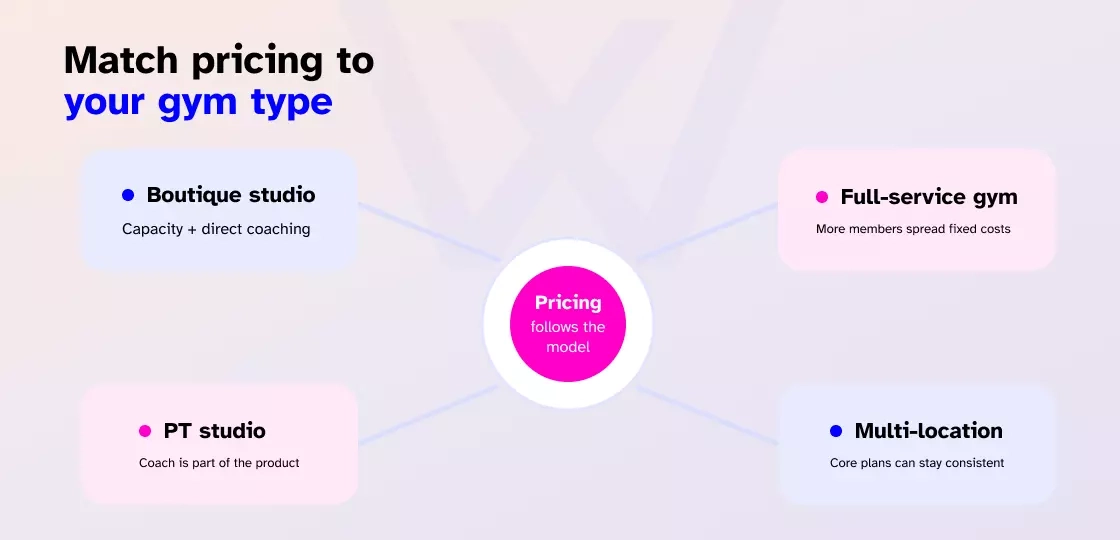
Boutique fitness studio
Boutique studios usually have fewer spaces per class and more direct coaching. Value-based pricing, class packs, and recurring attendance tiers can work well because each slot has clear capacity.
Full-service gym
A larger gym can spread fixed costs across more members. Monthly recurring memberships with two or three clearly differentiated tiers tend to be easier to understand.
Personal training studio
The coach is a large part of the product, so pricing should reflect attention, programming, accountability, and results rather than access to equipment alone.
Multi-location operator
Keep plan names and core benefits consistent where possible, but calculate economics at location level. Rent, payroll, competition, and capacity rarely remain identical across sites.
This is why there is no single “best gym membership price.” The model behind the membership changes the number.
Step 5: Choose the membership structure
Once you know how the number is calculated, decide how members buy.
| Membership structure | Strong use case |
| Rolling monthly | Low commitment and predictable recurring revenue |
| Annual/fixed-term | Longer commitments and upfront cash flow |
| Class packs | Infrequent or class-led attendance |
| Drop-in/day pass | Visitors and occasional users |
| Family plan | Households with multiple members |
| Corporate plan | Employer or partner groups |
| Hybrid membership | Combined digital and in-person access |
Monthly memberships are simple, but easier to cancel. Annual plans improve commitment, but pause and refund policies matter more. Class packs provide flexibility, although the per-visit price should normally remain high enough that regular users still have a reason to become members.
What about hybrid pricing?
Do not add a premium simply because the word digital appears in the offer. A useful testing method is to model digital-only access at roughly 30–40% of the in-person membership and test a hybrid plan around 15–25% above the normal in-person rate. Then measure actual use.
If members barely touch the digital service, the theoretical value does not matter. If they use live sessions, programming, coaching, and an actively maintained content library, the bundle becomes easier to defend.
Step 6: Connect pricing with retention
Pricing and retention are closely linked. Members constantly weigh one question: Am I getting enough value for what I pay?
That value can come from many things, including attendance, coaching, equipment, convenience, cleanliness, progress, and community. So when a member cancels because of price, the real issue may be that they no longer feel the membership is worth the cost.
Research also shows that regular use can support retention. Les Mills, citing ukactive Research Institute data, found that members taking three or more Les Mills classes per week stayed 50% longer than those who did not. The study is older and specific to that setting, so it should not be treated as a universal benchmark. Still, it highlights a simple point: members who use more of what they pay for may have more reason to stay.
Retention also affects profitability. Research cited by Harvard Business Review found that a 5% increase in customer retention can raise profits by 25% to 95% across some businesses. This is not a gym-specific forecast, but it shows why pricing should be judged beyond the initial sale. For practical ways to improve retention, see these gym member retention strategies.
Step 7: Use upgrades and secondary revenue carefully
Membership fees do not have to generate all of your revenue. Personal training, small-group coaching, retail, recovery services, workshops, challenges, and specialist programs can increase revenue per member.
This can also give you more flexibility with membership pricing. If members regularly buy additional services, you may not need to push the base membership price as high.
However, build your financial model around realistic demand. If you expect revenue from personal training or recovery services, use different uptake scenarios rather than assuming a large share of members will buy them.
Tiered memberships can also give existing members a clear path to upgrade as their needs change. In many cases, that is more sustainable than repeatedly discounting higher-tier plans. See these gym membership upgrades for more detail.
Step 8: Test before rolling out a new price
Do not reprice the entire membership base because one spreadsheet says you can. Instead, start with new joiners or a defined campaign period and track:
- Lead-to-member conversion
- Revenue per inquiry
- Tier selection
- Early attendance
- Upgrades and downgrades
- 60- and 90-day retention
A four-week test may tell you how the new price affects sales. It cannot tell you whether those members stay, so keep tracking the cohort afterwards. For example, imagine conversion drops from 30% to 27% after a price increase. That looks negative until you calculate whether the higher monthly revenue more than offsets the missing sales.
Step 9: Raise prices without creating unnecessary churn
How you communicate a price increase can matter as much as the increase itself. A member should never discover a price increase by checking a bank statement or seeing an unexpected charge without prior notice.
Handle the price increase carefully. Start by explaining the reason. Costs may have risen, the offer may now include more value, capacity may be constrained, or the membership may simply have been underpriced for too long.
Then work backwards from the effective date. A practical operating schedule is:
| Timing | Action |
| 60–90 days before | Add or clearly demonstrate value where possible |
| 30–45 days before | Notify affected members |
| With notice | State the old price, new price, and effective date |
| With notice | Explain downgrade, annual, or alternative options |
| First 60 days after | Monitor cancellations, downgrades, and payment failures |
The 30–45 day notice range is an operating target, not legal advice. Always follow the membership agreement and applicable state or local requirements if they demand more notice.
For planning, you can also model 4–6% increases every 12–18 months and compare the outcome with a larger delayed correction. Again, this is a scenario to test against costs, value, and churn—not an industry rule.
Small, explainable reviews are usually easier to manage than leaving a rate untouched for years and eventually needing a much larger change.
Local conditions should change the answer
National numbers give context. Your catchment area pays the bills. Look at household income, competing gyms, commute patterns, parking, population density, nearby employers, opening hours, and the alternatives a member can realistically reach.
US Census data can help with household income and demographic context, although the geography should resemble the area members actually travel from rather than an entire city or state.
Capacity belongs in that local calculation too. If the gym is already crowded at the hours members value most, a cheaper membership could create a worse experience rather than stronger economics. Before blaming the membership rate, compare it with gym revenue per square foot. Sometimes the real problem is underused space, an inefficient class schedule, or the wrong service mix.
What should you track after changing gym prices?
The pricing decision is not finished when the new rate goes live. Track:
| KPI | Calculation | What it tells you |
| Average revenue per member | Revenue ÷ active members | Whether member value is rising |
| Lead-to-member conversion | New members ÷ qualified leads | Whether the new offer still converts |
| Monthly churn | Cancellations ÷ starting members | Whether retention changed |
| Lifetime value | Revenue per member × average tenure | Long-term member economics |
| Tier mix | Members in each tier ÷ total members | Whether tiers guide decisions |
| Secondary revenue share | Non-dues revenue ÷ total revenue | How dependent you are on dues |
| Failed-payment rate | Failed charges ÷ attempted charges | Revenue leakage rather than deliberate churn |
Do not chase arbitrary benchmark percentages if they do not match your model. Start with your historical baseline, compare cohorts, and then use external benchmarks where the populations are genuinely comparable. For a wider financial scorecard, set your gym KPIs to track metrics and maximize revenue.
Five gym pricing mistakes to avoid
1. Copying the gym down the road: Their rent, capacity, payroll, positioning, and member profile may be completely different from yours.
2. Over-discounting: Frequent discounts make the promotional price feel like the real price. Keep introductory offers controlled and time-bound.
3. Creating too many membership options: More choice is not automatically better. If members need ten minutes and a staff explanation to understand the rate card, simplify it.
4. Freezing prices for years: Avoiding a small review today can create a much harder conversation later.
5. Changing prices without measuring the result: A price increase that improves monthly dues but destroys conversion or retention is not automatically successful. Look at the entire member economics.
Final word
A gym pricing strategy should not begin with the competitor’s price page, and it should not end when a new membership rate is published.
Start with the economics of the facility. Understand what comparable members pay locally and what they receive for it. Choose the pricing model that suits the business, keep the membership structure understandable, and then watch what happens to conversion, usage, retention, and lifetime value. That process is quieter than chasing the latest discount or copying the busiest gym nearby, but it gives you something far more useful: a price you can explain, measure, and change for a reason.
If you need a gym membership management system that helps you customize and manage your pricing structure, Wellyx is a strong option. It connects membership tiers, billing, member activity, reporting, and access rules in one gym-management system, which makes pricing changes easier to manage once the strategy itself is clear.
Frequently Asked Questions
1. What is the best gym pricing strategy?
For most gyms, the strongest approach combines a cost floor, local competitor benchmarking, value-based thinking, and a small number of clearly differentiated membership tiers. The exact mix depends on the gym’s capacity, services, target members, and operating model.
2. How much should I charge for a gym membership?
Calculate the minimum sustainable rate first, then compare it with genuinely similar local gyms and the value included in your membership. National averages are useful context, but they should not determine the final price for an individual gym.
3. Which pricing model is best for a small gym?
Cost-plus pricing helps establish the financial floor. Value-based and tiered pricing can then help a small gym charge more appropriately for coaching, classes, access, amenities, and outcomes.
4. How many membership tiers should a gym offer?
Three clear tiers are a strong starting structure for many gyms because members can compare them quickly. Add another only when it serves a genuinely different usage pattern rather than creating another small feature variation.
5. How often should a gym review membership prices?
Review pricing during annual budgeting and whenever costs, capacity, services, or local market conditions change materially. You can model smaller increases every 12–18 months, but the decision should come from your own financial and member data.
6. How can a gym raise prices without losing members?
Give clear advance notice, explain what is changing and when, reinforce the value behind the membership, provide reasonable alternatives where appropriate, and monitor cancellations for at least the first 60 days after the change.
7. How should I price a hybrid gym membership?
A useful test is digital-only at around 30–40% of the in-person price and hybrid at roughly 15–25% above the standard in-person rate. Treat those numbers as testing ranges, not market benchmarks, then adjust them according to actual usage, conversion, and retention.
8. Should gyms use discounts to attract new members?
Discounts can work for launches, trials, or defined introductory periods. But they become risky when they run indefinitely or train prospects to wait for the next promotion. Keep the normal price clear from the beginning.