



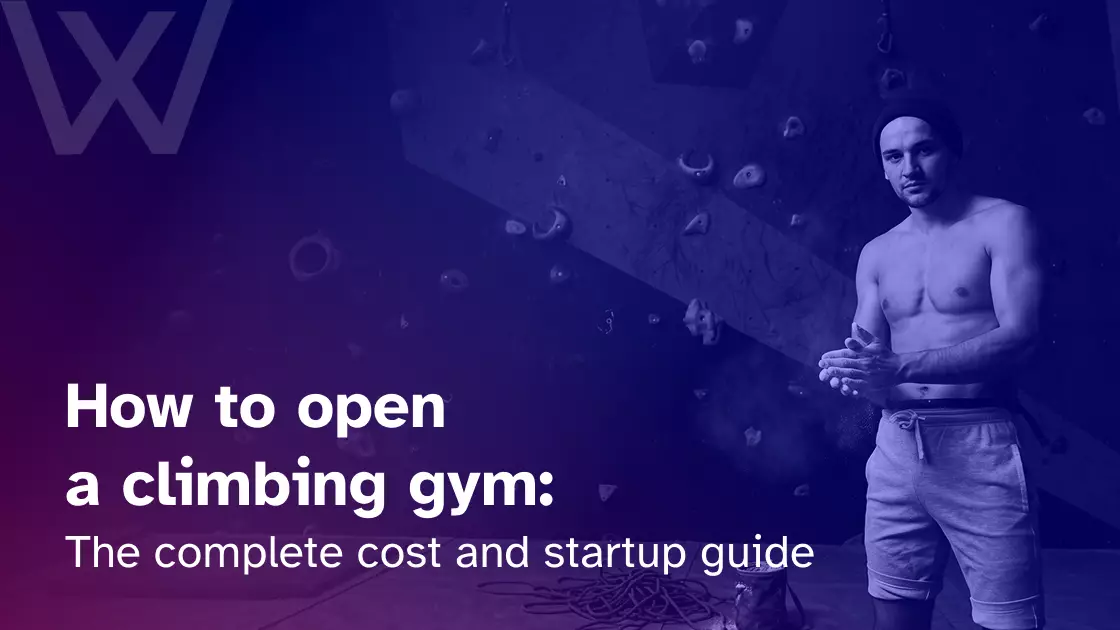
Most gym-opening advice assumes a floor plan you can fill with racks and cardio machines and a buildout that’s mostly paint, flooring, and mirrors. A climbing gym breaks that model immediately. The climbing wall itself is a structural engineering project, not a fixture, and that single difference reshapes the budget, timeline, staffing plan, and regulatory process compared to opening any other kind of fitness facility.
This guide covers everything involved in opening a climbing gym: real costs, format choice, industry standards and certifications, insurance, staffing, design considerations, and a realistic timeline from concept to opening day.
Why climbing gyms don’t follow standard gym economics
A traditional gym’s biggest capital cost is usually equipment, purchased off a shelf, insured, and replaced on a predictable schedule. A climbing gym’s highest cost is the wall itself: an engineered structure built to hold falling body weight, load-tested, and often requiring a structural engineer’s sign-off before a city will issue an occupancy permit.
Wall construction commonly runs $25 to $40 per square foot installed, and that figure covers only the climbing surface itself, not the building shell, safety flooring, or holds and hardware layered on top of it. For a modest 2,000-square-foot bouldering wall, that’s $50,000 to $80,000 in wall construction alone, before a single crash pad or hold is purchased. Total startup costs for a climbing gym commonly land well into six figures and often cross into seven, a genuinely different category than the $50,000 to $250,000 range that covers most traditional gym formats.
Choosing a format: bouldering, top-rope, lead, or mixed
This decision shapes every cost and process step that follows, so it comes before location scouting or a detailed budget.
Bouldering-only facilities skip ropes and harnesses entirely; climbers fall onto padded flooring rather than being caught by a belay system. This is generally the lowest-cost entry point into the category: lower ceiling heights work, no rope and harness inventory to manage, and no belay certification process for members to complete before climbing independently. It’s also worth noting, for insurance purposes, that this is a category some specialized insurers price differently based specifically on wall height.
Top-rope and lead climbing require significantly higher ceilings, a rope and harness inventory, anchor systems engineered into the wall structure, and either staffed belay support or a member belay-certification program. This format carries meaningfully higher liability exposure and insurance cost than bouldering alone, since it depends on correct human technique, not just physical padding, to prevent a fall injury.
Auto-belay systems offer a middle path: mechanical devices that control a climber’s descent without a human belay partner, allowing a facility to offer rope climbing without the certification and staffing overhead that top-rope normally requires. Auto-belay units are a real, specific equipment line item, not a minor add-on, and they come with their own inspection and maintenance schedule that becomes an ongoing operational cost, not just a one-time purchase.
Most new climbing gyms choose bouldering-only or a bouldering-plus-auto-belay hybrid specifically to control both construction costs and the facility’s liability profile, reserving a full top-rope and lead program for a later expansion once the business is established.
What it actually costs: the real line items
| Category | Typical range | What drives it |
| Wall construction | $25-$40/sq ft installed | Height, angle complexity, surface area |
| Safety flooring | 6-12/sq ft installed | Coverage area, fall-zone requirements |
| Climbing holds and hardware | $30,000–$150,000 | Gym size, route variety and turnover |
| Ropes, harnesses, belay devices | 100-600 per rope, 400 per set | Format (skip if bouldering-only) |
| Auto-belay units | Significant per-unit cost | Number of stations, brand |
| Building shell and fit-out | Varies widely by space condition | Ceiling height, existing structure |
| Insurance (first year) | $5,000–$15,000+ | Format, coverage limits, claims history |
Real estate deserves specific attention here: ceiling height is often the deciding factor in which spaces are even viable. A warehouse or industrial space with 25 to 40+ feet of clearance is commonly the only realistic option for anything beyond bouldering, which immediately narrows the available real estate market and shifts negotiating leverage compared to a standard retail gym search.
A genuinely useful planning rule: treat the per-square-foot wall quote with real skepticism until it’s itemized. Wall height, angle variety, and surface complexity all move the number substantially, and a quote that looks attractive on a per-square-foot basis can still balloon once engineering review, structural attachment work, and inspection costs are added. Get a full itemized bid, not just a blended rate, before locking in a budget.
Industry standards and staff certifications
This is the part of opening a climbing gym most first-time owners underestimate, and it’s specific enough to this category that no generic gym-opening guide covers it.
The Climbing Wall Association (CWA) is the trade association that sets industry standards for climbing wall engineering, facility operations, and staff training across the indoor climbing industry. Its standards committees address facility design and engineering, periodic structural inspection requirements, and operational policy development, giving a new gym owner a real, established framework to build around rather than inventing safety policy from scratch.
The CWA also maintains three certification tracks worth knowing before you build a staffing plan:
Climbing Wall Instructor (CWI) certification covers the basic technical skills needed to run an instructional program, provide belay instruction, offer movement coaching, and supervise the facility. Entry requirements start as young as 16 with some climbing experience for Level 1.
Work-At-Height (WAH) certifies staff to safely perform work at height, inspections, hold-setting on tall walls, and rope rescue, an operational necessity for any facility with walls tall enough to require staff working above the ground. WAH Level 1 requires candidates to be 18, able to climb 5.9 on lead, and lift 50 pounds.
Professional Routesetting (PRS) is the newest and most rigorous track, reflecting how professionalized routesetting has become as a specialized trade rather than a task any staff member picks up informally. PRS certification requires 1,500 hours of routesetting experience, with at least 750 of those hours on roped walls, plus six hours of formal work-at-height training, and demonstrated climbing ability up to V4 bouldering or 5.10 lead.
What this means in practice: budget staff training and certification as a real line item, not an assumed skill new hires already have. A hiring manager who can point to a candidate’s actual CWA certification level has a documented, third-party-verified competency standard, which matters both for genuine safety and for the legal defensibility of your operation if an incident ever occurs.
Insurance and legal risk management
Climbing carries an inherent fall risk that standard gym insurance policies aren’t built around, and this is one of the areas where treating a climbing gym like a standard gym creates real exposure.
Specialized sports and recreation insurers price climbing facilities with real specificity: one established provider’s general liability program sets a $5,000 minimum annual premium, with coverage limits from $1 million to $5 million, and notably prices bouldering walls differently based on height (commonly a 15-foot threshold) and requires auto-belays specifically if a policy is meant to cover belayed climbing without staffed belay.
For bare general liability coverage alone, separate from a fuller specialized package, other sources cite a lower range of roughly $400 to $1,100 annually per $1 million in coverage, though a genuinely comprehensive climbing-specific policy, covering the full range of real exposures, typically costs more than a bare-minimum general liability quote would suggest.
The waiver nuance most owners get wrong. A signed waiver is essential, but it isn’t a blanket shield. Under the legal doctrine of assumption of risk, courts commonly refuse to enforce a waiver that doesn’t specifically identify the risk that actually caused an injury; a generic “climbing is dangerous” waiver is weaker protection than one that specifically names falling, equipment failure, and other real, identifiable climbing risks. A waiver written from a generic template, rather than one reviewed specifically for this industry, is a real gap, not just a formality to check off.
What this means in practice: shop insurance with a specialized sports and recreation carrier rather than a generic small-business insurer, confirm your policy’s specific requirements around wall height and belay method before finalizing your format, and have your waiver reviewed against your actual facility’s specific risks rather than using a generic fitness-industry template.
The process: from concept to opening day
Choose your format and write a business plan. Bouldering, top-rope, lead, or a hybrid, this decision (covered above) drives every subsequent step, so it needs to happen first, not get decided during buildout. Your business plan should include real market research: how many climbers are in your target area, how saturated the market already is, and what specific niche differentiates your concept, such as competitive training, youth programs, or a social bouldering-and-coffee model.
Find a space with genuinely adequate ceiling height. This is the single hardest real estate constraint in this category. Confirm actual clearance, not just a landlord’s estimate, before committing to anything.
Get a structural engineer involved early. A climbing wall is a load-bearing safety structure, and most cities will require engineering sign-off before issuing an occupancy permit for the completed build. Bringing a structural engineer in during site selection, not after signing a lease, avoids discovering a space simply can’t support the wall system you want.
Budget realistically, with a real contingency. Given how many line items depend on final engineering decisions, building in a meaningful cushion, commonly cited as around 10 percent of the total budget, is standard practice rather than optional padding in this category, since construction costs in this space are more prone to mid-project surprises than a standard gym buildout.
Handle permitting and insurance early, not late. Beyond standard business licensing, climbing-specific occupancy and safety inspections take real time, and insurance for a facility with inherent fall risk needs to be shopped specifically for climbing coverage, as covered above.
Design your layout around member flow, not just wall placement. Beyond the climbing surface itself, plan for a dedicated training area (hangboards, campus boards, or a systems wall for dedicated training separate from route climbing), a beginner-friendly low-angle zone separated from advanced overhangs, clear sightlines for staff supervision, and retail and lounge space if your model includes gear sales or a social hangout component. Kids’ programming, if part of your plan, generally needs its own semi-separated area both for supervision and for insurance and safeguarding reasons.
Set up membership, waiver, and access systems before opening day. Every climbing gym needs a strong digital waiver process, given the sport’s inherent risk profile, along with real membership and day-pass management from day one, rather than a manual sign-in sheet. Digital forms handled through your membership platform keep waivers, belay certifications, and liability documentation organized and searchable, rather than buried in a filing cabinet. This matters more here than in most other fitness categories, given how directly waiver documentation ties to your actual liability exposure.
Hire and train route setters and instructional staff. Routesetting is a specialized, ongoing labor cost unique to this category, not a one-time setup task, and CWA certification levels (covered above) give you a real standard to hire and train against. Budget for regular route rotation as a recurring operational expense.
Plan your pre-opening membership drive. A pre-sale campaign before opening reduces the amount of outside capital the project needs and provides a real signal of demand before the full monthly cost structure kicks in. Lead management tools that actually track a prospect from first inquiry through a signed membership matter here just as much as in any other fitness format, arguably more given how much capital is typically on the line before opening day.
A realistic timeline
Climbing gym construction timelines run longer than a standard gym buildout specifically because of the engineering and permitting cycle. A rough sequence: 1 to 2 months for site selection and lease negotiation with structural engineering input already underway, 1 to 2 months for permitting and final engineering sign-off, 3 to 6 months for wall construction and buildout depending on scope, and 1 to 2 months for staff hiring, certification, routesetting, and a pre-opening membership drive before doors open. A realistic total from signed lease to opening day commonly runs 6 to 12 months, longer than most owners initially plan for, and the engineering and permitting phase specifically is where timelines most often slip.
Revenue beyond membership dues
Membership dues are the foundation, but most successful climbing gyms build real secondary revenue around the core facility. Day passes and punch cards capture visitors who aren’t ready to commit to membership. Gear rental, specifically shoes and chalk bags, is nearly universal since most new climbers don’t own equipment yet. Retail space for shoes, chalk, and apparel adds margin on top of a purchase many members make eventually anyway. Youth programs, school partnerships, birthday parties, and corporate team-building events can become significant revenue streams because climbing naturally lends itself to group activities. A competitive team or coaching program adds both revenue and community retention value for gyms with the space and staff to support one.
Ongoing costs once you’re open
Routesetting, auto-belay maintenance and inspection, and rope and harness replacement on a safety-driven schedule are recurring costs specific to this category that a standard gym’s monthly budget doesn’t need to account for. Insurance also tends to run higher than a standard gym given the sport’s inherent risk profile, and that’s a real ongoing line item, not just a startup cost.
Staffing needs differ by format too: a bouldering-only facility can run with fewer specialized staff than a top-rope or lead facility, where trained belay staff or a certification program adds real, ongoing payroll and training cost beyond what a standard front-desk and instructor model requires.
Common pitfalls that catch new owners off guard
Underestimating the engineering and permitting timeline is the most common one; a wall quote often doesn’t include the weeks or months of structural review a city requires before construction can even begin. Treating insurance as a standard gym policy with a slightly higher premium, rather than a specialized climbing policy, is another issue, and it tends to surface at the worst possible moment: when a claim is actually filed. Underbudgeting route-setting as an ongoing labor cost rather than a one-time setup task is a third: members notice stale routes quickly, and route rotation is a recurring expense for the life of the business, not a startup line item. Finally, choosing a space based on square footage alone, without confirming the actual ceiling height and the wall system’s structural capacity, is a mistake that can force a costly format change mid-project.
Frequently asked questions
How much does it cost to open a climbing gym?
Startup costs range from the low hundreds of thousands into the millions, driven primarily by wall construction, which typically runs $25 to $40 per square foot installed. This is a meaningfully higher range than the $50,000 to $250,000 typical of standard gym formats, because the climbing wall itself is a structural engineering project, not a standard fixture.
Is bouldering or top-rope cheaper to start?
Bouldering-only is generally the lower-cost entry point. It requires lower ceiling heights, no rope and harness inventory, and no belay certification program for members, all of which add real cost and complexity to a top-rope or lead climbing setup from day one.
How much does climbing wall construction cost per square foot?
Wall construction commonly runs $25 to $40 per square foot installed, though this varies with wall height, angle complexity, and total surface area. That figure covers the climbing surface itself, not safety flooring, holds and hardware, or the surrounding building shell.
Do route setters need a specific certification?
There’s no universal legal requirement, but the Climbing Wall Association’s Professional Routesetting certification has become the industry’s real standard, requiring 1,500 hours of setting experience and formal work-at-height training. Hiring or training toward this standard gives a gym a documented, defensible competency benchmark.
How much does climbing gym insurance cost?
Specialized climbing-specific policies commonly start around a $5,000 minimum annual premium for a real general liability program with $1 million to $5 million in coverage, though bare-minimum general liability alone can run lower. Coverage requirements often depend on wall height and belay method, so shop with an insurer that specializes in climbing facilities specifically.
The real difference is structural, not just financial
Every step in opening a climbing gym eventually comes back to the same fact: the wall is a safety structure, not a fixture, and that changes the engineering timeline, the permitting process, the insurance conversation, the staffing standard, and the budget all at once. Owners who treat it like a standard gym buildout with taller ceilings are the ones who get surprised by cost overruns and compliance gaps partway through. Owners who bring in structural and engineering expertise early, build a staffing plan around real industry certification standards, and budget a genuine contingency are the ones who actually open on schedule and stay open.
Once the doors are open, Wellyx connects membership management, digital waivers, and access control in one system, built for exactly this kind of category where documentation and safety process matter as much as day-to-day operations.