




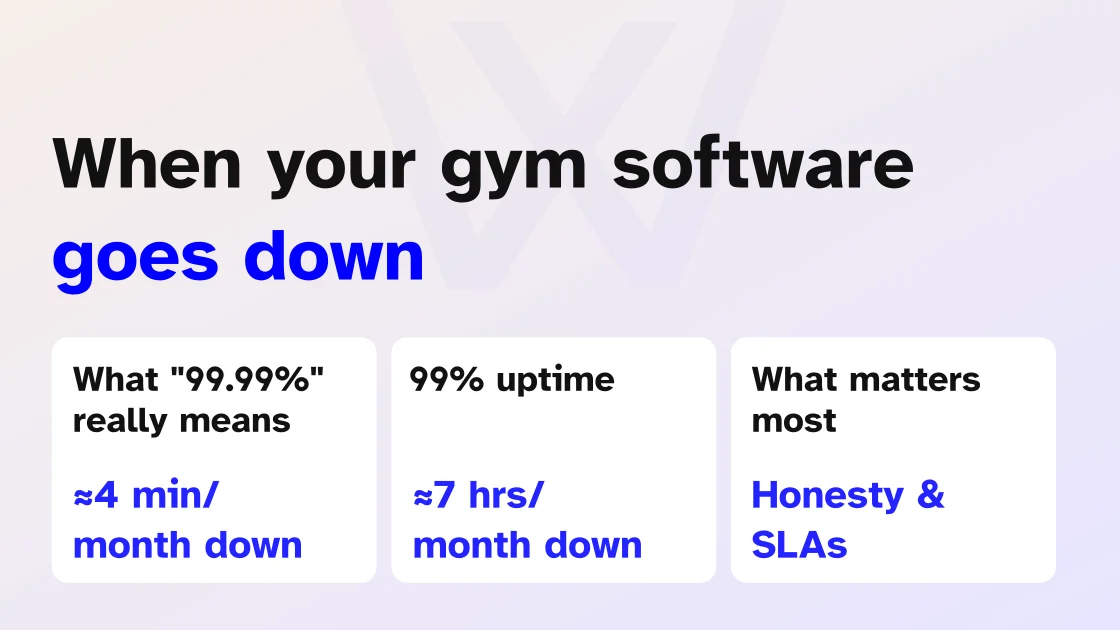
Every platform makes promises. The ones worth trusting are honest about the bad days instead of pretending they never arrive.
A while back, a client stopped me halfway through a demo to ask what the software’s downtime actually looked like, and how fast problems got fixed when they happened. It’s one of the smartest yet least asked questions, precisely because it never makes the highlight reel. Unlike most, he wasn’t asking about the good days. He was asking about the bad ones, which is where you find out what you’ve really bought.
Like most software providers, I could have given him the standard answer: our uptime is 99.99%, our system doesn’t crash. NEVER. But I didn’t, because anyone who has spent time building or working with software knows that “never” is not a word an honest engineer uses.
Software runs into problems. Servers run into problems, integrations drift, and a release ships a bug that slips past testing. That’s pretty normal, and a serious provider plans for it. So the question is not whether a platform fails. It’s what the company does when it happens, and whether they were honest with you before it did.
The trouble with “we don’t crash. EVER.”
A few years ago, one of the better-known names in gym software, PushPress, published an article on how downtime costs you money, leads, and members. The underlying point was fair: downtime is expensive. But the framing reached further than reality usually allows. It opened with the line “We don’t crash. EVER,” argued that anything under 99.5% monthly uptime should have you demanding better from your provider, and stated that the platform was running at 99.99%.
The problem with a promise pitched that high is that it has nowhere to go but down.
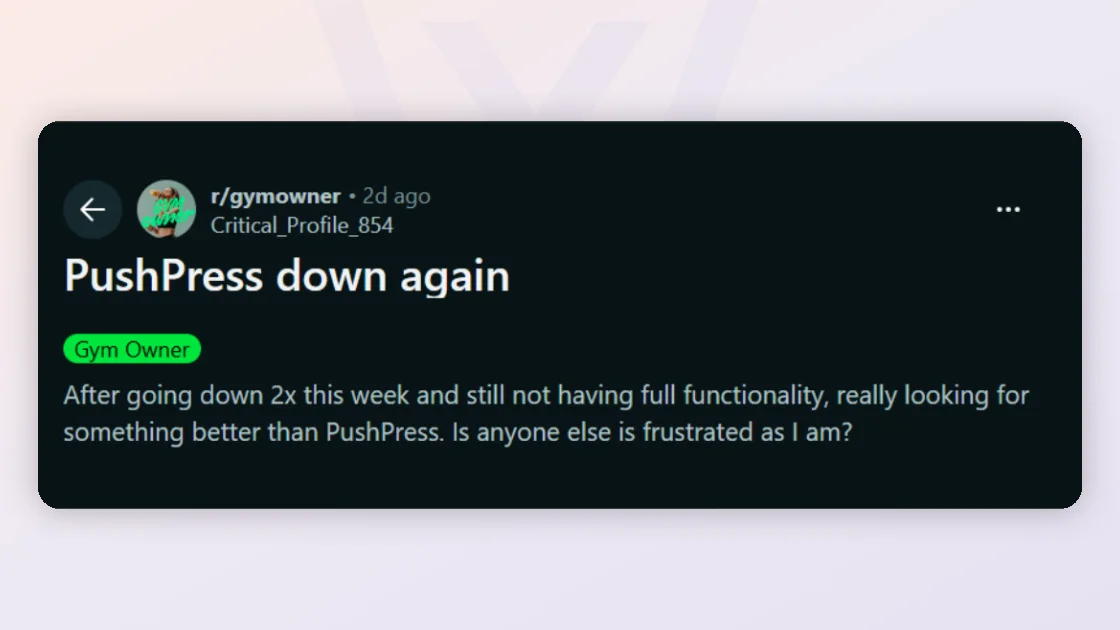
Spend ten minutes in the owner communities where these same platforms get recommended, and you’ll find threads bluntly titled “PushPress down again,” owners describing two outages in a single week with features still half-broken afterward, and the occasional sentence that should make any buyer wince, that switching was one of the biggest mistakes they ever made.
None of that makes PushPress uniquely bad; some version of it follows nearly every product in the category. That’s exactly the point. The company that promises it will never crash has the furthest to fall when a server inevitably has a bad morning, and 99.99% reads very differently once you’ve watched the check-in screen spin during a 6 a.m. rush.
It also helps to understand what that number actually means.
| Monthly uptime | Maximum downtime |
| 99% | Around 7 hours 18 minutes |
| 99.5% | Around 3 hours 39 minutes |
| 99.9% | Around 43 minutes 50 seconds |
| 99.99% | Around 4 minutes 23 seconds |
| Note: Based on an average calendar month (30.44 days). Actual allowable downtime varies slightly depending on the number of days in the month. | |
Those figures aren’t there to excuse outages. They’re a reminder that reliability is a measurable engineering target, not a guarantee of perfection.
A platform like PushPress is not one program running on one machine. It’s a collection of systems working together in real time: a database holding member records and billing details, an application layer, a payment processor the company doesn’t own, notification services, third-party integrations, and the hosting underneath all of it. Every layer is another place where something can silently go wrong, and many of them are maintained by different teams.
A payment provider can experience an issue even while the application is healthy. A careless database query can slow everything during the morning rush. A memory leak can bring down a server weeks after the release that introduced it. “Never” simply doesn’t survive contact with that reality.
Downtime is usually a symptom, not the disease
To its credit, that same article made one observation worth keeping: repeated downtime is rarely bad luck. It usually points to something deeper: infrastructure that’s struggling to keep up, releases pushed faster than they can be properly tested, or quality assurance processes that need more investment. That’s the right lens. The outage itself matters less than what it reveals about how the company operates.
And the frustrations that stay with gym owners are rarely limited to downtime. They often arrive alongside smaller reliability issues: duplicate notifications, billing edge cases, integrations that behave inconsistently, or support tickets that are marked resolved while the problem still exists. Each one on its own is manageable. Together, they become your members’ experience of your gym, even though the software sits behind the scenes.
What you should actually look for in gym software
This is the part most buyers skip, and it’s far more important than any feature comparison. Every serious platform can schedule classes and process payments. What determines whether you’re still happy eighteen months later is much quieter:
- Reliability you can verify: Ask for a public status page and real uptime history, not a number quoted in a sales meeting. A team that’s confident in its system leaves that record in the open.
- A written SLA: “We aim for 99.9%” in a blog post commits a company to nothing. A contractual service-level agreement with defined response times does. Ask what happens internally the moment the system goes down.
- Support that reaches a real person: Everyone says their support is excellent. The real question is how quickly a genuine emergency gets to someone who can act, and what happens if the first fix doesn’t hold.
- Billing that survives awkward cases: Pausing memberships, setting future start dates, running pre-sales or reversing mistaken charges. The edge cases are exactly where billing systems reveal their quality.
- Honesty about migration: What moves across, what gets left behind, and who actually does the work. Fear of migration is one of the biggest reasons gym owners stay on software they’ve already outgrown.
- How they talk about their own failures? This might be the clearest signal of all. A company that openly shows its incident history and explains what it learned is worth more than one promising perfection, because perfection is not a standard that software can realistically guarantee.
Notice that none of these are promises. They’re all things you can ask and verify yourself.
The bottom line
You’re entitled to expect your software to work, and just as entitled to expect the company behind it to be honest about the days it doesn’t. Those aren’t competing expectations; they’re the same standard.
So when a platform tells you it will never go down, treat that as a reason to ask better questions rather than a reason to stop asking them. The partner worth having is not the one promising the screen will never go dark. It’s the one that planned for the morning, it does, tells you the truth while it’s happening, and is still standing beside you when the fix lands.
Weighing up gym management platforms? Take these six questions into every demo. The answers will tell you far more than any feature list.