



Mindbody is still one of the largest fitness and wellness software platforms on the market. But if you’re a Mindbody user reading this, you already know that’s not the same as being the right one for your business.
I’ve been in this industry long enough to remember when Mindbody was the answer. Back in the early 2000s, I ran a Pilates studio that switched over from paper booking to Mindbody, and the difference it made back then was real. The booking engine cut our admin load by more than half, and at that point, the price was worth the hassle it removed. That was a genuine leap forward for our operation.
But the problem is that fitness software has to keep evolving, and by every measurable signal: G2, Capterra, Trustpilot, BBB, and every Reddit and Facebook group where operators actually talk to each other, Mindbody has moved in the opposite direction. Pricing has climbed, contracts have gotten longer, support has slipped, and the platform that once saved you time has now become the thing you spend time working around.
If you’re one of the thousands of owners currently trying to figure out how to cancel, migrate, and choose something better, this guide is written for you. A full Mindbody review covers the platform on its own terms; this guide picks up where that leaves off, at the point you’ve decided to leave. I’ll take you through the four Mindbody weaknesses that are actually driving the switch, the seven alternatives that solve each one, and the exact migration process I’ve walked owners through more times than I can count.
What’s actually going wrong with Mindbody?
I’ve been in the fitness industry for more than 15 years, running facilities, advising owners, and evaluating almost every major gym management platform that’s come and gone since. So when I tell you Mindbody is still a serious platform, I mean it. With sixty thousand businesses, a partner marketplace with 700+ integrations, and a consumer app that reaches millions of members every month, you don’t build that footprint by accident.
But I’ll also tell you this: in the last three years, “how do I get off Mindbody?” has become the single most common question I hear from operators. And it isn’t because Mindbody stopped working. It’s because of four specific problems that show up in every review site, every subreddit, and every conversation I have with owners who are frustrated.
If you’re on the platform now, you’ll recognize at least two of them.
- The price you’re quoted is not the price you’ll pay. Mindbody advertises its Starter plan at $99 per month, but the price is per location, not per business. Third-party sources, including Capterra, GymBird, and Punchpass, consistently put:
- Starter quotes between $99 and $159 per location.
- Accelerate lands in the $259–$279 range per location.
- Ultimate runs $499–$699 per location.
Comparing gym management software packages side by side is the only reliable way to see which modules are core and which are upsells. On top of that, you’re paying 2.75%–3.5% in payment processing, a 20% commission when a new client books through the Mindbody consumer app, and $249–$299 per month if you want a branded member app (which sits behind an add-on paywall on the lower tiers). One Capterra reviewer described a $30/month price increase arriving without any notice. If you’ve been on Mindbody for more than two years, I’d bet good money you can tell a similar story.
- The contract is longer and harder to leave than you realize when signing. Mindbody’s standard contracts run 12 or 24 months. The Better Business Bureau currently lists 11 complaints against Mindbody with no company response. One Capterra reviewer, warning other owners, wrote plainly:
“Please be careful when dealing with Mindbody, you are signing a year-long contract, and if they give you the impression that you can get out of it, I’m proof that you can’t.“
Another reviewer described being “locked into a 24-month term on a system that is unusable” after onboarding stalled. I’ve personally advised two owners in the last year who paid out the balance of their contracts just to be free of the platform. That’s not a software cost, that’s a tax on trying to run your own business.
- Support quality has been slipping, and everyone in the industry has noticed. Capterra rates Mindbody’s customer service at 3.8/5 and lists “long hold times, slow follow-up, unresolved issues, and varying expertise across agents” as its recurring complaint themes.
Reddit threads on r/gymowner and r/mindbody describe phone waits of 45+ minutes and ticket response times of multiple days. Multiple sources point to Mindbody’s 2022 workforce reductions as the moment the support experience visibly changed. If you feel like you’re getting less help from the platform than you were three years ago, you’re not imagining it.
- Onboarding takes longer than you’d expect from a two-decade-old platform. Mindbody’s own documentation and multiple user reviews reference onboarding cycles of up to eight weeks. If you’re opening a facility or migrating from another platform, that’s two months of paying for a subscription to a system you can’t yet run your business on. I’ve watched newer platforms get an operator fully live in under a week. Eight weeks in 2026 is not a technical constraint; it’s a legacy of how the platform was built and how the onboarding team is scaled.
None of this makes Mindbody a bad platform. It makes it a specific kind of platform which is built for enterprise scale, priced for it, and structured around long contracts and slow implementations. If that’s a fit for you, stay. If it isn’t, and for most single-location operators, small studios, and even some growing multi-location businesses, it isn’t, then the rest of this guide is written for you.
What to do before you switch?
Before I take you through the seven alternatives, I want you to do three things first. I’ve seen too many owners rush this decision, land on a platform that has the same structural problems in a different wrapper, and be shopping again 18 months later. Don’t be that owner.
1. Audit your true monthly Mindbody cost
Pull twelve months of invoices. Add every line: base subscription, per-location fees, payment processing, marketplace commission, branded app charges, SMS overages, add-ons. Divide by twelve. That single number is what you’re actually replacing.
In my experience, it’s 30%–60% higher than what owners believe they’re paying when I ask them cold. Don’t compare that real number to a competitor’s sticker price. Compare it to what the competitor’s fully loaded stack will actually cost you, at your scale, with your feature set.
2. Read your contract carefully today, not next week
Find the renewal date, the notice period (usually 30 days, but not always), any early termination clauses, and whether the contract auto-renews. Put a calendar reminder in for 45 days before the renewal window. If you sign up for a new platform without knowing exactly when your Mindbody exit is possible, you’re going to end up paying for two subscriptions at once. I’ve watched that happen too many times.
3. Write down your top three non-negotiables
Not a wishlist of features, the three things that, if a new platform doesn’t have them, disqualify it. This is the single most useful exercise you can do before you start taking demos, because sales reps will happily spend an hour showing you features you don’t need.
Common non-negotiables I hear from owners: published pricing, month-to-month billing, native workout or belt tracking, multi-location reporting, integrated payments that work in their country, or a specific vertical workflow.
With those three inputs, real cost, exit date and non-negotiables, the shopping process becomes filtering, not browsing. And filtering is faster.
How did we rank these alternatives?
This is not “the best gym software overall.” A martial arts school and a boutique yoga studio are not shopping for the same product. Every platform below earned its spot by closing a specific, cited Mindbody weakness that operators discuss on G2, Capterra, Trustpilot, the BBB, r/gymowner, and r/mindbody.
Every platform had to meet four criteria:
- Verifiable market presence: 100+ combined G2 and Capterra reviews, active roadmap, and support across North America, UK, and EU.
- Structural difference from Mindbody: pricing transparency, contract length, module bundling, or vertical specialization. Lookalikes were cut.
- Solves a real Mindbody pain point: at least one of the four dominant complaints: layered pricing, long contracts, inconsistent support, slow onboarding.
- Independent editorial framing: no paid inclusion, no affiliate influence. The publisher’s own product held to the same standard.
The 7 best Mindbody alternatives in 2026
1. Wellyx – Best for operators who want an all-in-one platform with published pricing
Wellyx is an all-in-one gym, studio, and multi-service fitness management platform. Its positioning centers on one premise that runs directly against how Mindbody prices and packages its product: every essential module needed to run a modern fitness business, member management, class and appointment scheduling, POS, marketing automation, branded member app, staff scheduling, and multi-location reporting, is included in the core platform rather than sold as tiered add-ons. It serves gyms, boutique studios, fitness centers, and martial arts schools across the UK, US, EU, and Middle East, with a customer base weighted toward multi-service operators who would otherwise need to combine two or three separate tools.
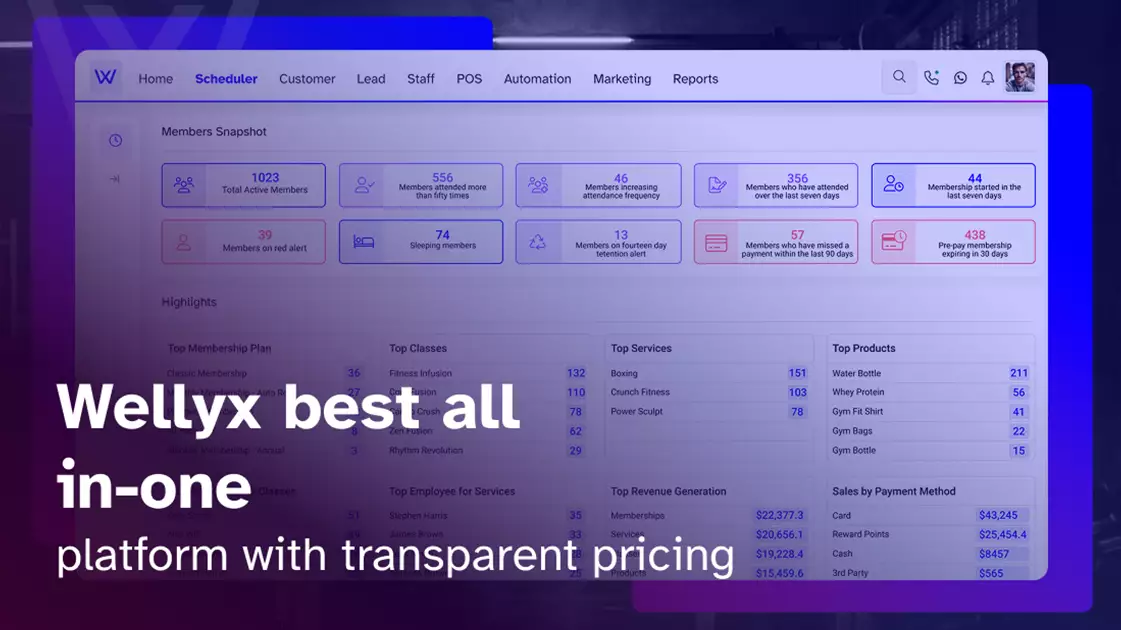
The Mindbody weakness Wellyx addresses is the top-cited complaint in public reviews: layered pricing where the sticker rarely matches the invoice. Mindbody’s Starter plan explicitly excludes marketing automation, the branded app, and higher-tier reporting; you either upgrade to Accelerate or Ultimate or you bolt on add-ons at $249–$299/month each.
Wellyx publishes its three tiers openly: Excel at $99/month, Exceed at $199/month, and Ultimate at $299/month and positions marketing automation and the branded app inside the core platform rather than behind separate SKUs. There’s no long-term contract at any tier: monthly, quarterly, or annual billing; cancel anytime per the platform’s stated policy. For a Mindbody switcher whose primary frustration is unpredictable monthly cost and contract lock-in, this is the structural fix.
Pricing
- Excel: $99/month
- Exceed: $199/month
- Ultimate: $299/month
- Monthly, quarterly, or annual billing, no long-term contract.
- 50% off the first 12 months for new studio setups.
- Free data migration included.
Where it’s stronger than Mindbody
- Pricing is published transparently on Wellyx’s website.
- Marketing automation and branded member app are included in the core platform, not tiered add-ons.
- No 12- or 24-month lock-in on any tier.
- Free data migration and 24/7 human support at every tier.
For studios where the checkout layer is the deciding factor, the best gym POS for small studios breaks down how native POS differs from a bolted-on one.
Considerations
- The third-party integration marketplace is smaller than Mindbody’s 700+ partner ecosystem.
- Very large multi-location franchises should evaluate enterprise-specific reporting depth alongside dedicated franchise-first platforms.
2. PushPress – Best for small independent gyms starting on a budget
PushPress is a gym management platform built primarily for small independent gyms, CrossFit boxes, martial arts academies, and coach-led facilities. It’s become one of the more visible names in the small-gym segment largely on the strength of Core Free, a plan that costs $0 per month and includes membership billing, scheduling, check-ins, digital waivers, and a member app. Paid Core Pro ($159/month) and Core Max ($229/month) unlock lower payment processing rates and additional operational features.
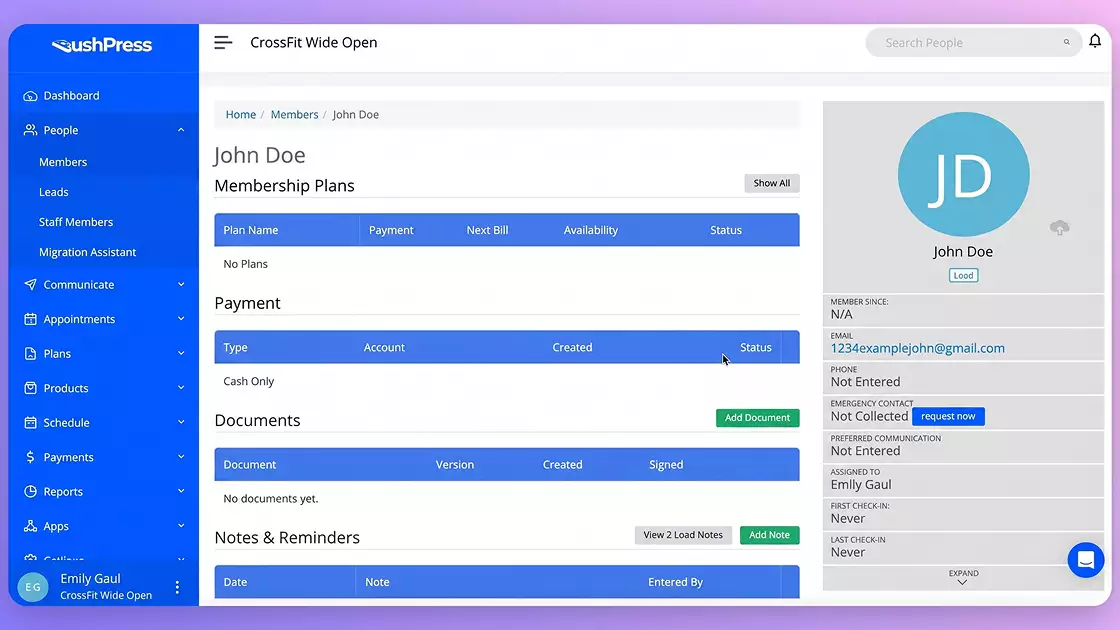
The Mindbody weakness PushPress addresses is the complete absence of a free tier at any Mindbody plan level. If you’re opening a facility, running a single-coach studio, or bootstrapping a CrossFit affiliate, the difference between $0 and $99–$159/month per location is meaningful. Just note the tradeoff: the free tier carries higher payment processing rates (4.19% + $0.30 per card transaction versus 2.89% + $0.30 on Pro and 2.75% + $0.30 on Max), so once you’re processing more than roughly $10,000/month, upgrading to Core Pro usually saves more than it costs.
Pricing
- Core Free: $0/month (4.19% + $0.30 credit card processing)
- Core Pro: $159/month (2.89% + $0.30 credit card, 0.79% + $0.30 ACH)
- Core Max: $229/month (2.75% + $0.30 credit card, same ACH)
- Train (workout tracking): from $79/month
- Grow (CRM and marketing): $329/month
- Branded App: $97/month
- All plans month-to-month, no contracts
Where it’s stronger than Mindbody
- Genuine free-forever Core plan.
- No contract at any tier.
- Free white-glove migration from Mindbody, Wodify, Zen Planner, Glofox, and others.
- Transparent Stripe-based payment processing without hidden platform surcharges.
Considerations
- Free tier’s higher processing fees erode the cost advantage past ~$10,000/month in payments.
- Marketing (Grow) and workout tracking (Train) are separately priced modules; a full PushPress stack lands around $585/month.
- Grow is built on GoHighLevel as a separate interface; expect some tab-hopping.
- Weaker fit for spa, salon, or hybrid wellness businesses.
3. Wodify – Best for CrossFit and functional fitness boxes
Wodify is a purpose-built platform for CrossFit affiliates, Jiu-Jitsu academies, and functional fitness gyms, founded in Philadelphia in 2012 and independently owned. That independence is the real point of difference in a market where most competitors are now part of private equity portfolios. Whereas Mindbody, WellnessLiving, and Wellyx are fitness platforms, Wodify’s product design is anchored around the CrossFit workflow: WOD programming and delivery, workout tracking against benchmarks, community leaderboards, and (added more recently) belt-level tracking for martial arts schools.
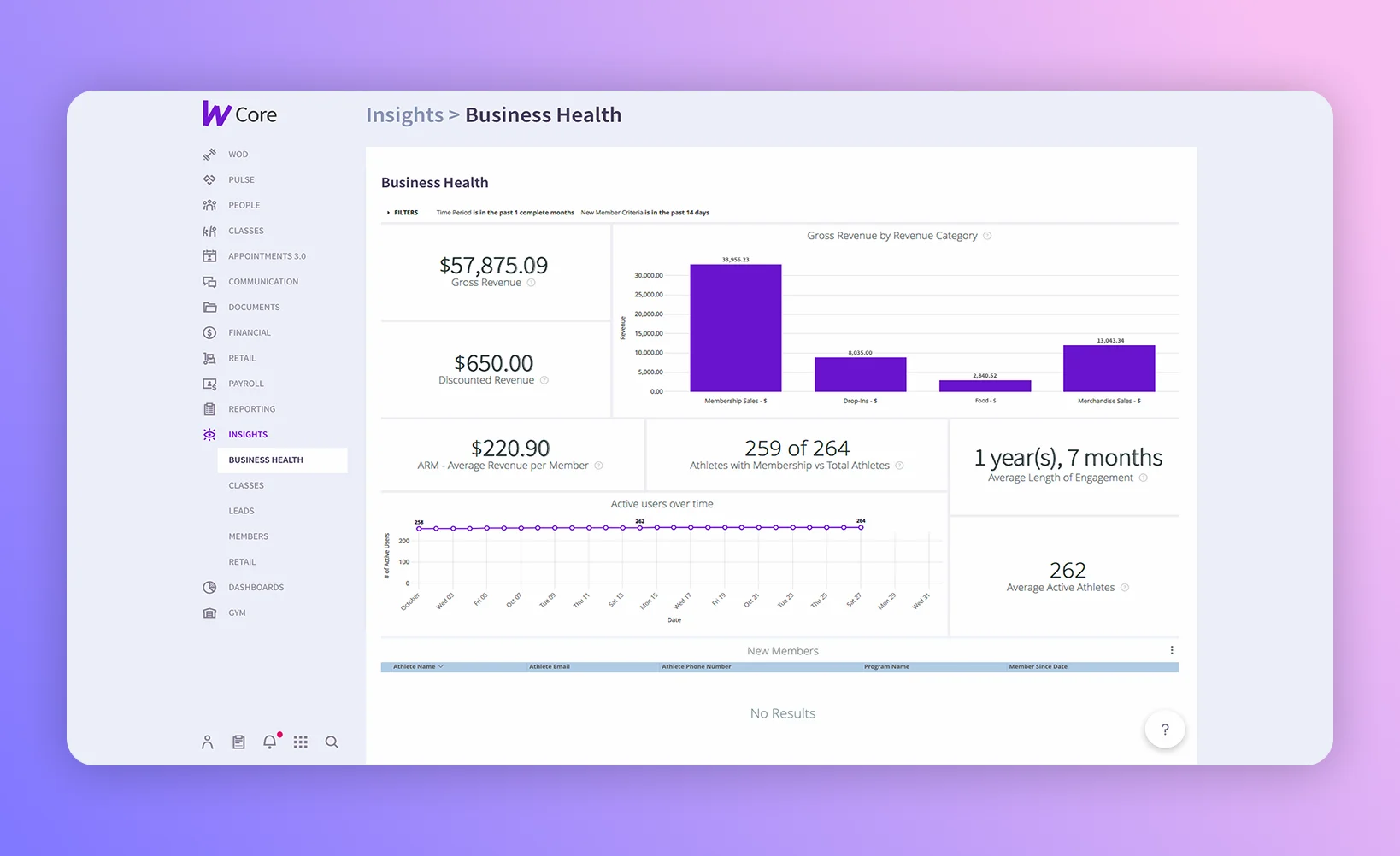
The Mindbody weakness Wodify addresses is the total absence of any native workout programming or performance tracking. On Mindbody, a CrossFit box either configures around a workflow the platform wasn’t designed for, or runs a second tool alongside it. Wodify eliminates that duplication for a specific vertical. Outside that vertical, Wodify’s advantages narrow considerably, which is exactly why it’s positioned here as a specialist alternative rather than a general Mindbody replacement.
Pricing
- Essentials: currently promoted at $79/month per location (standard rate $179/month).
- Accelerate and Accelerate Ultimate: custom quote.
- Small onboarding fee for platform setup.
- 5,000+ gyms worldwide.
Where it’s stronger than Mindbody
- CrossFit, functional fitness, and Jiu-Jitsu workflows built into the core product.
- Independently owned, no post-acquisition roadmap uncertainty.
- Established community and leaderboard tooling with more than a decade of tenure in the affiliate box market.
- Free migration support from Mindbody and other legacy platforms.
Considerations
- Overkill outside CrossFit, functional fitness, and martial arts verticals.
- Interface has been described as dated in recent G2 and Capterra reviews.
- Pricing only partially transparent above the entry tier.
- Weaker fit for spa, salon, appointment-based, or hybrid businesses.
Software choice is one lever for affiliate owners; how to make a CrossFit gym profitable usually turns on retention and pricing before it turns on tooling.
4. WellnessLiving – Best for yoga, wellness, and multi-vertical studios
WellnessLiving is one of the most suitable Mindbody replacements on the market by feature scope, covering fitness, wellness, salon, spa, and hybrid businesses in a single platform. It sits directly across from Mindbody in the enterprise-adjacent segment, and operators who evaluate one almost always evaluate the other. What differentiates WellnessLiving in a switching decision isn’t the feature list, it’s the member-facing experience and the fact that, unlike Mindbody, it actually publishes its pricing.
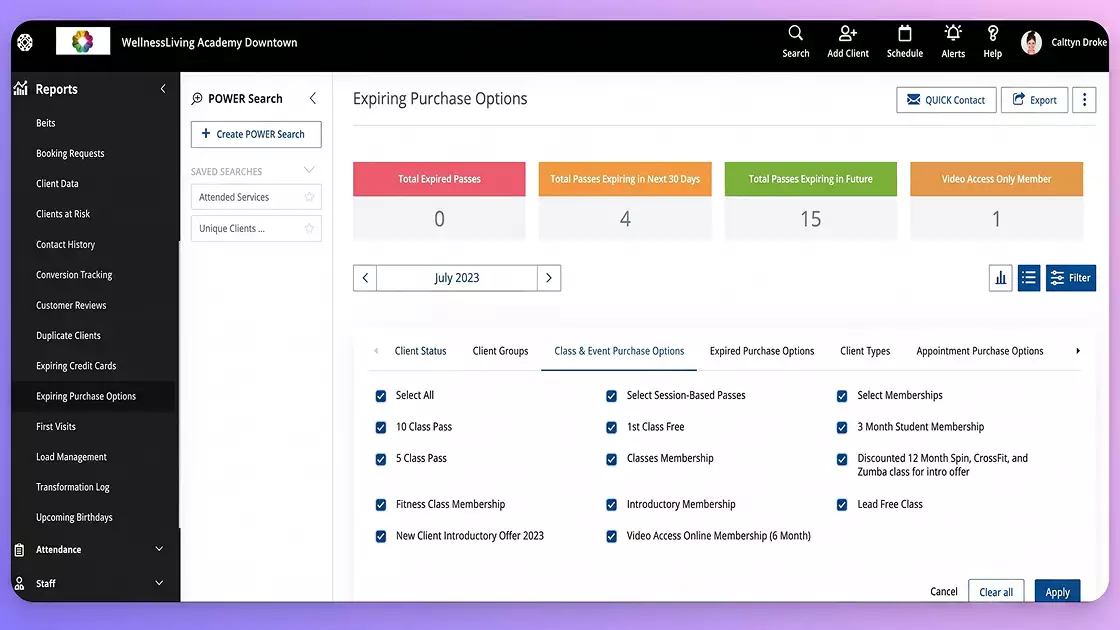
The Mindbody weakness WellnessLiving addresses is twofold. First, the member app: when Mindbody restructured its consumer app, reviewers began flagging discoverability drops, glitches, and confusing navigation. WellnessLiving’s Achieve branded app and rewards system have held up comparatively better in reviews. Second, pricing transparency: WellnessLiving publishes tiered pricing on its own site, running from a Starter tier around $69/month through Business at $199/month and BusinessPro at $349/month. Not every feature is included at the base tier. The Achieve-branded app requires a higher plan, but the tier structure is publicly visible in a way Mindbody’s is not.
Pricing
- Starter: from ~$69/month
- Business: ~$199/month
- BusinessPro: ~$349/month
- Enterprise: custom quote
- 7,500+ gyms, yoga studios, and wellness centers worldwide
Where it’s stronger than Mindbody
- Broadest one-for-one Mindbody replacement for feature scope.
- Pricing published, unusual for platforms at this feature depth.
- Built-in Rewards and Referrals program supports retention.
- Achieve member app reputation compares favorably to Mindbody’s rebranded consumer app.
Considerations
- Multiple public reviews cite escalating processing fees and challenges with contract cancellation.
- Feature depth can overwhelm smaller operators.
- Achieve, a branded app, is locked behind the BusinessPro tier.
- Contract terms similar in structure to Mindbody at higher tiers, confirm at demo.
5. Vagaro – Best for fitness, beauty, and wellness hybrid businesses
Vagaro is a scheduling, POS, and marketing platform sitting at the intersection of fitness, beauty, and wellness. Its customer base skews toward salons, spas, aesthetic clinics, and small fitness studios that offer appointment-based services alongside classes, a hybrid segment that’s grown steadily since 2020.
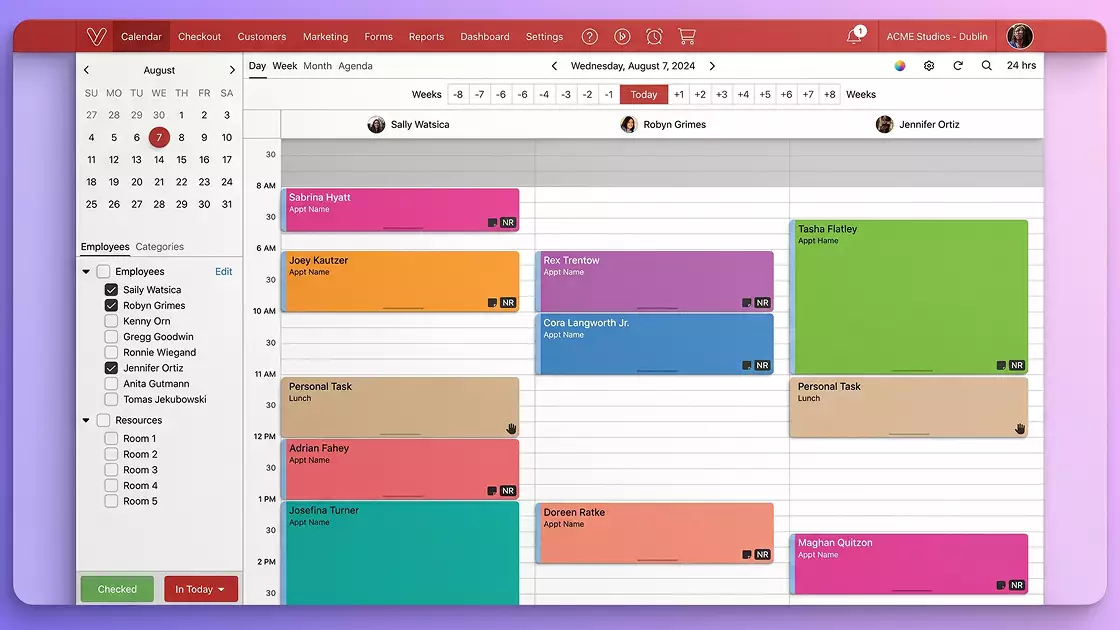
Vagaro serves 90,000+ businesses and has processed $4 billion+ in payments. What separates it from gym-first alternatives is that it runs its own consumer marketplace, which continues to drive discovery bookings for appointment-based businesses.
The Mindbody weakness Vagaro addresses is the decline in marketplace-driven inbound bookings that many operators reported after Mindbody’s consumer app rebrand. For studios where the Mindbody marketplace was previously a real acquisition channel, Vagaro is the closest functional replacement in the appointment-heavy segment. It also carries one of the lowest published starting prices in this guide, though the per-calendar pricing model scales quickly as your team grows.
Pricing
- One Location plan: from $30/month for one bookable calendar (promotional pricing: $23.99/month).
- Each additional bookable calendar: +$10/month, capped at $90/month for 7 or more.
- Multi-location: separate pricing tier.
- Payment processing: 2.2%–2.75% depending on merchant tier.
- 30-day free trial.
- Free data migration from the previous platform.
Where it’s stronger than Mindbody
- Low, published starting price.
- Vagaro consumer marketplace drives real inbound bookings for appointment-based verticals.
- Native support for hybrid fitness plus beauty and wellness operations.
- Month-to-month billing available.
Considerations
- Fitness-specific workflows are lighter than dedicated gym platforms.
- Best fit for appointment-driven businesses; weaker for high-volume class-based gyms.
- Per-calendar pricing scales quickly as the team grows.
- Add-ons for SMS marketing, forms, and payroll are billed separately.
6. Zen Planner – Best for martial arts schools and family-oriented studios
Zen Planner is a fitness management platform with the strongest vertical specialization for martial arts schools, BJJ academies, boxing gyms, and family-oriented fitness businesses. It was founded in 2006 by a martial arts school owner, which shows in the product: belt and rank progression, testing workflows, family and household membership structures, and skill-based attendance tracking are core, not customizations. Zen Planner is owned by Daxko, which acquired it in 2017, and now serves more than 6,000 customers worldwide.
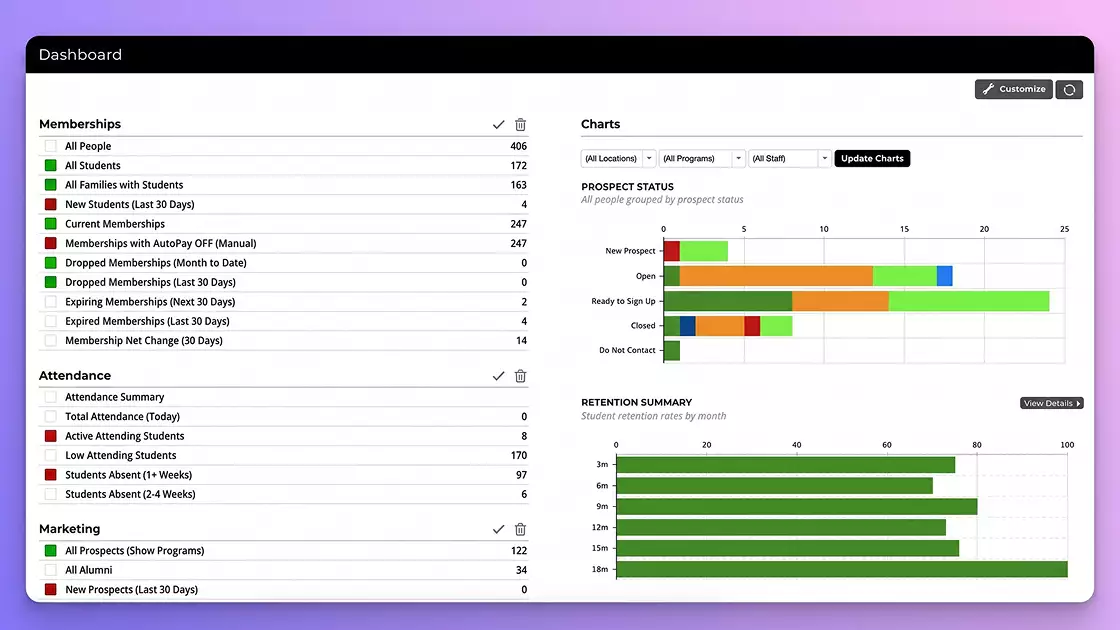
The Mindbody weakness Zen Planner addresses is a vertical gap. Mindbody has no native belt or rank progression, no built-in family membership hierarchy, and no martial-arts-specific attendance logic. A martial arts school on Mindbody either works around the platform or builds its own workarounds. On Zen Planner, those workflows are the platform. Two structural considerations to weigh, though: Zen Planner recently consolidated onto Daxko Payments as its required processor, removing third-party processor choice; and marketing/CRM lives in a separate Zen Planner Engage product (built on GoHighLevel) that costs extra.
Pricing
- Studio plan: from $99/month (scales with active member count)
- Essentials: ~$198/month
- Ultimate: ~$348/month
- Zen Planner Engage (CRM/marketing): separate paid add-on
- Branded App: $39/month
- Month-to-month subscription; annual contracts available on request.
- Requires Daxko Payments as processor.
Where it’s stronger than Mindbody
- Purpose-built for martial arts and skill-based fitness verticals.
- Family memberships handled natively without workarounds.
- Belt and rank progression built into the core member profile.
- Retention analytics focused on the vertical.
Considerations
- Interface described as dated across recent public reviews.
- Overkill outside martial arts, boxing, and family fitness.
- Now requires Daxko Payments, no third-party processor choice.
- Marketing and CRM sit in a separate paid module rather than the core platform.
- Owners shortlisting it usually work through the same Zen Planner FAQs around processor lock-in and the separate Engage module.
7. TeamUp – Best for operators who refuse to sign contracts
TeamUp is a small-group training and class management platform positioned squarely against the contract-heavy incumbents. It operates entirely on a month-to-month basis, publishes its pricing openly, and charges no setup fees, a combination that’s rare enough that it’s become TeamUp’s primary market position. Its customer base is weighted toward functional fitness gyms, boot camps, small yoga studios, and coach-led facilities that value flexibility over vendor lock-in.
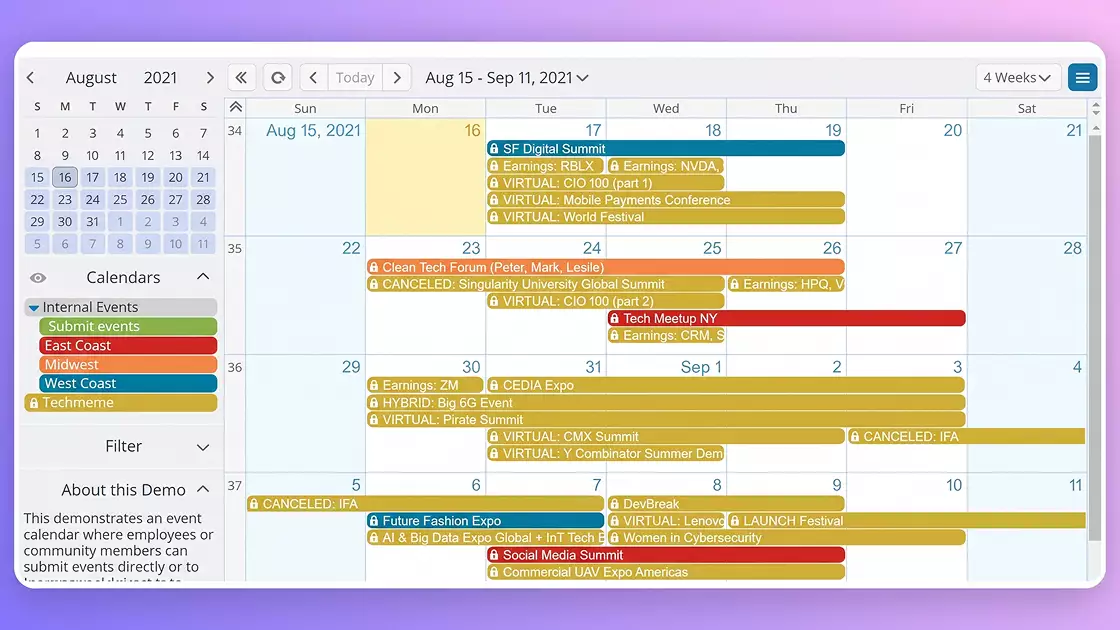
The Mindbody weakness TeamUp addresses is contract structure. As I noted earlier, contract lock-in shows up repeatedly in BBB complaints, G2 reviews, and public conversations. TeamUp removes that risk category entirely. Pricing scales by active customer count rather than feature tier. This means everyone gets the same feature set; you pay for how many active customers you have in a given month. For an owner whose top non-negotiable is being able to leave without penalty, no other alternative in this guide addresses the concern as cleanly.
Pricing
- Starts at $104/month for up to 100 active customers.
- Scales up or down with active customer count month-to-month.
- Free trial available.
- No setup fees, no contract, no cancellation penalties.
- Integrates with Stripe, GoCardless, and multiple payment processors.
Where it’s stronger than Mindbody
- No contract, no setup fees, cancel anytime.
- Every plan gets the same feature set, pricing scales by usage only.
- Transparent published pricing.
- Strong reputation for support responsiveness (~4.6 on G2).
Considerations
- Lighter marketing automation than full-suite platforms.
- Fewer third-party integrations than Mindbody’s marketplace.
- No native belt tracking or martial arts-specific workflows.
- Reporting depth lighter than enterprise-oriented alternatives.
Mindbody alternatives compared at a glance
| Platform | Best For | Starting Price | Public Pricing | Free Plan |
| Wellyx | Multi-service fitness (gym, studio, martial arts) | $99/mo | ✔ | ⛌ |
| PushPress | Small independent gyms, CrossFit | Free / $159 | ✔ | ✔ |
| Wodify | CrossFit, Jiu-Jitsu, functional fitness | ~$79/mo (promo) | Partial | ⛌ |
| WellnessLiving | Yoga, wellness, salon hybrids | ~$69/mo | ✔ | ⛌ |
| Vagaro | Beauty + wellness + fitness hybrids | $30/mo (1 calendar) | ✔ | ⛌ |
| Zen Planner | Martial arts, family memberships | $99/mo | Partial | ⛌ |
| TeamUp | No-contract group training | $104/mo | ✔ | ⛌ |
Platforms we evaluated but did not include
Objectivity in a comparison guide is as much about what’s left out as what’s included. Several platforms surfaced during research and were excluded for specific reasons, which are documented here, so you can weigh them independently if your situation differs from the majority pattern.
- Glofox was excluded despite its historical position as one of the most-cited boutique studio platforms. Glofox is now a business unit within ABC Fitness Solutions, acquired in 2022, and its pricing model, contract structure, and post-acquisition roadmap direction closely mirror the model Mindbody switchers are usually trying to leave: quote-only pricing, annual contracts, and a corporate parent focused on enterprise consolidation. Glofox may remain a strong choice for boutique operators evaluating without an incumbent bias. As a Mindbody alternative specifically, one that structurally solves the problems driving the switch, the fit is weaker.
- Trainerize was excluded because its product is fundamentally a personal trainer coaching app rather than a facility management platform. Studios switching away from Mindbody are shopping for a facility operating system, not a trainer-side app. Trainerize can complement a gym platform effectively but is not a substitute for one.
- ClubReady was excluded because its target segment, franchises and enterprise multi-location gym chains, represents a smaller share of the operators actively searching for Mindbody alternatives. For genuine franchise operators, ClubReady deserves direct evaluation. For most single-location or small-multi-location operators driving the switching conversation, it’s not the appropriate fit.
- Kilo was evaluated and excluded because its coverage skews toward CrossFit-adjacent operators, where Wodify holds a stronger established position, and because its review volume across G2 and Capterra sits below the threshold for confident public sourcing.
- Mariana Tek was evaluated and excluded because its product depth is concentrated in boutique franchise studios, a segment where its capability is strong, but which overlaps materially with WellnessLiving’s coverage in this guide.
- Xplor Recreation and other Xplor-family fitness products were excluded because ongoing Xplor consolidation continues to reshape their roadmaps, and current operator reviews reflect the transition rather than a stable product state.
None of these exclusions is a judgment that the platform is weak. They reflect selection criteria applied consistently. If your specific situation aligns with any of them, evaluate directly rather than treating exclusion as a recommendation against.
How to migrate off Mindbody?
Once you’ve picked your platform, run the migration as a five-step process. I’ve walked owners through this too many times to count, and skipping any of these steps costs money.
Step 1: Export your Mindbody data first. Members, transaction history, class attendance, contract terms, gift card balances. Pull all of it before you have any conversation with Mindbody about canceling. Mindbody’s own documentation confirms data conversion support exists, but your leverage disappears the moment you give notice.
Step 2: Confirm the exit terms in writing. Notice period, final billing cycle, any early termination fees and the date your access ends. Get it in email before you initiate the switch. Verbal confirmations don’t survive contract disputes.
Step 3: Verify migration support from the incoming platform. Any serious Mindbody alternative, Wellyx offers a free data migration service to ensure a smooth transition from Mindbody to Wellyx. Other alternatives like WellnessLiving, PushPress, and others explicitly offer dedicated onboarding for Mindbody switchers. However, confirm scope in writing: which data fields transfer, which don’t, who owns the historical archive if some fields can’t be moved.
Step 4: Communicate the switch to members in three channels. Email, in-app notice, and in-person at the front desk. Cover what changes, what stays the same, when the new member app goes live, and how to log in the first time. A migration lost to poor member communication costs more than the software itself. Every time.
Step 5: Run in parallel for one billing cycle. Bill through the new platform, keep Mindbody active as a read-only reference until the first month closes cleanly. The overlap is a known cost; it protects you against data gaps that only surface after a full billing cycle. Worth every dollar.
Switch gym software only after you have followed these five steps, so the platform you land on is chosen thoughtfully, not in a rush.
Choosing your Mindbody alternative
The right Mindbody alternative is the one that closes the specific gap driving you to switch.
If layered pricing and add-on invoices are your main frustrations, an all-in-one platform with published pricing solves them structurally. If cost at your current scale is the issue, a free entry tier is a genuine option. If your business is CrossFit, martial arts, or a fitness-and-wellness hybrid, a vertical-specific platform will outperform a generic one. If contract lock-in is the deal-breaker, a month-to-month platform removes that risk entirely.
Every platform in this guide addresses a real, cited weakness in the Mindbody experience. The question is not which one is objectively best; it’s which one solves the specific problem you actually have.
Take the three inputs I asked you to write down at the start of this guide, your true monthly cost, your exit date, and your top three non-negotiables, and use them as your filter. That’s how you make a decision you won’t be revisiting in 18 months.
Frequently Asked Questions about Mindbody alternatives
1. What is the best Mindbody alternative in 2026?
There’s no single answer, and I’d distrust anyone who gives you one. It depends on which Mindbody weakness is pushing you to switch. For all-in-one operations with published pricing, Wellyx. For a free entry tier, PushPress. For CrossFit-native workflows, Wodify. For Mindbody-scale breadth with a better member app, WellnessLiving. For consumer marketplace reach in beauty and wellness hybrids, Vagaro. For martial arts, Zen Planner. For no contracts, TeamUp.
2. How much does Mindbody actually cost per month?
Mindbody’s Starter plan is advertised at $99/month per location, with third-party sources placing typical Starter quotes at $99–$159. Accelerate is reported at $259–$279 per location, Ultimate at $499–$699 per location. Add payment processing (2.75%–3.5%), a 20% marketplace commission on new-client first bookings, and branded app pricing of $249–$299/month as a separate add-on. Confirm your specific quote at Mindbodyonline.com/business/pricing.
3. Is there a free Mindbody alternative?
Yes. PushPress offers a genuine free-forever Core plan covering gym management basics, with marketing and workout tracking as paid modules. No other major Mindbody alternative currently offers a permanent free tier.
4. What’s the cheapest Mindbody alternative?
PushPress at $0 for the Core plan. Vagaro at $30/month for one bookable calendar (or $23.99 promotional). Wodify’s Essentials plan is currently promoted at $79/month per location. Actual cost depends on modules, users, and payment processing.
5. Which Mindbody alternative is best for CrossFit?
Wodify is the CrossFit-native choice — WOD programming, workout tracking, and performance leaderboards are core features. PushPress is a strong secondary option for smaller boxes wanting a free entry point.
6. Which Mindbody alternative is best for yoga or Pilates studios?
WellnessLiving offers the broadest one-for-one Mindbody replacement with a better member app. Wellyx suits studios that also run appointments, retail, or wellness services alongside classes. TeamUp works for smaller class-based studios that prioritize month-to-month billing.
7. Which Mindbody alternative is best for martial arts?
Zen Planner. Belt progression, family memberships, and martial-arts-specific attendance workflows are built into the platform natively. Wodify also offers belt-level tracking if your school is CrossFit-adjacent.
8. Can I migrate my Mindbody data to another platform?
Yes. Mindbody’s own documentation confirms data conversion support. Most competing platforms, including Wellyx, PushPress, and WellnessLiving, offer dedicated migration for Mindbody switchers. Confirm the exact scope of the data transfer in writing before signing.
9. Do Mindbody alternatives require long-term contracts?
Not all of them. Wellyx, TeamUp, Vagaro, PushPress, and Zen Planner operate on month-to-month models. WellnessLiving and Wodify typically require annual commitments at higher tiers. Confirm current terms during sales conversations.
10. Why are so many operators looking for Mindbody alternatives in 2026?
Reddit threads on r/gymowner and r/Mindbody, alongside Capterra and G2 reviews, consistently cite four themes: per-location pricing that scales faster than expected, 12- to 24-month contracts, support quality that declined following Mindbody’s 2022 workforce reductions, and hidden costs including a 20% marketplace commission on new-client first bookings.