





Tax season can feel heavy for a fitness business owner. A gym runs on tight schedules, memberships, and staff management. Taxes add another layer of work. Many owners focus on training programs, equipment, and member results. But financial organization often get pushed aside.
A fitness business still works like any other small business. It must report income, track expenses, manage staff pay, and follow tax rules. The challenge is that gyms often have many moving parts. Membership fees, personal training sessions, class bookings, and merchandise sales all create different income streams.
According to the U.S. Small Business Administration, small businesses spend an average of 120 hours per year handling federal tax compliance. That is a lot of time for someone who already manages workouts, trainers, and customer service.
A simple structure helps reduce that pressure. When the right systems are in place, tax season becomes more about reviewing numbers than chasing paperwork.
The 7 steps at a glance
- Step 1: Understand your fitness business tax obligations
- Step 2: Track all income with a reliable invoice system
- Step 3: Separate personal and business expenses
- Step 4: Claim all eligible fitness business tax deductions
- Step 5: Manage staff taxes with proper payroll software
- Step 6: Organize financial records before tax deadlines
- Step 7: Work with a tax professional or fitness studio accounting software
Step 1: Understand your fitness business tax obligations
Fitness businesses must pay the correct taxes based on their structure and income sources. Before preparing for tax season, a gym owner must know which taxes apply to the business.
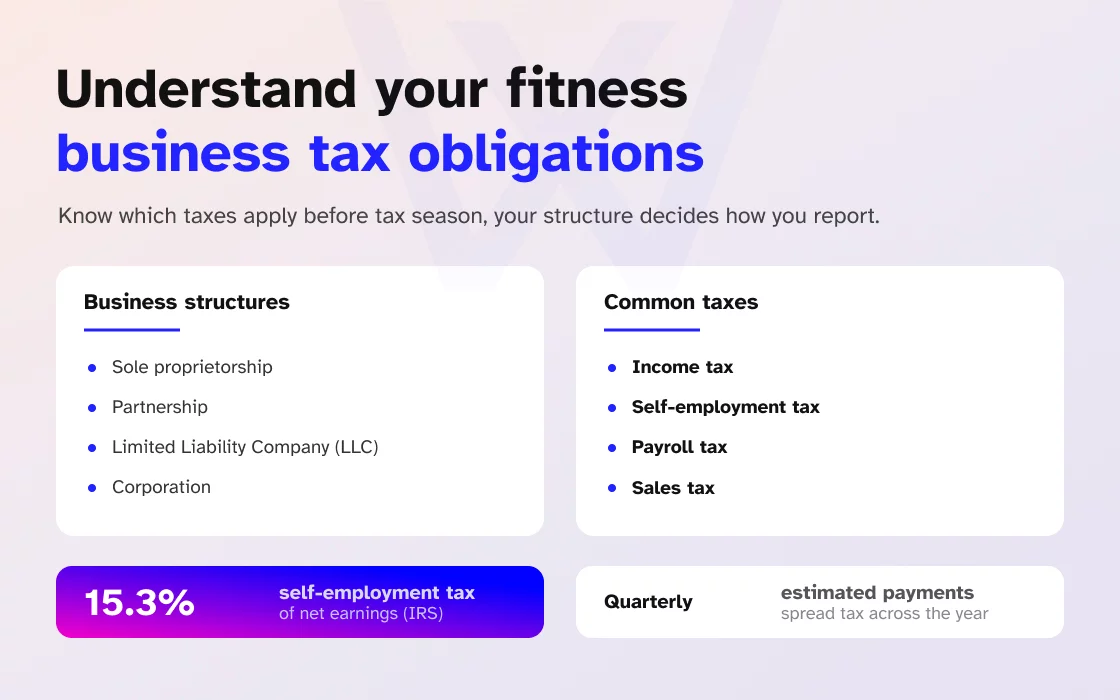
Most fitness businesses fall under one of these structures:
- Sole proprietorship
- Partnership
- Limited Liability Company (LLC)
- Corporation
Each structure affects how taxes are reported.
For example, a sole proprietor reports business income on a personal tax return. A corporation files a separate return for the business.
The Internal Revenue Service explains that small businesses usually deal with several types of taxes.
Common taxes for fitness businesses
- Income tax: Paid on business profits
- Self-employment tax: Covers Social Security and Medicare contributions
- Payroll tax: Required if the business has employees
- Sales tax: Required in some states for services or merchandise
Self-employment tax alone is 15.3% of net earnings, according to the IRS.
Fitness businesses must also report income regularly. Some owners make quarterly estimated tax payments. This means taxes are paid throughout the year instead of once annually.
Knowing these obligations early prevents surprises later.
Step 2: Track all income with a reliable invoice system
Every payment entering the fitness business must be recorded clearly using an organized invoice system.
Fitness businesses receive money in different ways.
These can include:
- Membership subscriptions
- Personal training sessions
- Group class bookings
- Nutrition coaching
- Online fitness programs
- Retail product sales
Without a structured invoice system, these payments can become difficult to track. Some payments come through gym mobile apps, while others through bank transfers or card payments. A digital invoice system records each transaction automatically.
Benefits of an invoice system
- Clear records of every member payment
- Easy tracking of monthly memberships
- Accurate income reporting during tax filing
- Reduced risk of missing transactions
The National Federation of Independent Business reports that poor financial tracking is one of the most common problems small businesses face during tax filing.
Fitness studio owners who maintain accurate income records spend less time fixing errors later. Income tracking should happen every week, not only during tax season.
Step 3: Separate personal and business expenses
Fitness business owners must keep personal and business finances separate to simplify tax reporting.
Many fitness entrepreneurs begin their journey as trainers. They may start training members privately before opening a studio. At the beginning, personal and business expenses sometimes mix together.
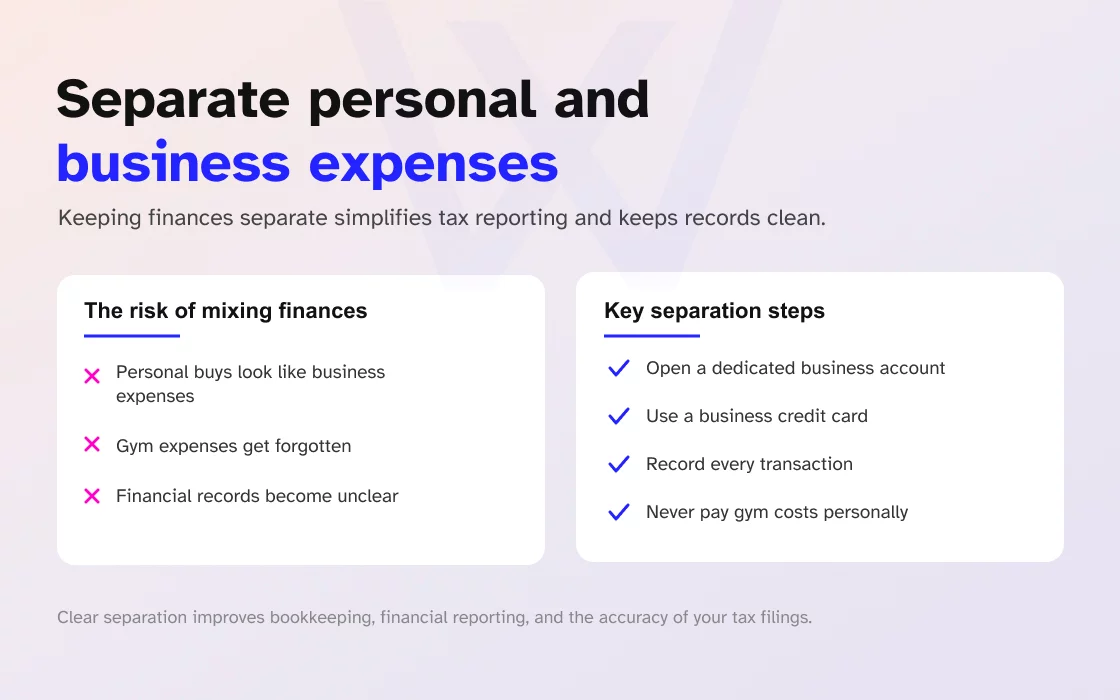
But as the business grows, this becomes risky. Mixing finances can create confusion during tax preparation.
For example:
- Personal purchases may look like business expenses
- Gym expenses may be forgotten
- Financial records become unclear
A separate business bank account solves this problem.
Key financial separation steps
- Open a dedicated business bank account
- Use a business credit card for expenses
- Record every transaction
- Avoid paying gym expenses from personal accounts
Clear financial separation helps with bookkeeping. It also improves the accuracy of financial reports and tax filings.
Step 4: Claim all eligible fitness business tax deductions
Gym owners can reduce taxable income by claiming legitimate expenses related to running the business.
Tax deductions lower the amount of income that gets taxed.
Many fitness studio owners miss deductions simply because they do not track expenses throughout the year.
The IRS allows businesses to deduct expenses that are ordinary and necessary for operating the business.
Common tax deductions for fitness studios
- Gym equipment purchases
- Facility rent or lease payments
- Trainer wages
- Software subscriptions
- Insurance costs
- Marketing campaigns
- Cleaning and maintenance services
- Utility bills
Fitness equipment is often one of the biggest deductions.
Machines, weights, and training equipment may qualify for depreciation deductions over time.
Marketing costs also qualify as deductions.
These can include:
- Social media advertising
- Website development
- Promotional campaigns
- Event marketing
Tracking these expenses carefully helps reduce total tax liability.
Step 5: Manage staff taxes with proper payroll software
Fitness businesses must manage staff wages and payroll taxes correctly.
Many gyms employ several types of workers.
These include:
- Personal trainers
- Front desk staff
- Class instructors
- Cleaning teams
- Managers
Each worker may be classified as either an employee or an independent contractor. Employees require payroll tax deductions. Contractors usually handle their own taxes.
Misclassification can cause legal penalties. A structured payroll system helps prevent mistakes.
What payroll software handles
- Salary calculations
- Tax deductions
- Employee records
- Wage reports
Many fitness businesses use gym payroll software like Wellyx to manage these tasks automatically.
According to the Internal Revenue Service, employers must also contribute matching Social Security and Medicare taxes for each employee.
This makes payroll accuracy extremely important.
Step 6: Organize financial records before tax deadlines
Organizing financial records early makes tax filing faster and more accurate. Waiting until the last minute creates unnecessary stress.
Fitness business owners should prepare records several weeks before the filing deadline.
Important documents usually include:
- Income reports
- Expense receipts
- Payroll records
- Bank statements
- Gym software invoices
- Tax payment records
The U.S. Small Business Administration recommends keeping business tax records for at least three years.
Useful tools for record organization
• Bookkeeping software
• Invoice system reports
• Payroll system reports
• Accounting dashboards
When financial information is organized, the tax filing process becomes much easier.
Step 7: Work with a tax professional or gym accounting software
Professional guidance or gym accounting software helps fitness businesses manage taxes correctly and avoid costly mistakes.
Tax laws change frequently. A fitness business owner may not always know about new deductions or rule changes.
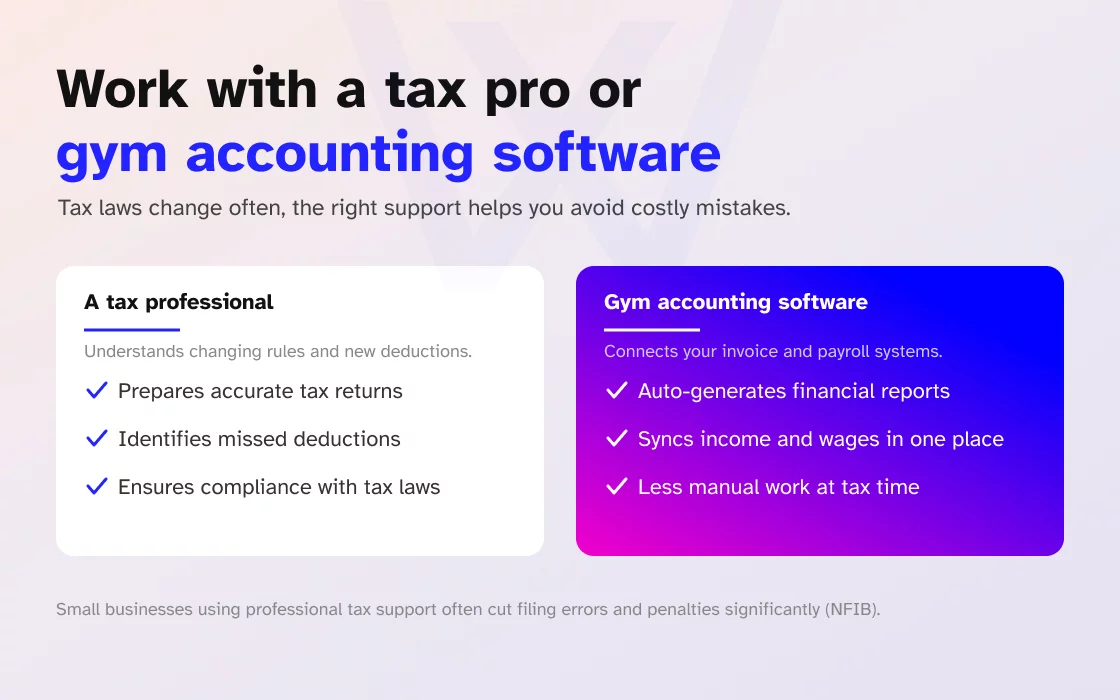
A tax professional understands these details.
They can help:
- Prepare accurate tax returns
- Identify missed deductions
- Ensure compliance with tax laws
Some studio owners prefer accounting software instead.
These tools connect with the invoice system and payroll system to generate financial reports automatically.
According to the National Federation of Independent Business, small businesses that use professional tax support often reduce filing errors and penalties significantly.
Choosing the right support depends on the size of the business.
FAQs
Do fitness business owners need to pay estimated taxes?
Yes, many do. The IRS says self-employed individuals generally file an annual return and pay estimated taxes quarterly, especially when income is not subject to withholding. That is common for personal trainers, studio owners, and other independent operators.
What are the main IRS deadlines I should remember?
For most calendar-year individual filers, the federal filing and payment deadline for 2025 returns is April 15, 2026. Estimated tax payments for 2026 are generally due April 15, June 15, September 15, and January 15, 2027. Form 941 is generally due by the last day of the month after each quarter ends.
Do I owe self-employment tax as a solo personal trainer?
Usually, yes, if your net earnings from self-employment are $400 or more. The IRS says that is the usual threshold for self-employment tax.
Can I deduct gym equipment and studio software?
Often, yes, if the costs are ordinary and necessary for the business and are properly documented. That may include equipment, software, an invoice system, and other tools used to operate the business.
Are class instructors always independent contractors?
No. The IRS says the answer depends on the full business relationship and the level of control over the worker. Instructors are not automatically contractors just because they teach classes.
Do gym memberships and fitness services have sales tax?
Sometimes. The SBA says state and local tax rules vary by location and business structure. That means some states may tax certain services or products while others may not. You need to check your state rules instead of assuming.
How long should I keep tax records?
The IRS says the general rule is often three years, but employment tax records should generally be kept for at least four years after the tax becomes due or is paid, whichever is later.
Do I still need help if I already use software?
Often yes. Software keeps records clean, but it does not always answer judgment questions. A tax pro can help with deductions, worker classification, filing choices, and structure issues that software cannot fully decide for you. That matters even more when your business has staff, contractors, retail sales, or more than one revenue stream.
Final Thoughts
Tax season does not have to feel overwhelming for a fitness business owner. Most problems appear when records are disorganized or financial systems are unclear.
Following a simple seven-step process makes a big difference. Understanding tax obligations, tracking income with an invoice system, separating expenses, claiming deductions, managing payroll through gym payroll software, organizing records, and seeking professional guidance all make tax season easier to handle.
When these steps become part of the business routine, tax preparation becomes easier each year.
A well-organized payroll system and financial structure also support long-term growth. Instead of worrying about paperwork, a gym owner can focus on what matters most: helping clients stay healthy and building a stronger fitness community.