



Many pt studio owners work hard to keep their facilities full. The schedule is packed with classes. Music is loud. The energy is high. Members come in, sweat, and love.
Yet behind the busy floor, a different story often appears.
Members join. They attend for a few weeks. Then they slowly disappear.
New members keep replacing them, but the cycle never stops. Revenue feels unpredictable. Coaches feel stretched. Owners spend more time chasing new members instead of building relationships with the ones they already have.
This is the quiet challenge many studios face today.
For years, drop-in fitness classes were the easiest way to run a pt studio. The model was simple. Fill the timetable with workouts and let people attend whenever they want.
But the fitness industry is changing. Members now want more than a sweaty hour. They want results. They want guidance. They want to feel like someone is actually helping them improve.
Because of this shift, many successful studios are redesigning their model around the kind of structure that pt studio software can streamline across the whole business.
Instead of running endless drop-in classes, they are building progressive small-group personal training programs. These programs blend the energy of group workouts with the structure of personal coaching.
The result is powerful.
- Members stay longer
- Results improve
- Coaches deliver better guidance
- Revenue becomes more predictable
For studio owners looking for sustainable growth, this shift sits alongside the advantages of offering digital fitness services as one of the most important trends reshaping the floor.
What drop-in fitness classes are and why they became popular
Drop-in fitness classes allow members to attend workouts whenever they want without following a structured training program.
They become popular because they are flexible, social, and easy for studios to schedule.
Drop-in classes were designed around convenience. A studio creates a schedule. Members pick the class they like. They walk in, join the workout, and leave after the session ends.
This format helped many pt studios grow quickly. It offered several benefits.
Why are drop-in classes becoming popular
- Members could attend anytime
- No long-term program commitment
- Social and energetic environment
- One coach could train many people
- Easy for gyms to manage large groups
Group workouts also created excitement. People enjoyed the shared effort. The music, the countdown timers, and the energy of the room made workouts feel engaging.
For fitness business owners, the number looked attractive.
If one coach trains 20 people, many boutique fitness studios and functional training gyms adopt the drop-in class model.
According to reports, group exercise classes makes 36% of the most widely offered services in fitness studios around the world. But over time, many pt studio owners noticed a deeper problem. At that scale, managing group fitness classes well becomes the difference between a packed timetable and a chaotic one.
Attendance looked good. But retention often did not.
The biggest problems with drop-in class models
Drop-in class models struggle because members follow random workouts and rarely see structure progress.
When members do not see progress, motivation drops, and retention suffers.
The biggest weakness of drop-in classes is the lack of progression.
Every day brings a different workout. One day focuses on cardio. Another day includes strength. Another day mixes mobility.
Variety keeps things exciting. But it also removes structure.
Fitness improvement depends on gradual progression. The body adapts when training loads increase in a planned way.
Without that structure, members often feel lost. Common problems gyms experience with drop-in classes include:
1. Weak member retention
Many members start with enthusiasm, but lose motivation when they cannot track progress.
Research on retention studies shows the average gym loses around 50% of its members every year. Closing that gap is exactly where learning to retain members in your gym makes sense. That means half the member base must be retained annually just to stay even.
2. Limited coaching attention
In large classes, a coach may supervise 20 or more participants.
It becomes difficult to:
- Correct exercise form
- Adjust movements for injuries
- Track individual progress
Members who need guidance may feel overlooked.
3. Random training structure
Without a progressive program:
- Strength gains slow down
- Skill development stalls
- Confidence drops
Members stop seeing improvement and eventually stop showing up.
4. Unpredictable attendance
Some classes become overcrowded. Others remain empty.
This creates inefficiencies in:
- Staff scheduling
- Equipment use
- Facility space management
Over time, these small problems combine into one major challenge.
What progressive small group personal training means
Progressive small group personal training combines structured coaching programs with the motivation of group workouts.
Members train in small groups while following a long-term fitness progression designed by a coach.
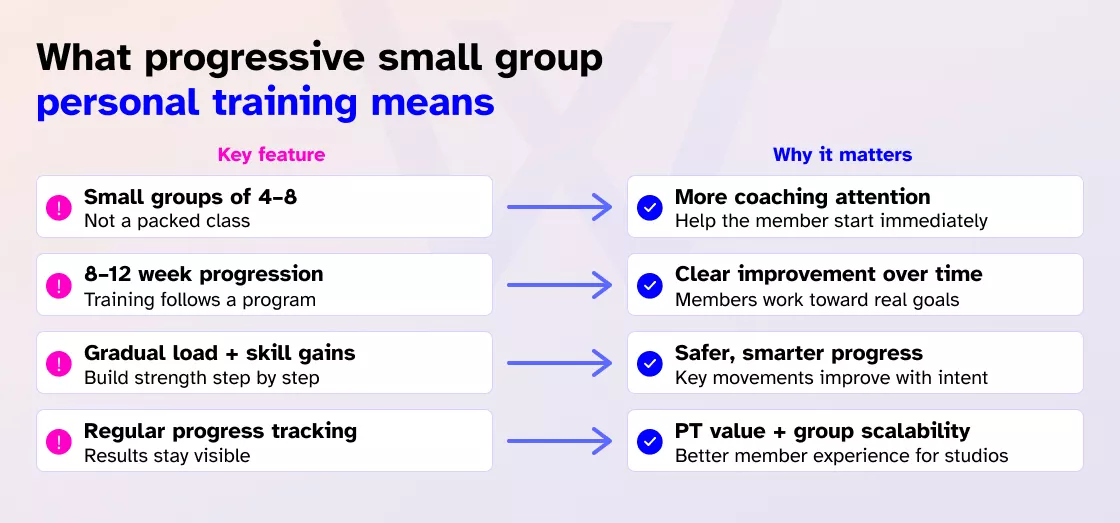
This model keeps the group energy but improves coaching quality. Instead of 20 people in a class, a group typically includes 4 to 8 members. This smaller size allows the coach to observe every participant.
More importantly, the workout follows a structured program. Members do not train randomly anymore.
They follow a plan.
A typical progressive training program may include:
- A strength progression lasting 8-12 weeks
- Gradual increases in training load
- Skill development for key movements
- Regular progress tracking
This structure creates clear improvement over time. Members feel like they are working toward something meaningful. For studio owners, this model blends personal training value with group scalability, and it often reshapes the floor itself, which is why personal training studio design ideas matter once small groups take over.
Why do members get better results in progressive training programs
Members get better results because progressive programs follow scientific training principles.
Structured programs allow gradual improvements in strength, endurance, and movement skills.
Fitness progress relies on the concept of progressive overload. This means the body must experience slightly higher demand over time.
Drop-in classes rarely provide this consistency. Progressive programs do.
A well-designed program includes:
- Gradual increase in weight
- Controlled increases in training volume
- Planned recovery periods
- Movement skill development
According to the American College of Sports Medicine (ACSM), structured strength programs significantly improve performance compared to unplanned workouts.
Members also benefit from measurable milestones.
Examples include:
- Lifting heavier weights
- Completing more repetitions
- Improving movement quality
These visible improvements keep motivation high. And when motivation stays high, members stay longer.
Why studio owners earn more revenue with progressive small groups
Progressive small group training allows studios to charge higher prices because members receive structured coaching and personal attention. This increases revenue per member and improves financial stability.
In the drop-in model, pricing stays low because the experience feels similar to a regular class.
But coaching-based programs offer more value.
Member receives:
- Personalized guidance
- Progress tracking
- Program design
- Direct interaction with coaches
Because of this value, pricing can increase.
Example:
Drop-in class model
- $15 per class
- $120 monthly unlimited membership
Small group personal training
- $200-$350 per month coaching program
Even with fewer people in each session, the total revenue can increase.
For example:
- 6 members paying $250 each = $1500 monthly group revenue
This is often higher than the revenue generated by large classes. Many pt studios are now focusing on revenue per member instead of crowd size. It’s one of the most dependable revenue streams an owner can build, because it scales with value rather than footfall.
How progressive training improves member retention
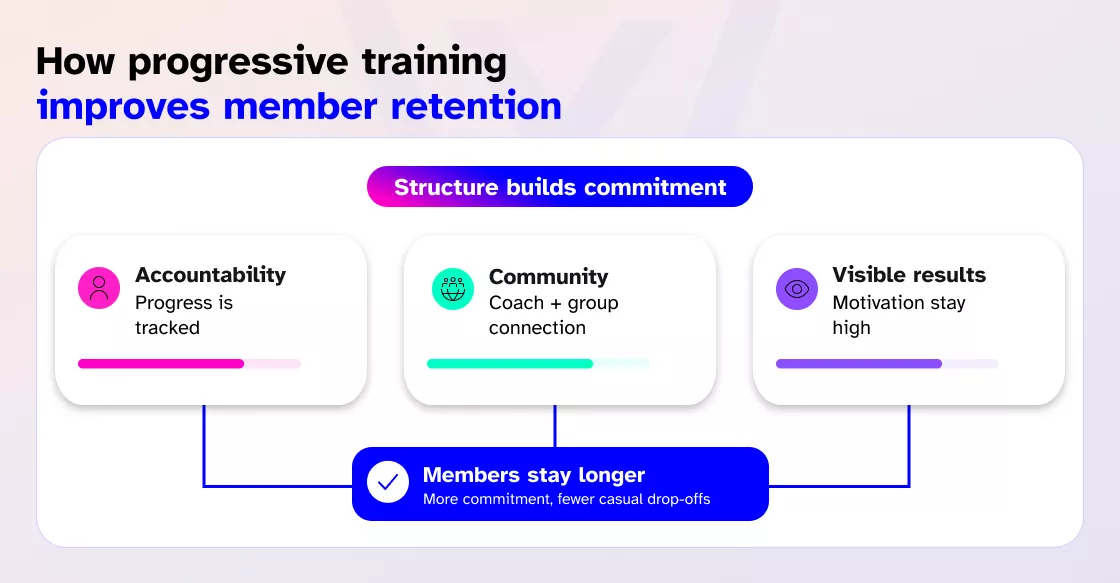
Retention improves because members feel accountable to both the program and the coach. Structured training programs make members more committed to their fitness journey.
Retention is the foundation of a successful studio. When members stay longer, the business becomes easier to grow. Progressive training naturally strengthens retention.
Members develop stronger relationships with:
- Their coach
- Their training group
- Their personal goals
They begin to see themselves as part of a program rather than casual visitors.
Several factors increase retention:
- Accountability: Members know someone is tracking their progress.
- Community: Small groups create stronger connections between participants.
- Visible results: Improvement keeps motivation alive.
Underneath all three sits the technology layer: the Wellyx CRM features that engage and retain customers by keeping that accountability visible and automatic. According to industry research, improving retention by just 5% can increase profitability by 95% because fewer new members must be acquired.
Why coaching quality improves in small group training
Coaching quality improves because trainers can focus on individual members instead of managing large crowds. Better coaching leads to safer workouts and stronger results.
In large classes, coaches often act more like class leaders than trainers. They manage time, music, and equipment while monitoring dozens of people.
In small group training, the coach can focus on true coaching.
Key benefits include:
- Personalized technique corrections
- Exercise modifications
- Injury prevention
- Progress tracking
Members feel supported.
They know the coach is watching and helping. For trainers, this environment also improves job satisfaction. They can do what they were trained to do: coach people properly.
Why scheduling and capacity planning become easier for pt studios
Progressive training programs make scheduling predictable because members reserve recurring sessions.
Predictable attendance improves operational efficiency for pt studios.
Drop-in classes create uncertainty. Attendance changes daily. Some classes overflow while others remain empty. Structured programs solve this issue.
Members usually commit to:
- Fixed training days
- Recurring weekly sessions
This predictability helps studio owners plan:
- Staff schedules
- Equipment usage
- Room capacity
Operations become smoother. Less chaos. More control.
Real industry statistics behind the shift
Fitness industry data confirms that personalized coaching services are growing rapidly. Small group training and personal training remain among the fastest-growing revenue segments.
Several reports highlight this trend.
Key industry insights
- The global fitness industry generated nearly 160 billion in 2021, and the industry is expected to grow 171.75% to 434.74 billion USD by 2028. (RunRepeat).
- The ACSM Worldwide Fitness Trends Report consistently ranks personal training among the top trends.
- Personalized coaching services continue expanding faster than traditional gym memberships.
These numbers reflect a bigger change. Members are no longer paying only for access to equipment. They are paying for results and guidance.
How pt studios can transition from drop-in classes to progressive programs
PT studios can transition gradually by introducing small group coaching programs alongside existing classes.
Successful programs can slowly replace traditional drop-in classes over time.
The shift does not need to happen overnight. Many studios start small.
A common transition strategy includes:
Step 1: Launch a pilot program
Create a small group training program lasting 8–12 weeks.
Step 2: Track member progress
Measure improvements in strength, mobility, and attendance.
Step 3: Collect feedback
Members who experience results often become strong advocates.
Step 4: Expand successful programs
Add more groups and gradually reduce random classes.
With time, the personal training studio becomes a coaching-focused training facility instead of a class-based studio. This change can transform the entire business. PT studio automation handles the recurring billing, reminders, and session bookings underneath, so coaches spend their time coaching rather than administrating.
FAQs
1. Why are pt studios moving away from drop-in fitness classes?
PT studios are shifting away from drop-in classes because members often struggle to see consistent results without structured training programs. Progressive small group personal training provides guidance, accountability, and better retention for studio businesses.
2. What is progressive small group personal training?
Progressive small group personal training is a coaching model where small groups follow structured training programs designed to improve fitness over time while still benefiting from group motivation and shared workouts.
3. How does small group training improve member retention?
Small group training improves retention because members follow structured programs and build relationships with their coach and group. Accountability, progress tracking, and visible results encourage members to stay longer.
4. Is small group personal training more profitable for studios?
Yes. Small group personal training allows studios to charge higher monthly fees because members receive coaching and structured programs. This increases revenue per member while maintaining manageable group sizes.
5. Do members get better results in small group training?
Members often achieve better results because structured programs follow progressive training principles. Coaches can monitor technique, adjust exercises, and ensure members gradually improve strength, endurance, and movement quality.
6. How can a pt studio transition from drop-in classes to small group training?
Personal training studios can transition by launching pilot programs with small groups, tracking results, and gradually expanding successful programs. Over time, structured coaching sessions can replace traditional drop-in classes.
Final thoughts
The fitness industry is evolving. Busy schedules and loud classes are no longer enough to keep members engaged.
People want progress. They want guidance. They want coaching that helps them improve week after week.
That is why many studios are replacing drop-in fitness classes with progressive small group personal training.
This model creates powerful benefits:
- Stronger member results
- Higher retention
- Better coaching quality
- More predictable revenue
For pt studio owners looking to expand their business, this shift offers a clear opportunity.
The studios that focus on structured coaching programs are not just running workouts.
They are building systems that help members succeed.
And when members succeed, the business grows with them.