




A new client signs up excited. She fills out a form, gets a confirmation email, and three days later sits down for her first session with a trainer who has never seen her goals because nobody actually read the form before she walked in. Nothing about her signup was broken. The paperwork existed. The booking went through. The breakdown happened in between, in the handoff from one system or one person to another, and that’s exactly the kind of failure that “we automated our onboarding” usually doesn’t fix.
Most advice on this topic treats onboarding as a single checklist: collect a form, send a welcome email, book a session, done. But a studio can execute every one of those steps perfectly and still lose the client, because the actual weak point isn’t inside any single step. It’s the gap between steps, where information, or a person, is supposed to pass from one hand to the next and sometimes just doesn’t. This guide is built around those handoffs specifically: what to automate at each one, what to deliberately keep human, and where the real risk sits when a studio gets that balance backward.
Why the gap matters more than the steps
Owners audit the onboarding stage by stage: is the intake form good, is the welcome email warm, is the first session well run, and each one can pass inspection, yet the handoff between them still drops the client.
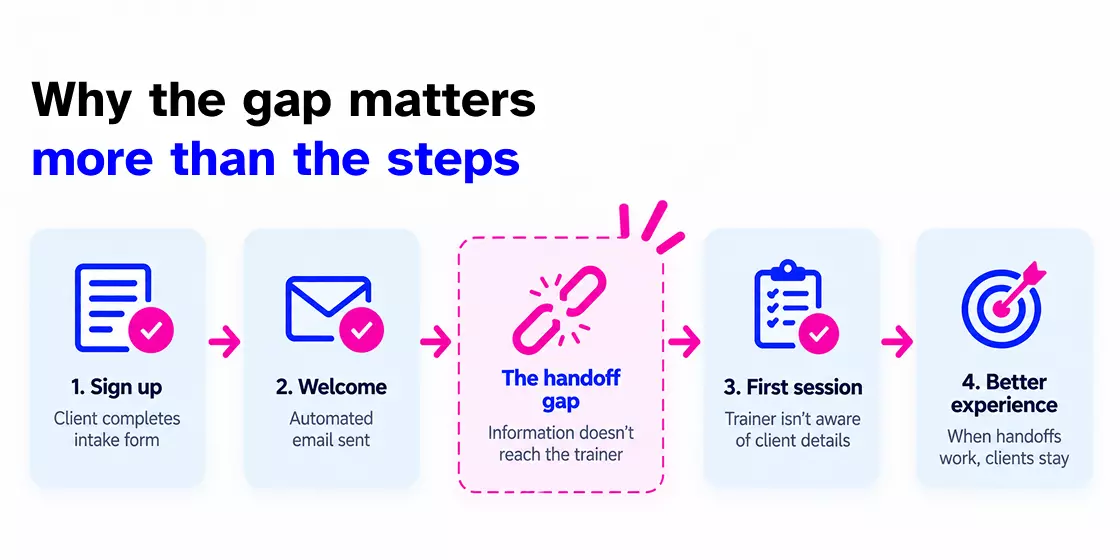
A signup form and a trainer’s session prep are often two completely disconnected moments, even in studios that consider their onboarding automated. The form exists. Whether anyone reads it before the client arrives is a separate question entirely, and it’s the one that actually determines whether the first session feels personal or generic.
A client’s PAR-Q and goals questionnaire sit in a shared inbox. The trainer assigned to her first session never opens it, not from carelessness, but because nothing in the workflow routes it to her before the appointment. The client answers the same questions out loud that she already answered in writing three days earlier.
Audit handoffs, not stages. Every step in onboarding has an entry and an exit; the exit is where things actually go missing.
Handoff one: curiosity to commitment
The gap between someone expressing interest and actually booking a first session is where many studios lose people who, just a few minutes earlier, were genuinely ready to commit.
Speed matters here more than most owners assume. The Kellogg School of Management and MIT’s Lead Response Management study, based on more than 100,000 real contact attempts, found that reaching out within five minutes made a business 100 times more likely to make contact and 21 times more likely to qualify that lead than waiting 30 minutes. That’s not fitness-specific, but the underlying principle still applies directly to a prospective client who just filled out an inquiry form: interest fades fast without a quick response.
Self-scheduling that lets someone book a specific first-session time immediately closes this gap automatically. A generic auto-reply that says “someone will be in touch” does not, and a specific question buried in that inquiry about pricing or a physical limitation deserves a real answer, not a templated one.
Automate speed and logistics: instant booking confirmation, calendar holds, and reminder sequences. Keep a human in the loop for anything that isn’t a scheduling question; a real reply to a real concern closes more of these gaps than a faster bot ever will.
Handoff two: form to trainer’s hands
This is the most commonly broken handoff in the entire sequence, and it’s invisible from the outside because the form genuinely exists and was genuinely submitted.
A digital intake form, including a PAR-Q, the standard physical activity readiness questionnaire used across the fitness industry to flag health risks before training begins, collects real information. Collecting it is not the same as delivering it to the person who needs it before the moment it matters. “We automated our intake” often means a form was digitized, not that a trainer reliably sees the answers before the client walks in.
A client discloses a knee injury on her intake form. The trainer, who never saw it, has her doing bodyweight squats in the warm-up. Nothing malicious happened. The form simply never made it through the handoff from submission to the person running the session.
The fix isn’t a better form; most intake forms are already fine. It’s making sure the answers land in front of the assigned trainer automatically, tied to that specific client’s upcoming session, not sitting in a shared inbox or a folder someone has to remember to check.
The one handoff that shouldn’t exist
Some studios, in the enthusiasm to automate everything, start looking for ways to streamline the first session itself.
This is the one place in the whole sequence where automation should stop. The actual assessment involves watching how a client moves, reading whether they’re pushing too hard or holding back out of nerves, and adjusting the plan in real time. None of that is a handoff at all. It’s direct, human, in-the-room judgment, and it’s the entire reason someone is paying for personal training instead of a template.
According to fitness business consultancy Two-Brain Business, the most common reason a client doesn’t return after a first session is mismatched expectations. The workout may not have been bad; it simply did not match what the client thought they’d signed up for. That’s a judgment call a trainer makes by reading the person in front of them, not something a workflow can automate around.
Everything before this moment exists to set the trainer up to be fully present for it, not to replace it. If an “onboarding automation” idea touches what actually happens during the session itself, it’s solving the wrong problem.
Handoff three: session one to week three
A genuinely good first session can still be followed by silence, and silence is where many new clients quietly decide not to come back.
Peer-reviewed research on fitness attrition, including a 2016 study in the Journal of Science and Medicine in Sport, has documented how steep early dropout can be once structured contact stops, particularly before a client has built enough of a habit to keep showing up on their own. The first few weeks after session one are exactly when a client’s motivation is least self-sustaining and most dependent on the studio staying visibly engaged.
A generic drip sequence that emails every new client the same three tips, regardless of what they said in intake, reads exactly as it is: automated and impersonal. A check-in that references a client’s actual stated goal from her intake form reads as someone paying attention.
Automate the timing and the trigger, not the content. A message that fires on day three and day ten is useful scaffolding; a message that’s actually personalized using what was captured earlier in the sequence is what makes that scaffolding feel like attention instead of automation.
Mapping your own handoffs
| Handoff | What typically breaks | What fixing it looks like | Cost of leaving it broken |
| Curiosity to Commitment | Slow or generic reply to inquiry | Instant self-scheduling, fast human reply to real questions | Interested prospects go cold before ever booking |
| Form to Trainer’s Hands | Intake data collected but never read | Answers routed automatically to the assigned trainer before the session | Trainer starts the relationship uninformed, client repeats themselves |
| The Session Itself | Attempts to script or streamline the assessment | Nothing; this handoff should stay entirely human | A generic first session undermines the entire reason for hiring a trainer |
| Session One to Week Three | Silence, or generic drip content | Timed, personalized check-ins referencing real intake data | Clients disengage during the exact window they’re least self-motivated |
Where the systems need to talk to each other
Handoff two is almost always a systems problem, not a people problem. A trainer who wants to read intake answers before a session usually isn’t failing to care; they’re working from a workflow that never actually puts those answers in front of them at the right moment.
Wellyx’s PT studio software keeps intake forms, session bookings, and client records in the same system, so an assigned trainer sees a client’s goals and health history attached to the actual appointment, not buried in a separate inbox. This doesn’t replace the judgment call that happens in the room. It just makes sure the information that should have made that handoff actually does.
Find your broken handoff
- Does a new client know their exact first-session time before they leave the signup page, or do they wait for someone to follow up?
- Does the assigned trainer see the intake answers before the session starts, or find out during the session?
- How many days typically pass between signup and the first session, and do you know if that number has crept up?
- Is there a scheduled check-in before the three-week mark, or does contact stop after the first session until the client reaches out?
- If you asked your newest client what they told you in their intake form, would your trainer be able to repeat it back?
Close one handoff this week
Pick the single handoff that’s weakest in your studio right now, not all four at once, and fix that one first.
- If it’s Handoff One: turn on self-scheduling for first sessions and set a response-time standard for real questions.
- If it’s Handoff Two: confirm intake answers are automatically attached to the trainer’s view of that client’s upcoming session, not sitting in a separate inbox.
- If it’s Handoff Three: build one personalized check-in message, triggered a few days after session one, referencing something specific from that client’s intake.
- Whichever you pick: leave the session itself alone. That handoff isn’t broken by definition; it’s not a handoff at all.
Frequently asked questions
What’s the difference between onboarding a client and onboarding software?
Software onboarding is the process of setting up a studio on a new platform. Client onboarding is the process a new client moves through: inquiry, intake, first session, and the following weeks, and it’s what this guide covers. The two get confused often because both use the word “onboarding,” but they’re entirely separate problems.
What should never be automated in PT client onboarding?
The assessment and judgment calls made during the actual first session. Reading a client’s form, reservations, or physical limitations and adjusting the plan in real time is direct trainer judgment, not a workflow step, and it’s the core reason someone hired a trainer instead of following a generic program.
What is a PAR-Q form and why does it matter for onboarding?
PAR-Q stands for Physical Activity Readiness Questionnaire, a standard pre-participation health screening used across the fitness industry to flag risks before training begins. It matters for onboarding specifically because collecting it digitally only helps if the answers actually reach the trainer before the first session, rather than just ending up in a file.
How fast should a studio respond to a new inquiry?
As fast as realistically possible: research on lead response speed generally finds that responding within five minutes dramatically outperforms waiting even 30 minutes to make real contact. For a PT studio, that means enabling immediate self-scheduling rather than relying on a callback that might happen hours or days later.
How long should PT client onboarding take?
There’s no universal number, but the first few weeks after signup, not just the first session, are the period that determines whether a client sticks around. Treating onboarding as complete after one good first session misses the handoff into ongoing contact, which actually determines retention.
The gap is the whole problem
Every stage of onboarding can look good in isolation and still lose a client because the failure almost never lives within a single stage. It lives in the space between one system and the next, or one person and the next, where something that should have transferred simply didn’t. Fix the handoffs specifically, and the individual steps mostly take care of themselves.
If you want to see how Wellyx keeps intake data, scheduling, and client records connected so nothing gets lost between handoffs, book a demo.