



Search this topic, and every guide reads the same way: a vendor selling one category of AI tool positions its own product as the clear leader, cites its own case studies, and rates every other category as equally exciting. One buyer’s guide reviewed while researching this piece left an unedited template placeholder in the published copy, a visible sign of how templated this content genre has become.
That produces uniformly positive coverage with no real signal about what’s actually proven versus early-stage marketing. A gym owner reading five of these guides back-to-back would conclude that every category of AI is equally mature. It isn’t.
This guide rates five categories based on the actual evidence behind them, independent research where it exists, and an honest “we couldn’t find much” when it doesn’t.
Category 1: AI reception and communication
What it does: Answers phone calls, texts, and web chat, captures lead information, books tours, and follows up with prospects, around the clock.
Leading tools: Replify markets specifically to gyms and fitness chains with phone, text, email, and chat coverage. HireBob focuses on chat and text for fitness businesses. TrueLark is an appointment-based AI assistant used by some studios, though it’s built primarily for salons and spas. Confirm that it handles gym-specific workflows, such as class packs and membership tiers, before assuming it’s fitness-first.
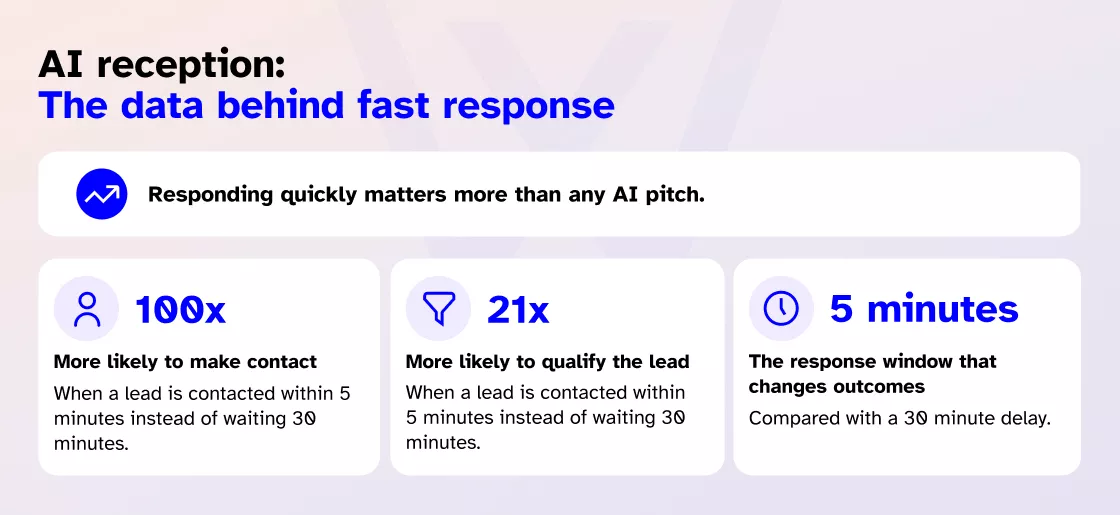
The evidence: The underlying problem is genuinely well-documented, independent of any AI vendor. The original Kellogg School of Management and MIT Lead Response Management study, led by Dr. James Oldroyd and based on more than 100,000 real contact attempts across six companies over three years, found that contacting a lead within five minutes made a business 100 times more likely to make contact and 21 times more likely to qualify that lead, compared to waiting 30 minutes. That’s not fitness-specific, but it’s real, peer-reviewed-adjacent, independent research on exactly the problem AI reception tools claim to solve.
Where the evidence gets thinner is in the fitness-specific numbers. The most commonly cited gym statistics, missed call percentages, follow-up rates, and revenue impact all trace back to studies commissioned by companies that sell AI reception software. That doesn’t make them false, but it means there’s no independent, third-party research confirming the specific fitness-industry numbers the way there is for the underlying speed-to-lead principle.
Verdict: Promising, with a strong underlying case; gym-specific numbers are vendor-sourced. The core problem this category solves is real and independently proven. Treat any specific “X% more leads” claim from a vendor as a claim to verify against your own numbers during a trial, not as an established industry fact.
Category 2: AI-powered member retention
What it does: Analyzes attendance, engagement, and billing data to flag members likely to cancel, then triggers automated outreach before they do.
Leading tools: Keepme is the most consistently named platform built specifically for fitness churn scoring and win-back campaigns, with a dedicated retention-and-reactivation product called Antares. Beyond Keepme, this category is thinner on fitness-specific standalone products; broader customer-data platforms outside fitness use similar modeling approaches but aren’t gym-built.
The evidence: This category has the strongest academic evidence of the five reviewed. A peer-reviewed study published through the IEOM Society built an artificial neural network model that predicted gym member churn with 92.1% accuracy, 89.1% sensitivity, and 93.8% specificity, outperforming an earlier benchmark model. Separate peer-reviewed research indexed in IEEE Xplore and Semantic Scholar has independently explored the same problem, yielding comparable results using different modeling approaches.
One honest caveat worth knowing: a widely cited 95.5% accuracy figure stems from a single study using a heavily imbalanced dataset, in which only 12.3% of sample members were still active. That’s a real result, but it’s from one dataset, not a universal guarantee that your gym would see the same number.
The bigger honest gap isn’t the prediction; it’s the action. Predicting who’s likely to leave is a well-studied machine learning problem. Reliably preventing that member from leaving once flagged is a separate, harder problem with far less independent research behind it.
Verdict: Most proven category on the prediction side, least proven on the intervention side. The technology for identifying at-risk members is well established. What happens after that flag, whether the automated save campaign actually works, depends much more on execution than on any of the research measures.
Category 3: AI marketing and lead scoring
What it does: Generates social content, scores which leads are most likely to convert, and adjusts pricing or promotions based on demand patterns.
Leading tools: This category is mostly driven by the marketing modules already built into all-in-one gym platforms rather than by standalone fitness products. Mindbody and ABC Fitness (via its Glofox and Ignite products) now both bundle AI-assisted content and lead-scoring features directly into their existing marketing tools, rather than selling AI marketing as a separate purchase. Wellyx AI follows the same pattern, generating campaigns, journeys, templates, and contact lists from a plain-English or voice prompt, built inside the same platform as membership and attendance data rather than as a disconnected add-on.
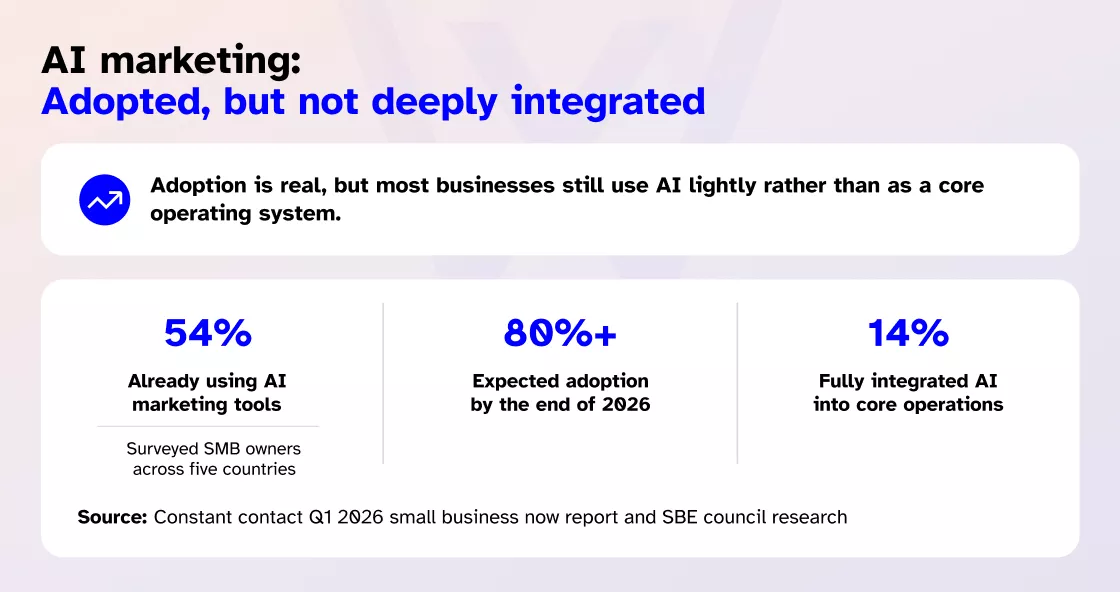
The evidence: This category is widely adopted, but it isn’t fitness-specific in any meaningful way. Independent research is genuinely strong at the small-business level: Constant Contact’s Q1 2026 Small Business Now report, surveying more than 1,500 SMB owners across five countries, found 54% already using AI marketing tools, with adoption expected to exceed 80% by the end of 2026.
The honest nuance comes from the Small Business & Entrepreneurship Council’s own 2026 research, cited in that same coverage: widespread trial and adoption do not mean deep integration. Only 14% of small businesses report fully integrating AI into core operations; most usage is still lightweight, content drafting, and basic automation rather than sophisticated, decision-driving systems.
Verdict: Widely adopted, but generic. A gym using AI to draft social captions or score leads is using the same technology as a plumber or a dental office. It’s genuinely useful, but nothing about it is specific to running a fitness business, and the evidence supports broad small-business adoption more than any fitness-specific advantage.
Category 4: AI training and coaching {#training}
What it does: Uses computer vision to analyze exercise form in real time, personalizes workout programming, and powers virtual coaching without a human trainer present.
Leading tools: EGYM Genius pairs AI with its own smart strength equipment. Virtuagym offers AI coaching and nutrition guidance layered on top of a broader gym management platform. Tempo uses 3D sensors for strength training at home and in the studio. Each approaches the underlying computer-vision problem differently; it’s worth a live demo before assuming any of them perform the same way in your specific facility.
The evidence: The underlying technology is real and has been demonstrated repeatedly in academic research. Multiple peer-reviewed and conference papers describe working systems using pose-estimation frameworks like MediaPipe and TensorFlow to track joint angles and flag incorrect form in real time, with one system tested specifically on squats, lunges, and push-ups reporting high sensitivity and specificity in detecting technique errors.
Here’s the honest gap: nearly every piece of evidence found for this category describes technical feasibility in a research or prototype setting, not real-world adoption by actual gyms. Papers describe their own findings as “preliminary” and note that “structured experimentation and user-centered investigation will be required” before practical validation. The technology works in a lab. Evidence that gyms are buying it and seeing business results from it is much harder to find.
Verdict: Technically proven, business case largely unproven. This is a real, active area of computer vision research with working prototypes. Whether it delivers member retention or revenue for a typical gym that adopts it remains an unanswered question in the current evidence.
Category 5: Operational AI
What it does: Predicts equipment maintenance needs before breakdowns, optimizes staff scheduling around demand, and manages HVAC and lighting for energy efficiency.
Leading tools: No standalone, fitness-specific product with published evidence was identified during research for this guide. Mindbody, ClubReady, and ABC Fitness advertise predictive scheduling and demand-forecasting features within their broader platforms, but no named, published gym case study specifically demonstrating predictive maintenance or energy AI was found. Ask directly for one before paying extra for this category.
The evidence: This category appears in nearly every “AI for gyms” article and has the least fitness-specific evidence among all categories researched for this guide. Searching specifically for gym or fitness-industry case studies on AI predictive maintenance and energy management turned up essentially nothing. The available evidence, real and often strong, comes entirely from manufacturing, oil and gas, and general industrial energy infrastructure, sectors with far more expensive, sensor-laden equipment than a typical gym floor.
That doesn’t mean the concept is wrong. Predictive maintenance is a well-established discipline in other industries. It means our research did not identify a single published, named case study from a gym or fitness chain demonstrating it working at fitness-industry scale.
Verdict: Least fitness-specific evidence of any category. This is the category most worth approaching with skepticism when a vendor pitches it specifically for a gym. The underlying technology exists, but, as of this writing, proof that it delivers value in a fitness setting specifically is essentially absent.
Comparison table
| Category | What it does | Best evidence found | Verdict |
| AI reception & communication | Answers calls/texts, books tours, follows up leads | Independent MIT/Kellogg lead response study; gym-specific numbers are vendor-sourced | Promising, verify vendor claims yourself |
| Member retention prediction | Flags at-risk members from behavior data | Peer-reviewed ANN models, 90%+ prediction accuracy | Most proven on prediction, less on intervention |
| Marketing & lead scoring | Content generation, lead prioritization, pricing | Strong independent SMB adoption data (Constant Contact, SBE Council) | Widely adopted, not fitness-specific |
| Training & coaching | Computer-vision form correction, personalized programming | Multiple peer-reviewed technical papers, lab-stage | Technically proven, business case unproven |
| Operational AI | Predictive maintenance, energy, scheduling | Strong evidence in other industries, none found for gyms | Least fitness-specific evidence |
Where this fits into your software stack
None of this matters if the AI tool operates in isolation from the system that actually runs your gym, memberships, scheduling, billing, and communication history. A retention-prediction signal is only useful if the person following up can see the member’s actual attendance and billing record in the same place. An AI reception tool is only useful if a booked tour lands directly on your real schedule instead of a spreadsheet someone has to check manually.
Wellyx AI, covered in the marketing category above, follows that pattern: AI that supports the judgment of the person running the gym rather than replacing it. AI can draft the message. It still takes a human relationship to know which member needs it.
Self-audit: Which category should you start with?
Match your biggest current pain point to the category with the strongest evidence behind it:
- Missed calls and slow follow-up on leads → Category 1 (AI reception). Strong underlying evidence; pilot before committing to a full contract.
- Members canceling without warning → Category 2 (retention prediction). The most research-backed category, but budget for the follow-through, not just the prediction.
- Not enough time for content and marketing → Category 3 (marketing/lead scoring). Broadly proven at the small-business level; treat it as a productivity tool, not a fitness-specific edge.
- Want a differentiated member training experience → Category 4 (training/coaching). Real technology, but go in expecting to be an early adopter, not buying a mature, proven category.
- Vague interest in “smart” building or equipment features → Category 5 (operational AI). Ask any vendor pitching this specifically for a named gym case study before paying for it.
Owner action checklist
- Identify your single biggest operational pain point before shopping any AI category
- Ask every vendor for named, verifiable case studies, not just claimed percentages
- For reception and marketing tools, request a trial period and measure your own numbers against the vendor’s claims
- For retention tools, confirm what happens after a member is flagged, not just how the flag is generated
- For training or operational AI, treat vendor pitches as early-stage technology, not a proven category, and price accordingly
- Confirm any new AI tool integrates with your existing membership, scheduling, and billing system before buying
Frequently asked questions
What is the best AI tool for gyms?
There isn’t one best tool; the five categories solve different problems, each with different levels of proof. Member retention prediction has the strongest independent research. AI reception addresses a well-documented problem, but relies mostly on vendor-sourced fitness data. Match the category to your biggest current pain point rather than picking whatever a single vendor calls the leader.
Does AI replace gym front-desk staff?
No. AI reception tools handle repetitive inbound contact, answering common questions, booking tours, and capturing lead details, but the underlying research on lead response speed is about getting a human-quality response fast, not eliminating the human relationship that actually converts and retains members.
How much does AI for gyms typically cost?
Costs vary widely by category and vendor, commonly ranging from the low hundreds to the low thousands of dollars per month per location for communication and retention tools. Request pricing tied to a trial period so you can measure real results against your own numbers before committing to an annual contract.
Is AI retention prediction actually accurate?
Peer-reviewed research has demonstrated churn prediction models exceeding 90% accuracy using attendance, billing, and engagement data. That figure varies by dataset and gym, and predicting who’s at risk is a different problem from successfully retaining them once flagged, which depends more on the follow-up than the prediction itself.
Is AI training technology (like form-correction cameras) ready for a typical gym?
The underlying computer-vision technology is real and demonstrated in multiple peer-reviewed studies. Most available evidence describes lab or prototype settings rather than proven results at typical gyms, so an owner adopting this today should expect to be an early tester of the category, not buying an established, low-risk solution.
What this means for your next purchase
The honest answer to “What’s the best AI for gyms?” is that the category matters more than the vendor. Member retention prediction is supported by peer-reviewed research. AI reception solves a well-proven problem, even if the specific fitness numbers come from the companies selling the fix. Training technology and operational AI are real but immature for gym-specific use, closer to an experiment than a safe bet. Buy based on the evidence for the category, not on the sales page’s confidence.
If you want to see how Wellyx connects membership, attendance, and communication data in one place, the foundation any of these AI tools eventually need to be useful, book a demo.