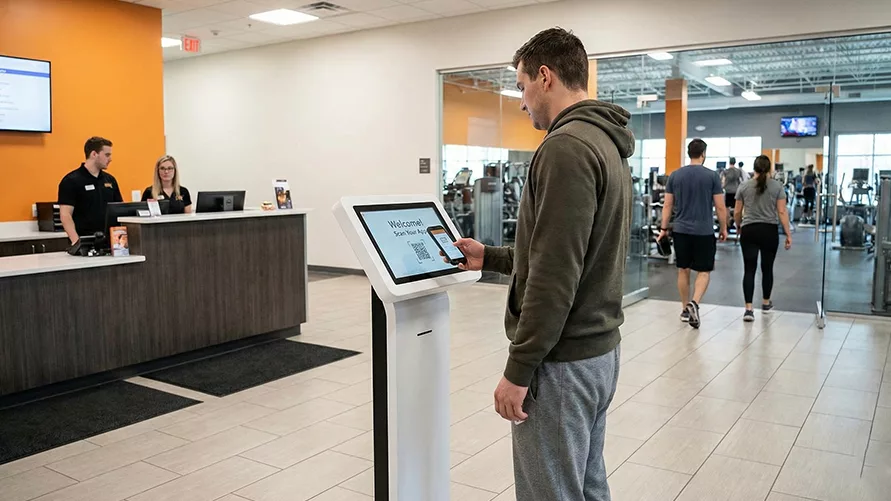
Manual gym billing usually costs more in the long run as it requires more administrative labor. Despite the manpower, it results in missed renewals, duplicated entries, and payment failures, which are more time-consuming than cost-effective. On the other hand, automated invoice systems require software fees but significantly improve billing and collection rates, reduce staff workload, and stabilize recurring revenue.
Most gym owners compare manual billing to automated billing solely based on subscription cost. But the real question is:
Which system protects more revenue, reduces overhead, and strengthens long-term financial stability for a U.S. gym?
For most membership-based gyms in the United States, automating billing costs less over time. Manual billing often drains revenue silently through missed payments, staff labor, inefficiencies, and compliance exposure. This guide breaks down where the money goes and where it’s lost.

What counts as manual billing?
Manual billing means staff handle payment tracking and renewals without automated recurring systems. This often includes spreadsheets, manually sent invoices, individual card entries, and cash or check tracking. Then staff manually reconciles payments with bank statements.
In very small gyms, this may seem manageable at first. But as membership grows, manual processes require increasing administrative time. Every payment must be tracked. Every failed charge must be followed up on manually. Every renewal requires attention. These billing tasks stack on top of daily operations, and they’re prone to errors. As a result, what starts as a money-saver slowly turns into administrative overhead.
What is an automated invoice system?
An automated invoice system integrates gym management software with secure payment processing. It charges members on a recurring schedule, retries failed payments, sends automated reminders, and records all transactions instantly.
Instead of staff tracking payments manually, the system handles:
- Recurring billing cycles.
- Expiration alerts.
- Failed payment retries.
- Secure card and ACH storage.
- Real-time revenue reporting.
- Tax-ready exports for accounting.
In the U.S., most established gyms use automated systems because recurring revenue is the backbone of their business model.
Cost comparison: Manual vs Automated billing
| Cost Factor | Manual Billing | Automated Billing |
| Software Fees | None | $50–$300/month typical |
| Payment Processing | Manual entry | Integrated processing (2–3% cards, lower ACH) |
| Staff Admin Time | High | Minimal |
| Missed Renewals | Common | Automated reminders |
| Failed Payment Recovery | Manual follow-up | Automated retry logic |
| Revenue Predictability | Low | High |
| Compliance & Security | Higher risk | PCI-compliant systems |
| Scalability | Limited | Highly scalable |
The hidden costs of manual gym billing
Manual billing may seem doable initially, but it turns the other way around once your gym scales. Here is what manual billing in a growing gym results in:
Revenue leakage from failed payments
Payment declines are common in subscription businesses. Cards expire. Accounts have insufficient funds. Fraud monitoring flags transactions.
In a manual system, failed payments depend on staff noticing and following up. Some members delay payments. Others forget entirely. Some never respond.
Consider a 300-member gym charging $79 per month. That generates $23,700 in monthly revenue. If just 7% of payments fail and half are not recovered quickly, the gym could lose nearly $830 per month, over $9,900 annually.
That alone can exceed the annual cost of most billing software. Automated systems retry failed payments automatically and send notifications immediately, significantly improving recovery rates.
Administrative labor is a real expense
Manual billing requires ongoing attention. Staff must track due dates, update spreadsheets, send reminders, reconcile payments, correct errors, and manage delinquent accounts.
If an employee spends 10 hours per week on billing at $22 per hour, that equals approximately $880 per month in labor cost, before payroll taxes and overhead.
In cities with higher wage floors, the cost increases further.
Automated billing software reduces this time dramatically. Transactions process automatically. Payment statuses update in real time. Reports generate instantly. Staff can redirect time toward retention, sales, and member experience instead of chasing payments.
Cash flow instability
Recurring revenue is critical for U.S. gyms because expenses such as rent, payroll, and equipment financing are fixed. But manual billing disrupts predictability. Payments may come late. Follow-ups delay cash collection, and forecasting becomes unreliable.
However, automated billing stabilizes cash flow by charging on consistent cycles and retrying failed payments. This creates reliable monthly recurring revenue (MRR), allowing owners to plan confidently. Stable cash flow supports smarter marketing investments, equipment upgrades, and staffing decisions.
Compliance and security risk
Handling card data in the United States comes with PCI compliance obligations. Manual storage of card details, even unintentionally, creates liability exposure.
Automated systems are typically PCI-compliant and securely store payment data within encrypted environments. They maintain audit trails and transaction histories that protect against disputes.
A single compliance issue or data mishandling incident can cost more than years of subscription fees.
Chargebacks and disputes
Chargebacks are a growing issue in subscription businesses. Manual systems often lack detailed transaction records, making dispute defense difficult.
Automated billing platforms record:
- Authorization timestamps.
- Signed membership agreements.
- Payment confirmation logs.
This documentation improves dispute win rates and protects revenue.
Where automated billing creates direct financial gains
Compared to manual billing, automated billing offers several advantages, including:
Higher collection rates
Automated retry logic significantly improves payment recovery. Systems attempt charges multiple times based on structured schedules. Many platforms also offer card updater services to automatically refresh expired card information.
These tools increase successful collection percentages without staff involvement.
Reduced delinquency
When membership access links to billing status automatically, unpaid accounts can be restricted immediately. Members receive structured reminders before and after due dates.
This reduces long-term delinquency and unpaid balances, something manual systems struggle to enforce consistently.
Financial visibility
Automated billing provides real-time insights into:
- Monthly recurring revenue.
- Churn rate.
- Payment failure ratios.
- Revenue by membership type.
- Aging reports for overdue accounts.
Manual spreadsheets can approximate this data, but require significant effort and are often outdated. Better visibility leads to better pricing decisions, improved promotions, and stronger retention strategies.
When may manual billing still work?
Manual billing can function effectively in very small or transitional environments. A gym with fewer than 40 members, operating primarily on cash payments and without recurring contracts, may manage manually without severe inefficiency.
It can also work temporarily during launch phases when membership volume is low. However, once recurring memberships exceed 75–100 members, the administrative load and revenue risk increase sharply.
Scalability: The structural difference
Manual billing scales linearly. As membership grows, so does administrative work. More members mean more invoices, more follow-ups, and more reconciliation.
Automated billing scales without proportional labor increases. Whether you have 150 members or 1,500, the system processes transactions automatically.
For gyms planning expansion, multi-location growth, or franchising, automation becomes infrastructure, not an optional tool.
Scenario to help you understand this better
Consider a 400-member gym charging $69 per month:
Monthly revenue potential: $27,600
Annual potential: $331,200
If manual inefficiencies result in:
- 5% revenue leakage.
- $1,000 per month for administrative labor.
That equals $2,380 in monthly financial impact or $28,560 annually.
Even a $250 per month billing system ($3,000 annually) represents a fraction of that loss. The math becomes difficult to ignore.
Final verdict: What is actually costing you more?
Manual billing looks inexpensive because its costs are invisible. Automated systems look expensive because the fee is obvious.
But US gym owners operating recurring membership models typically lose more through manual inefficiency than they spend on automation.
The real cost is not the software subscription. It is the missed payments, labor overhead, chargeback exposure, inconsistent cash flow, and limited scalability that manual systems create.
For growth-focused gyms, automated billing is not just a convenience; it is a financial control system. If your team spends time chasing payments instead of improving the member experience, the billing system is already costing you more than you think.