





Recently, I was reading through online parent and studio-owner conversations about recital season, and the same frustrations kept showing up.
Long check-in lines. Confused parents. Seating disputes. Volunteers are unsure where to stand. Staff is trying to answer ticket questions while also managing performers backstage.
Almost nobody was talking about choreography, costumes, or decorations.
The more I read, the more obvious it became that many recital frustrations start long before recital day. They start with ticketing.
I have seen that from the front desk, the lobby, and the backstage doors, where parents need help at the exact moment staff are already stretched. Dance recital ticketing is not only about selling seats. It affects parent communication, seating assignments, venue capacity, check-in flow, volunteer coordination, backstage access, revenue tracking, refunds, and post-event reporting.
A successful recital is rarely the result of one great performance. It is usually the result of dozens of decisions made weeks before the curtain opened. This guide is about building that system, not just opening a ticket page.
Why recital season exposes every weak spot
Dance recital ticketing reveals operational gaps because it connects parents, dancers, staff, money, schedules, and safety.
When recital season begins, every loose process becomes visible. A parent who missed one email needs seats. A family with two dancers needs clear show details. A volunteer asks where to stand. A teacher needs the running order. Someone is still chasing unpaid fees.
That is why I treat ticketing as part of dance recital management, not a side task. A ticket tells a family when to arrive, where to go, what to expect, and how prepared the studio feels.
Disconnected systems make the team repeat work. If ticket sales sit in one platform, payments in another, student records somewhere else, and schedules in a spreadsheet, staff become the bridge between all of them.
That bridge gets tired.
Names get missed. Refunds get delayed. Parents receive outdated instructions. This is where dance studio software cuts admin time by keeping daily operations from turning into seasonal guesswork.
Start with the venue before selling a seat
A good dance recital seating plan starts with the room.
Capacity is only the first number I check. I also look at how families enter, where the line forms, and whether the lobby can hold people between shows. A venue can have enough seats and still feel chaotic.
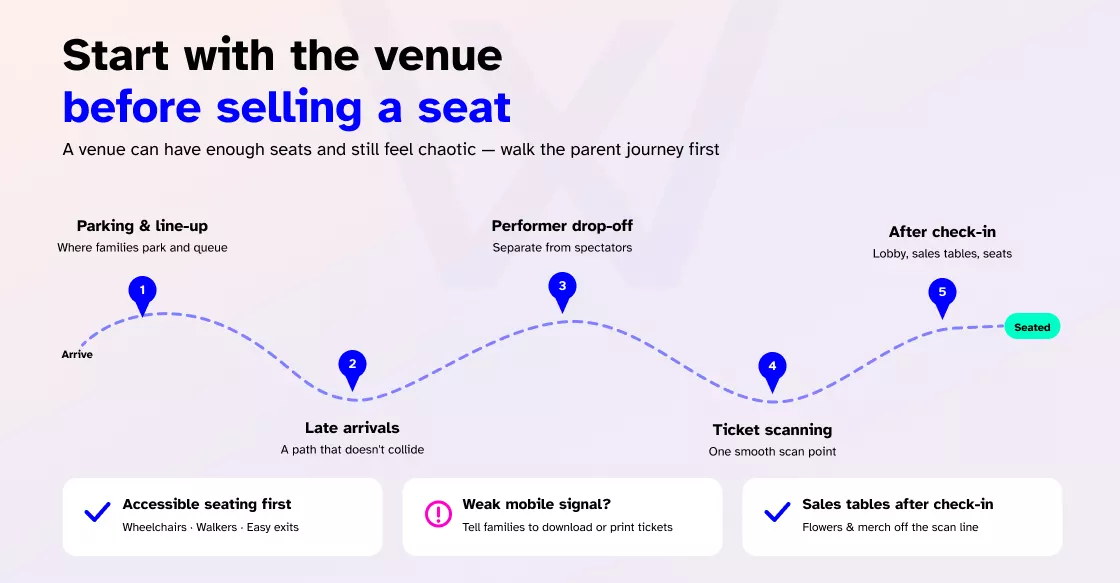
Before I sell dance recital tickets, I walk the parent journey:
- Where do families park and line up?
- Where do late arrivals go?
- Where does performer drop-off happen?
- Where does ticket scanning happen?
- Where do families go after check-in?
If those paths collide, I adjust the plan before tickets go live.
Accessible seating should never be an afterthought. I reserve space for wheelchairs, walkers, and families who need easier entry or exit. I also keep emergency exits open, even when flower tables and relatives fill the lobby.
Mobile signal matters too. If the venue has weak service, QR code scanning may be slow. I tell families to download tickets or bring printed copies.
Merchandise, concessions, flowers, and programs add value, but they create clusters. I keep them away from the main scan line. When possible, I place sales tables after check-in so families are not trying to buy flowers while others are waiting to enter.
Choose the right ticketing model for your show
The best ticketing model is one your staff can manage calmly.
General admission tickets
General admission is easy to set up, and it works for smaller venues or relaxed shows. The tradeoff is pressure at the door. Families arrive early for good seats, volunteers become crowd managers before the door opens, and seat-saving can turn into a parent complaint before the first dancer steps onstage.
If I use general admission, I make door time, seat-saving rules, and late-arrival expectations clear.
Reserved seating tickets
Reserved seating can reduce arguments because families choose seats before they arrive. It works best when the venue map and purchase process are clear.
I still keep a few seats aside for accessibility needs, ticketing mistakes, and last-minute fixes. I treat them as a problem-solving space, not as extra inventory to sell too early.
Performer fees and recital charges
Some studios charge a performer fee to cover venue, staffing, production, and recital costs before ticket sales begin. I understand the logic because it protects fixed costs earlier.
The key is clarity. Parents should know what the fee includes, when it is due, whether tickets are separate, and what happens if a dancer withdraws.
Why do door sales usually create more stress?
I avoid door sales when possible. Collecting payment at the event slows entry, creates awkward conversations, and makes revenue tracking messier.
If door sales are necessary, I keep them at a separate table with clear signage, a clear price, and a staff member who is not also responsible for scanning tickets.
Ticket delivery formats
Ticket delivery affects check-in speed as much as the ticketing model itself. A studio can have the right prices and the right seating plan, but if families cannot find their tickets at the door, the line still slows down.
| Ticket format | Best for | Main risk | How to manage it |
| E-ticket | Most families, QR scanning and online purchases | Weak venue signal or parents searching for email at the door | Tell families to download tickets before arrival |
| Printed ticket | Older relatives, low-signal venues, backup access | Lost paper tickets or duplicate copies | Use clear scan rules and avoid accepting unverified screenshots |
| Wristband | Performer access, volunteers, backstage control | Not ideal for assigned audience seating | Use wristbands for access control, not full ticketing |
| Hybrid format | Most recital setups | Needs clear instructions | Use e-tickets first, printed backup where needed, and wristbands for controlled areas |
The best choice for most studios is a hybrid format. E-tickets keep purchasing and scanning simple. Printed tickets help families who struggle with apps or venues with poor signal. Wristbands or lanyards help separate audience access from backstage access.
That mix gives parents flexibility without turning the lobby into a guessing game.
Recital ticket pricing
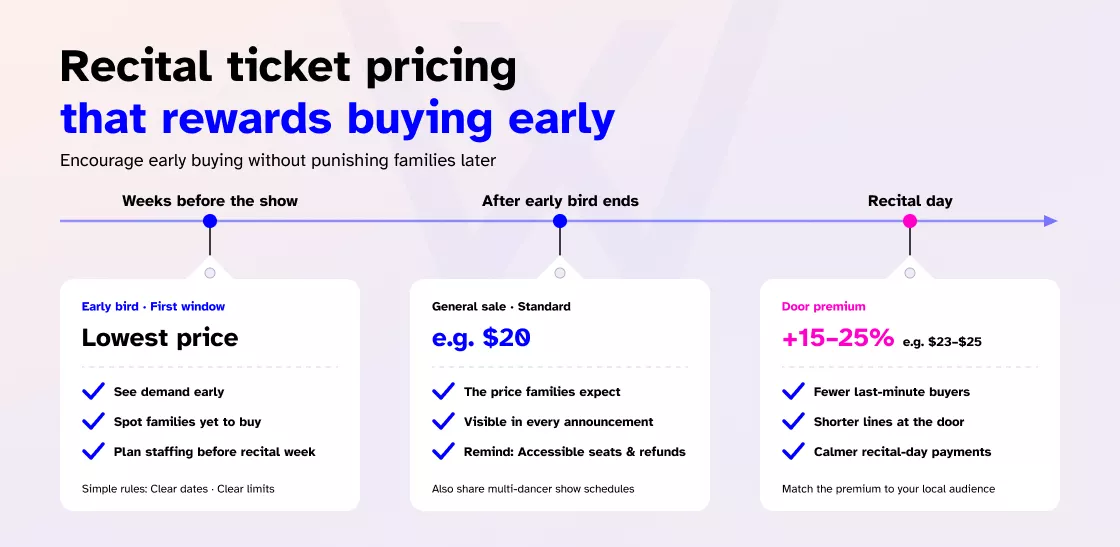
Recital ticket pricing should encourage families to buy early without making the studio look like it is punishing them later.
A simple three-tier structure works well for most shows.
Early-bird pricing
Early-bird pricing rewards families who buy during the first window. It also helps the studio see demand early, spot families who have not purchased, and plan staffing before recital week.
This window works best when the rules are simple: clear dates, clear limits, and clear seating access.
General sale pricing
General sale is the standard price after the early bird ends. This is the price most families expect to pay, so it should be easy to find in every ticket announcement.
This is also the right time to remind families about accessible seating, multi-dancer show schedules, and refund or exchange rules.
Door-premium pricing
If you allow door sales, consider pricing them 15–25% higher than general sale. The goal is not to squeeze families. The goal is to reduce last-minute buying, shorten lines, and keep recital-day payment handling under control.
For example, if general admission is $20, a door ticket may be $23 to $25. The exact premium should match your venue, audience, and local price sensitivity.
Build a seating strategy parents can trust
A fair seating strategy works because families understand the rules early.
| Seating approach | Best for | Main risk | How to manage it |
| General admission | Small venues, informal shows, lower-pressure recitals | Families arrive too early or save too many seats | Publish door time, seat-saving rules, and late-arrival expectations |
| Reserved seating | Larger shows, high-demand recitals, and families who care about the view | Seat map mistakes or complaints about blocked views | Test the seat map and hold a few seats for fixes |
| Accessible holdback seats | Families with mobility, hearing, sensory, or medical needs | Requests come too late | Ask for accessibility requests before tickets open |
| Multi-dancer family seating | Families with siblings in different shows | Parents buy wrong tickets or need back-to-back support | Explain show assignments and ticket rules before checkout |
| Operational holdback seats | Last-minute issues, blocked views and wrong-show purchases | Staff sells every seat too early | Keep a small problem-solving reserve until the final push |
Seat choice feels personal. Parents want a good view. Grandparents may need accessible seats. Families may be juggling siblings, schedules, and multiple shows.
I reduce conflict by publishing the rules early: ticket release date and time, purchase limits, accessible seating process, exchange rules, refund rules, late-arrival policy, and seat-saving rules if general admission is used.
When the policy is clear, staff do not improvise under pressure.
Multi-dancer families need special attention. If siblings perform in different shows, parents should know whether they need separate dance recital tickets, bundled tickets, or a discount option. The worst time to explain this is at checkout.
I also watch for families with dancers in back-to-back shows. They may need help moving between drop-off, seating, and pickup.
Every recital has surprises. A parent bought the wrong show. A seat is blocked by equipment. A family member arrives with a new mobility need. Holding a few seats gives staff options without creating public drama.
Treat ticket sales as a three-phase launch
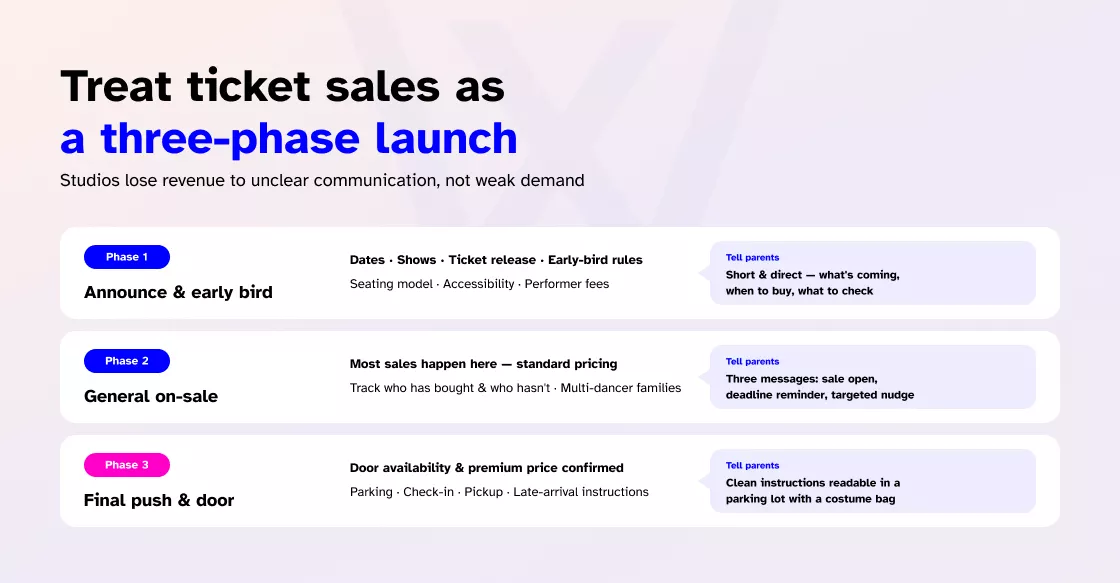
Most studios lose recital revenue through unclear communication, not weak demand.
Parents usually want to attend. The problem is missed dates, misunderstood rules, or a ticket message buried in a long email. Dance recital ticket sales need a rhythm, not one announcement.
Phase 1: Announce and early bird
This phase sets the tone. Announce the recital date, show assignments, ticket release date, early-bird pricing, purchase limits, seating model, accessibility request process, and performer fee details.
The goal is to prevent confusion before tickets open.
Parent communication during this phase should be short and direct. Tell families what is coming, when they can buy, and what they should check before checkout.
Phase 2: General on-sale
This is where most ticket sales happen. Tickets are open, standard pricing is active, and the studio should start tracking which families have bought, which families have not, and where support may be needed.
This is also the right time to check multi-dancer families, refund requests, exchange questions, and accessibility needs.
Parent communication during this phase should focus on reminders. Send one message when general sale opens, one reminder before the next deadline, and one targeted reminder to families who have not purchased.
Phase 3: Final push and door
The final phase is about clarity and control. Send final purchase reminders, explain whether door tickets will be available, confirm the door-premium price if used, and tell families what to bring.
This is also when arrival details matter most: parking, doors, check-in, pickup, venue rules, and late-arrival instructions.
Parent communication during this phase should avoid long blocks of text. Families are busy. They need clean instructions they can find while standing in a parking lot with a costume bag in one hand.
Keep internal deadlines ahead of parent deadlines
If parents need to buy by Friday, I want the team to review sales by Wednesday. That gives us time to spot missing families, duplicate purchases, wrong-show purchases, and accessibility requests.
Internal deadlines create breathing room. Without them, the staff spends recital week reacting.
Refunds, exchanges, and comp seats need one source of truth. I do not want them sitting in the inbox threads or sticky notes. A recital ticketing system should show what changed, who approved it, and what still needs attention.
Communicate before parents start guessing
Parent communication works best when it gives the right information at the right time.
I still use one complete recital guide, but I do not expect parents to absorb everything from it. Families are busy. They skim before leaving the house.
A long guide should be the reference. Short reminders should carry the deadlines.
Early messages should cover fees, show assignments, ticket sale dates, and pricing windows. Mid-season messages should cover seating, rehearsal, costumes, hair, and makeup. Final-week messages should cover arrival, check-in, pickup, parking, and venue rules.
That sequence reduces support requests because parents are not decoding everything at once.
Visual guides help when details matter. I like simple slides for hair, tights, shoes, makeup, costume pieces, rehearsal times, and pickup steps. Parents can save and share them.
When every email says “important,” parents stop noticing. I reserve urgent language for true deadlines and safety rules. Clear timing is kinder than louder messaging.
Use software to reduce administrative friction
Dance recital ticketing software should remove handoffs between sales, payments, schedules, and reporting.
I do not judge software by a long feature list. I judge it by the pressure it removes.
A useful system should show who paid, who has tickets, which show a dancer belongs to, what messages were sent, and what still needs attention.
The hidden cost of disconnected systems is staff attention. Every export, copy, paste, manual payment note, and separate parent list creates risk.
That risk gets expensive during recital week. A missed refund or a wrong show assignment can take longer to fix than a proper setup.
When ticketing connects with enrollment and payments, the team can work with cleaner information. Family accounts, balances, rosters, and communication history all matter during recital season.
For studios reviewing their setup, dance studio software is the natural next step because recital planning works better when enrollment, billing, communication, and scheduling live closer together.
Dance class software should support more than weekly attendance. It should help with groups, schedules, billing, messages, and records all year. The better question is whether dance class software earns its cost across daily operations.
Think beyond ticket revenue
Recital revenue should be tracked as several streams, not only ticket sales.
Tickets matter, but they are not the whole financial picture. A well-run recital may also include photos, programs, flowers, merchandise, and video sales. Each stream has different costs, labor, margins, and parent expectations, so I track them separately.
Photos
Photo sales work best when parents know the process before recital day. That means clear rules about who can take photos, whether a professional photographer is used, and how families will access galleries afterward.
Pre-orders can help estimate demand, but post-event galleries often catch families who want to buy once they see the images. The important part is to keep photo questions away from the check-in line.
Programs
Programs can be printed, digital, or both. A simple recital program gives families dancer names, class order, staff credits, sponsor ads, and a keepsake they may actually hold onto.
If sponsors are included, keep the layout clean. A program should feel like part of the recital experience, not a stack of ads with a running order squeezed inside.
Flowers
Flowers are one of the easiest recital add-ons because families already expect them. Pre-sale bundles make planning cleaner and help the studio avoid handling too many small payments at the door.
I place flower pickup away from ticket scanning. Otherwise, one excited grandparent buying roses can slow down twenty families trying to enter.
Merch
Recital merch works when it feels specific to the event. A recital shirt, hoodie, tote, or small keepsake can perform better than a large product table with too many choices.
Limited options are easier for parents and easier for staff. I would rather sell three well-planned items clearly than manage twelve products that create inventory leftovers.
Video
Video sales need clear rules. Parents should know whether personal recording is allowed, whether the studio is providing a professional recording, and how the final video will be delivered.
This is also where privacy matters. If minors are involved, the studio should be careful about consent, access, sharing rules, and delivery format.
Cleaner reporting for every stream
A dance studio POS system helps when event sales need clean categories. I want to know what sold, when it sold, who paid, and what needs refunding.
Refund rules should be written before tickets open. Staff need a policy they can apply consistently. Otherwise, every request becomes a negotiation, and the most persistent complaint can shape the rule.
Venue deposits, costumes, staffing, and production costs often arrive before final ticket revenue. Planning early keeps recital week from feeling financially tense.
Give volunteers jobs, not vague help
Volunteers reduce chaos when their roles are narrow, clear, and well-defined.
I never ask volunteers to “just help.” That creates confusion. I assign specific roles such as ticket scanner, lobby greeter, usher, dressing room runner, performer check-in helper, backstage door monitor, merchandise table helper, and flower pickup helper.
Each role needs a location, time, and escalation contact.
Volunteers should not invent policy answers. I give them short scripts: “Ticket changes are handled at that table,” or “Performer pickup starts after the finale.” Simple language keeps parents moving.
Backstage access, pickup verification, cash handling, and conflict resolution should not go to first-time volunteers. Those roles need calm, trusted adults.
Every volunteer should know who to call when something goes wrong. Without an escalation plan, one small problem creates a gap somewhere else.
Treat backstage access as a safety system
Backstage access must be controlled because recital day involves minors, costumes, movement, and crowds.
I am firm about backstage boundaries. Parents may feel comfortable walking in, but comfort is not the standard. Accountability is. I need to know which adults are allowed in performer areas.
Lanyards, wristbands, pickup cards, and verified lists can all work. Consistency matters more than the format. If one parent needs an ID, every parent needs an ID.
This is also where ticket delivery and backstage control should stay separate. A parent ticket should not automatically mean backstage access.
Backstage should not become ticket support. When parents ask about seating near dressing rooms, the safety boundary weakens. I keep ticket help in the lobby and performer areas focused on dancers.
Younger dancers need room leads, name lists, and pickup steps. Older dancers still need accountability for quick changes, props, and finale lineups.
Use rehearsals to protect the audience experience
Rehearsal organization shapes how the show feels from the seats.
Parents notice when transitions drag, dancers look unsure, or pickup feels messy. They may not know the cause, but they feel the effect. I use rehearsals to test movement and timing.
Quick changes need space and time. Props need a home. Teachers need to know when they are required backstage, in the wings, or in holding rooms. These details protect the show’s pace.
If check-in is confusing during rehearsal, it will be worse on recital day. I test the process with real families when possible. That shows where signs, volunteers, or timing need adjustment.
Rehearsal conflicts create audience problems later. When classes, rooms, teachers, and dancers are visible together, studios can prevent avoidable issues before the venue fills.
This is where dance studio scheduling software for rehearsal coordination can support planning, class visibility, and smoother recital preparation.
Review the show before memory softens it
A post-event review turns recital stress into next year’s plan.
I review tickets sold by show, late purchases, refunds, no-show seats, merchandise sales, photo sales, program sales, flower sales, video sales, check-in delays, support emails, volunteer gaps, and parent feedback.
None of this needs to be fancy. It just needs to be honest.
I ask three questions after every recital:
- What confused parents most?
- Where did staff feel stretched?
- What should we decide earlier next year?
Those answers usually reveal the real work.
Parent feedback is most useful when we connect it to operations. If parents complain about lines, I look at arrival times and scanning speed. If they complain about seating, I review the release process.
The point is not to defend every decision. It is to notice what the next recital can do better.
Bringing the system together
Dance recital ticketing works when it supports the whole recital, not just a seat sale.
After years of watching recital season unfold, I have learned that parents rarely remember whether a studio used paper tickets or QR codes. They remember whether the day felt organized, whether they found their seats easily, whether the show started on time, and whether they felt informed.
That is why dance recital ticketing is never just about tickets. It is one of the systems that quietly determines whether recital day feels stressful or successful.
If your studio is ready to connect ticketing with payments, scheduling, POS, communication, and daily operations, Wellyx is worth exploring. The real goal is bigger than software: giving families a recital day that feels cared for from the first email to the final pickup.
FAQs
What is dance recital ticketing?
Dance recital ticketing is the system for selling, assigning, scanning, refunding, and reporting recital seats. I treat it as part of recital operations, not just checkout. My practical recommendation is to connect ticket rules with seating, check-in, parent communication, and backstage access before tickets open.
How early should we start dance recital planning?
Studios should start dance recital planning several months before the show, even if ticket sales open later. Early planning should cover venue flow, show assignments, fees, seating rules, volunteer roles, pricing windows, and communication dates. I recommend building the ticket timeline after these decisions are already clear.
Should we use general admission or reserved seating?
Reserved seating usually reduces parent disputes, while general admission is easier to set up but can create door pressure. I choose based on venue size, demand, and staffing. If families care strongly about seat choice, I recommend reserved seating with clear purchase windows.
What is the best ticket delivery format for a dance recital?
A hybrid ticket delivery format is usually best. E-tickets work well for fast scanning, printed tickets help as a backup, and wristbands or lanyards help control backstage and volunteer access.
How should dance recital tickets be priced?
A simple model is early-bird pricing, general sale pricing, and door-premium pricing. If door sales are allowed, many studios use a 15–25% premium to reduce last-minute buying and keep check-in moving.
What should dance recital ticketing software include?
Dance recital ticketing software should include online sales, seat management, payment tracking, confirmations, scanning, refunds, and reports. I also look for parent communication and student record connections. My recommendation is to choose software that removes double entry, not just software with a clean ticket page.