



Building a dance studio website starts with a domain name, a reliable website builder, clear pages, class schedules, instructor profiles, online booking, and local SEO. Together, these pieces help prospective students find your studio and enroll more easily. A well-structured website does more than present information; it acts as a digital storefront that showcases your studio’s culture, instructors, programs, and community.
Whether you run a ballet academy, hip-hop studio, or multi-discipline school, a well-planned website can help attract new students, simplify bookings, and strengthen your brand presence online. Follow these 10 steps to build a dance studio website that looks professional and converts visitors into enrollments.
Step 1: Define your dance studio website goals
Before designing the website, clarify what you want the site to achieve. A dance studio website should support both marketing and operations. Most studios build a website to:
- Attract new students in your local area.
- Display class schedules and programs.
- Enable online bookings or registrations.
- Promote recitals, workshops, and events.
- Share updates with current students and parents.
Defining these goals helps you determine what pages and features you need. For example, if your priority is enrollment, your website should prominently feature class schedules, beginner programs, and trial booking options.
Tip: Design every page around a primary action such as “Book a trial class” or “View the class schedule”. Clear actions reduce confusion and increase sign-ups.
Step 2: Choose a domain name and hosting
Your domain name is the online address of your dance studio. It should be short, memorable, and related to your studio brand. Examples of effective domain strategies include:
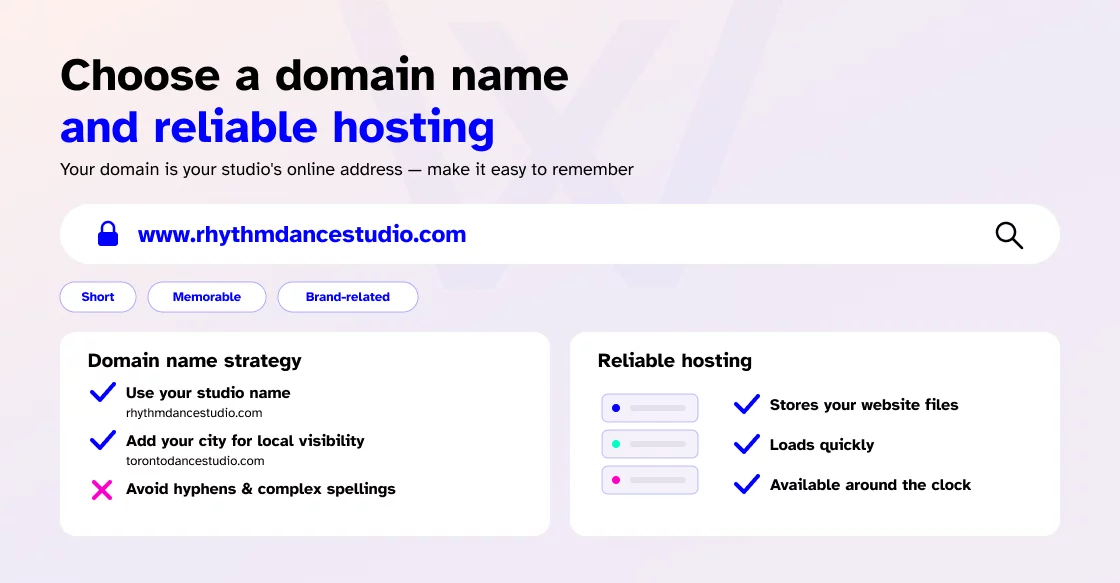
- Using your studio name (e.g., rhythmdancestudio.com).
- Adding your city for local visibility (e.g., torontodancestudio.com).
- Avoiding hyphens or complex spellings.
Hosting is the service that stores your website files and makes them accessible online. Reliable hosting ensures your website loads quickly and remains available to visitors at all times.
SEO Tip: If you operate in a specific city, including the location in your domain or page titles can improve visibility for searches like “dance classes near me”.
Step 3: Pick the right website builder
Most studio owners do not need to code a website from scratch. Website builders make it easy to design a professional site with drag-and-drop tools. Popular website builders include:
| Website Builder | Best For | Key Strength |
| WordPress | Highly customizable websites | Large plugin ecosystem |
| Wix | Beginners with no coding experience | Drag-and-drop design |
| Squarespace | Design-focused studios | Clean templates |
| Studio management platforms | Studios needing automation | Built-in scheduling and payments |
When choosing a platform, prioritize features that dance studios need:
- Class schedule integrations.
- Booking or registration forms.
- Mobile-responsive templates.
- Image and video galleries.
A platform Wellyx, that integrates with studio management and booking systems, can save significant time when managing enrollments and schedules.
Tip for efficiency: Choose a builder that supports calendar integrations and automated registrations so students can enroll without manual communication.
Step 4: Design your website structure
A clear website structure helps visitors find information quickly and improves search engine visibility. Each page should follow a clear structure so visitors can understand the information quickly. Most successful dance studio websites include the following core pages:
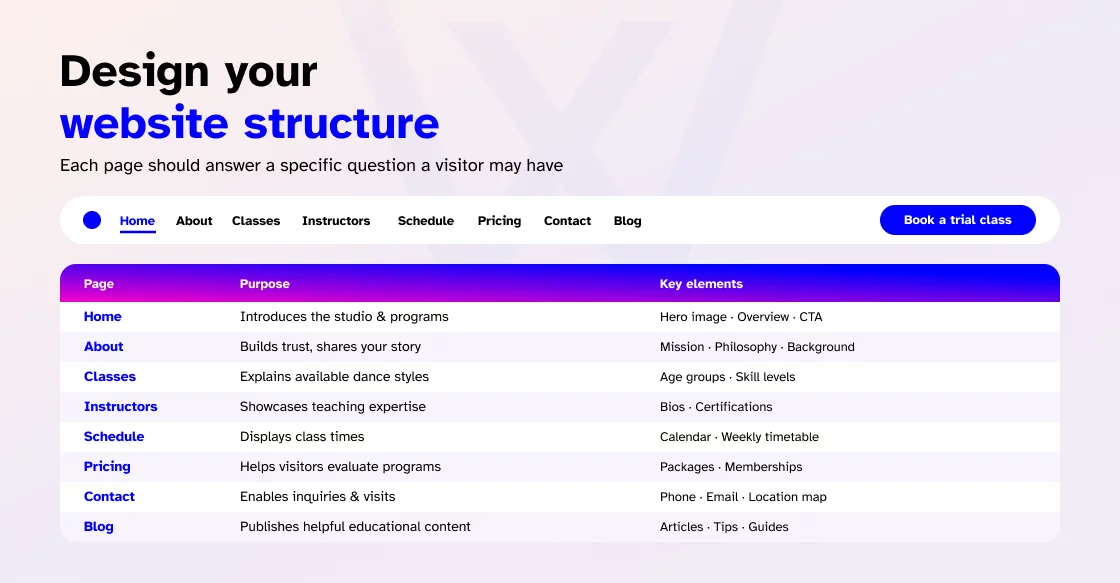
| Website Page | Purpose | Key Elements |
| Home | Introduces the studio and programs | Hero image, overview, call-to-action |
| About | Builds trust and shares the studio story | Mission, philosophy, background |
| Classes | Explains available dance styles | Age groups, skill levels |
| Instructors | Showcases teaching expertise | Bios, certifications |
| Schedule | Displays class times | Calendar or weekly timetable |
| Pricing | Helps visitors evaluate programs | Packages, memberships |
| Contact | Enables inquiries and visits | Phone, email, location map |
| Blog | Publishes helpful educational content | Articles, tips, guides |
Each page should answer a specific question a potential student may have. For example, parents often visit instructor pages to understand the experience and teaching background of the staff.
Conversion tip: Place a “Book a trial class” button in the navigation so visitors can register from any page.
Step 5: Add class schedules and online booking
A visible class schedule is one of the most important elements of a dance studio website. Visitors should immediately understand:
- What classes are available?
- When they take place?
- Who they are designed for?
Interactive schedules or calendar views allow users to filter classes by age group, style, or skill level. Online booking or registration further simplifies the enrollment process. Instead of calling the studio, prospective students can reserve a class instantly.
Insight: Studios that offer online bookings and instant confirmations typically see higher enrollment rates because the signup process is faster and more convenient.
Step 6: Use high-quality photos and videos
Dance is highly visual, and your website should reflect the energy, creativity, and personality of your studio. The visuals, colors, and graphics say a lot about your dance studio’s values and philosophy. It has to be strong, purposeful, and aligned with your brand values. Strong visual content means it should include:
- Photos of classes in action.
- Performance or recital highlights.
- Behind-the-scenes rehearsals.
- Instructor introductions.
- Studio facility tours.
Videos are especially powerful because they help visitors imagine themselves participating in your programs.
Engagement tip: Feature a short homepage video showcasing classes and performances. This instantly communicates your studio atmosphere and teaching style.
Step 7: Add testimonials and trust signals
Parents and adult beginners often research a studio before committing to classes. Trust signals reassure visitors that your studio provides quality instruction. Examples of strong credibility elements include:
- Student testimonials.
- Parent reviews.
- Competition awards.
- Instructor certifications.
- Media mentions.
Displaying positive feedback from current students helps potential clients feel confident about joining your studio.
Conversion tip: Highlight testimonials near the class registration or booking section to positively reinforce trust at the moment visitors are deciding whether to enroll.
Step 8: Optimize the website for local SEO
Dance studios rely heavily on local search visibility. Parents often search online before they ever visit a studio in person. They mostly search for studios online with queries such as:
- Dance classes near me.
- Ballet classes for kids in [city].
- Hip-hop dance studio in [location].
These queries are keywords that you can naturally use in your website content to improve your local search performance. Here is what you should do:
- Include your city name in page titles and headings.
- Create pages for specific programs (e.g., Kids ballet classes in Chicago).
- Embed a Google Maps location on your contact page.
- List your studio on Google Business Profile.
These signals help search engines connect your studio with people searching for dance classes nearby.
SEO tip: Use local keywords naturally and contextually throughout your site, especially on class pages and location descriptions.
Step 9: Ensure the website is mobile-friendly and fast
Most people searching for local services use mobile devices. If your website loads slowly or does not display properly on a smaller screen, potential students may leave immediately.
A mobile-optimized dance studio website should:
- Load in a few seconds.
- Use responsive design layouts.
- Display clear navigation menus.
- Make booking forms easy to complete on phones.
Fast and responsive websites not only improve user experience but also help improve search rankings.
Performance tip: Compress images and videos so your site loads quickly without sacrificing visual quality.
Step 10: Publish helpful content to attract students
Beyond the main pages, creating helpful content can attract new audiences through search engines. A blog section helps your website rank for informational searches and reach new audiences who may not yet be looking for a specific studio.
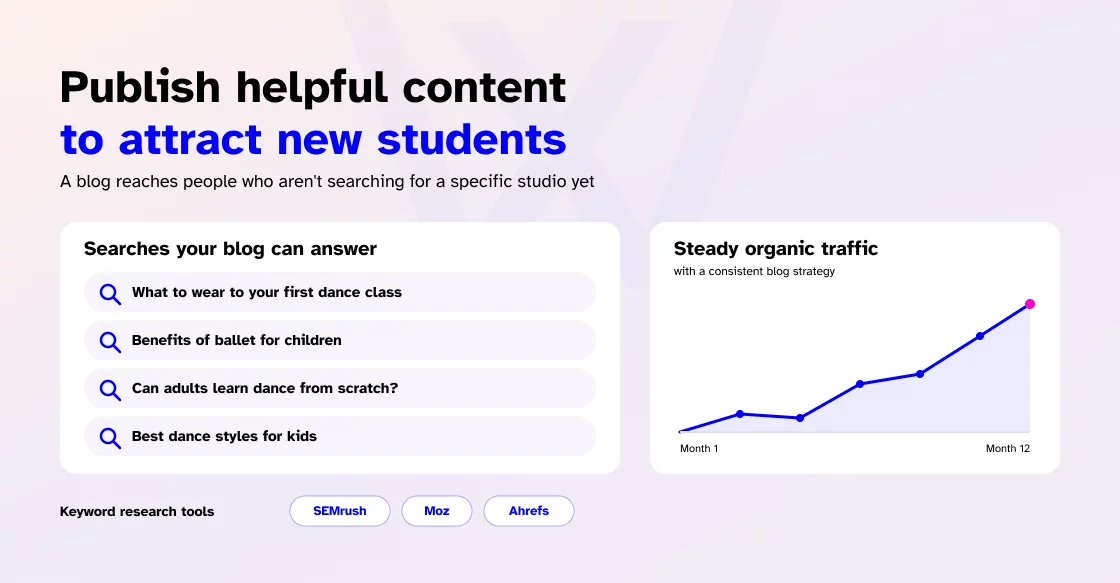
Publishing helpful articles allows your website to appear in searches such as:
- What to wear to your first dance class.
- Benefits of ballet for children.
- Can adults learn dance from scratch?
- Best dance styles for kids.
Each blog post answers a specific question that potential students might search online. But for more strategic content creation, use SEO keyword research tools like SEMrush, Moz, and Ahrefs. These tools help you find the most relevant keywords in your niche. Creating content around those keywords increases your chances of appearing in search results and AI Overviews.
Over time, a consistent blog strategy can bring steady organic traffic to your website.
Growth tip: End each blog article with a call-to-action such as “Book your first dance class” or “View our weekly class schedule.”
Essential features every dance studio website must include
Even a simple dance studio website should provide tools that help visitors quickly explore programs and enroll. Important features include:
- Class schedules and calendars.
- Online booking or registration.
- Instructor profiles.
- Photo and video galleries.
- Integrated payment options in dance school management software.
- Testimonials and reviews.
- Contact forms and maps.
These elements create a seamless experience where visitors can discover, evaluate, and join your studio easily.
Common dance studio website mistakes to avoid
Many studios launch websites that look appealing but fail to convert visitors into students. The most common mistakes include:
- Hiding the class schedule deep within the site.
- Not displaying pricing or trial options.
- Slow-loading pages with large images.
- Poor mobile design.
- Missing calls-to-action.
Avoiding these issues ensures your website works as a growth tool rather than just an informational page.
Dance studio website launch checklist
Before publishing your website, review this quick checklist to ensure everything is ready:
- Domain name registered
- Website builder selected
- Core pages created
- Class schedule added
- Online booking embedded
- Photos and videos uploaded
- Testimonials included
- Mobile optimization tested
- Google Business Profile set up
Completing this checklist helps ensure your website launches smoothly and supports student enrollment from day one.
Final words
A dance studio website is one of the most important assets for growing your studio. When designed thoughtfully, it showcases your programs, builds trust with prospective students, and simplifies enrollment through clear schedules and online booking options.
By following these ten steps, you can build a website that represents your studio clearly, supports enrollment, and helps new students find you over time.
FAQs
How much does it cost to build a dance studio website?
Costs to build a dance studio website can vary depending on whether you build the site yourself or hire a designer. A basic website using a builder may cost $100–$500, while professionally designed websites can cost several thousand dollars.
How long does it take to build a dance studio website?
Depending on the complexity of the design and features, a basic website can be built within one day or a complex one can take up to two weeks. Websites created with simple drag-and-drop builders can be launched quickly. However, more advanced websites that include booking systems, SEO pages, or extensive media content may require additional planning and setup.
What pages should a dance studio website have?
At minimum, a dance studio website should include a home page, about page, classes page, instructor profiles, schedule, pricing, and contact page.
Can a dance studio website help attract new students?
Yes, a well-optimized website can become one of the most effective tools for attracting new students. When optimized for local search and supported by helpful content, your website can appear for relevant dance class searches.
Can a dance studio website accept online bookings?
Yes. Many website builders and studio management platforms offer class booking, payment processing, and membership management tools that integrate directly into the website.