




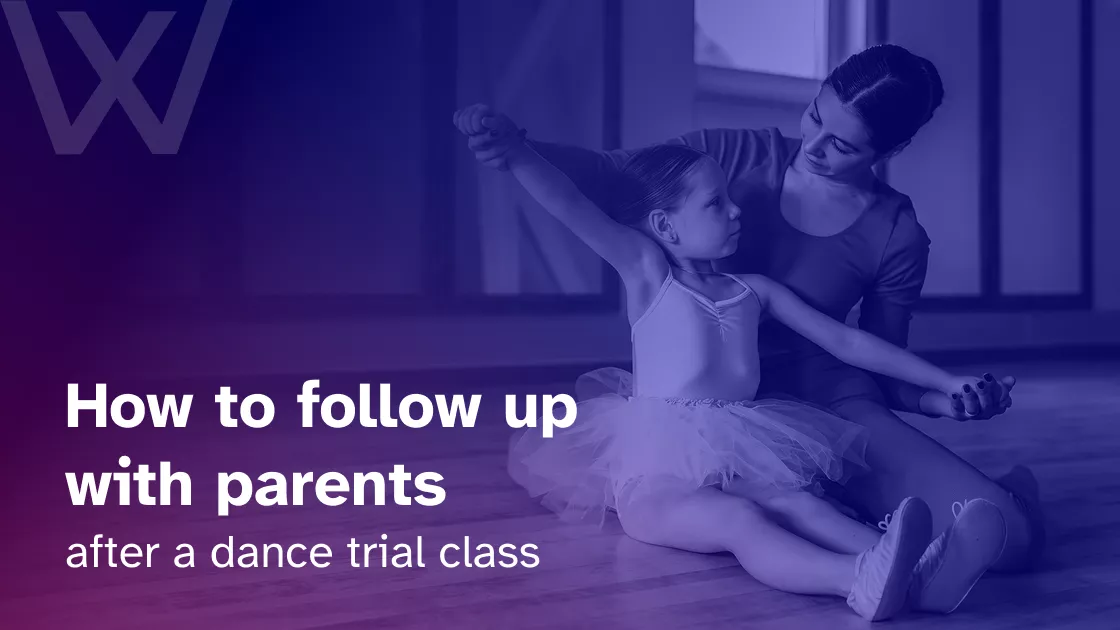
Most studios put real effort into the trial class itself: a welcoming instructor, a well-run first session, a child who leaves smiling, and then send one generic follow-up email a few days later, if that. The family doesn’t respond, and the studio assumes they weren’t interested. Often, they just seem to have a question the follow-up never answered: Is this a full-year commitment? Was it normal for my kid to seem shy the whole time? Which class actually fits my daughter? A trial class that goes well can still end in silence, not because the family lost interest, but because nobody addressed the specific thing they were quietly weighing. This guide is about closing that gap.
Two people to convince, not one
Follow-up messaging often speaks to a single audience, as if the person reading the email is the same person who decides whether to enroll.
With younger dancers especially, the parent usually initiates the trial and makes the final call, but the child’s reaction during the class is what the parent is actually weighing. A follow-up that only addresses logistics and pricing skips the question the parent is really asking themselves: did my kid actually like it?
A child who lit up during the trial but a parent still comparing studios on cost and schedule needs a different message than a parent who’s ready to enroll but noticed their child seemed unsure the whole time.
Structure follow-up to check in on both, explicitly. Ask how the child felt about the class, not just whether the parent has questions about enrolling. The two answers often point to two different next messages.
The most common version of this mismatch has a name every studio owner recognizes: the shy kid.
What to say when the kid was too shy to fully join in
A child who stands at the back, doesn’t fully participate, or looks overwhelmed during a first class is one of the most common trial outcomes, and it’s also the one most likely to end with a parent quietly deciding, “dance isn’t for her,” without ever saying so.
First-time shyness in a new group setting is developmentally normal, not a signal about long-term fit. But a parent watching from the sidelines doesn’t necessarily know that, and a generic follow-up that doesn’t mention what they just watched leaves that worry unaddressed.
A parent whose daughter stood near the wall for most of the trial may never ask the studio about it directly. She just doesn’t book the next class, and the studio never learns why.
Name it directly and reframe it, briefly and warmly: something like, “It’s completely normal for a first class in a new group to feel a little big; most dancers open up by the second or third session once the routine feels familiar.” That single sentence answers the question the parent hasn’t asked out loud.
Shyness is about the class itself. The next objection usually concerns everything that follows it.
Addressing the real commitment, not just the trial
Many dance studios build their year around a recital, which means enrollment isn’t really a single class purchase; it’s a season-long commitment that often includes costume fees, rehearsal attendance, and a performance date months away. Parents who don’t realize that upfront feel misled once they find out.
A trial class is low commitment by design. The actual ask, once someone enrolls, frequently isn’t. If follow-up messaging avoids mentioning the season structure, hoping to keep the ask small until the parent is more invested, parents often discover it later on their own, through a costume order form or a rehearsal schedule, and the discovery reads as a bait-and-switch even when it wasn’t intended as one.
A parent enrolls thinking they’ve committed to a monthly class, then receives a costume payment request in November for a recital they didn’t know was mandatory.
Name the real commitment in the follow-up itself, plainly and without apology: “Just so you have the full picture, our fall session runs through the spring recital in May, which includes a costume fee in the winter.” Parents who know the full ask upfront and still enroll are far less likely to drop mid-season than parents who found out gradually.
For some studios, that season structure also creates a real deadline, which changes how urgent the follow-up itself needs to be.
When enrollment has an actual deadline
Studios that enroll by season, tied to a recital cohort, have a real cutoff date. Generic follow-up advice rarely accounts for that, treating every trial family as if they can decide whenever they’re ready.
If registration genuinely closes once choreography is set or costumes are ordered, a family who takes three weeks to decide may simply be too late, not because they were rejected, but because the studio never made the deadline clear.
A family trials in late September, plans to “think about it,” and doesn’t hear back from the studio again until a casual email in November, well after costume ordering closed for that recital’s cast.
If a deadline is real, say so once, clearly, without manufacturing urgency that isn’t there. “We’re finalizing this fall’s roster by [date] so costumes can be ordered in time for the class” is a fact, not a sales tactic, and it gives an undecided family a genuine reason to decide sooner rather than later.
Not every family who hesitates is undecided about enrolling at all. Some are undecided about which class.
Helping parents choose the right class
Dance has more style and level variation than most activities. Ballet, jazz, tap, hip-hop, and contemporary are all options, and a single trial often doesn’t answer which one actually fits a specific child.
A follow-up that only asks, “Are you enrolling?” misses families who are genuinely interested but uncertain about placement, not commitment.
A parent whose son enjoyed a hip-hop trial but wonders whether a more structured class would build better fundamentals first is a real question, not a stall tactic.
Treat the second follow-up touch as a consultative touch. Offer a specific recommendation based on what the instructor observed during the trial, rather than leaving the family to guess from a class list alone.
A real follow-up sequence, with templates
A sequence works better than a single message because different families need different pieces of information at different moments, and a single email can’t do all of that without feeling like a wall of text.
Same day, text message. Speed and channel both matter here. The Kellogg School of Management and MIT’s Lead Response Management study, based on more than 100,000 real contact attempts, found that reaching out within five minutes made a business 100 times more likely to make contact and 21 times more likely to qualify the lead than waiting 30 minutes. Channel matters too: industry benchmarking across major SMS platforms puts text message open rates around 95 to 98 percent, against roughly 20 to 28 percent for email, though that figure is an informed estimate based on delivery and response data rather than a precisely instrumented metric, since text has no exact equivalent to an email tracking pixel.
“Hi [Parent name], it was great having [Child name] in class today! We’d love to see them again; let us know if you have any questions.”
Day 2 to 3, personal email or call. This is where the shy-kid reframe or the real-commitment context belongs, whichever applies.
“Hi [Parent name], thanks again for bringing [Child name] to try [class name]. [Specific detail the instructor noticed]. First classes can feel a little new; most dancers settle in by the second or third session. Happy to answer any questions about our fall session, which runs through the spring recital in May.”
Days 5 to 7, address the objection directly. By now, silence usually means a specific question is unanswered, not disinterest.
“Hi [Parent name], just checking in, no pressure at all. If cost, scheduling, or anything about the class structure is still a question, I’m happy to talk it through. We’re finalizing our roster by [date], if that’s helpful to know.
If a deadline applies, one final reminder close to the date. Factual, not pushy: the date, what it affects, and an easy way to say yes.
Action table
| Parent hesitation signal | What it usually actually means | Which touch addresses it |
| Child was quiet or reluctant during trial | Normal first-class shyness, not a fit problem | Day 2-3 message, name it and reframe it |
| No response after a positive trial | An unanswered question, often cost or commitment | Day 5-7 message, address objections directly |
| Asks about pricing repeatedly | Needs the full season commitment explained plainly | Day 2-3 or 5-7, name the real ask |
| Says “we’re still deciding” close to a cutoff | May not know a real deadline exists | Final deadline reminder, factual and specific |
| Asks which class or level fits | Genuinely undecided on placement, not commitment | Day 2-3, consultative class recommendation |
Where this fits into your operations
None of this works consistently if trial attendance, follow-up timing, and what actually came up during the trial live in a notebook or a staff member’s memory. A sequence only helps if the second message actually reflects what happened in the first class, not a generic template sent to everyone.
Wellyx’s dance school software keeps lead and trial bookings, family notes, and follow-up timing in the same system, so a reasonable amount of manual work, remembering which family’s kid was shy, which family asked about cost, which family is close to a deadline, becomes a record any staff member can see instead of something only one person remembers. This doesn’t write the message for you. It just means the message can actually reflect what happened.
Self-audit: Is your follow-up addressing the real objection
- Do you know which objection came up most in your last ten trial classes: shyness, cost, scheduling, or placement?
- Does your follow-up message change based on what actually happened in the trial, or is it the same template for every family?
- If your studio has a real enrollment deadline, does your follow-up sequence mention it, and when?
- Would a staff member other than the instructor know what came up during a specific family’s trial?
- How many of your last 20 trial families never heard from your studio again after the trial itself?
Owner action checklist
- Send a same-day text after every trial class, not just an email days later
- Build the shy-kid reframe into your standard second-touch message rather than improvising it each time
- State your studio’s real season commitment (recital, costume costs, rehearsal expectations) plainly in follow-up, not just at enrollment
- If enrollment has a real cutoff, name the date directly at least once in the sequence
- Track what came up during each trial so the follow-up can reference it specifically
- Review trial-to-enrollment outcomes monthly to see which objection is costing you the most families
Frequently asked questions
How soon after a trial class should a studio follow up?
Same day is ideal, ideally within a few hours by text, followed by a more detailed email or call within two to three days. Research on general lead response speed found contacting someone within five minutes made a business dramatically more likely to reach and qualify them, and that urgency fades quickly with delay.
What if the parent doesn’t respond to the first message?
Don’t assume disinterest. Silence after a good trial usually means an unanswered question, not a lost family. A second message a few days later that names a specific likely objection, cost, the season commitment, or how the class actually went often gets a response the first generic check-in never did.
Should follow-up messages mention pricing?
Yes, especially the real season-long commitment if your studio has one. Parents who learn the full cost structure gradually, a costume fee here, a rehearsal requirement there, after they’ve already enrolled, are far more likely to feel misled than parents who saw the whole picture plainly in follow-up before ever deciding.
How many follow-up touches should a studio send before moving on?
Three is a reasonable standard: a same-day text, a more detailed message a few days later, and a final check-in about a week out. A fourth touch only makes sense if there’s a genuine enrollment deadline worth referencing directly, not as a reason to keep messaging indefinitely.
Does a shy trial class mean a child won’t enjoy dance?
Not usually. First-time reservations in a new group setting are common and developmentally normal, and they often fade within the first few classes once the routine feels familiar. It’s worth saying that directly and warmly to parents in follow-up, rather than assuming they already know it and staying quiet.
Closing the gap after the trial
A trial class that goes well shouldn’t end in silence, and most of the time, it doesn’t have to. The families who don’t come back usually have a specific, answerable question: Was my kid okay? What am I actually signing up for? Which class fits? A follow-up sequence that answers those questions directly, instead of sending one generic message and hoping, is usually the difference between a trial that converts and one that quietly disappears.
If you want to see how Wellyx keeps trial notes and follow-up timing in one place, book a demo.