




A parent is asking about recital tickets. A teacher wants next month’s schedule. One student has missed three classes in a row. Tuition is due next week. And the mirror installer still has not called back.
That is the part most people do not picture when they dream about owning a dance studio. They picture the music, the stage, the smiling kids, and the final performance. They do not picture payroll, attendance drops, flooring quotes, refund questions, or parents asking hard questions.
But that is the job.
If you want to learn how to run a dance studio, you have to run the whole machine. Not just the class. Not just the show. Everything. That includes the business plan, the space, the budget, the schedule, the team, and the full student and parent experience.
This guide is built for that. It is not fluffy advice. It is one clear system to help you run a studio that is safe, structured, profitable, and easier to manage.
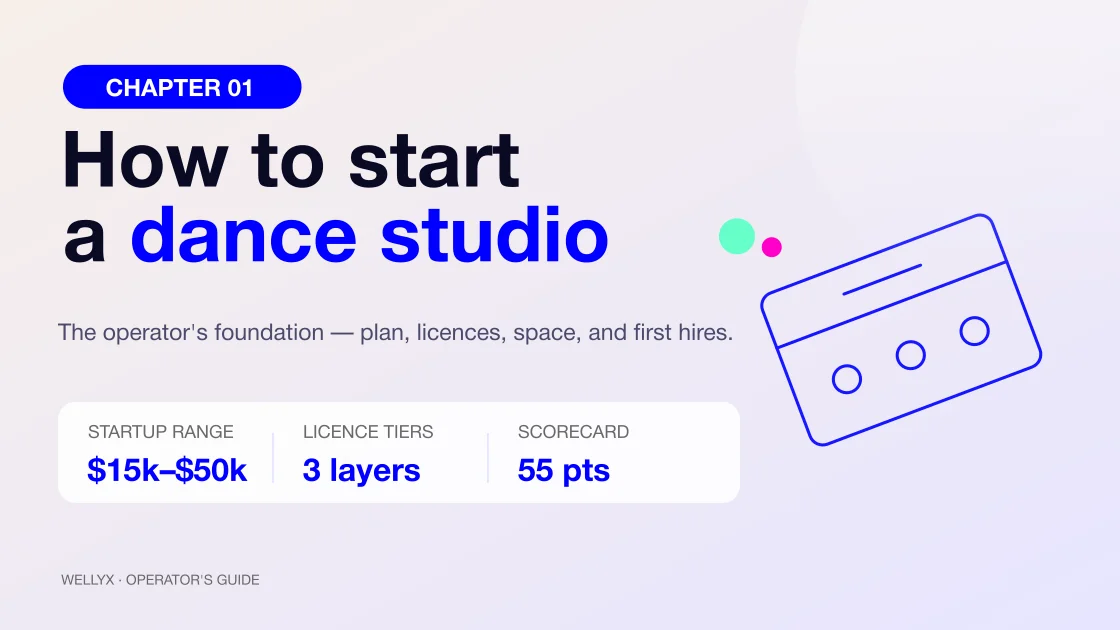
Chapter 1: How to start a dance studio
Before any mirrors go up or music plays, the real work begins with building a strong foundation that can support everything your studio will become.
How to run a dance studio before opening day
If you want this simple answer, here it is: You run a dance studio well by making smart decisions before the first class ever starts.
That sounds boring. It is not.
It is the difference between a studio that grows on purpose and one that lives in panic mode.
A lot of owners start from the heart. That part matters. You should care deeply about dance, kids, adults, training, creativity, and community. But care does not pay the rent. Care does not fix a bad lease. Care does not save you when payroll hits, and your trial students did not convert.
So the first phase is about turning passion into a real business.
The U.S. Small Business Administration (SBA) is useful here because it strips away the romance and gets back to fundamentals. It states that a business plan should help you structure, run, and grow the business, treating startup costs and location as core planning decisions, not side notes.
What running a dance studio actually means
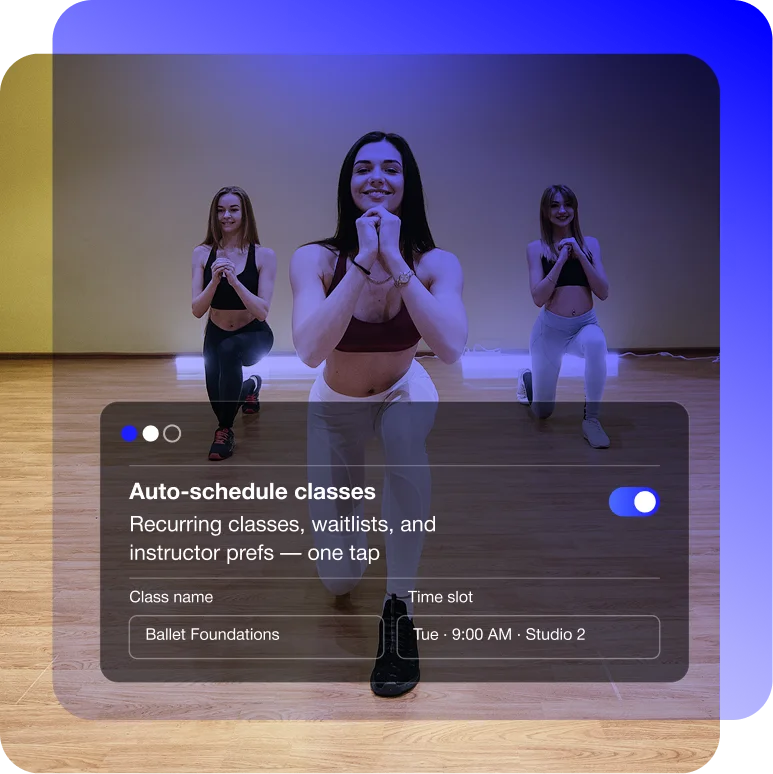
Most new owners think the job is teaching. It is not
Teaching is one part of the job. Running the studio means you are now responsible for class scheduling, payroll, tuition collection, safety, parent communication, hiring, training staff, marketing, student retention, recital planning, maintenance, insurance, and reporting.
A teacher asks,
“How do I give a great class today?”
An owner asks,
“How do I build a studio that gives great classes every day, even when I am not in the room?”
That shift changes everything.
This is where many studios get stuck. The owner is great in the room and underprepared everywhere else. They can correct a turn sequence in six seconds, but they cannot tell you the churn rate, the cash left after payroll, or which class is only surviving because they love it emotionally.
That is normal at first. It just cannot stay normal for long.
Pick your business model early
Not every dance studio is trying to do the same thing. That’s why so many studios feel messy. They try to be everything to everyone.
Pick your model early. Then build around it.
A recreational studio is usually family-heavy. It focuses on fun, confidence, skill-building, and long-term participation. A pre-professional academy is more serious. It focuses on training, discipline, level progression, and sometimes audition or performance pathways.
A competition-heavy studio can create strong visibility and premium add-on revenue, but it can also create more travel, more politics, and more family fatigue. An adult-focused studio often gets ignored, even though it can bring recurring revenue and deep loyalty. A hybrid model can add digital access, recorded lessons, or progress tracking, but only if the tech is strong and the delivery is worth paying for.
| Studio Model | Primary Audience | Revenue Profile | Main Advantage | Main Risk |
| Recreational | Families, children | Stable monthly tuition | High retention, strong community loyalty | Lower ceiling on premium pricing |
| Pre-professional | Serious dancers, teens | Tuition + private lessons | Premium positioning, strong word of mouth | Smaller audience, higher dropout at plateau |
| Competition-focused | Competitive families | Tuition + team fees + add-ons | High visibility, premium add-on revenue | Travel cost, family fatigue, internal politics |
| Adult-focused | Working adults | Drop-ins + monthly plans | Recurring loyalty, underserved market | Schedule sensitivity, lower peak enrollment |
| Hybrid/digital | Mixed | Tuition + digital access | Scalable content revenue | Tech dependency, delivery quality risk |
Build a real business plan, not a hopeful one
You do not need a 60-page business plan.
You do need a clear one.
The SBA says there is no single right format, but it is clear that the plan should meet your needs and help you think through the key elements of the business. That matters because a lot of dance owners either overbuild a “formal” plan they never use or skip planning altogether.
A strong studio plan can be lean, plain, and practical as long as it answers the questions that actually drive the business.
At a minimum, your plan should answer these questions:
| Questions | What you need to define |
| Who is this studio for? | Kids, teens, adults, competitive dancers, beginners, families |
| What do we sell? | Weekly classes, teams, private lessons, camps, workshops, events |
| How do we make money? | Tuition, retail, recital tickets, camps, rentals, fundraising |
| How many students do we need? | Enough to cover monthly costs and hit break-even |
| What is our price structure? | Drop-ins, monthly tuition, class packs, family discounts |
| What makes us different? | Culture, schedule, teacher quality, systems, performance focus, and convenience |
Keep it plain.
For example:
“Our studio serves families within a five-mile radius who want strong dance training in a safe, welcoming environment. We offer beginner through intermediate classes for ages 4 to 16, plus an adult evening program. Our main revenue comes from monthly tuition, summer camps, recital tickets, and private lessons.”
That is already useful.
It is much better than:
“We aim to redefine the local dance experience through excellence, empowerment, and innovation.”
That sounds nice. It says almost nothing.
The three-part license and legal checklist
Local rules vary by city, country, and state. So always check your area before signing a lease or opening your doors.
Tier 1: Mercantile/Business license
This is the basic license that says you are allowed to operate a business. Depending on your city, it may be called a business license, local operating permit, or general business tax certificate.
Tier 2: Health and safety/fire requirements
A dance studio is a physical space with children, adults, movement, equipment, and public access. That means you may need fire inspection approval, occupancy clearance, emergency lighting, exit signage, restroom compliance, and basic safety checks.
Tier 3: Zoning/Certificate of occupancy
This is where people get burned. Just because a space is empty does not mean you can use it as a dance studio. You may need zoning approval for instructional or assembly use, a certificate of occupancy, signage permission, parking compliance, and noise review if the building is shared.
So your checklist should include:
- Business license or local operating permit
- Certificate of occupancy or equivalent approval
- Fire and safety inspection requirements
- Restroom and accessibility compliance
- General liability insurance
- Professional liability insurance
- Property insurance
- Parking or traffic limits, if applicable
Operator Rule — Licences: Do not assume the landlord knows. Do not assume the broker knows. Do not assume “the last business here was similar” means you are fine. Check it yourself.
Choosing the right facility
A cheap space can be expensive. A beautiful space can be unusable.
A big space in the wrong place can stay quiet for years.
The SBA’s location guidance says the right place depends in part on the target market, partners personal preferences, and the costs, benefits, and restrictions that come with the location. That may sound broad, but it is exactly right. Your rent is only one part of the decision. You are not just renting square feet. You are renting access.
Ask these questions first.
Who lives within five miles? If your studio is for children, look for family-heavy areas. If your studio is adult-focused, look at commuting patterns, parking, and walkability.
How many schools are nearby? A studio near schools, daycare clusters, and family neighborhoods has a built-in advantage.
Is this a neighborhood stop or a drive-by site? A neighborhood site may get more routine families. A high-traffic road may give visibility, but a weaker community feel.
Is there safe parking? Parents notice this right away. If pickup feels stressful, they will remember.
Is the building safe at night? Adult students and parents care about lighting, entrances, and how the area feels after dark.
Is the layout actually usable? A dance studio needs more than open space. It needs good ceiling height, safe flooring options, sound control potential, reception flow, waiting area options, storage, restrooms, and easy check-in paths.
One more operator check matters here: accessibility. If your studio is open to the public, the space should be reviewed with accessibility in mind, not as an afterthought. Entrances, routes through the facility, restrooms, and parking all affect whether the studio feels welcoming and usable from day one.
A practical facility scorecard
Print this out or copy it into a spreadsheet. Score each potential location from 1 to 5 before you sign anything. A location scoring below 35 out of 55 deserves a hard look before you commit.
| Factor | Score 1-5 | Notes |
| Family access within 5 miles | ||
| Parking and pickup flow | ||
| Evening safety | ||
| Ceiling height | ||
| Flooring potential | ||
| Sound control | ||
| Waiting area potential | ||
| Storage | ||
| Restrooms | ||
| Lease flexibility | ||
| Visibility | ||
| Growth potential |
It is a simple tool, but it helps stop emotional decisions.
Startup costs: what owners usually underestimate
Dance studio owners usually do not plan to fail. They just underestimate two things:
The real cost of opening and the slow months right after it.
The typical startup range for a small to mid-size dance studio sits around $15,000 to $50,000. But that is only a starting point. In higher-rent areas or custom-built spaces, costs can climb much faster. What matters is not the number. It is how you plan for it.
Here is a simpler way to break it down:
- Space: Deposit, rent, build-out, signage
- Studio build: Flooring, mirrors, barres, sound, acoustics
- Front desk: Furniture, check-in, waiting area
- Tech: Software, devices, Wi-Fi, payment systems
- Legal: Licenses, insurance, contracts
- Staff: Early payroll, hiring, onboarding
- Marketing: Website, launch offers, local promotion
- Working cash: Reserve for slow months
Here is the mistake most owners make. They budget for opening day. They do not budget for what comes after.
And that is where studios struggle.
Even if your opening is full, your second or third month might not be. Rent still comes. Payroll still comes. Bills do not wait.
A studio does not fail because of a lack of passion. It fails when cash runs out before the studio becomes stable.
Set your first prices with logic
Do not price by vibes. Do not price by fear.
Do not price by copying the cheapest studio in town.
Start with three things: your real monthly cost, your audience and market, and your class model.
A simpler starter structure often looks like this:
| Offer type | What it does |
| Drop-in class | Low barrier for adults or first-time trial students |
| Monthly tuition | Predictable recurring revenue |
| Class packs | Flexible option for lighter users |
| Private lessons | Premium margin |
| Sibling/family discount | Helps multi-child households stay longer |
| Founding member offer | Creates urgency before full pricing begins |
Here is a simple operator scenario. Let’s say your monthly fixed costs are $8,000. You have 60 students. That means your fixed cost per student is already about $133 before you even factor in instructor time, payment fees, recital prep, or supplies.
If you price a weekly plan too low because you are scared to ask for more, you may fill the room and still lose money.
That is why pricing should start with cost and capacity, not emotion.
Hire your team carefully
A weak hire costs more than a vacant slot. That is true in almost every business. It is very true in dance.
Your early staff shapes the studio culture, parent trust, student confidence, retention, and safety. So before the first shift, they should know the pay structure, class expectations, arrival time, pickup rules, emergency basics, dress code, and how parent communication works.
Look for strong teaching basics, warmth with families, calm energy under pressure, reliability, and the ability to follow a system. Test with a sample teaching plan, a trial class, a reference, and a background check where needed.
A studio can survive a weak logo. It cannot survive weak trust.
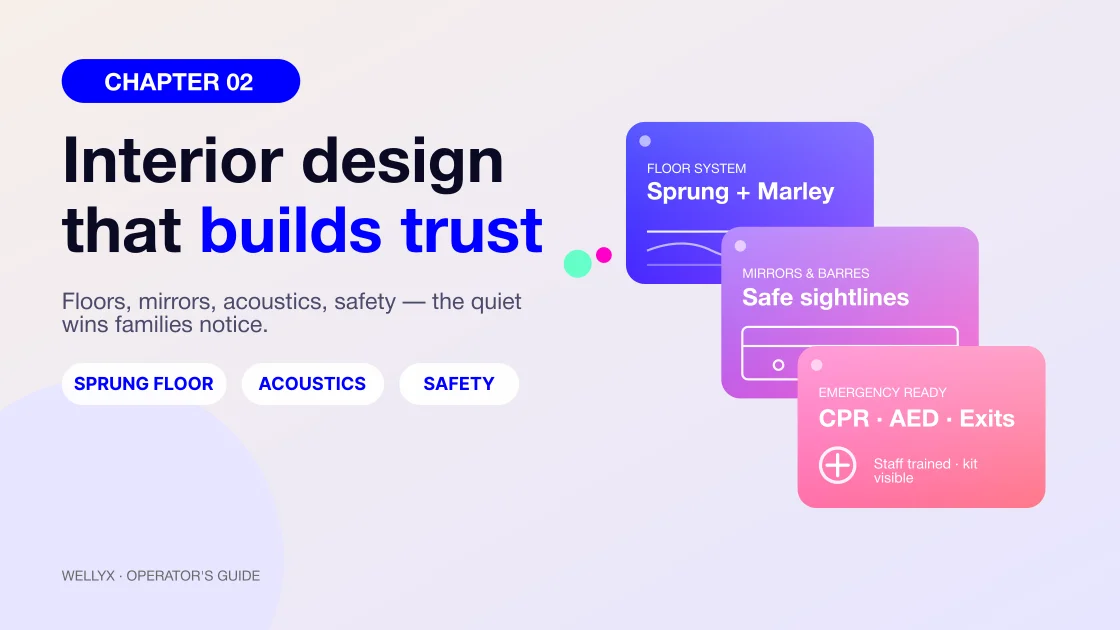
Chapter 2: Dance studio interior design
The second people walk into your studio, the room starts talking.
- It tells them if you are careful
- It tells them if you are organized
- It tells them if you understand dancers
- It tells parents if they should relax or stay on alert
That is why dance studio interior design is not just about color and branding. It is about flow, safety, mood, sound, and trust.
If you want a useful outside lens here, two dance organisations are worth knowing. NDEO describes itself as a nonprofit dedicated to advancing dance education. Dance/USA’s Task Force on Dancer Health exists specifically to support dancer health, safety, and well-being through medical expertise and practical resources.
Those are helpful reminders that design choices are not cosmetic. They sit inside a larger conversation about learning, safety, and dancer health.
Start with flow, not Pinterest
A lot of studio design goes wrong because the owner starts with inspiration photos instead of daily movement.
Ask:
- Where do students enter?
- Where do parents wait?
- Where do bags go?
- Where do teachers stand?
- Can staff see the room clearly?
- Can a child get from the lobby to the studio without chaos?
- Does the check-in point create a line?
A strong layout feels easy. Nobody bumps into each other. Nobody is wondering where to stand. Nobody is dragging a bag across the front desk because there is nowhere else to put it.
That is what good design looks like in real life.
Sprung flooring technicals: the floor matters more than almost anything
If you remember one thing from this design chapter, remember this:
The floor is not a decoration. The floor is equipment.
It affects fatigue, jumps, recovery, safety, and long-term wear on the body.
Harlequin Floors (industry dance-floor reference, not an independent medical source) makes a useful point here. Commercial and sports floors do not give dancers the same feel as floors developed for dance. Harlequin defines a sprung floor as one that provides some degree of shock absorption.
It also links sprung floors to better protection from impact, slipping, or falling. That does not mean every dance owner has to buy the most expensive option on the market, but it does mean the “just put down a hard surface and figure it out later” approach is shortsighted.
What is a sprung floor?
A sprung floor is a floor system built to absorb shock and reduce impact stress.
That does not mean “soft.”
It means the floor gives enough under force to reduce strain while still feeling stable.
This matters for jumps, landings, repeated training, long rehearsals, younger dancers with growing bodies, and teachers who demonstrate all day.
Why impact absorption matters
Hard surfaces increase stress on ankles, knees, hips, and lower back.
Over time, bad flooring can contribute to:
- Fatigue
- Soreness that lingers too long
- Heavier impact on landings
- Less comfort during long training days
Again, Harlequin is a vendor and not a regulator. However, its guide is still useful as a technical reference when you are trying to understand the difference between dance floors and generic commercial floors. Pair that kind of technical guidance with the broader dancer-health mindset encouraged by Dance/USA, and the core lesson is clear: flooring is a safety and training decision, not just a construction choice.
High-density foam vs rubber pad systems
Here is the simple operator version.
High-density foam systems often provide more controlled cushioning. They can feel slightly softer, depending on the build. They can work well for repeated jumps, younger dancers, and studios that want a bit more give underfoot.
Rubber pad systems can create a firmer, more durable feel while still allowing shock absorption. They often suit heavier use, multi-style studios, and owners who want long-term durability.
The real rule is not “foam good, rubber bad,” or the other way around.
The real rule is this: match the floor to your class mix, your age groups, your training intensity, and how many hours the room will be used each day.
Marley over-sprung subfloor vs hardwood
This comes down to style mix and training goals.
Marley over a sprung floor often makes sense for ballet, contemporary, and modern work because it offers controlled traction and a studio-style finish many dancers already understand.
Hardwood over a sprung structure may suit tap, certain multi-use studios, or owners who want a warmer visual finish.
| Floor Type | Best Dance Styles | Shock Absorption | Durability | Visual Finish | Cost Range |
| Marley over sprung subfloor | Ballet, contemporary, modern | High | Medium-high | Studio-standard matte | Medium-high |
| Hardwood over sprung structure | Tap, multi-use, social dance | Medium-high | High | Warm, traditional | Medium-high |
| High-density foam system | Repeated jumps, younger dancers | High | Medium | Depends on top surface | Medium |
| Rubber pad system | Heavy use, multi-style | Medium-high | Very high | Depends on top surface | Medium |
| Generic commercial/sports floor | Not recommended for dance | Low | High | Variable | Low |
Front desk tech and access control
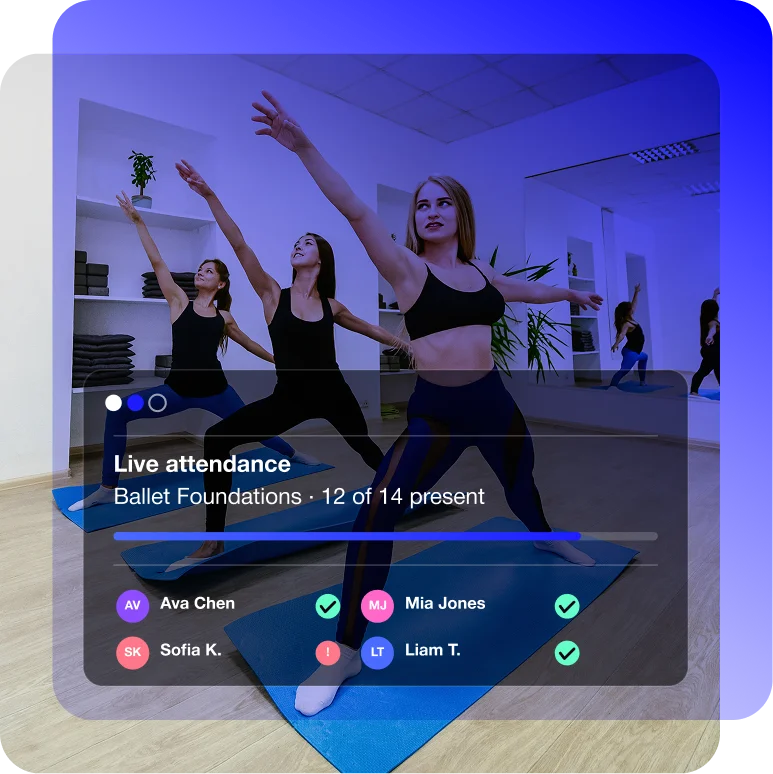
A front desk should reduce friction, not create it.
That means quick check-in, easy attendance tracking, simple payment support, clear schedule access, safe pickup rules, and no endless paper clutter.
This is also where tech choices start shaping trust. If check-in feels sloppy, parents assume the rest of the business may be too.
A well-designed studio is not just about mirrors, colors, or a beautiful wall for photos. It is about how the whole space works when classes are full, parents are waiting, and students are moving from reception to the dance floor. If you want more practical ways to shape a studio that feels open, safe, and easy to manage, explore these Dance studio interior ideas before making your next design decision.
Chapter 3: Dance studio financial plan
Most studio problems do not announce themselves as money problems.
They show up like this:
- Classes are “busy”, but payroll still feels tight
- The recital made money, but you cannot tell how much
- Families are slow to pay
- One teacher is expensive, but you are not sure which class is carrying the load
- Summer feels thin every year, but you still act surprised
- You are exhausted, but you still cannot see where the leak is
This is why every owner needs a real dance studio financial plan.
Not a folder of receipts.
Not a “we usually do okay.”
A real plan.
What does it actually cost to run a studio?
The costs of running a dance studio often look simple on paper, but they add up fast in real life. Most owners start with the basics: rent, utilities, insurance, salaries, taxes, marketing, supplies, licenses, and maintenance. That is a solid starting point, but it is only part of the picture.
Here is the reality. Studies show that around 20–30% of small businesses fail in the first year, and one of the biggest reasons is underestimating costs and running out of cash. Rent alone can take 20–40% of your monthly revenue, while payroll can easily reach 30–50% as you grow your team. Add marketing, software, and seasonal dips, and the pressure builds quickly.
That is why the real goal is not just opening your doors. It is staying open. The U.S. Small Business Administration emphasizes this clearly: you need to calculate your full costs upfront so you can predict when your studio will actually become profitable, not just operational.
A studio that understands its numbers early has a huge advantage. It can plan, adjust, and grow with confidence instead of reacting under pressure.
Here is a cleaner operator view.
Fixed monthly costs
These stay fairly steady.
- Rent
- Insurance
- Software
- Internet
- Base utilities
- Cleaning contracts
- Loan payments
- Some admin wages
Variable costs
These move with use, season, or enrollment.
- Instructor hours
- Merchant fees
- Recital costs
- Camp staffing
- Marketing spend
- Supplies
- Laundry or consumables, if offered
- Event staffing
Hidden costs people miss
- Refunds
- Failed payments
- Chargebacks
- Last-minute costume changes
- Staff training time
- Damage and maintenance
- Owner hours that are never costed properly
Start with a monthly budget, not an annual guess
A studio lives month to month. So even if you plan annually, you need to view money monthly.
Your budget should show expected revenue, fixed costs, variable costs, owner pay, tax reserves, emergency reserve goals, and the cash left after core operations.
Here is a simple budget view.
| Category | Monthly target |
| Tuition revenue | $12,000 |
| Private lessons | $1,200 |
| Retail and add-ons | $600 |
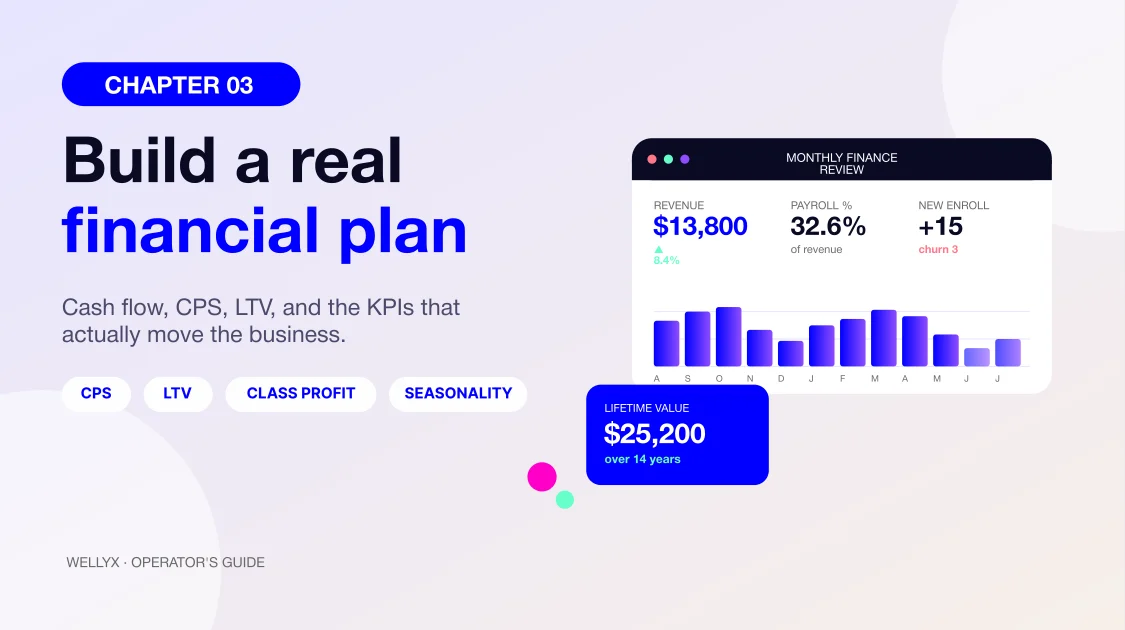
| Total revenue | $13,800 |
| Rent | $3,200 |
| Payroll | $4,500 |
| Software and admin | $450 |
| Utilities and internet | $600 |
| Insurance | $250 |
| Marketing | $700 |
| Supplies and maintenance | $400 |
| Total expenses | $10,100 |
| Operating margin before tax reserve | $3,700 |
This is just a model. The point is to make the money visible.
The seasonality problem
Studios often act like every month should perform the same.
That is not real life. A studio has seasons.
And if you do not budget for those seasons, one slow month can feel like a surprise every year.
Here is a common rhythm.
| Time of year | What usually happens |
| August/September | Strong enrollment push, back-to-school energy |
| October | Good momentum, social content opportunity |
| November | Stable but can soften near holidays |
| December | Schedule disruptions, family travel, payment gaps |
| January | New trial interest, adult beginners, reset season |
| February/March | Good retention window if systems are strong |
| April/May | Recital build-up, costume, ticket, and event activity |
| June | Summer transition begins |
| July | Often a dip in regular tuition unless camps and intensives help |
Operator Rule — Seasonality Budget your studio for the year you actually live through, not the one you wish you had.
Three KPIs every studio owner should know
This part should stay plain. No finance fluff.
Just numbers that help you make better calls.
- Cost per Student (CPS)
This tells you how much it costs to bring in one new enrolled student.
Formula: Total enrollment and marketing cost ÷ number of new enrolled students
Example: You spend $1,200 on ads, flyers, a trial event, and promo support. That month, 15 new students fully enrolled. Your CPS is $80.
Why it matters: if you spend $80 to get a student who only stays one month, that is a problem. If you spend $80 to get a student who stays two years, that is fine.
- Class Profitability
This tells you if a class is actually helping the business.
Formula: Class revenue − instructor hourly rate − direct class costs
Example: A Tuesday jazz class brings in $480 in monthly tuition. The instructor cost for that class block is $180. Direct costs and payment fees tied to that class are $40. Profitability is $260.
Now imagine another class is packed with energy but only brings in $190 while costing $170 to teach. That class may still matter strategically. But now you know the truth.
- Lifetime Value (LTV)
This is the total revenue a student brings over the full time they stay with you.
Formula: Average monthly revenue per student × average months retained
Example: A child enrols at age 4 and stays until age 18. If the average effective monthly revenue across those years is $150, that is 168 months, or $25,200 in lifetime value.
The exact number will vary. The lesson does not.
Long retention changes everything.
That is why student retention strategies are not just “community-building.”
They are finance.
Other numbers worth watching
Keep these on your dashboard too:
- Payroll percentage
- Revenue per active student
- Revenue per square foot
- Failed payment rate
- Recital margin
- Trial-to-enrollment rate
- Average attendance per class
- Family churn rate
You do not need 40 KPIs. You do need the right 8 to 10.
Where studios quietly leak revenue
Revenue leaks are sneaky. They are often small. They happen in ordinary places: cancelled memberships handled wrong, failed payments ignored too long, classes kept alive for emotional reasons, old discounts never removed, manual collection delays, families slipping out after attendance drops, or software gaps that confuse status, access, or billing.
Boo Jackson’s owner of Factory Fitness, truly highlights the problem:
“Mindbody was s***… people like try to come back and they’re like, ‘Oh, my membership has been cancelled.’ So, we’re losing revenue.”
That is not an “IT issue.” That is a business issue.
Factory Fitness is a good example of this. The issue was not only bad software. It was what bad software was doing to trust, renewals, and the day-to-day member experience.
If your system causes friction around membership status, access, billing, or reactivation, money leaks out before you even realize it.
Tuition collection and failed payments
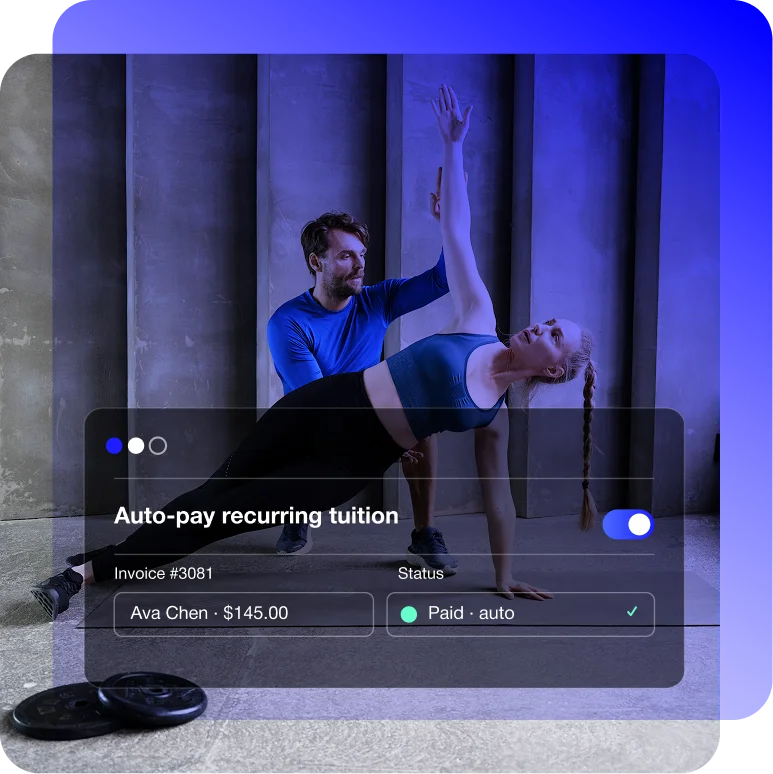
Manual collection feels human.
It also burns time and creates tension.
Better systems usually include auto-pay, clear billing dates, retry logic for failed payments, reminder messages, easy parent access to invoices, and staff visibility into account status.
When payments are messy, staff waste time chasing money. Parents get embarrassed. Good families slip into avoidable lapses. Owners lose cash flow clarity.
You want payment to feel boring.
Boring is good.
Accounting tools and automation that reduce revenue leaks
Good dance studio software should do more than send invoices. It should reduce the little money leaks that build up all year. The basics matter: auto-pay, retry logic for failed payments, invoice access, failed-payment alerts, integrated POS, and class revenue reporting.
Beyond billing, the right software should also give you visibility into your accounting layer: expense tracking by category, instructor-hour costing per class, and reconciliation between what was billed and what was actually collected. Studios that treat accounting software as a separate tool from their booking and attendance system often end up with sync gaps, revenue that looks fine on the booking side but leaks on the accounting side. A single platform that handles both eliminates that gap.
These are not “nice extra features.” They are part of protecting cash flow, reducing admin time, and making sure families do not slip through billing gaps. If your studio takes card payments, payment security matters too. PCI DSS exists to provide baseline technical and operational requirements designed to protect payment account data, so payment handling should be treated as part of operations, not an afterthought.
Budgeting for growth, not just survival
A lot of owners budget like this: “How do I stay open?” A better question is: “How do I stay healthy while getting stronger?”
That means budgeting for staff development, better flooring, additional class slots, another room, stronger software, cleaner check-in tools, camp growth, and more predictable parent communication.
If growth only happens after you are already drowning, it will feel painful.
Build ahead. Even slowly.
A monthly finance review that actually helps
Use this once a month:
| Question | Why it matters |
| What was the total revenue this month? | Basic top-line clarity |
| What was payroll as a percentage of revenue? | Labor control |
| Which classes are most profitable? | Schedule decisions |
| Which classes are weak but strategic? | Long-term thinking |
| How many failed payments did we have? | Revenue leakage |
| How many new enrollments came in? | Growth health |
| How many students left? | Retention reality |
| What is our cash reserve now? | Stability |
Do this every month. Not when there is a problem. Before there is one.
Pay yourself a salary
This is one of the most commonly skipped financial disciplines for new studio owners. The pattern usually goes: cover rent, cover payroll, pay suppliers, take whatever is left. Some months that is a reasonable owner draw. Most months it is not.
A better structure:
- Set an owner salary as a fixed monthly line item
- Pay it on the same date every month, treated like any other payroll
- Adjust it deliberately once a year, based on actual studio performance
- Keep it separate from any owner draws or distributions taken at year-end
The benefit is not just financial. It also forces the studio’s pricing and cost structure to be honest. If the business cannot sustain a fair owner salary, that is information you need early, not three years in.
Schedule business taxes
Tax bills surprise studios more often than they should. The cause is usually the same: tax money is sitting in the operating account, gets spent on something else, and reappears as a problem at filing time.
A simple system:
- Open a separate tax reserve account
- Move a fixed percentage of monthly revenue into it automatically (work with your accountant on the right number)
- Treat it as untouchable — it is not part of your operating cash
- Schedule tax review check-ins quarterly, not annually
This applies to income tax, sales tax where it applies to your services or merchandise, and any local business taxes. The setup is boring. The peace of mind is real.
Chapter 4: Dance studio marketing ideas
Most studios do not have a marketing problem. They have a rhythm problem. They market in bursts. They panic-promote.
They post when they remember. They run a discount when enrollment dips. Then they wonder why growth feels random.
A better studio treats marketing like a calendar. Not a mood.
What dance studio marketing ideas should actually do?
Studio marketing has five jobs:
- Fill beginner spots
- Keep current families engaged
- Bring referrals in naturally
- Build local trust
- Feed camps, recitals, and special programs
That is it.
If your marketing is not helping one of those five jobs, cut it.
Start with local search before fancy content
A lot of studio owners jump straight to social content because it feels visible. But local search is usually where intent lives. When a parent searches “dance classes near me” or “ballet classes for kids in [city],” they are closer to acting than someone casually watching a Reel.
Google’s Business Profile matters here. Google describes it as a free profile that helps turn people who find you on Search and Maps into customers. Google also says reviews can help your business stand out, appear next to your profile, and give potential customers helpful information. Verified businesses can reply to reviews, which also helps show families that feedback matters.
So before you worry about going viral, make sure you have:
- A complete Google Business Profile
- Real photos of your studio
- Up-to-date hours
- A clear category and service list
- A working phone number
- A useful business description
- A process for asking happy families for honest reviews
That is not flashy. It is effective.
Your year needs enrollment seasons
A studio owner should know the year like a farmer knows the weather. Not every month is for the same thing.
Some months are for enrollment. Some are for retention. Some are for waitlists. Some are for event hype. Some are for protecting revenue.
Here is a clean 12-month model.
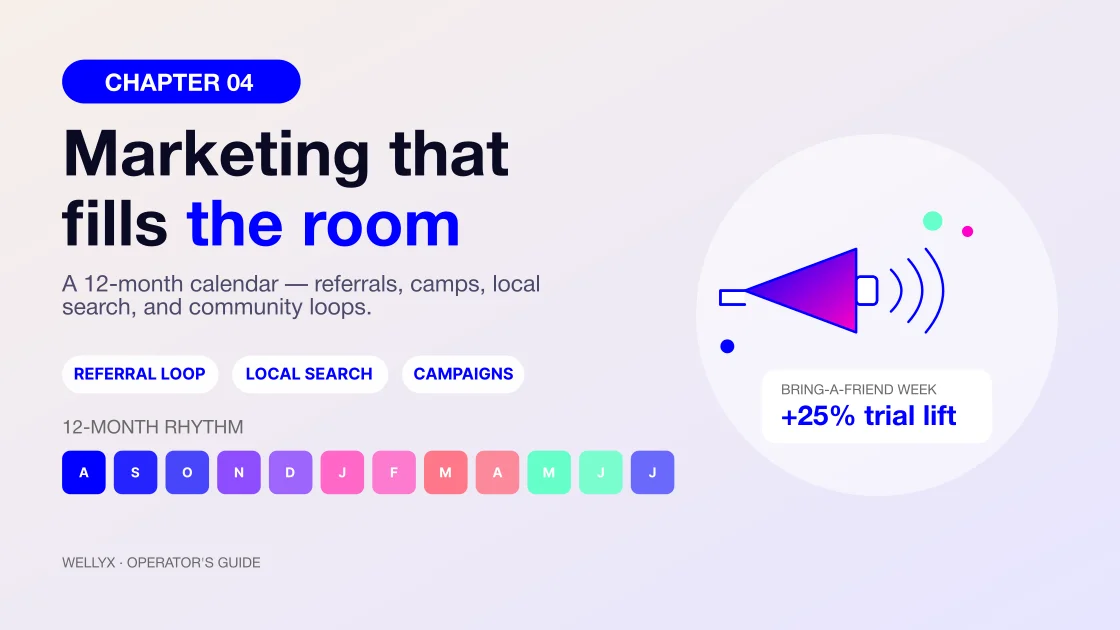
| Month | Campaign focus | Core offer | Content angle | Main KPI |
| January | New year beginner push | Intro class pack | “New year, new rhythm” | New trials |
| February | Parent trust and community | Bring-a-friend week | Student wins, teacher moments | Referral leads |
| March | Local visibility | Open house or watch week | Rehearsal snippets, teacher intros | Tour bookings |
| April | Recital pre-hype | Early recital info | Costume prep, backstage stories | Parent engagement |
| May | Recital to summer bridge | Summer registration priority | Performance clips, testimonials | Summer signups |
| June | Camp enrollment | Early-bird summer camp offer | Theme reveals, camp schedule | Camp bookings |
| July | Revenue protection | Workshops, intensives, rentals | The studio is still active this summer | Revenue per week |
| August | Back-to-school referral loop | Sibling or referral offer | “Bring a dancer” | New enrollments |
| September | Foundations month | Beginner pathways | Culture, welcome, consistency | Beginner conversion |
| October | Halloween campaign | Costume classes and content | Reels, challenge videos, family fun | Reach and leads |
| November | Retention and gift sales | Merchandise or mini packages | Gratitude, loyalty, holiday planning | Retention |
| December | Community and January pipeline | Gift cards, mini camps, waitlist | Year recap, January invite | January lead list |
This single table solves a lot of studio confusion.
Now let’s make a few months real.
August: the back-to-school referral loop
The referral material you shared has lots of ideas. The best operator version is simple.
Use one campaign.
Not twelve.
A strong August referral model looks like this:
- A current family refers to a new family
- The new family enrolls
- The referring family gets a reward
- The new family gets a starter incentive
- A deadline creates urgency
- A leaderboard is optional, not required
Good reward examples include tuition credit, a branded bag or jacket, a free workshop, a sibling registration discount, or a recital photo voucher.
A mom already has two kids in your studio. In August, she gets a simple message: “Refer one new family before August 31 and get a $50 tuition credit when they enroll.”
That is clean. Easy to explain. Easy to track. Right for the season.
October: Halloween that actually converts
But the smarter move is not to do everything. It is to pick a few ideas and run them well. Studios that keep campaigns simple often see 20–30% higher engagement and better conversion compared to scattered promotions.
The strongest October strategies usually come down to three simple moves:
- A fun costume class week that gets students excited to show up
- A short social choreography challenge that boosts visibility online
- A bring-a-friend class, which can increase trial sign-ups by 25% or more when done right
That last one is the real growth driver. It brings new families into your space without heavy ad spend.
Keep the campaign tight and focused. Do not turn the month into a crowded schedule of ideas. When studios try to do too much, they often see lower turnout and more stress.
Use Halloween as a tool. It should create energy, attention, and new leads. Not noise.
May and June: summer camp enrollment
The summer camp content you shared gets something very right: families do not just want “more classes.” They want something that feels like summer.
That is the whole trick.
Sell the experience.
What works:
- Themed camps
- Clear start and end dates
- Early-bird deadlines
- A mini showcase or recap
- Strong visual content
- Email reactivation for past families
A few good camp examples:
- Princess and Pirates Dance Week
- Broadway Bootcamp
- Acro and Tricks Intensive
- Glow Dance Camp
- TikTok Choreo Camp
- Mini Movers Summer Week
Here is a simple camp structure:
| Piece | What to include |
| Theme | One clear idea families understand fast |
| Age band | Easy placement for parents |
| Duration | 3 days, 5 days, half-day, or full-day |
| End moment | Showcase, parent watch, or video recap |
| Upsell path | Fall enrollment offer at the end |
Marketing channels that deserve your time
You do not need to be everywhere.
You need to be where your family actually notices you.
For many studios, the strongest channels are:
- Google Business Profile
- TikTok, if your audience fits
- Local school and community partnerships
- Referral loops
- Parent-generated word of mouth
The old-school channels still matter too. Flyers at the right community spots, recital posters, school partnerships, and local business cross-promotions are not glamorous, but they can work when used on purpose.
The rule is simple. Tie every channel to a job.
Do not “do social media.”
Use social media to move families toward the next step.
A simple content framework for busy owners
If content feels heavy, use this weekly rhythm:
| Day | Content idea |
| Monday | One class photo or short clip |
| Tuesday | One parent-facing reminder or FAQ |
| Wednesday | One student wins, or the teacher highlights |
| Thursday | One behind-the-scenes post |
| Friday | One offer, event reminder, or review request |
That is enough to stay visible without turning your week into a content factory.
Chapter 5: Dance studio revenue
Tuition matters. But if tuition is doing all the work, the studio gets fragile.
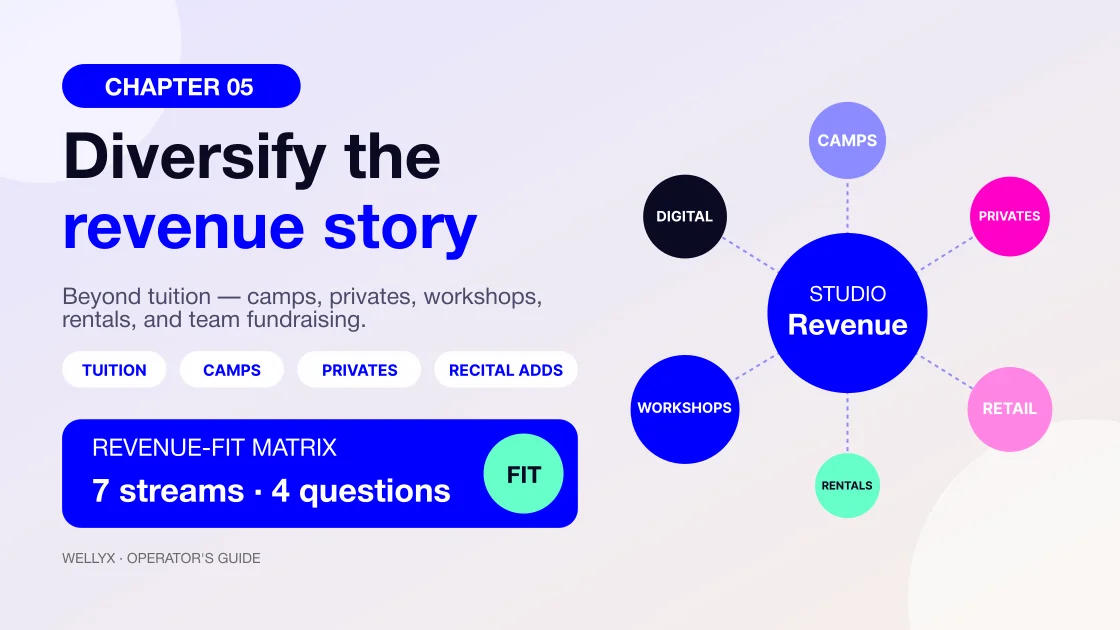
Dance studios generate revenue from multiple sources: monthly tuition, private lessons, summer camps, merchandise, recital ticket sales, studio rentals, and digital classes. Each one plays a different role in keeping the business stable across the year.
One bad summer. One soft season. One tough retention cycle. One teacher was excited. And suddenly everything feels tight.
That is why revenue diversification matters. Not because you want a messy list of side hustles. Because you want stability.
What healthy revenue diversification looks like
The best extra revenue streams do one of three things:
- Use the studio space better
- Use the teacher’s talent better
- Use the audience better
That means they should fit the studio naturally.
Common strong revenue streams include tuition, private lessons, summer camps, masterclasses, workshops, merchandise, recital tickets, recital add-ons, studio rentals, birthday parties, digital courses, and community events.
Do not add ten at once. Add the ones that make sense for your model.
Revenue streams that fit a dance studio naturally
A few strong options deserve a closer look.
- Specialized classes
These are great for new audience segments, short-term campaigns, and trial conversion.
Examples include beginner teen hip-hop, adult jazz basics, wedding dance prep, and stretch or conditioning for dancers.
- Private lessons
These can bring premium revenue, focused support, competition prep, and extra help for older or more committed dancers.
- Workshops and masterclasses
These bring fresh energy, short-term revenue, guest teacher visibility, and social content.
- Space rental
This can create midday income and deepen local relationships. Rehearsals, photography rental, acting workshops, and community arts use all possibilities.
- Merchandise
This is not usually a giant revenue stream, but it can support brand visibility, team culture, and seasonal campaigns.
- Digital offers
Only do these if they are actually useful. Short technique libraries, parent access to practice clips, recorded drills, or virtual catch-up sessions can work if the delivery is clean.
- Flexible membership plans
Rigid monthly tuition works for committed families. It loses the families who want to dance but cannot commit to the same weekly schedule for nine months straight.
Adding a flexible tier captures that audience without discounting your core programme. Common formats:
- A class pack of 4, 8, or 12 sessions used over 60 to 90 days
- A monthly “any class” plan with a capped number of sessions
- A family plan that pools sessions across siblings
- A pause option that lets a family hold their place for one or two months without cancelling
Flexible plans usually carry slightly higher per-class rates than full monthly tuition. That is the trade-off families pay for flexibility, and it protects the value of your committed plans.
- Loyalty programs
A simple loyalty layer encourages longer enrollment without discounting heavily. A few formats that work:
- A points system tied to attendance, referrals, and renewals, redeemable for merchandise or workshops
- Tiered perks at one, three, and five years of enrollment
- An annual loyalty event for long-term families
- Renewal rewards for families who re-enrol before a deadline
The mistake to avoid is building a loyalty programme so complicated that nobody understands it. One screen of rules is enough. If it takes a flowchart, families will ignore it.
- Virtual dance classes
Virtual classes are not a replacement for in-studio training. They are an add-on that captures revenue you would otherwise lose:
- Travelling families who still want to train
- Adult students with shifting schedules
- Recovery or modified classes for injured dancers
- Out-of-town students who want a connection to your brand
- Holiday and snow-day programming when the studio is closed
Two formats work best: a small live-streamed class with the instructor on camera, and a recorded library of drills, technique work, or short combinations. Charge less than a full in-studio class but more than free, and treat it as a separate product, not a discount on the real thing.
Dance team fundraising ideas that still feel like dance
This matters because families get tired when fundraising feels random, repetitive, or disconnected from what the studio actually does.
Fundraisers that still feel like a dance
- Showcase night
- Donor-sponsored choreography event
- Dance-a-thon
- VIP parent watch night
- Style swap workshops
- “Sponsor a move” campaign
- Mini performance pop-up
Fundraisers that double as marketing
- Silent disco pop-up
- Public flash performance
- Community dance workshop
- Artist partnership event
- Theme-based family dance night
Fundraisers’ families will actually join
- Personalized dance-o-grams
- Costume swap and resale event
- Team calendar or video project
- Parent-and-child social dance night
- “Round up your tuition” seasonal campaign
Fundraising ideas worth testing
If you want a cleaner fundraising list inside the guide, keep it simple and practical:
- Showcase night
- Dance-a-thon
- Silent disco pop-up
- Donor-sponsored choreography event
- VIP parent watch night
- Costume swap and resale event
- Dance-o-grams
- Team Calendar or video project
- Community dance workshop
- Sponsor-a-move wall campaign
Creative fundraisers worth testing
A few ideas work well because they feel like the studio itself, not a bake sale.
- Choreography draft night. Families bid or buy tickets to vote on which choreography pieces appear in the next showcase. Treat it like a sports draft, with previews, brackets, and a final reveal.
- Dance my painting night. Pair dancers with a local artist or art supplier. Dancers improvise to a piece of art on stage, and families buy tickets to watch and donate. The art and the choreography both go up for sale.
- Behind-the-scenes mini series. Sell access to a short video series following teams through their training, costume fittings, and final performance. Families pay a small fee for the series; outside fans pay a higher price.
- Sponsor a movie campaign. Build a short film around the studio — a rehearsal documentary, a themed dance video, or a recital recap — and sell sponsor slots in the credits, intro card, and social posts.
- Dance dare calendar. Each day of the month features a small dance challenge. Families donate to participate, and the leaderboard gets posted weekly. The end-of-month winners get a studio prize.
- Dance passport. Run a series of one-off classes in different dance styles from around the world. Families buy a “passport” that gets stamped at each class. Strong for community feel, exposure to new styles, and parent buy-in.
These work because they are events, not asks. Families donate because they get something memorable in return.
How to test a fundraiser before you run it
Before you launch anything, ask five questions:
- How much staff time will this take?
- What is the likely margin?
- Will families enjoy it or tolerate it?
- Does it match our brand?
- Can we repeat it next year?
A fundraiser that raises $1,500 but burns out your whole team may not be worth it. A fundraiser that raises $700, creates local buzz, and brings in five new leads may be better.
A quick revenue-fit matrix
Use this before adding a new offer.
| Revenue idea | Easy to launch? | Strong margin? | Helps retention? | Helps lead gen? |
| Private lessons | Yes | High | Yes | Sometimes |
| Summer camp | Medium | Good | Yes | Yes |
| Retail | Yes | Low to medium | Sometimes | Sometimes |
| Studio rental | Medium | Good | No | No |
| Workshop/masterclass | Medium | Good | Yes | Yes |
| Birthday parties | Medium | Good | Sometimes | Yes |
| Digital library | Harder | Medium | Yes | No |
When are you ready for a second location?
Growth sounds exciting. But here is the truth most owners learn the hard way: wanting to expand is easy. Being ready is rare.
Industry patterns show that many small businesses struggle when they scale too early. Nearly 20% fail in the first year, and poor systems and cash flow issues are among the biggest reasons. Expansion does not fix weak foundations. It exposes them.
Strong studios do not grow because the owner feels ready. They grow because the business is ready.
You are closer to a second location when:
- Enrollment is stable and predictable month to month
- Retention is strong, not dropping after each season
- Staff can run classes without you in every room
- Your systems are written, not stored in your head
- Financial reports are clear and reviewed regularly
- One slow month does not create panic
- The studio feels calm, not constantly catching up
Operator Rule — Scaling: If your studio runs smoothly without you for a few days, you are building something scalable. If everything pauses when you step away, you are still the system. And scaling a business that depends on you is not growth.
License model vs franchise model
If you ever expand beyond one studio, do not treat a license model and a franchise model like the same thing. A franchise usually gives another operator the right to use your name, system, and business format under tight rules, support, and ongoing requirements.
A license model is usually lighter. It may let someone use parts of your curriculum, brand, or method, but with fewer controls than a full franchise system. For most dance studios, the practical lesson is simple: do not think about either path until the first location runs well without daily rescue work from the owners.
What a dance studio franchise actually costs
If you ever look at buying into someone else’s franchise, or franchising your own brand, the cost picture is bigger than the headline number. Most franchise models include four cost layers:
- Initial franchise fee. A one-time payment for the right to operate under the brand and access the system.
- Ongoing royalties. A percentage of monthly or annual revenue paid back to the franchisor, usually for the life of the agreement.
- Advertising and marketing fees. A separate contribution to a brand-wide marketing fund, on top of any local marketing you fund yourself.
- Support and training costs. Sometimes bundled into the fee, sometimes billed separately for training updates, conferences, or system upgrades.
The combined effect is that a “franchise opportunity” priced at $30,000 to enter can carry six-figure obligations across the first three to five years once royalties and fees are factored in. Read the full disclosure document, not just the brochure.
The pitfalls owners underestimate
Franchising solves some problems. It creates new ones.
- Loss of flexibility. You cannot simply change pricing, schedules, branding, or class formats whenever you want. Most franchise contracts protect brand consistency, which means your local instincts may get overruled.
- Market saturation. Fast-growing franchises sometimes approve new locations close enough to existing ones that revenue per studio drops. Territory protection clauses matter.
- Strict contract terms. Length of agreement, exit fees, renewal terms, and resale restrictions can all limit what you do with the business later.
Questions to ask before signing a franchise agreement
If you ever sit across from a franchisor, do not leave the room until you have clear, written answers to:
- What is the total cost over the first five years, including royalties and marketing fees?
- What is my territory, and how is it protected?
- What happens if I want to sell, exit, or close the studio?
- What is included in the support and training package, and what costs extra?
- Can I see the financial performance of existing franchisees, not just the top performers?
- What are the renewal terms at the end of the agreement?
- What happens if the brand is sold to another company?
Where franchise money actually comes from
The money in a franchise studio rarely comes from one location running well. It tends to come from system-wide consistency: predictable margins per studio, retention rates that hold across markets, and recurring revenue strong enough to cover royalty layers without crushing the operator’s take-home.
If your single studio cannot yet produce reliable margin, a franchise structure will not fix it. It will magnify whatever is already happening.
Chapter 6: Student retention strategies
Students usually do not wake up one day and quit for no reason. There is usually a path. A missed class. Then another.
A little less energy. A parent who stops replying. A student who stops talking about recitals.
A payment issue. A child who no longer feels seen. That is why retention needs a system.
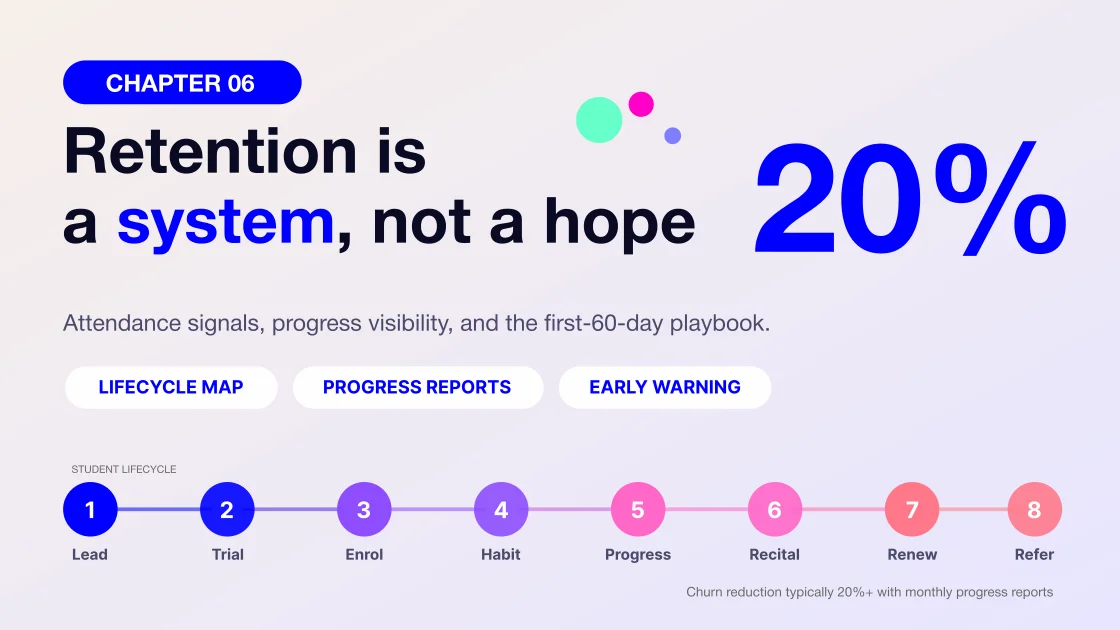
The student lifecycle map
Every studio should know this map.
- Lead
- Trial
- Enrollment
- Early habit-building
- Progress visibility
- Recital or event connection
- Renewal
- Referral
If you skip the middle parts, especially habit-building and progress visibility, you weaken the whole journey.
Student retention strategies that actually work
Retention is not magic. It is often the result of simple habits done consistently.
- Make students feel known
People stay where they feel seen. Use names. Remember goals. Notice effort. Celebrate small wins. This is not fluff.
It is retention.
- Watch attendance closely
Attendance is one of the earliest warning signs.
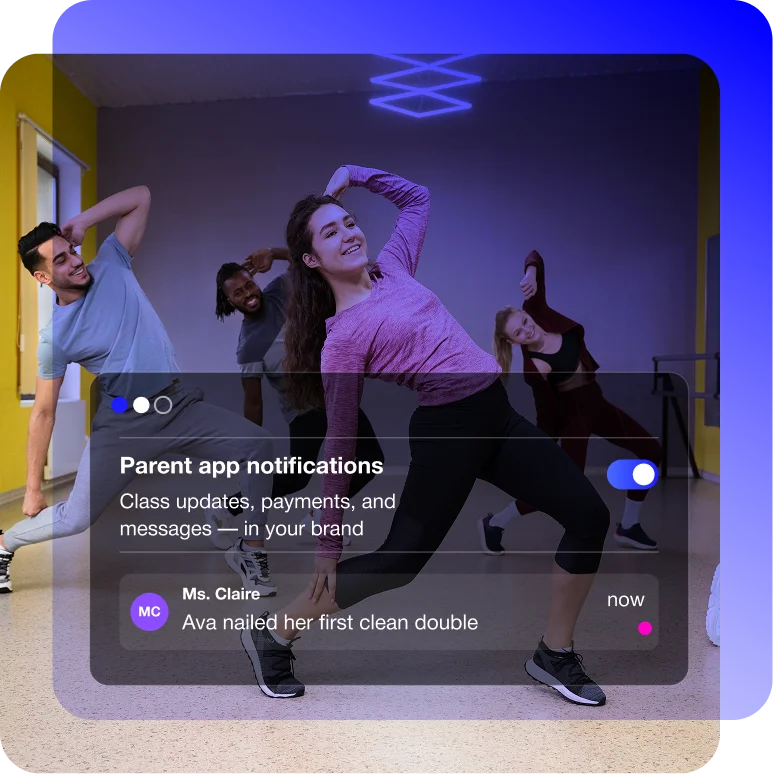
If a student misses two or three classes in a row, do not wait. Reach out. Not with a sales pitch. With care.
“Hey, we missed Ava in class this week. Just checking in.”
That one message can save more churn than a fancy promo ever will.
- Show progress clearly
Students stay longer when they can feel change. Parents stay longer when they can see it. That means progress should be visible, not hidden in a teacher’s head.
- Keep parents in the loop
If you teach children, parents are your seconRecital revenue beyond ticketsd customer. Sometimes you’re first.
They need updates, clear expectations, trust signals, easy payment flow, good pickup structure, and confidence that their child is growing.
- Keep the studio fresh
Routine is good. Stale is bad.
Add theme weeks, guest teachers, small milestone moments, class challenges, and performance goals.
- Make payment easy
Retention drops when billing gets awkward. This is one reason good dance school management matters.
- Build community outside class
Movie nights. The team hangs. Parents watch days. Small socials. Team celebrations.
People leave businesses. They stay in communities.
Monthly progress reports: One of the smartest tools you have
A good progress report does not need to be long. It needs to be consistent. Here is a simple monthly structure:
| Section | What to include |
| Attendance | Classes attended, absences, makeups |
| Skill win | One thing the student improved |
| Current focus | The next technique or goal |
| Teacher comment | One short personal note |
| Parent action | What to support at home, if anything |
Here is the operator difference.
Instead of sending nothing for months and then asking for recital fees, imagine this:
At the end of the month, a parent gets a short note.
- Attendance: 92%
- Progress win: Cleaner timing in group combinations
- Focus now: Stronger turns and spotting
- Teacher note: “Maya came in much more confident this month.”
- Parent tip: “Keep encouraging practice on balance at home for 5 minutes a day.”
That is a retention tool. That is also trust.
Why progress tracking helps reduce churn
Studios that implement consistent monthly progress reporting typically see churn reduction in the 20%+ range, with some operators reporting reductions at the higher end of that range when progress visibility is combined with early attendance intervention. These figures vary by studio size, age mix, and how systematically progress reports are delivered. But the directional truth is consistent across the data.
When progress is visible:
- Students feel more motivated
- Parents feel better informed
- Staff can intervene sooner
- Advancement feels fair
- Retention usually improves
Use your software for more than billing
Good dance school management should help you:
- Flag attendance drops
- Track skill notes
- Share parent updates
- Manage schedules
- Handle payments
- See student history
- Store recital readiness information
That is what turns software into an operator tool, not just a payment tool.
A branded app can help here, too. When parents can check attendance, see updates, view progress notes, and follow the schedule in one place, progress tracking stops feeling hidden. It becomes part of the studio experience. That kind of visibility helps families feel informed without creating more admin work for staff.
Early warning signs before a student leaves
Watch for:
- Falling attendance
- Missed payments
- Less class energy
- No progress notes
- Parent silence
- Pullback before recital
- Student isolation from peers
The goal is not to watch people like a machine.
The goal is to notice earlier.
Collect feedback, and act on it
Most studios collect feedback once a year, file it, and move on. That is not feedback. That is record-keeping.
A simple monthly or quarterly feedback loop usually works better:
- A short two-question survey to families (“What’s working? What’s one thing we could improve?”)
- A quick post-class check-in for adult students
- A teacher debrief on what families have been mentioning casually
The bigger half is what comes next. If families flag the same issue three months in a row and nothing changes, the next survey response rate drops. Visible follow-through is what makes the loop work.
Recognise long-term loyalty
Families who stay for years rarely get acknowledged in a way that feels personal. A few low-cost moves change that:
- A loyalty milestone for one, three, and five years of enrollment — a small gift, a card, or a public mention at recital
- Sibling discounts that scale with how long the family has been with the studio
- Early registration windows for long-term families before public enrollment opens
- A named alumni or “founding family” tier with small visible perks
Long-term families are also your strongest referrers. Recognising them is a retention move and a marketing move.
Let data guide your retention strategy
A lot of retention work is done on instinct. That is fine when the studio is small. Once you have more than 100 students, instinct misses things.
Things worth tracking monthly:
- Churn rate by class, age band, and instructor
- Average tenure by enrollment cohort
- Attendance trend per student over the last 90 days
- Re-enrollment rate from one term to the next
- Trial-to-six-month survival rate
You do not need a complicated dashboard. A monthly review of those numbers will tell you where retention is leaking before the families themselves do.
The first 60 days matter more than owners think
A lot of studios lose students early, not because the class is bad, but because the new family never quite lands.
The first 60 days should answer four questions fast:
- Does this place feel organized?
- Does my child feel welcome?
- Is there visible progress or at least a clear direction?
- Do I know what happens next?
If the answer is “not really,” enrollment can stall into quiet churn.
A simple early retention flow can help:
| Time | What the studio should do |
| Day 1 | Warm welcome, check-in clarity, easy next step |
| Week 1 | Follow-up message and first positive comment |
| Week 3 | Quick attendance check |
| Week 4 | Small progress note or teacher comment |
| Week 6 | Parent reminder about next milestone or event |
| Week 8 | Clear renewal or next-level path |
That is not overcommunication. That is the structure.
Chapter 7: Dance studio operations: Systems, burnout, and scaling
There comes a point where the studio is no longer limited by demand.
You limit it. That sounds harsh. It is also normal.
A studio often grows around the owner’s energy at first. That is fine. In the early phase, the owner is the engine. But if everything still depends on you, growth starts to hurt.
This is the chapter where the jobs change.
The shift from teacher to owner
This is the uncomfortable truth. You cannot teach every class forever. You cannot answer every question forever.
You cannot fix every problem forever. You cannot hold the whole studio in your head forever.
At some point, you have to move from being the hero to building the system. That means writing things down, standardizing training, setting rules, delegating clearly, building checklists, and trusting your team.
The five growth killers
If a studio feels busy but stuck, one or more of these is usually in play.
- Manual tuition collection
It slows cash flow, eats admin time, and creates awkward parent moments.
- Weak hiring and no background-check discipline
One poor hire can damage trust fast.
- Owner-held knowledge
If only you knew how recital seating works, how trial follow-up happens, or how class placement decisions are made, growth is fragile.
- Patchwork software and sync gaps
One system for billing. One for attendance. One spreadsheet for teams. A text thread for pickup. A separate app for schedules.
That is not a stack. That is a leak.
- No visibility into class profitability or churn
If you cannot tell which classes make money or where students slip away, you are guessing while busy.
- Disorganised staff and instructor schedules
When teachers schedule live in someone’s head, in a text thread, or in a paper rota, the cost adds up fast. Classes get covered late, parents get mixed messages about who is teaching, and instructor pay calculations get messy at the end of the month.
A clean schedule shows every class, every cover, every paid hour, and every absence in one place. It also lets staff see their own hours without asking.
- No online presence
A studio with weak local search visibility, no Google Business Profile, no website, or a website that has not been updated in three years is invisible to most new families.
The minimum:
- A complete Google Business Profile with photos and current hours
- A website with class info, pricing direction, and a clear way to enquire
- One active social channel where the brand looks alive
- A handful of recent reviews
You do not need to win at marketing. You need to be findable.
Operator experience matters too
Most studio owners focus on the dancer experience.
That makes sense. But here is what often gets missed: if the system is hard for you and your staff, everything else starts to break.
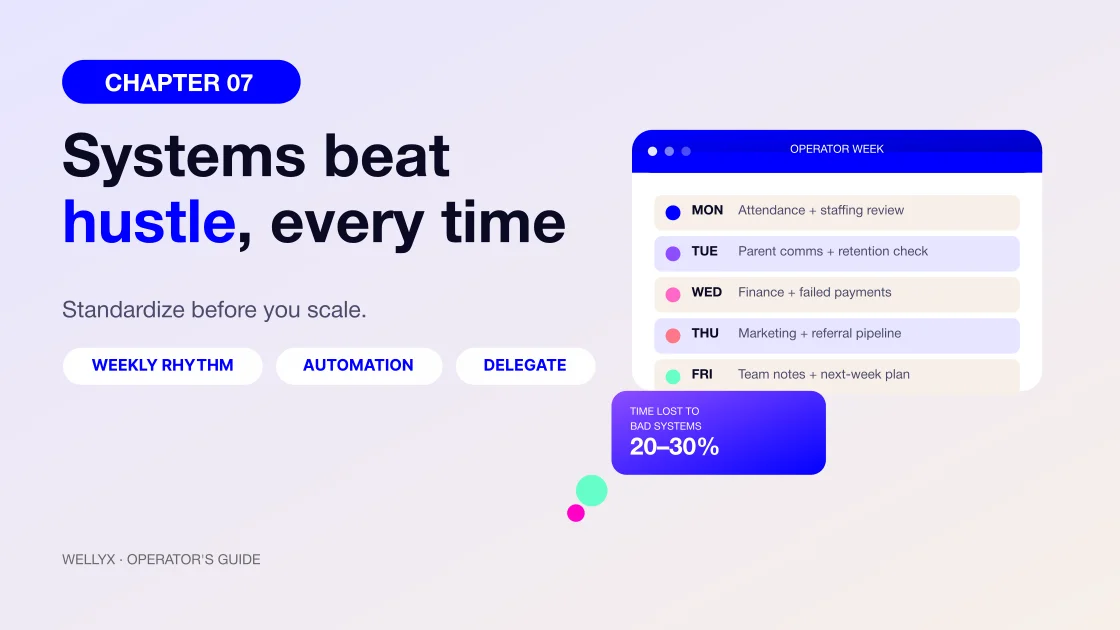
Studies across small businesses show that teams lose 20-30% of their time to inefficient tools and manual work. On top of that, nearly 8 out of 10 employees say bad systems increase daily stress and mistakes. In a dance studio, that does not just stay behind the desk. It shows up in missed attendance, billing errors, late replies, and confused parents.
That is why operator experience matters more than most people think.
Operator experience matters too. Factory Fitness case study
Factory Fitness is a fitness facility that faced a common but expensive problem: their existing software was creating friction at the door, in the billing system, and across daily operations. Members were getting bounced at entry due to membership status errors, and the team spent significant time manually resolving access and payment issues that the system should have handled automatically.
The problem was not dramatic. It was slow and accumulative. Access errors chipped away at member trust. Staff time disappeared into daily fixes. Chanelle, who manages operations, needed a system that integrated door access, membership status, and billing into one clean view — not three separate tools patched together.
After switching to a platform that combined all three, the access confusion stopped. Staff could see membership status and door-access status in the same place. Manual interventions dropped. The operational picture became what Chanelle described in her own words:
“Door Integration was absolutely critical.. It looked healthy and digestible. Not too much, not too little.”
That is a measurable operator outcome: fewer daily interruptions, less staff time spent on access troubleshooting, and a front-desk experience that no longer required constant manual correction. The lesson for dance studios is direct. When your check-in, membership, and billing systems do not speak to each other, you absorb the cost in staff time, parent frustration, and quiet member loss. When they do, the studio runs calmer, and calmer studios retain better.
A good system should feel simple the moment you use it.
- Not bloated
- Not confusing
- Not “powerful” in a way that slows you down
Because when systems are messy, the impact spreads fast:
- Staff make more mistakes
- Parents get mixed messages
- Access and check-in breakdown
- Payments get delayed or missed
- The owner spends more time fixing problems than growing the studio
The truth is simple.
A smooth studio is not just built on great classes. It is built on systems that are easy to run every single day.
The dancer’s experience matters.
But the operator experience matters just as much, because it shapes everything behind the scenes.
Use founder stories as operator lessons
Danielle from Grit to Greatness Performance said,
“In Wellyx, you can do everything in one, and that’s what I really loved about it.”
And added that fast support mattered because “a lot of time you need help now to make that sale.”
That is not an operator lesson, not just a software line. When the system is fragmented, you do not just lose time.
You lose moments that matter.
Phil, owner of Train Better, was in the middle of launching a new facility and needed software that could be set up quickly without months of configuration. He said the usability “wasn’t just talk, it was action,” and that the team “bent over backwards” during the launch phase.
The point for any new studio owner is practical: in the first six months, you do not have time to learn a complicated system. Whatever you choose has to work on day one, and the support around it has to be available when something breaks.
Access control, check-in, and daily friction
If your studio uses doors, access windows, check-in stations, or pickup rules, they need to feel clear.
Daily friction shows up in confused arrivals, wrong students entering the wrong room, parents hovering because pickup feels vague, staff not knowing who is checked in, or membership confusion at the desk.
Better systems reduce the little annoyances that slowly drain trust.
Standardize before you scale
Before you open a second site, ask:
Can I explain how this studio runs in writing?
If not, you are not ready.
You need repeatable systems for:
- New student intake
- Trial follow-up
- Staff onboarding
- Curriculum and class levels
- Parent communication
- Billing
- Refund rules
- Recital operations
- Incident response
- Facility opening and closing
Burnout prevention is a systems problem
A lot of owners say they are burned out because they work hard.
That is only part of it.
Many are burned out because the studio depends on them for everything.
The answer is not just “take care of yourself.”
The answer is to remove manual work, protect operator time, stop carrying the whole studio in memory, train team leads, use templates, decide what does not need your approval, and build calmer communication rules.
A simple burnout audit
Ask:
- What am I still doing that someone else could own?
- What repeats every week and should be templated?
- What creates the most interruptions?
- What breaks when I take one day off?
- What do I keep fixing because there is no system?
If the answer to that last question is “a lot,” start there.
Weekly operating rhythm for owners
A simple weekly structure can help:
| Day | Owner focus |
| Monday | Attendance and staffing review |
| Tuesday | Parent communication and retention check |
| Wednesday | Finance and failed payments |
| Thursday | Marketing and referrals |
| Friday | Team notes and next week’s planning |
You do not need more chaos. You need rhythm.
Chapter 8: Dance recital ticketing
A recital is one of the best things a studio can do. It is also one of the fastest ways to expose weak operations.
- If parent communication is weak, the recital season will show it
- If ticketing is clumsy, the recital season will show it
- If volunteers are not clear, the recital season will show it
- If payment tracking is messy, the recital season will show it
That is why dance recital ticketing should never be treated like a tiny event detail.
If you want to go deeper into the full event flow, this dance recital ticketing management guide explains how ticket sales, seating, payments, check-in, volunteers, and post-recital reporting work together. I would place that resource here because it naturally continues the same idea: ticketing is not just a sales step, it is the structure that keeps the recital organized.
Why recital season exposes everything
Recital season puts pressure on:
- Scheduling
- Parent communication
- Costumes
- Ticket flow
- Volunteer staffing
- Backstage movement
- Seating logic
- Merchandise
- Front desk load
- Staff coordination
If your studio is missing structure, the recital season will find the gap.
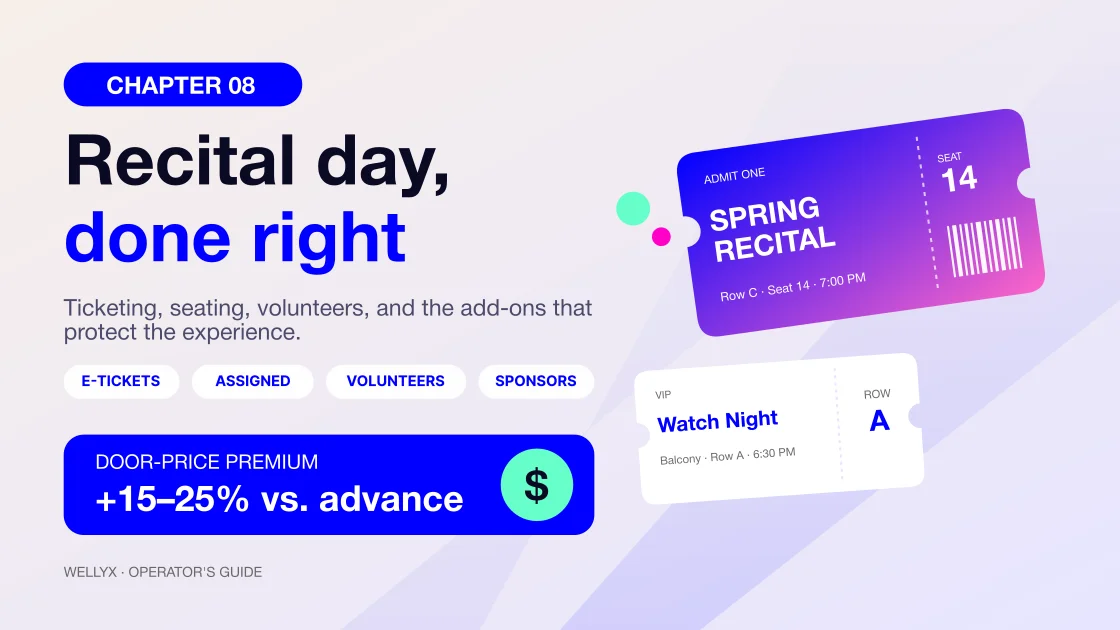
Digital vs. physical tickets
Your recital framework should start with the ticket type.
E-tickets
Best for simplicity, faster scanning, lower printing hassle, and mobile-friendly parents.
Watch for battery issues, inbox confusion, or less tech-comfortable family members.
Printable tickets
Best for families who want a paper backup or prefer something physical.
Watch for reprints, forgotten tickets, and slower check-in.
Wristbands
Best for performer control, backstage access, or multi-session flow.
Watch for setup time, extra cost, and distribution logistics.
A smart hybrid
A mixed setup often works best:
- E-tickets for the general audience
- Wristbands for performers or minors
- Printed backup for those who need it
Seating strategy and capacity
This part matters more than people think.
Bad seating causes family stress, volunteer stress, front-door conflict, late starts, and refund tension.
Main seating models
| Model | Best for | Watch-outs |
| General seating | Smaller venues, simple setup | Less control, rush behavior |
| Assigned seating | Larger venues, tiered pricing | More admin |
| Tiered seating | Revenue optimization | Needs very clear communication |
Other things to decide early:
- Accessibility seats
- Family group blocks
- Ticket limits
- Waiting list rules
- Late release policy for held seats
Stage lighting and production basics
Lighting is part of the recital experience, not a side concern. Even modest lighting upgrades change how the show feels for parents and how the photos and video turn out later.
Practical priorities:
- A clear front wash so faces are visible from row 1 to the back
- Side lighting for dimension on group numbers
- Coloured washes for mood shifts between pieces
- Spotlighting for solos, duets, or feature moments
- Backstage cue lights so dancers know when to enter
Most studios rent lighting from the venue or a local production company. Ask for a tech rehearsal slot so cues are set before the audience arrives, not improvised in real time.
Getting sponsors and recital partners
Recitals can be partly funded by local sponsors if you make it easy for them to say yes.
Common sponsor formats:
- A logo placed on the printed program in exchange for a flat fee
- A full-page program ad sold at a higher tier
- Banner placement in the lobby on recital day
- Sponsor mention from the MC between acts
- A “presented by” line on tickets and digital promo
Local businesses that already serve your families — physiotherapists, dance retailers, family restaurants, photographers — are usually the easiest first sponsors. Build a one-page sponsor sheet with three tiers and a clear ask. Reach out four to six months before the show.
Ticket sales workflow
A recital should have a real ticket workflow. Not just a launch email.
| Stage | What happens |
| Early announcement | Families get the recital date and basic seat info |
| Priority window | Performer families or members get early access |
| Public launch | Remaining seats go live |
| Reminder phase | Final purchase push |
| Waitlist | Manage overspill fairly |
| Door plan | Clear policy for last-minute sales |
| Check-in | Staff ready with scan or list system |
A small price increase at the door can work if the venue and staffing support it. But the bigger point is clarity. People forgive sold-out events.
They do not forgive confusing events.
FAQs
How do you run a dance studio successfully?
You run a dance studio successfully by treating it as a full business system. That means strong legal setup, safe space design, clear pricing, good hiring, steady marketing, progress tracking, parent communication, and clean financial reporting.
How much money do you need to start a dance studio?
Startup costs for a dance studio can vary widely depending on your city, size, and how fancy you want the space to be. For a small to mid-size studio, a typical range is $15,000 to $50,000 just to get doors open, based on recent industry surveys. That includes essentials like flooring, mirrors, sound systems, permits, and initial marketing. According to the SBA, nearly 30% of small business failures come from underestimating startup expenses, making it critical to plan carefully.
What is the best flooring for a dance studio?
The best flooring depends on your dance styles, schedule, and training needs. In many cases, a sprung floor system with the right top surface is a smart long-term choice because it helps manage impact stress. Industry dance-floor guidance also distinguishes dance floors from generic commercial or sports floors.
What are the best dance studio marketing ideas for new enrollment?
The best dance studio marketing ideas are the ones tied to the season. Back-to-school referrals, beginner intro offers, open houses, themed class events, summer camp enrollment pushes, and parent-friendly local content usually work better than random promotions.
How do dance studios make money besides tuition?
Studios often add revenue through private lessons, camps, workshops, merchandise, recital add-ons, studio rentals, digital content, and well-run dance team fundraising ideas.
How can I improve student retention in a dance studio?
Focus on attendance tracking, parent communication, visible progress, community feel, easy billing, and early outreach when a student starts to slip. Strong student retention strategies are usually simple, consistent, and personal.
What should a dance studio’s financial plan include?
A solid dance studio financial plan should include fixed costs, variable costs, monthly revenue targets, payroll, tax reserves, seasonal dips and peaks, class profitability, and cash reserves.
What is the best way to handle dance recital ticketing?
The best dance recital ticketing setup is the one that families can understand fast. That usually means clear seat rules, simple launch timing, easy payment, and a calm check-in system on recital day.
What safety basics should parents see in a dance studio?
Parents should see a clear check-in flow, clean spaces, safe floors, professionally mounted mirrors, calm staff, visible first-aid readiness, clear exits, and adults who know what to do in an emergency. CPR/AED readiness is also a strong trust signal. The CDC and AHA both emphasise acting fast with CPR and AEDs in cardiac arrest situations.
How can I prevent burnout as a studio owner?
Burnout gets worse when everything depends on you. Start by removing manual work, training team leads, documenting systems, and protecting time for operator work instead of constant reactive work.
Final thoughts
If you came here asking how to run a dance studio, the real answer is bigger than class plans and recital sparkle.
You are not just building a place to dance. You are building a place that has to work.
- It has to work when enrollment is strong
- It has to work in July when things get quiet
- It has to work when a teacher leaves
- It has to work when recital week gets loud
- It has to work when a new family walks in and decides in two minutes whether this place feels safe, steady, and worth trusting
That is the job.
And the good news is this: a great studio is not built by doing one big thing perfectly. It is built by doing many small things clearly.
- Choosing the right space
- Setting the right prices
- Watching the right numbers
- Tracking student progress
- Making families feel informed
- Keeping the room safe
- Using systems that lower friction
- Planning your marketing before you need it
- Treating the recital like a process
- Building the business so it does not lean on your memory forever
That is how to run a dance studio well. Not perfectly. Not without stress.
But with far more control, far more trust, and far more chance to grow something that lasts.
Ready to make your studio easier to run?
If you want to turn all of this into something practical, the right software makes a big difference.
Wellyx is one of the best dance studio software solutions designed to help you grow without adding more chaos.. Our software brings your scheduling, payments, attendance, and communication into one simple system so you are not juggling multiple tools every day.
With the right setup, you can:
- Automate billing and reduce failed payments
- Track attendance and student progress easily
- Simplify class scheduling and staff management
- Improve parent communication and retention
- Cut down admin time so you can focus on teaching and growth
Instead of fixing problems manually, you start running your studio with clarity and control.
Book a demo with Wellyx and see how it can help you run a smoother, more profitable, and less stressful dance studio.