





A parent pays for a new gi and a belt-test fee at the front counter. The card runs fine. The receipt prints. But neither charge appears on the family’s membership record, so the front desk has no idea the fee was ever paid, the revenue report can’t tell membership dues from retail sales, and next month someone asks the same parent to pay the testing fee again.
That’s not a POS problem. It’s a POS-and-membership problem, and it’s specific to how dojos actually make money: recurring tuition, one-time belt-test and grading fees, retail (gis, belts, sparring gear), and often several students from one family paying through one account. Generic POS reviews don’t test for this. This guide does.
The numbers behind dojo POS and membership sync
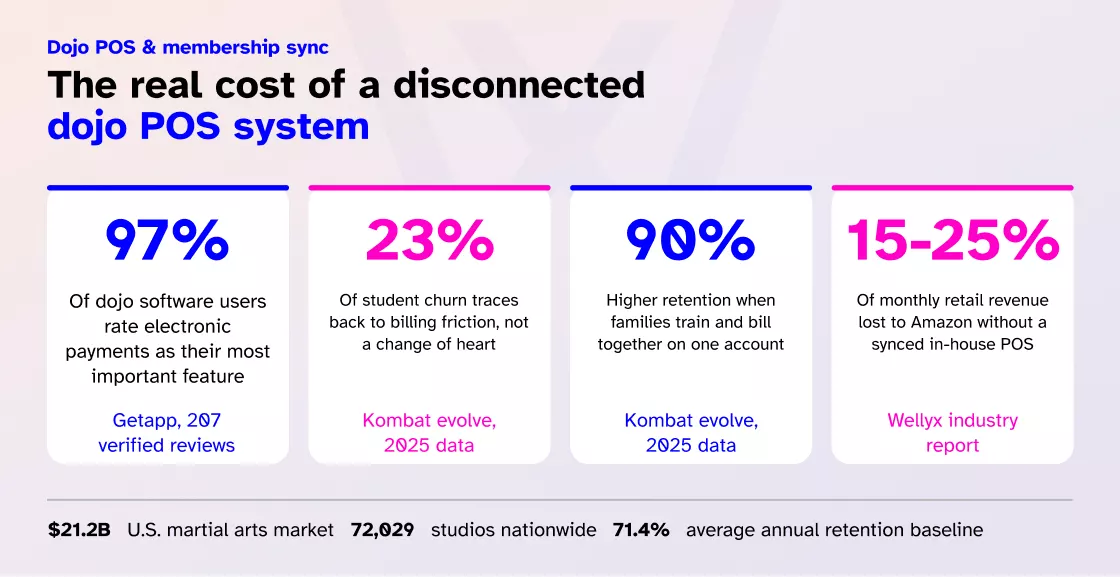
This isn’t a niche problem. The U.S. martial arts market reached $21.2 billion across 72,029 studios in 2026, according to IBISWorld, with average monthly tuition sitting near $150 per student. At that scale, the operational details this guide checks for translate directly into revenue and retention.
On retention and revenue:
- Studios without a structured retail offering (gis, belts, gear sold through their own POS rather than sent to Amazon) surrender an estimated 15 to 25 percent of potential monthly revenue per student.
- Billing friction, failed cards, forgotten updates and manual invoice chasing account for roughly 23 percent of student churn, per Kombat Evolve’s 2025 data cited in Wellyx’s own martial arts industry statistics report.
- Families that train together show 90 percent higher retention than students enrolled individually, and studios offering family membership plans report up to 25 percent higher retention than those pricing per individual, per the same report.
- The average martial arts student stays enrolled 18 to 24 months, but schools with strong retention systems and clear, trackable belt progression see average enrollment length stretch to 36 months or more, according to a June 2026 dojo operations analysis that reviewed IBISWorld, Gymdesk, and Mindbody industry data alongside retention-specific research. That’s the direct link between a software feature (automated belt-test tracking) and a revenue outcome (nearly doubled average student lifetime).
Family billing and retail POS aren’t administrative nice-to-haves against that backdrop. They’re two of the more direct, measurable levers a dojo has on retention and revenue, which is exactly why this comparison checks for them specifically rather than treating “has POS” as a single yes-or-no feature.
What “POS that handles memberships well” actually means for a dojo
A POS system can ring up a sale without knowing anything about the student. What a dojo actually needs is different: a point-of-sale system that writes every transaction back to the same student and family record used for membership billing, so a belt-test fee, a gi purchase, and monthly tuition all show up in one place instead of three.
That’s a narrower question than ‘Does this software have POS?’ and a different question from ‘Does this software have a CRM for leads and retention? This guide covers the intersection specifically: family and multi-student billing, belt-test and grading fee handling, and retail sales tied to a student’s profile, not POS in isolation and not general martial arts management software.
How we evaluated
We evaluated five criteria specific to this intersection, using each vendor’s product pages, documentation, and independent pricing trackers:
- Does a POS sale (retail or a one-time fee) write to the same student or family record used for membership billing, or does it live in a separate, unlinked transaction log?
- Can multiple students under one family pay through a single account while still being tracked individually?
- Is a belt-test or grading fee a defined charge type the system can trigger automatically, or does it get entered manually as a miscellaneous charge?
- Does revenue reporting separate retail and one-time fees from recurring membership dues, or does it blend into one number?
- What does the platform actually cost once POS and family billing are both turned on, not just the advertised entry price?
Comparison table: dojo POS and membership fit
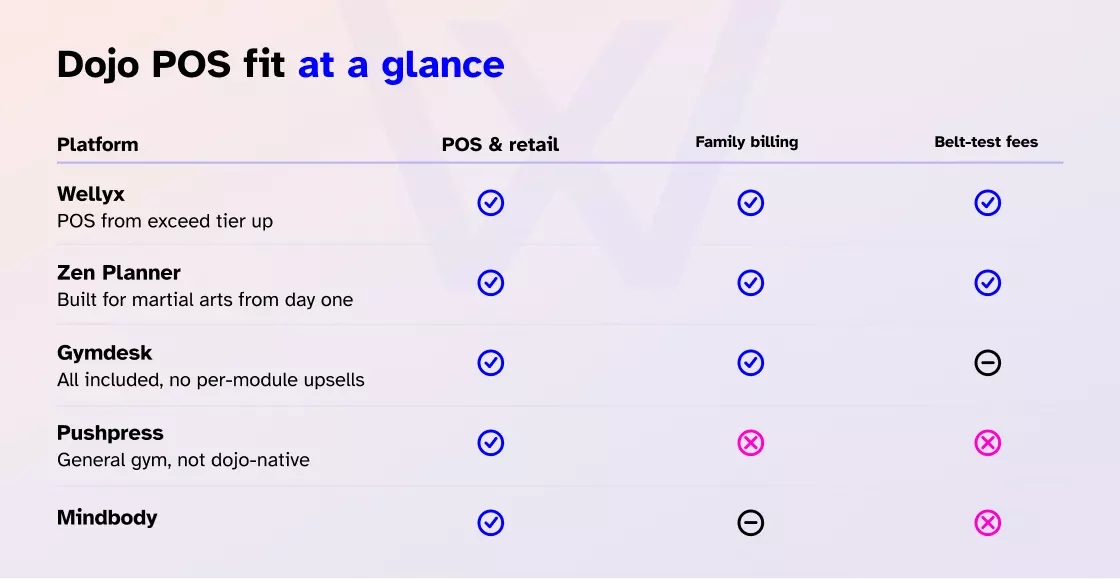
| Platform | POS and retail | Family/multi-student billing | Belt-test fee handling | Starting price |
| Wellyx | Native, included from Exceed tier up; retail low-stock alerts built in | Family portal with shared account, multiple students under one profile | Automated as part of billing workflows, alongside tuition and class packs | $99/month (Excel); POS requires Exceed at $199/month |
| Zen Planner | Native; users specifically credit it for POS and retail management | Shared family accounts with automatic sibling discounts | Belt and rank tracking is core to the product; testing-fee automation available through its billing tools | $99/month for the Studio plan; higher-tier pricing is reported inconsistently across sources, so confirm current tiers directly |
| Gymdesk | Native POS included at every tier, no add-on required | Family accounts included at every tier | Belt and rank tracking included; no separately documented “belt-test fee” charge type | Transparent, member-count-based: roughly $49 to $150+/month depending on active students |
| PushPress | Native POS through Core | Not built around family/multi-student billing | No native belt tracking | Core plans are available at free, $159-per-month, and $229-per-month levels; the Grow CRM add-on costs an additional $329 per month |
| Mindbody | Native POS | General fitness billing, not family-account-specific | Often requires workarounds; may not support belt tracking natively | Approximately $99 per month at entry level (quote-based), plus a reported 20% marketplace commission on app-driven bookings |
The pricing and feature claims above were checked against each vendor’s website and recent third-party pricing trackers as of July 2026.
Confirm current numbers directly with the vendor before budgeting, especially for Zen Planner’s higher tiers, where published sources disagree.
Wellyx: best for tying POS, family billing, and retention together
Wellyx martial arts software fits dojos that want POS, family billing, and belt-test fee automation reading from the same student record as marketing and retention tools, and are comfortable being on the Exceed tier or higher to get POS.
Wellyx’s martial arts product explicitly automates belt testing fees alongside tuition, invoices, and recurring payments, and flags retail stock (gis, belts, pro-shop items) before it runs low. Its family membership and shared-profile tools let a parent link multiple students under one account, bill them collectively, and still track each student’s attendance and progress individually. Belt and rank progression tracking includes automatic test-fee assignment when a student becomes eligible, not just a static rank field.
The catch is tier placement. POS, lead management, and marketing automation all sit on the $199 Exceed plan or the $299 Ultimate plan, not the $99 Excel entry tier, a detail confirmed by independent martial-arts-software comparisons as well as Wellyx’s own pricing structure. Independent reviewers have also noted that Wellyx wasn’t purpose-built for martial arts specifically, and it shows in how belt-promotion workflows are configured compared with dojo-native platforms.
Who should avoid it: dojos on a strict Excel-tier ($99) budget, since POS isn’t included until Exceed; schools that want a platform built exclusively around belt-based curriculum from the ground up.
Practical takeaway: choose Wellyx when POS and family billing need to connect to broader marketing and retention tools under one login, and budget for Exceed or Ultimate rather than the entry tier.
Zen Planner: best for family billing built specifically around martial arts
Zen Planner fits dojos where family billing is the priority. Multiple parents and children can share one family account, siblings get discounts applied automatically, and parents manage payments from a single portal.
Zen Planner was founded by a martial arts school owner, and it shows in the specifics: belt and rank tracking on every student profile, shared family accounts built as a core feature rather than an add-on, and users specifically credit it with saving hours a week on POS and retail management.
Pricing is where sources disagree. Every source confirms Studio starts at $99/month. Beyond that, Capterra lists Essentials at $198/month and Ultimate at $348/month, while other trackers describe a $249/month Engage add-on for CRM and marketing ($299/month for non-Zen Planner customers, plus a $300 setup fee). Confirm the current tier structure directly with Zen Planner before budgeting; it appears to have changed or be represented differently across sources.
Who should avoid it: schools that have found the interface dated or reviewers’ complaints about high processing fees and billing issues to be a dealbreaker; anyone who needs firm pricing before a sales call, given the conflicting tier information. (See a fuller Wellyx vs. Zen Planner comparison for how the two platforms stack up beyond POS and family billing specifically.)
Practical takeaway: choose Zen Planner when family billing depth and belt-based curriculum tracking matter more than interface polish, and verify the exact plan and price directly before signing.
Gymdesk: best for transparent, no-upsell pricing with everything included
Gymdesk fits dojos that want POS, belt tracking, and family accounts included at every paid tier, with no separate CRM or marketing add-on required to unlock them.
Gymdesk’s own pricing breakdown lists billing, scheduling, check-in, member app, website, belt tracking, POS, family accounts, and reporting as included, full stop, with pricing that scales by active member count rather than by feature tier. A 200-member gym pays roughly $150/month for the complete feature set, no per-module upsells.
What Gymdesk doesn’t clearly document is a dedicated belt-test fee workflow the way Wellyx does. Belt and rank tracking is included, but automatic fee-triggering tied to testing eligibility isn’t spelled out in the same way, so confirm this specifically in a demo if it’s a priority. Marketing automation is also lighter than Wellyx’s, and SMS is a paid add-on rather than bundled in.
Who should avoid it: dojos that want deep marketing automation and lead nurturing bundled in, not just operations and billing. (See Wellyx vs. Gymdesk for a side-by-side beyond the POS and family-billing angle covered here.)
Practical takeaway: choose Gymdesk when transparent, all-included pricing matters more than deep marketing tooling, and confirm belt-test fee automation specifically before assuming it works the way Wellyx’s does.
PushPress: built-in POS, but not built around family or belt-based billing
PushPress fits gyms that also run some martial arts classes, not dedicated dojos. Its POS is genuinely built in, but the platform has no native belt tracking and isn’t structured around family or multi-student billing.
Independent comparisons are consistent on this point: PushPress works well for general fitness gyms that host martial arts classes alongside other programming, but lacks the belt-rank and family-account depth that dedicated dojo software or Zen Planner and Gymdesk provide natively.
Who should avoid it: any dojo where belt tracking and family billing are core to daily operations, not a nice-to-have. (See Wellyx vs. PushPress for a broader feature comparison.)
Practical takeaway: choose PushPress only if your business is a general gym with some martial arts classes mixed in, not a dedicated dojo.
Mindbody: strong POS and marketplace reach, weak on belt-based operations
Mindbody fits martial arts businesses that want marketplace-driven student discovery and are willing to work around its lack of native belt tracking to get it.
Its POS and retail tools are mature and well-established, and its consumer marketplace app is a genuine differentiator for new-student discovery that dedicated dojo platforms don’t offer. But independent martial-arts-software comparisons note it may not support belt tracking at all without workarounds, since it was built for general fitness and wellness businesses first.
Pricing starts near $99/month, with higher tiers reported between $259 and $699/month requiring a sales call, plus a reported 20% commission on marketplace-acquired clients on top of the subscription.
Who should avoid it: dojos where belt and rank tracking is central to how the business runs; anyone who doesn’t want new-student discovery running through a third-party consumer app. (See Wellyx as a Mindbody alternative for a fuller comparison.)
Practical takeaway: choose Mindbody only if marketplace exposure is worth paying a premium for and working around the missing belt-tracking depth.
What to look for in a dojo POS system: buyer’s checklist
- Family and multi-student billing under one account, with each student still tracked individually for attendance, belt rank, and payment status. (Wellyx’s family membership tools are one example of what this looks like done well.)
- Belt-test and grading fees as a defined charge type, ideally one the system can trigger automatically based on eligibility, not something staff enter manually as a miscellaneous line item.
- Retail tied to the student’s profile, with revenue reporting that separates gi and gear sales from recurring tuition rather than blending both into one number.
- Walk-in and trial payments that don’t create a duplicate student record when that person later signs up for a membership.
- Hardware support: card reader and receipt printer compatibility, confirmed for your specific setup rather than assumed. Worth checking specifically for contactless and tap-to-pay support: over 65 percent of in-person card transactions in the U.S. now use contactless technology as of 2026, and that share is higher among the parents of younger students, a core dojo demographic.
- Offline mode, since a POS that goes down when the internet drops mid-class is a real problem at a front desk during a busy testing day.
- Migration scope in writing, covering what specifically transfers (active records, payment methods, historical transaction data) versus what needs manual rebuilding.
Frequently asked questions
What is the best dojo membership POS software in 2026?
It depends on priority. Zen Planner and Gymdesk lead on family billing built specifically for martial arts. Wellyx adds the strongest marketing and retention layer once you’re on its Exceed tier or higher, where POS is included.
Is POS martial arts software different from general martial arts management software?
Yes. Management software covers scheduling, CRM, and retention broadly. This comparison specifically checks whether a POS transaction (a retail sale or a one-time fee) writes back to the same student and family billing record, which not every “all-in-one” platform handles the same way.
Can a dojo POS system handle family or multi-student billing?
Yes. Wellyx, Zen Planner, and Gymdesk all support multiple students under one family account under one family account with individual tracking. PushPress and Mindbody are built around general fitness billing and don’t offer the same family-account depth natively.
How do belt-testing and grading fees get charged through dojo POS software?
On platforms that support martial arts-specific billing workflows, including Wellyx and Zen Planner, belt-test fees may be automated alongside tuition. On general fitness platforms (PushPress, Mindbody) and on Gymdesk’s documented feature set, this typically has to be entered as a one-time charge rather than triggered automatically by testing eligibility, so confirm this directly in a demo.
Is retail revenue (gis, belts, gear) tracked separately from membership dues?
On the platforms with native POS built into the same system as membership billing (all five compared here), retail sales and recurring dues are both recorded in the same platform. Whether reporting separates the two cleanly by default varies, so check this specifically rather than assuming it.
What’s the difference between martial arts studio management software and a dojo POS system?
Management software is the broader category: scheduling, CRM, lead follow-up, retention. POS is the specific function of processing a sale or a fee at the point of transaction. The best dojo software combines both under one student record; the two terms get used interchangeably in search, but they’re not the same feature.
Conclusion
The right answer depends on what’s actually breaking at your front desk. If family billing and belt tracking are the daily friction, Zen Planner or Gymdesk may be the strongest fits. If automated belt-test fees are essential, confirm Gymdesk’s workflow during a demo. If POS needs to connect to broader marketing and retention tools, Wellyx does that, once you’re on Exceed or higher. If your business is a general gym running some martial arts classes rather than a dedicated dojo, PushPress or Mindbody’s mature POS tools may be enough, even without native belt tracking.
Want to see how Wellyx’s POS, family billing, and belt-test fee automation work together on a live dojo account? Book a demo.