





Students quit martial arts in the first six months because expectations meet reality. The excitement of trying something new fades, progress becomes harder to see, and training starts competing with soreness, schedules, cost and daily life.
A new student may arrive early, buy a uniform, ask questions, and talk about earning a first belt. Four weeks later, they miss one class. Then another. Their membership remains active, but their usual place on the mat stays empty.
That quiet disappearance is more common than a dramatic cancellation. Most students do not leave because of one bad session. They leave after several small frustrations begin to stack up.
Many people start martial arts because they want confidence, fitness, discipline, self-defense, or stronger self-belief. Training can begin changing how they carry themselves before they master a difficult technique. But early motivation is temporary. The novelty settles, the physical work becomes clearer, and beginners sometimes lose sight of the reason they joined.
A useful discussion about why people quit martial arts reflects the same idea. Long-term students do not stay because their motivation never drops. They continue because they keep finding new goals, useful relationships, and reasons to return.
That is why the first six months should be treated as an extended onboarding period. The goal is not to lower standards. It is to help each beginner feel safe, capable, noticed, and clear about what comes next.
Why the first six months matter so much
The first six months determine whether martial arts becomes part of a student’s identity or remains something they briefly tried.
Beginners usually attend because they are excited. Long-term students return because they have built stronger foundations:
- A predictable training habit
- Relationships with instructors
- Friendships on the mat
- Confidence in the learning process
- Evidence that they are improving
- A meaningful goal beyond the first belt
A new student has not developed those supports yet. They are still deciding whether they belong, whether the physical demands feel manageable, and whether training deserves a permanent place in the week.
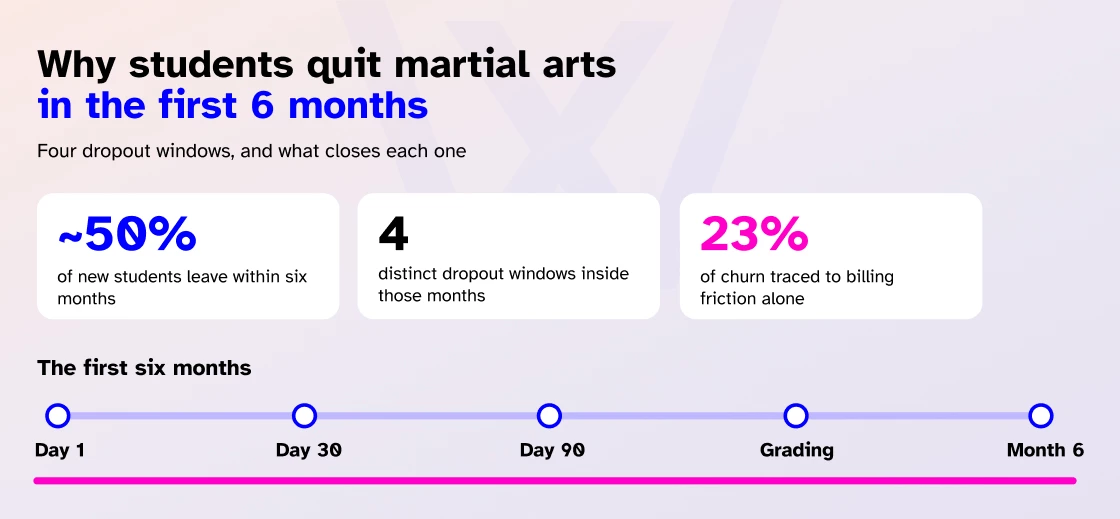
Industry reporting suggests that approximately 50% of new martial arts students leave within six months. This should be treated as an industry estimate rather than a universal peer-reviewed dropout rate, but it still shows why martial arts student retention needs attention from the first class.
By months three through six, the novelty has faded. Yet the student may not have trained long enough to build the identity, routine, and relationships that bring experienced members back during difficult weeks.
Students who stay vs. students who quit
| Retention signal | Students who stay | Students who quit |
| Expectations | Understand that progress is gradual | Expect fast belts or dramatic skills |
| Attendance | Train on predictable days | Attend only when convenient |
| Progress | Can name specific improvements | Feel stuck or overlooked |
| Relationships | Know instructors and classmates | Feel anonymous in the room |
| Intensity | Know how to scale training | Associate class with pain or fear |
| Goals | Have a clear next milestone | See only a distant belt |
| Absences | Receive a clear return path | Feel too far behind to return |
The difference is not always talent, discipline, or physical ability. It is often the quality of the early experience.
The four dropout windows inside the first six months
Students do not face the same problem throughout their first six months. Each stage creates a different kind of friction and requires a different response.
Window one, days 1 to 30: When excitement meets reality
The first classes feel exciting. Then the reality phase begins.
The student discovers that martial arts is not instant confidence or cinematic technique. It involves repetition, correction, conditioning, and awkward movement before control develops.
Beginners may worry about:
- Looking uncoordinated
- Slowing down a training partner
- Forgetting a technique
- Making mistakes in public
- Getting hurt during sparring
- Not being fit enough
- Asking an obvious question
- Feeling older, younger, or less athletic than everyone else
Some students also feel overwhelmed by unfamiliar etiquette, equipment, terminology, and class structure. Everyone else seems to know where to stand and what to do.
Physical burnout can begin here too. A beginner placed into hard conditioning, intense rolling, or heavy sparring may leave dreading the next session. Moderate soreness may be normal, but unnecessary pain can make the school feel unsafe.
What owners may notice
Strong attendance during the first week may suddenly fall. The student may avoid partner work, ask about easier classes, leave quickly after training, or stop making future bookings.
They may not complain. Quiet beginners often disappear without explaining what made them uncomfortable.
How to fix it
Set realistic expectations before asking for long-term commitment. Tell beginners that repetition, awkward movement, corrections, and mild soreness are normal parts of learning.
Schools should also:
- Send clear first-class instructions
- Explain what to wear and when to arrive
- Introduce the student by name
- Pair them with a patient training partner
- Use beginner or fundamentals classes where possible
- Scale conditioning and technical drills
- Protect beginners from aggressive sparring
- Give them one achievable goal for the class
- Check in before they leave
The student is not deciding whether they love martial arts yet. They are deciding whether they feel safe enough to remain a beginner.
Window two, days 31 to 90: When novelty fades, and progress becomes invisible
After a few weeks, the excitement of trying something new settles. Regular classes begin to feel ordinary.
At the same time, progress becomes less obvious. A student may improve balance, breathing, distance, timing, control, and resilience without noticing. Martial arts progression is rarely linear, so visible breakthroughs do not happen every week.
Problems grow when:
- Belt promotions feel far away
- Feedback focuses only on mistakes
- Students compare themselves with faster learners
- Adults assume they are too stiff or unathletic
- Children receive little recognition between gradings
- Parents cannot see what their child is learning
- Curriculum requirements remain unclear
- Progress is recorded but never discussed
The student may still be developing, but progress that remains invisible does little to protect motivation.
What owners may notice
Attendance often becomes irregular rather than stopping completely.
A student attends twice, misses a week, returns once, and then disappears again. They may ask whether they are progressing normally or when the next grading will take place.
Parents may also begin questioning whether their child is gaining enough from the program.
How to fix it
Use smaller, program-appropriate milestones between major belt promotions.
These may include:
- Curriculum checkpoints
- Technique sign-offs
- Attendance goals
- Progress cards
- Stripes where appropriate
- Grading-readiness reviews
- First sparring or drilling milestones
- Short parent updates
- Instructor feedback notes
Specific feedback matters more than general praise. “Your balance stayed stable through that combination” gives the student clearer evidence than “good job.”
Progress does not need to be exaggerated. It needs to be seen.
Window three, the first grading: When progress becomes a test
A first grading provides direction, but it can also create anxiety.
Some students worry about failing in front of instructors, classmates, or parents. Others do not understand the criteria, feel behind, or are surprised by additional testing fees.
There is another risk after promotion. The student reaches the goal they had been working toward, but nobody helps them choose the next one. A milestone that should create momentum becomes a stopping point.
Common sources of friction include:
- Unclear grading requirements
- Fear of public embarrassment
- Comparison with classmates
- Pressure from parents
- Confusion about eligibility
- Unexpected grading costs
- Missed preparation sessions
- Feeling physically unprepared
- Believing failure means they do not belong
What owners may notice
Students may miss grading-preparation classes, delay registration, repeatedly question their readiness, or disappear before the test.
Attendance can also fall immediately after promotion when no new goal has been established.
How to fix it
Explain the grading process several weeks in advance.
Students should know:
- Which skills will be assessed
- How readiness is decided
- What the grading will look like
- Which fees are involved
- What happens if they need more time
- What goal comes next after promotion
A low-pressure mock grading can remove much of the uncertainty. Instructors should normalize mistakes and explain that needing more practice is part of learning.
After the grading, hold a short conversation about the next realistic target.
A belt should confirm progress. It should not decide whether the student belongs.
Window four, months 4 to 6: When training competes with real life
By month four, martial arts is no longer new. Work, school, transportation, childcare, injuries, finances, and competing activities begin testing the habit.
The student may still enjoy training, but their routine is vulnerable. A new work shift, school exams, another sport, a minor injury, or an expired payment card can interrupt attendance.
The longer someone stays away, the harder returning may feel. They worry about being out of shape, falling behind, or having to explain where they have been.
What owners may notice
- Longer gaps between visits
- Repeated scheduling complaints
- Membership-freeze questions
- Failed transactions
- Missed events
- Parents becoming less responsive
- Students promising to return “next week”
- Injured students with no return date
How to fix it
Help students create a realistic routine instead of an ideal one. Two predictable classes may be more sustainable than an ambitious five-day plan.
Schools can also:
- Offer clear class alternatives
- Provide suitable make-up options
- Create a return plan after injury
- Explain fees before they are charged
- Make schedule changes easy to find
- Contact students before absence feels awkward
- Revisit the reason they originally joined
Billing friction matters too. Industry data attributes 23% of student churn to billing-related problems. A failed card is not always a conscious decision to quit. It can become one when nobody follows up.
Warning signs that a student may be preparing to quit
Cancellation is a late indicator. Changes in attendance, body language, and communication usually appear first.
Watch for:
- Attendance falling below the student’s normal routine
- Two or three expected classes being missed
- Grading preparation being avoided
- Lower engagement during class
- A parent questioning progress
- Future classes no longer being booked
- Messages going unanswered
- A failed payment remaining unresolved
- No return after an injury
- Repeated scheduling problems
- Less participation in partner work or events
- No discussion of a future goal
One missed class means little on its own. Compare current behavior with that student’s established pattern.
Someone who normally trains once a week should not be assessed in the same way as someone who usually attends four times.
Warning signs only matter when the school has a clear process for acting on them.
Diagnose where your school is losing students
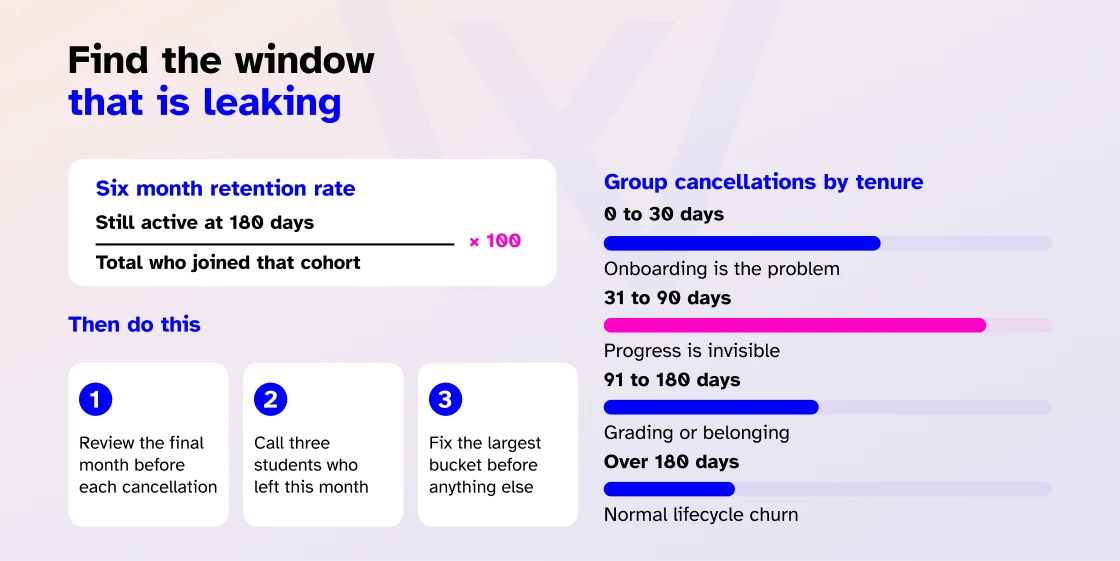
Before adding more martial arts retention strategies, identify the stage that is already leaking.
Calculate your early retention rate
Choose students who joined during the same month or quarter. Record how many remained active after 30, 90, and 180 days.
Six-month retention rate = students still active after 180 days ÷ total students who joined that cohort × 100
Overall membership growth can hide unhealthy churn. A school may enroll many new students while losing nearly the same number, creating the appearance of stability without meaningful growth.
Group cancellations by student tenure
Sort former students into four groups:
- 0 to 30 days
- 31 to 90 days
- 91 to 180 days
- More than 180 days
The largest group shows where to investigate first.
Early losses may point to poor onboarding. Month-two losses may reflect invisible progress. Grading-period exits may reveal anxiety or unclear expectations. Months-four-to-six cancellations may involve schedules, injury, belonging, cost, or billing.
Review the final month before cancellation
Check:
- Attendance frequency
- Missed bookings
- Grading dates
- Failed payments
- Instructor notes
- Schedule changes
- Previous messages
- Injury reports
- Membership-freeze requests
A cancellation marked “too expensive” may have followed several weeks of declining attendance. Cost may be the final reason, but disengagement could have begun much earlier.
Speak with former students
Ask two simple questions:
- What changed?
- What would have made training easier to continue?
The aim is not to pressure the student into returning. It is to identify the part of the experience the school failed to see.
Retention self-audit checklist
- We track 30-, 90-, and 180-day retention
- Beginners receive instructions and recommended training days
- Staff can identify attendance changes quickly
- Progress is visible between belt promotions
- Parents receive useful updates
- Grading fees and requirements are explained early
- Injuries and failed payments trigger follow-up
- Cancellation reasons are reviewed monthly
- One person owns every follow-up task
The six-month martial arts student retention playbook
The strongest retention systems are simple enough to repeat during busy weeks.
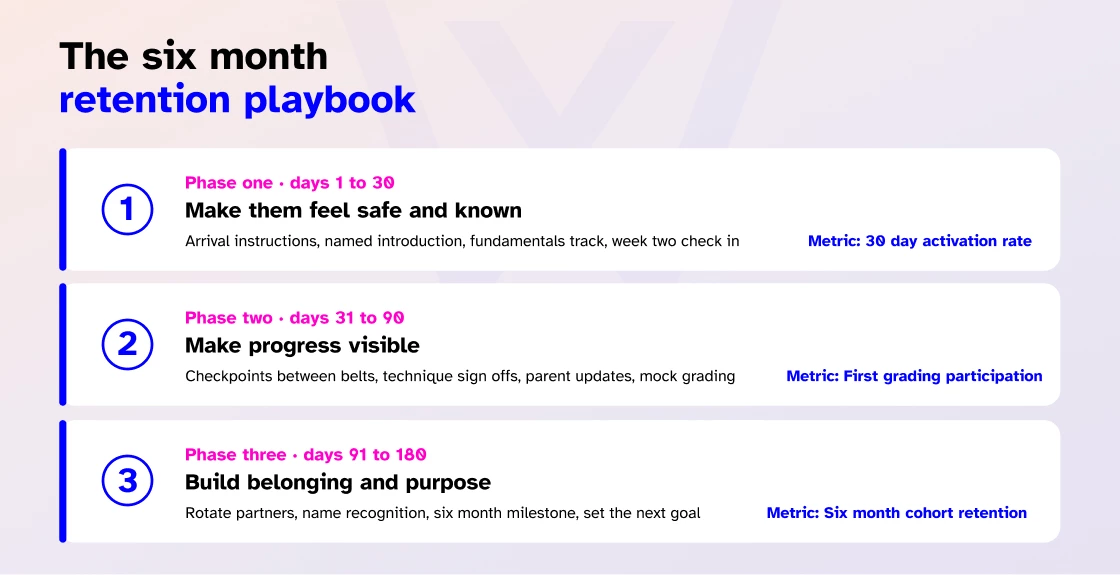
Phase one, days 1 to 30: Make the student feel safe and known
Before the first class:
- Send arrival instructions
- Explain clothing and equipment
- Identify the instructor
- Describe the class structure
- Recommend two realistic training days
During the first few weeks:
- Introduce the student to several classmates
- Assign a supportive training partner
- Use beginner classes where possible
- Scale drills appropriately
- Protect beginners from aggressive sparring
- Teach recovery and soreness management
- Check in after the first class
- Follow up again during week two
Set one achievable first-month goal, such as attending eight sessions or completing the introductory curriculum.
The goal should be clear enough that the student can recognize success without waiting months for a belt.
Phase two, days 31 to 90: Make progress visible
The student should be able to name something they can do now that they could not do on day one.
Use a combination of:
- Technique sign-offs
- Progress cards
- Attendance milestones
- Curriculum checkpoints
- Grading-readiness reviews
- Parent updates
- Stripes where appropriate
Recognition should focus on meaningful development. Notice control, consistency, balance, confidence, patience, and effort.
Prepare students for grading several weeks in advance and run a practice assessment.
The next belt may be months away, but the next meaningful achievement should not feel that distant.
Phase three, days 91 to 180: Build belonging and purpose
Belonging develops through repeated signs that the student matters.
Instructors should:
- Learn and use the student’s name
- Watch changes in body language
- Rotate training partners
- Include quieter beginners
- Invite students to suitable events
- Recognize six-month participation
- Let developing students help newcomers
- Set a new goal after grading
- Keep parents informed
- Address scheduling and injury barriers early
A student who joined for fitness may later become interested in competition. A child who joined for confidence may begin working toward leadership.
Goals should develop as the student develops.
Students rarely quit places where they feel known. They drift away from places where they feel like another monthly payment.
Run an absence-and-return protocol
Use a trigger such as:
- Two or three consecutive missed classes
- Seven to ten days without attendance
- A clear decline from the student’s usual routine
One case study included in Wellyx’s industry report found that using three missed classes as a re-engagement trigger increased dormant-student reactivation from below 8% to 19%.
Follow this sequence:
- Send a personal check-in.
- Ask what is making attendance difficult.
- Recommend one suitable return class.
- Offer a modified session if needed.
- Record the reason for the absence.
- Follow up again if inactivity continues.
A simple message can remove much of the awkwardness:
Hi [Name], we missed you this week. Is everything okay? I can help you choose an easy class to get back into your routine.
Automation can identify the absence. An instructor still needs to rebuild the connection.
Why retention systems fail when schools get busy
Manual retention work often collapses as a school grows. Attendance records, instructor notes, payments, and follow-up tasks end up in different places.
One instructor may know that a student is injured, while the person managing billing sees only missed payments. Another student may stop attending without anyone realizing that their normal routine has changed.
Understanding the benefits of martial arts management software helps owners connect attendance, progression, billing, communication, and reporting.
Owners comparing systems should also examine how martial arts CRM software manages onboarding, missed-class follow-up, student records, payments, and parent communication.
A connected martial arts management software platform can support:
- Attendance alerts
- Class scheduling
- Belt progression
- Parent communication
- Billing follow-up
- Automated reminders
- Membership reporting
Vendor-adjacent industry data summarized by Wellyx reports 31% higher retention among studios using automated payments and proactive communication. This is vendor-adjacent industry reporting rather than an independent academic finding, so it should be presented with that context.
Software should not replace instructor relationships. It should show instructors which relationships need attention.
Five metrics that show whether retention is improving
| Metric | What it measures | Review cadence |
| 30-day activation rate | New students establishing regular attendance | Weekly |
| Average weekly attendance | Whether the training habit is strengthening | Weekly |
| Absence-response time | How quickly staff contact inactive students | Weekly |
| First-grading participation | Whether students reach the first major milestone | Monthly |
| Six-month cohort retention | Share still active after 180 days | Monthly |
Compare your school with its previous enrollment groups before chasing broad benchmarks.
Use the numbers to identify the problem:
- Low 30-day activation points to weak onboarding
- Falling attendance suggests a weakening habit
- Slow response time means follow-up is happening too late
- Low grading participation may reveal anxiety or unclear preparation
- Weak six-month retention means the routine never became stable
Owner action checklist for the next 30 days
- Sort the past year’s cancellations by student tenure
- Identify the weakest dropout window
- Improve the first-class welcome process
- Add one milestone before the next belt
- Set alerts for missed classes and failed payments
- Contact three former students
- Assign one person to every follow-up task
FAQs
Why do most people quit martial arts?
Most people quit when training stops feeling manageable, rewarding, or connected to their goals. Common early triggers include unrealistic expectations, invisible progress, inconsistent attendance, physical burnout, grading anxiety, and weak social connection.
What percentage of martial arts students quit in the first year?
No definitive peer-reviewed rate applies to every discipline or school. However, industry reporting suggests that approximately half of new martial arts students leave within six months. Schools should also calculate their own 30-, 90-, and 180-day retention rates.
How long does the average martial arts student stay?
There is no universal average. Student tenure changes by discipline, age group, schedule, pricing, instructor quality, and school culture. Owners should calculate average membership duration from their records and compare it across programs.
How can a martial arts school stop students from quitting?
Set realistic expectations, control beginner intensity, make progress visible, monitor attendance, prepare students for grading, communicate with parents, and contact students quickly when their normal routine changes.
Should I let my child quit martial arts?
First, understand why the child wants to stop. Temporary frustration, soreness, social discomfort, or grading fear may improve with support. Persistent distress, bullying, unsafe coaching, or a genuine mismatch with the program should be taken seriously.
Stop losing students quietly with Wellyx
Keeping students engaged requires visibility into attendance, communication, memberships, payments, and progress.
Wellyx brings these areas together so staff can identify students who are drifting, contact them earlier, manage memberships, simplify billing, and keep families informed.
Explore Wellyx martial arts software to build a stronger first-six-month retention system while keeping the instructor-student relationship at the center.