



A Pilates studio can look ready for its first class long before the equipment budget is truly complete. Six reformers may seem like a straightforward purchase, but have you accounted for the space around them, the supporting apparatus, delivery, maintenance, and the cost of keeping every machine in use? A commercial reformer alone can cost $3,500 to $8,000, so a few overlooked expenses can quickly change your setup budget.
The key is to plan your equipment around the way your studio will operate, not just the price tags. You need to know which machines and accessories to buy, how much room instructors and clients need, and what each reformer must generate to justify its cost.
This guide breaks down the Pilates studio equipment list, 2026 price ranges, space calculations, and total cost of ownership. It also explains how to inspect used equipment and estimate revenue per reformer. Throughout, we use an illustrative six-reformer studio, where the machines occupy 144 square feet and the exercise area and storage allocation total 426 square feet.
What equipment do you need to open a Pilates studio?
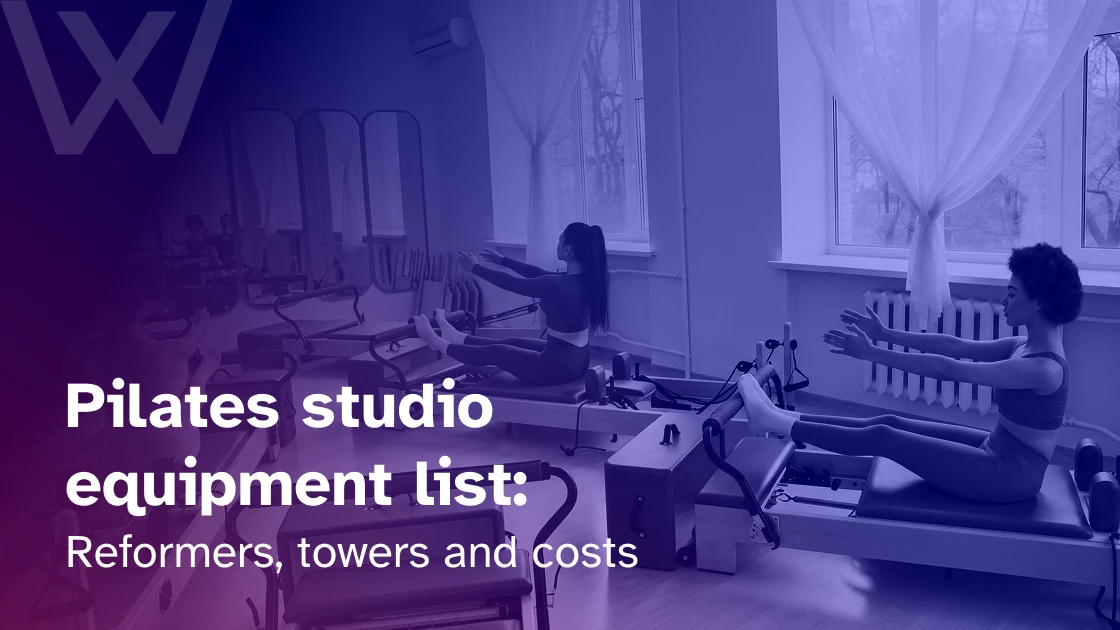
Commercial reformers are the main equipment in a reformer-based Pilates studio, with one machine typically accommodating one client during a group class. Supporting apparatus depends on the classes and private sessions you plan to offer.
A mat-only studio is the cheaper alternative, but it can’t run reformer classes.
Use this Pilates apparatus checklist to match the order to your schedule:
| Item | Typical new cost | Job in the studio |
|---|---|---|
| Commercial reformer | $3,500 to $8,000 each | Group classes, privates and duets |
| Cadillac or trapeze table | $3,500 to $6,000 | Privates and specialty work |
| Wunda chair | $1,200 to $2,500 | Compact apparatus for privates and chair classes |
| Tower unit | Priced by configuration | Spring-and-bar work, standalone or on a reformer |
| Mat-only setup | $2,000 to $5,000 total | Mats, props and storage |
These are 2026 new-equipment ranges before freight, installation and taxes.
Add the small items to the Pilates studio setup order so they don’t arrive as an afterthought:
- Props: Magic circles, small soft balls, resistance bands, foam rollers
- Reformer add-ons: Jump boards and boxes
- Spares: Extra ropes and spring sets
- Storage: Wall racks for mats and props
Delivery times vary by manufacturer, stock availability and equipment configuration. Confirm production, shipping and installation timelines before setting your studio’s opening date.
How much does a commercial Pilates reformer cost in 2026?
New commercial reformers cost $3,500 to $8,000 each in 2026. The spread usually reflects frame material, build quality and warranty terms.
Per-machine prices become studio budgets like this:
| Studio type | Equipment budget | What moves it |
|---|---|---|
| Mat only | $2,000 to $5,000 | Mat quality, storage |
| Small reformer studio (4 to 6 reformers) | $18,000 to $50,000 | Brand tier, one Cadillac or chairs |
| Full reformer studio (8 to 12 reformers) | $35,000 to $80,000+ | Brand tier, mix of towers and chairs |
Treat these as planning ranges, not quotes.
A reformer uses a spring-loaded sliding carriage, while a tower provides spring-and-bar exercises through a fixed frame. A tower is a spring-and-bar frame that attaches to a reformer or stands alone. For group classes, buy reformers first, because one machine fills one spot. Towers and Cadillacs earn their floor space in privates and duets.
Apparatus training is a separate cost per instructor. BASI lists mat and reformer course at $3,000 tuition with a $500 deposit due at enrollment. That is close to the price of one entry-level reformer, per instructor, and it is a US program price, not your local rate.
How many reformers does a new Pilates studio need?
Four to six reformers suit a small studio, and eight to 12 suit a full one. Your reformer count is your maximum group class size, so it also caps what each class can earn.
Size to the class you fill on a typical peak evening, not your best Saturday:
Reformers = Typical peak-class attendance ÷ target fill rate
5 ÷ 0.85 = 5.9, so six reformers
Class mix matters too. Every private or duet taking a reformer slot during a time that could hold a group class removes sellable capacity.
Booking software tracks utilization per machine by counting paid bookings against the spots each class offers. When a class is capped at your reformer count, every booking fills one machine, so the class-level fill rate is your machine utilization:
Utilization = Paid bookings ÷ Scheduled spots
216 ÷ 240 = 90% in our illustrative week, or 36 of 40 slots per reformer
That figure averages across the room. To see one specific reformer, the system needs numbered spot assignment.
Weekly bookings depend on the number of scheduled classes and how many spots are filled. In our 40-class weekly example, each reformer offers 40 spots and generates 36 paid bookings at 90% occupancy. Here is the weekly arithmetic for six reformers:
Weekly paid bookings = Reformers × bookings per reformer
6 reformers × 36 paid bookings = 216 paid bookings per week
At an illustrative $35 average, that is $7,350 to $10,500 per week. Equipment is one line in how much it costs to open a Pilates studio, next to the lease deposit, buildout, insurance and marketing. Fix the reformer count first, and the other lines get easier to estimate.
What space and layout checks matter before you sign a lease?
Check ceiling height, floor load, electrical supply and exits before you sign, because a lease is the one purchase you can’t return. Reformers need roughly 8 x 3 feet each, but the machine is only about a third of the floor you need.
Work through the Pilates studio setup checks in this order:
- Ceiling height: Measure to the lowest duct, sprinkler or light fixture, then compare it with the tallest frame on your list (Cadillac or tower) on its spec sheet
- Floor load: Get the floor’s rated load from the landlord, and an engineer’s check for upper floors, then compare it with spec-sheet weights plus members
- Electrical: Reformers need no power, but lighting, sound, HVAC and check-in do, and outlets along walls beat outlets mid-floor
- Egress: Keep a clear path from every position to an exit, and confirm required widths with your local fire authority
- Storage: Reserve floor for spring sets, ropes and props, about 30 sq ft in our example
Total floor area = Room width × room depth + storage area
In this illustrative layout, six reformers occupy 144 square feet of equipment space. An 18 × 22-foot exercise area provides 396 square feet, with another 30 square feet allocated to separate storage. That brings the example to 426 square feet. Actual space requirements depend on equipment dimensions, circulation clearances, and local safety requirements.
| Room shape | Layout for six reformers | Floor area | Watch for |
|---|---|---|---|
| Rectangle, 18 x 22 ft | Two rows of three, center aisle | About 396 sq ft | Exits at the ends |
| Narrow, 12 ft wide | Three rows of two, two aisles | About 384 sq ft | Back-row sight lines, long walk to the door |
| Room with a column | Shift one row off the column | 400 sq ft or more | Column in a walkway |
These are illustrative layouts, not code guidance, so confirm clearances locally.
How do you compare total cost of ownership across brands?
Total cost of ownership is the sticker price plus freight, installation, spring replacements and parts over five years.
Get these in writing from every brand:
| Cost item | What to compare | Why it moves the total |
|---|---|---|
| Freight | Per unit or per pallet, liftgate, delivery to your site | Often missing from the headline price |
| Installation | Assembly included or separate | Labor adds up across six or more machines |
| Warranty | Frame, springs and upholstery, and whether studio use is covered | Home-use warranties can exclude commercial wear |
| Springs | Replacement price and lead time | Check the manufacturer’s spring replacement schedule and include the required replacements in your five-year cost estimate. |
| Spare parts | Ropes, straps, pulleys, upholstery availability | A reformer waiting weeks for a part is a lost seat in every class |
Five-year cost per reformer = Price + freight and installation + spring replacements + other parts
Hypothetical quotes show how it works. Brand A is $4,200, plus $650 freight and assembly, plus two spring sets at $350 each: $4,200 + $650 + $700 = $5,550. Brand B is $5,000 with freight and assembly included, plus two spring sets at $280 each: $5,000 + $0 + $560 = $5,560. An $800 sticker gap disappears.
What should you inspect on used reformers?
Inspect springs, straps, carriage, frame and paperwork before paying. If a used reformer is offered at a 30% to 50% discount, a comparable new model priced between $3,500 and $8,000 would represent potential savings of $1,050 to $4,000 before reconditioning costs.
Use this checklist in person, with the machine loaded:
- Springs: Look for rust, stretching, uneven tension or mismatched sets
- Straps and ropes: Check for fraying and loose stitching at the attachment points
- Carriage: It should glide quietly through its full travel, with no wobble, grinding or flat spots on the wheels
- Frame: Look for cracks, loose joints, split wood and bent rails
- Footbar and headrest: Each should adjust and lock at every position
- Upholstery: Torn or compressed pads are cosmetic but expensive to replace
- Paperwork: Ask for the purchase date, service history, former use (home or studio), whether the warranty transfers and whether the manufacturer still sells parts
Real used price = Asking price + new springs + new ropes + freight
If reconditioning significantly reduces the savings, compare the total used-equipment cost with the price, warranty and maintenance benefits of buying new.
How do you forecast revenue per reformer?
Forecast revenue per reformer by multiplying paid bookings by the average revenue earned per booking. Then subtract instructor pay and rent to estimate the amount remaining before other operating expenses. This is a preliminary operating surplus, not net profit.
Instructor pay is another important cost to estimate. Rates vary by location, experience and payment arrangement. For context, the U.S. Bureau of Labor Statistics reported a median annual wage of $47,160, or $22.67 per hour, for fitness trainers and instructors in 2025. These national figures cover the broader fitness occupation, so use local Pilates instructor rates when estimating your payroll.
The following example assumes an instructor receives $35 per class, including preparation time. This is an illustrative payment assumption, not a national Pilates instructor rate:
- Scheduled spots: 40 classes × six reformers = 240 per week
- Unfilled or unpaid spots (10%): 24 of the 240 available spots generate no revenue, leaving 216 paid bookings, or 36 per reformer
- Revenue: 216 × $35 = $7,560 per week, or $30,240 over four weeks
- Instructor pay: 160 classes × $35 = $5,600
- Rent: Allocation for the four weeks $6,000
- Left over: $30,240 − $5,600 − $6,000 = $18,640, about $3,107 per reformer
That is before software, insurance, marketing, utilities, front desk and owner pay.
Bookings per reformer per week needed to cover instructor pay and rent = (Four-week instructor pay + four-week rent) ÷ (Average revenue per booking × 4 × reformers)
$11,600 ÷ $840 = 13.8, about 14 paid bookings per reformer per week to cover those two lines.
Where Wellyx fits
Most of this is about rooms, machines and people, not software. Still, once the reformers arrive, the calendar has to match them.
Wellyx Pilates studio software allows owners to set class capacity based on available reformer stations. For example, a studio with six reformers can limit a group class to six bookings. Group classes, privates and duets run on a single calendar, and billing and POS live in the same system.
Through class booking, Wellyx supports class packs such as 5-, 10-or 20-session bundles, monthly unlimited reformer memberships and introductory trial offers. Wellyx also provides attendance reporting, allowing owners to compare paid bookings with available class spots and calculate the paid-slot fill rate used in the forecast above.
Keep a separate equipment maintenance log with purchase dates, inspection records, and spring replacement dates.
When should you buy a package versus individual pieces?
When buying several reformers, request quotes for both equipment packages and individual machines. Packages may offer savings on freight or installation, while matching machines can make parts replacement easier. Compare the total quoted costs, warranties, accessories, and replacement-parts availability before deciding.
If you’re financing the equipment, compare the monthly payment with what your studio can realistically afford. Rates and deposit requirements vary by lender. For example, consider a hypothetical $34,000 equipment purchase financed at 9% annually over 36 months:
Monthly payment = P × r ÷ (1 − (1 + r)^−n)
$34,000 × 0.0075 ÷ (1 − 1.0075^−36) ≈ $1,081 per month
That is about $38,930 paid in total, or roughly $4,930 above the purchase price. The rate is an assumption, not a quote.
Before financing equipment, test whether the monthly payment remains affordable after instructor pay, rent, insurance, utilities, software, maintenance and other operating costs. Use a conservative occupancy forecast rather than the 90% scenario alone.
What delivery and tax factors affect final cost?
Delivery, customs duties and local taxes can move a Pilates studio equipment cost well beyond the quote, especially when you order from an international manufacturer.
Landed cost = Equipment price + freight and insurance + customs duty + import taxes + broker fees + delivery to site
State and local sales or use taxes may apply, depending on the purchase and your location. For imported equipment, duties and fees depend on the product classification and country of origin. Ask your supplier for a delivered quote showing who pays these charges, and confirm the applicable taxes with your accountant. This is general information, not tax advice.
Customs clearance may delay overseas orders, so confirm delivery timelines before setting your opening date. A delay can mean paying rent before your studio is ready to welcome clients.
The bottom line
A Pilates studio equipment list includes commercial reformers at $3,500 to $8,000 each, supporting apparatus, and a total of $18,000 to $50,000 for four to six reformers. Measure the room, compare five-year costs, inspect anything used, and forecast revenue per reformer before you order.
Exact measurements keep you from buying machines you can’t fit, and booking data keeps you from guessing whether they are earning.
If you want to see how Wellyx handles this, book a demo. Set a class to six reformers and try to book a seventh client.
Frequently asked questions
Is it worth buying used Pilates equipment for a new studio?
Often, yes, if you inspect it. Used commercial reformers can save 30% to 50% versus new. Add the cost of new springs, ropes and freight, and ask for the service history and warranty terms. If those additions erase most of the savings, or there is no history, buy new.
How do I track reformer bookings and no-shows for each machine?
Track by class slot first. Cap each class at your reformer count, then record paid bookings, no-shows and late cancels against that cap. If you number your reformers, log spring changes by number in a separate equipment record.
What does it cost to equip a studio floor?
A mat-only studio typically costs $2,000 to $5,000. A small reformer studio with four to six reformers costs $18,000 to $50,000. A full studio with eight to 12 reformers costs $35,000 to $80,000 or more. Freight, installation and taxes are usually extra.
How many reformers fit in my studio space?
Plan about 70 square feet per reformer all-in. Our illustrative six-reformer layout takes 426 sq ft, including a 4 ft instructor aisle and 30 sq ft of storage. A 500 sq ft room may accommodate the illustrated six-reformer layout, but the exact capacity depends on room shape, equipment dimensions, circulation space and local safety requirements.
Should a new studio buy new or used reformers?
It depends on cash and risk. Buy new when you want a full warranty and matching parts across the room. Buy used when the machine passes inspection and its total purchase, repair, and delivery costs make it a better value than a comparable new model.