



Pilates certification confuses many aspiring instructors for one specific reason: there’s no single governing body issuing a universal credential, unlike some other fitness certifications. Instead, the real path runs through a comprehensive training program from one of several respected providers, and often a separate, third-party validation exam on top of it.
Understanding that structure upfront, with the training program first and third-party certification second, makes the whole path far clearer than it looks from the outside. This guide covers exactly how that works: the training tiers, what PMA certification actually is, real costs, and a realistic timeline.
Do you need a background in dance or fitness first?
Not formally, though it genuinely helps. Comprehensive training programs are built to take someone with a personal Pilates practice, not necessarily a professional movement background, through to teaching competency. That said, the training itself is real and substantial; this isn’t a weekend course, and instructors who come in with some movement or anatomy background tend to move through the material faster than complete beginners.
The training tiers: mat, mat-plus-reformer, or full comprehensive
Most programs are structured in tiers, and the tier you choose determines both the cost and what you’re actually qualified to teach afterward.
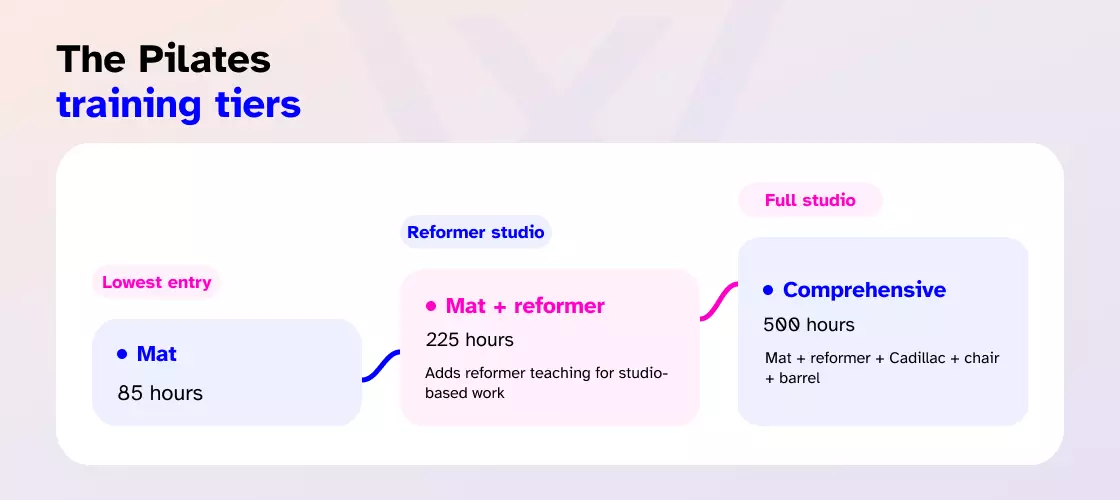
Mat-only certification runs around 85 hours and qualifies an instructor to teach mat-based classes without apparatus, the lowest-cost, fastest entry point into teaching Pilates. Mat-plus-reformer certification extends that to roughly 225 hours, adding the reformer, the most commonly used piece of Pilates equipment in studios.
Full, comprehensive certification, covering mat plus the reformer, Cadillac, chair, and barrel, runs around 500 hours total. It includes a meaningful split between observation hours, supervised teaching hours, and practice hours, and qualifies an instructor to teach the full studio equipment lineup.
What this means in practice: decide early on your teaching goal, whether that means mat classes at a gym, teaching at a boutique reformer studio, or eventually running a full-equipment Pilates practice, since that decision determines which tier is actually worth the time and cost.
Choosing a training program
Several established providers offer comprehensive training, and they genuinely differ in approach rather than just brand name.
Balanced Body offers flexible formats, in-person and hybrid options, with a strong emphasis on anatomy and movement science, and has been training instructors since 1976. STOTT Pilates, now under the Merrithew name, takes a more structured, workshop-based format, emphasizing biomechanics and modified spinal alignment principles rather than classical technique.
Polestar Pilates, founded by a physical therapist, leans heavily toward rehabilitation and postural analysis, a strong fit for instructors interested in working with clients who have movement limitations or are recovering from injury. BASI Pilates offers a classical-style comprehensive program with deep, structured technical training across the full equipment lineup.
None of these is objectively the single best choice. The right one depends on whether an aspiring instructor wants a classical or contemporary teaching style, a rehabilitation-focused or general fitness focus, and how their schedule fits a given program’s format.
What PMA certification actually is
This is the part most aspiring instructors get confused about, and it’s worth getting exactly right.
PMA is not a provider; the Pilates Method Alliance is a professional association that maintains industry certification standards. It offers the NCPT (National Certified Pilates Teacher) credential through a third-party exam that validates that an instructor’s training meets a recognized standard, rather than teaching the underlying curriculum itself.
A comprehensive training program from Balanced Body, STOTT, Polestar, or BASI provides the actual instruction; passing the PMA-NCPT exam afterward is a separate, additional validation step many instructors pursue on top of that training.
The PMA-NCPT exam itself is a 150-question, multiple-choice, psychometrically validated exam, described by the PMA as the only third-party certification exam of its kind in the Pilates field. Most training programs structure their comprehensive curriculum specifically to prepare graduates for this exam, even though completing the training program alone is enough to begin teaching in many settings.
What this means in practice: a comprehensive training certificate from a respected program is the primary training credential many studios look for when hiring instructors. The PMA-NCPT exam is an additional, genuinely valuable layer of third-party validation on top of it, not a replacement for the training itself.
What it actually costs
Real program pricing varies significantly by provider and tier. Comprehensive programs run into the thousands, reflecting the several hundred training hours involved, and location can add real cost on top of the base price; some providers charge a specific premium for courses held in major markets like New York. Mat-only certification, given its shorter roughly 85-hour requirement, costs meaningfully less than a full comprehensive track.
Get an itemized quote directly from your chosen provider rather than relying on a single blended figure, since course fees, materials, and exam costs are sometimes bundled differently between programs.
Staying certified after you’re trained
Pilates certification isn’t a one-time credential. Re-qualification requirements are real and ongoing: maintaining active certified status commonly requires a minimum weekly practice commitment, a minimum weekly teaching commitment, and a set number of continuing education hours completed periodically, not just passing an initial exam once and being done.
A realistic timeline
Mat-only certification can often be completed in a matter of weeks given its shorter hour requirement. Mat-plus-reformer typically takes a few months of part-time study. Full comprehensive certification, given its roughly 500-hour requirement split across coursework, observation, supervised teaching, and practice hours, commonly takes several months to a year depending on how intensively a candidate can study alongside other commitments.
The real demand behind this career
This isn’t a shrinking field, and the federal government’s own labor data says so specifically about Pilates.
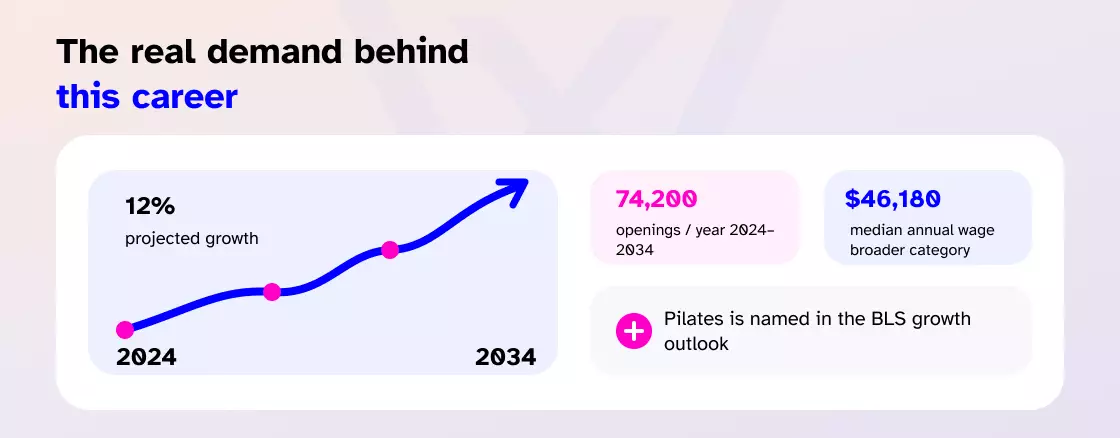
BLS projects 12 percent growth for fitness trainers and instructors between 2024 and 2034, four times faster than the 3 percent average projected across all occupations, with roughly 74,200 openings expected annually over that decade. The median annual wage for the broader occupational category was $46,180 as of May 2024, though that figure blends part-time group instructors with full-time specialists, so it understates what a certified, in-demand Pilates instructor working full hours can realistically earn.
What makes this specifically relevant to Pilates is that the BLS doesn’t just lump the category together; it names Pilates directly as a growth driver. The agency’s own outlook states that participation in yoga and Pilates is expected to keep increasing, driven partly by older adults seeking low-impact exercise and relief from arthritis and other joint-related conditions, a demographic tailwind most other fitness formats don’t have in the same way.
Pay within Pilates varies by certification tier, studio type, and location, with reformer-certified and fully comprehensive-certified instructors generally commanding higher rates than mat-only instructors, given the additional training investment. For a broader look at staffing and hiring trends in the Pilates industry, see Wellyx’s Pilates industry statistics report.
For studio owners hiring instructors
If you’re staffing a Pilates studio rather than pursuing certification yourself, understanding this tier structure matters for hiring too: a mat-only certified instructor and a fully comprehensive-certified instructor aren’t interchangeable for a reformer-heavy class schedule, and re-qualification lapses are a real, recurring compliance gap to track, not a one-time hiring check. Wellyx’s Pilates studio software keeps instructor certifications, class scheduling, and equipment-specific class assignments organized in one system, helping reduce the risk of a mat-only instructor being scheduled for a reformer class.
Frequently asked questions
Do you need a college degree to become a Pilates instructor?
No. Comprehensive training programs are designed to take someone with a personal Pilates practice through to teaching competency without requiring a prior college degree or fitness credential, though real training hours, commonly hundreds for a full comprehensive certification, are still required.
What is PMA certification, and is it required?
The Pilates Method Alliance issues the NCPT credential through a third-party validated exam, but the PMA itself doesn’t provide training; a comprehensive program from a provider like Balanced Body or STOTT does. The PMA exam is a valuable additional credential many instructors pursue, not a strict requirement to begin teaching everywhere.
How long does it take to become certified?
Mat-only certification can take just weeks given its shorter, roughly 85-hour requirement. A full comprehensive certification, covering mat and all major apparatus, commonly takes several months to a year given its roughly 500-hour requirement across coursework, observation, and supervised teaching.
How much does Pilates certification cost?
Costs vary significantly by tier and provider. Mat-only certification, given its shorter training hours, costs meaningfully less than a full comprehensive program, which commonly runs into the thousands of dollars given the several hundred hours of coursework, observation, and supervised teaching involved. Get an itemized quote directly from your chosen provider.
Which Pilates certification is the best one to choose?
There’s no single best option. Balanced Body, STOTT, Polestar, and BASI each take a genuinely different approach, classical versus contemporary technique, general fitness versus rehabilitation focus, so the right choice depends on an instructor’s teaching goals and preferred learning format.
The path is clearer once the structure makes sense
Becoming a certified Pilates instructor isn’t confusing once the two-part structure is visible: a real, hours-based training program from a respected provider teaches the actual craft, and the PMA’s NCPT exam offers an additional, genuinely valuable layer of third-party validation on top of it. Choosing the right tier and provider upfront, based on what you actually want to teach, saves real time and money compared to guessing and adjusting later.