



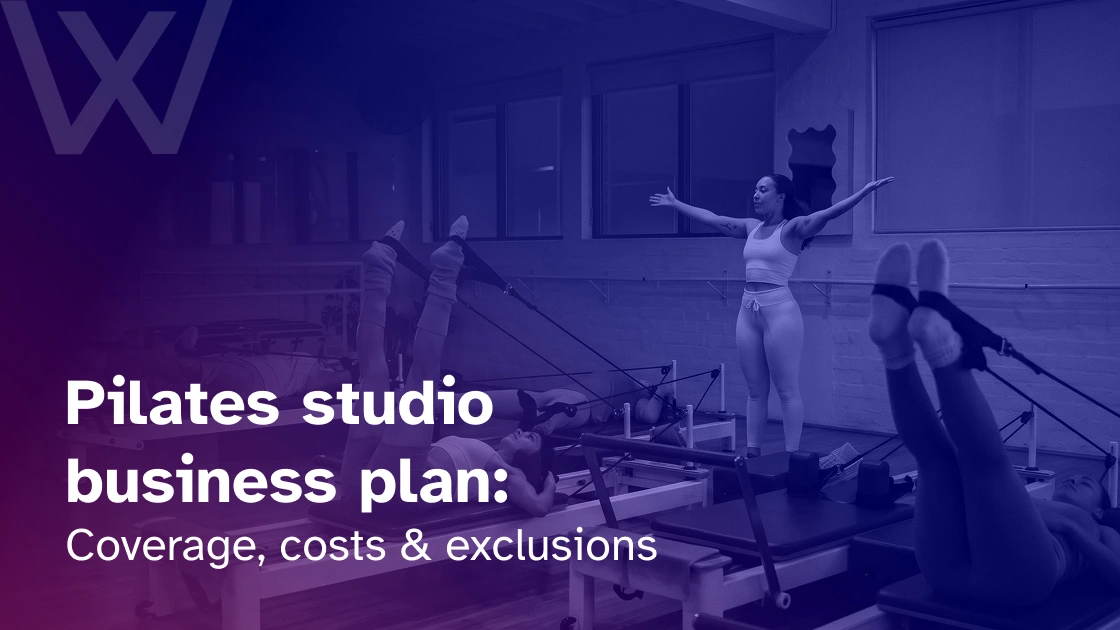
You’ve found a promising studio location, compared reformer prices, and started thinking about your first class schedule. But how many paying clients will you need to cover your monthly expenses?
A Pilates studio business plan helps answer that question. It brings together your business concept, target customers, services, pricing, operations, startup costs, and financial projections. It shows how those decisions connect.
A reformer studio, for example, can only book as many clients as its equipment and schedule allow. Empty spots aren’t just disappointing attendance. They change the revenue available to cover instructor pay, rent, insurance, and other bills. Even a busy class can earn less than expected when memberships and discounted packages lower the revenue per visit.
That’s why planning should happen before you commit to a lease or equipment order. A realistic forecast helps you estimate your opening investment, test different attendance levels, and calculate how many paid visits you need to break even. It also gives you a clearer case to present to a lender or partner.
This guide includes a free editable template, nine practical planning steps, and a worked example of a 12-reformer studio. You’ll see how to connect your ideas to numbers you can check.
Free Pilates studio business plan template
A Pilates studio business plan template organizes the information needed to launch, operate, and grow your business. It helps you document important decisions rather than relying on assumptions.
Use the free Pilates studio business plan template to record your plans.
| Business plan section | What to include |
| Executive summary | Studio name, location, mission, goals |
| Market analysis | Target clients, competitors, demand |
| Services and pricing | Classes, memberships, packages |
| Location and equipment | Floor space, reformers, class capacity |
| Operations | Instructors, schedules, software, policies |
| Marketing | Client acquisition and retention |
| Financial plan | Startup costs, revenue, expenses, break-even |
| Funding and risks | Capital requirements, challenges, milestones |
Replace the blank fields with information from your local market research, supplier quotations, and financial estimates.
If you’re preparing a plan for investors or lenders, the U.S. Small Business Administration also recommends detailed financial projections and supporting documentation.
How to write a Pilates studio business plan
A successful business plan connects what you want to offer with what customers will pay and what your studio can realistically deliver.
Follow these nine steps to build yours.
1. Write your executive summary and define your concept
Your executive summary introduces the business, its customers, services, funding requirements, and financial goals.
Include:
- Business name and location: Proposed studio name, city, and neighborhood
- Business model: Reformer, mat, private, or hybrid Pilates studio
- Target audience: The people your classes will serve
- Competitive advantage: Why clients would choose your studio
- Financial goals: Startup investment and expected revenue targets
For example:
Core & Flow Reformer Studio is a proposed boutique Pilates business serving working professionals through small-group reformer classes, memberships, and private appointments.
Keep the summary short and specific. Although it appears first, write it after completing the financial sections.
2. Research your local market and competitors
Market research helps determine whether enough customers near your proposed location will pay for your services.
Start by researching three to five nearby studios. Compare their class schedules, prices, membership options, and customer reviews.
Your research should answer:
- Who are your ideal customers?
- What are competing studios charging?
- Which class times appear most popular?
- Are customers looking for beginner, advanced, or private sessions?
- What services are missing from the local market?
National Pilates industry statistics provide broader market context.
According to the Health & Fitness Association’s 2026 research, Pilates participation among U.S. fitness-facility members increased 28.1% between 2021 and 2025.
However, national participation growth doesn’t guarantee local demand. Use competitor research, customer interviews, and early signups to support your business projections.
3. Choose your Pilates services and pricing model
Your services determine how much revenue the studio can generate and how frequently clients return.
A Pilates business usually combines recurring memberships with flexible packages and private sessions.
| Service | Example pricing model |
| Reformer classes | Drop-ins and memberships |
| Mat Pilates | Individual classes or packs |
| Private sessions | Per appointment |
| Duet sessions | Shared appointment fee |
| Monthly memberships | 4, 8, or unlimited classes |
| Workshops and retail | Separate purchases |
For Core & Flow, the following prices are hypothetical planning assumptions, not verified local market averages.
| Membership or service | Illustrative price |
| Introductory 3-class pack | $75 |
| Four classes monthly | $136 |
| Eight classes monthly | $248 |
| Unlimited membership | $319 |
| Ten-class package | $340 |
| Single drop-in | $38 |
| Private session | $105 |
Membership attendance matters as much as the advertised price.
For example, an unlimited member paying $319 who attends 15 times generates approximately $21.27 per visit. That is considerably less than the $38 drop-in price.
Use expected attendance to calculate the average revenue earned per occupied class spot. Avoid promising more unlimited memberships than your busiest classes can accommodate.
4. Choose your location and calculate class capacity
Your location, equipment, and timetable determine the number of clients your studio can serve.
Consider lease costs, accessibility, parking, customer convenience, and room layout. Check that the building can accommodate your intended equipment and occupancy.
For a reformer studio, calculate weekly group capacity:
Weekly class capacity = Number of reformers × Weekly classes
Suppose Core & Flow operates:
- 12 commercial reformers
- 48 group classes weekly
- 50-minute sessions
Its maximum scheduled capacity would be:
12 × 48 = 576 available group-class spots weekly
That doesn’t mean 576 clients will attend. Actual attendance depends on demand, bookings, and cancellations.
Reserve time for cleaning, equipment inspections, instructor changes, and private appointments. Use early demand to decide which classes deserve the most space on the timetable.
5. Estimate startup costs and operating expenses
Your startup budget should separate one-time opening investments from ongoing business expenses.
One-time costs usually include reformers, flooring, mirrors, lease deposits, signage, permits, and pre-opening marketing.
Recurring expenses include:
- Rent, utilities, and insurance
- Instructor compensation and payroll expenses
- Booking software and payment processing
- Marketing and client communication
- Cleaning and equipment maintenance
- Administrative and accounting services
The cost to open a Pilates studio depends on your premises, equipment choices, renovations, and business model.
A mat studio may require less equipment investment than a dedicated reformer facility. However, both need enough working capital to operate while membership revenue develops.
Request written quotations and allow for unexpected expenses. A studio can appear profitable on paper but still run short of cash during its first few months.
6. Build your staffing and daily operations plan
Your operations plan explains how classes, staff, equipment, payments, and member communication will work every day.
Document instructor qualifications, employment arrangements, compensation, and substitute coverage.
The U.S. Bureau of Labor Statistics reported median annual pay of $47,160 for fitness trainers and instructors in May 2025. This is a broad occupational figure, not a Pilates-specific salary.
Understanding how much Pilates instructors make can help you estimate local staffing costs.
An illustrative instructor compensation model could include:
- $45 base pay per scheduled group class
- $4 for each attendee above six
- A maximum teaching payment of $69 for a full 12-person class
The studio must also budget for employment costs and paid substitute coverage. For daily administration, Wellyx can help connect class bookings, memberships, instructor schedules, payments, and attendance records.
Also document cancellation policies, equipment maintenance, safety procedures, and emergency arrangements. Check applicable state and local rules, insurance requirements, accessibility, and worker classification.
Follow equipment manufacturers’ inspection and replacement guidance rather than assuming every reformer component has the same service life.
7. Create your marketing and member retention strategy
Your marketing plan should explain how clients will discover your studio, attend their first class, and become regular members.
Divide the strategy into three stages.
Before opening
- Build a website and early-interest list
- Prepare a Google Business Profile
- Test introductory and founding-member offers
- Connect with nearby businesses
During launch
- Promote trial packages and opening classes
- Share authentic studio photos and videos
- Encourage referrals from early customers
After opening
- Follow up with introductory clients
- Track repeat bookings and cancellations
- Offer suitable membership options
- Contact inactive members with relevant updates
Practical Pilates studio marketing ideas can help shape your acquisition plan.
8. Forecast revenue and calculate break-even
Your financial forecast should connect available class spots, expected attendance, realized pricing, and operating expenses.
Calculate monthly group-class revenue
Use:
Monthly group revenue = Reformers × Classes per week × 4.33 × Occupancy × Revenue per visit
For Core & Flow:
| Assumption | Illustrative figure |
| Reformers | 12 |
| Weekly classes | 48 |
| Average paid occupancy | 52% |
| Realized revenue per group visit | $24 |
| Available monthly group spots | 2,494 |
| Expected monthly occupied visits | 1,297 |
| Estimated monthly group revenue | $31,126 |
The $24 realized price reflects the estimated mix of memberships, packs, and drop-ins. Do not add those payments again as separate group-class revenue.
With 30 private appointments monthly at $105, the studio would generate another $3,150.
Estimated total monthly revenue: $34,276.
Calculate break-even occupancy
Break-even occurs when operating revenue covers the costs included in your calculation.
The SBA’s break-even guidance uses contribution per unit after variable costs.
For a Pilates studio:
Required group visits = (Monthly cost burden − Other-service contribution) ÷ Group contribution per visit
Then:
Break-even occupancy = Required group visits ÷ Available group spots × 100
Include scheduled instructor costs even when attendance is low. For bonuses tied to class size, model how compensation changes as occupancy increases.
Use separate scenarios for weak, expected, and stronger attendance. A forecast is more useful when it shows how much room you have for a disappointing month.
9. Identify funding requirements, business risks, and milestones
Your funding plan should explain how the studio will pay for opening expenses and manage early cash shortages.
Possible funding sources include owner savings, investors, business loans, and equipment financing.
Address these risks:
- Slower membership growth than expected
- Instructor shortages or turnover
- Unexpected repairs and equipment downtime
- Seasonal attendance changes
- Higher rent or renovation costs
Set measurable milestones for presales, opening, the first 90 days, and annual reviews.
Pilates studio business plan example: Core & Flow Reformer Studio
The following is a fictional business plan example. All financial figures are illustrative assumptions rather than verified local quotes or actual studio results.
Business overview
Core & Flow Reformer Studio is a proposed 1,800-square-foot boutique Pilates studio serving busy professionals and fitness enthusiasts.
Its main offer is instructor-led reformer classes, supported by memberships, class packages, private appointments, and selected workshops.
The studio plans to operate 12 reformers and 48 group classes weekly. Its marketing will focus on local discovery, founding memberships, introductory packages, and referrals.
Startup budget example
| Startup expense | Cost |
| Commercial reformers and equipment | $58,000 |
| Renovations, flooring, and mirrors | $42,000 |
| Lease deposit and prepaid rent | $18,000 |
| Pre-opening marketing | $9,000 |
| Sound, signage, furniture, and stock | $10,500 |
| Legal, insurance setup, and technology | $5,500 |
| Initial working capital reserve | $22,000 |
| Total funding requirement | $165,000 |
The example assumes $115,000 in owner equity and $50,000 in financing.
The $22,000 reserve is not enough to cover three full months of the operating costs shown below. A monthly cash-flow forecast must determine whether the studio needs additional funding before opening.
Monthly operating forecast
Assume the studio reaches 52% average paid occupancy, with 30 private sessions monthly.
| Financial item | Monthly amount |
| Group-class revenue | $31,126 |
| Private-session revenue | $3,150 |
| Total revenue | $34,276 |
| Premises, utilities, insurance | $8,500 |
| Group instructor budget | $11,431 |
| Front-desk and administrative payroll | $2,600 |
| Marketing, software, maintenance, admin | $2,500 |
| Owner compensation | $3,500 |
| Group visit-level expenses | $1,945 |
| Private-session direct expenses | $1,650 |
| Total modeled operating expenses | $32,126 |
| Estimated monthly operating surplus | $2,150 |
The instructor budget uses an average loaded cost of $55 per scheduled class, allowing for estimated bonuses and related compensation costs.
This is an operating illustration, not net profit. Financing costs, depreciation, income taxes, and unmodeled expenses remain excluded.
Break-even calculation
The studio earns $24 per occupied group visit, less an assumed $1.50 in visit-level expenses.
That leaves a $22.50 contribution per group visit.
Private appointments contribute $1,500 after their direct costs.
Using the modeled $28,531 fixed and scheduled cost burden:
Required visits = ($28,531 − $1,500) ÷ $22.50 = approximately 1,202 visits.
With 2,494 monthly group spots, break-even occupancy is approximately 48.2% under these assumptions.
The studio’s planned 52% occupancy leaves only a small margin for error.
The model should be recalculated if instructor bonuses, class schedules, prices, or private-session demand change.
Three-year financial outlook
A longer-term revenue forecast might use these illustrative scenarios:
| Metric | Year 1 | Year 2 | Year 3 |
| Average group occupancy | 52% | 71% | 80% |
| Realized revenue per visit | $24 | $25.15 | $25.80 |
| Private sessions per month | 30 | 40 | 45 |
| Estimated annual revenue | $411,313 | $584,826 | $674,434 |
These projections assume the same 48-class weekly schedule, 4.33 weeks per month, and $105 per private session.
They are revenue scenarios, not profit forecasts. A lender-ready plan also needs separate annual operating costs and monthly cash-flow projections, particularly during the opening year.
Core & Flow should review attendance, instructor costs, membership renewals, and cash reserves after its first 30, 60, and 90 days.
FAQs
How do I write a business plan for a Pilates studio?
Start by defining your studio concept and target audience. Research the local market, select services, set prices, and estimate equipment capacity. Then prepare your staffing, marketing, startup budget, and financial projections. Complete the executive summary after calculating your funding requirements.
How much does it cost to open a Pilates studio?
Startup costs depend on location, rent, renovations, equipment, and studio size. Reformer facilities generally require more equipment investment than mat studios. Your budget should include opening expenses, insurance, marketing, professional setup, and sufficient working capital to operate while demand develops.
Is owning a Pilates studio profitable?
A Pilates studio can be profitable when realized class revenue and income from additional services exceed operating expenses. Important factors include occupancy, pricing, instructor compensation, rent, and customer retention. A busy timetable doesn’t guarantee profit when heavily discounted memberships reduce revenue per visit.
How do you calculate break-even occupancy for a Pilates studio?
Calculate how many paid group visits are needed to cover remaining monthly costs after accounting for contributions from other services. Divide that number by the available monthly group-class spots. Include variable costs, scheduled instructor pay, and the effects of attendance-based compensation.
Can I use a Pilates studio business plan to apply for a business loan?
Yes. A business plan helps lenders evaluate your concept, local demand, funding requirements, and financial forecasts. They may also request cash-flow statements, supplier quotes, credit information, ownership documentation, and other financial evidence. Confirm your lender’s requirements before submitting an application.
Make your Pilates studio work on paper first
A Pilates studio business plan should help you understand the numbers before committing to a lease, hiring instructors, or purchasing equipment.
Use the template to test local demand, class capacity, pricing, expenses, and break-even occupancy. Revise your assumptions as real information becomes available.
Once your plans become daily operations, Wellyx software for Pilates studios can help you manage bookings, memberships, instructor schedules, and payments in one place. You can book a free demo to explore how those workflows fit your studio.