





The martial arts industry is experiencing steady growth. According to IBISWorld, the U.S. martial arts training market is valued at $21.2 billion in 2026, with approximately 76,364 schools operating nationwide. Globally, the market is estimated at $31.2 billion, and demand continues to grow.
Yet the harsh reality: nine out of ten new martial arts schools close within their first three years.
The difference between schools that fail and those that thrive isn’t talent, passion, or location; it’s strategy. Successful schools build systems. They understand their economics. They know who they’re serving and why those people should choose them. Most importantly, they understand that a martial arts school is not a passion project; it’s a business.
The core insight: Schools that survive and scale make deliberate, measurable decisions about positioning, pricing, retention systems, and revenue diversification.
What is a martial arts business?
A martial arts school is a recurring-revenue membership business built on three foundational elements: progressive skill development, community identity, and instructor expertise. Unlike generic fitness gyms, a martial arts school creates a structured progression system. Students earn belts. They achieve visible milestones. They progress from white to yellow to orange to green, or through whatever rank system their discipline uses. This progression is psychological genius from a business perspective. It creates natural points of re-commitment. A student is not just going to the gym. They’re working toward their black belt, which is a multi-year commitment with tremendous emotional and personal investment.
Discipline types and their market positioning
Not all martial arts are created equal from a business perspective. Each discipline attracts a distinct demographic, commands different pricing, and faces unique competitive dynamics. Understanding this before you open determines who you market to and how you position your school.
| Discipline | Core Market | Pricing Power | Market Trend | Key Differentiator |
| BJJ (Brazilian Jiu-Jitsu) | Adults 18–45; competitive athletes; MMA enthusiasts | High: $150–$250/mo | Fastest growing; MMA culture driving demand | Technical depth; competition pathway; adult community |
| MMA (Mixed Martial Arts) | Adults 18–40; fitness + combat; aspiring fighters | High: $150–$200/mo | Strong growth; mainstream fitness crossover | Versatility; conditioning; broad commercial appeal |
| Karate (Traditional) | Children 5–15; families; self-discipline focus | Moderate: $100–$150/mo | Stable; Olympic status boosting youth interest | Structure; discipline; family values; after-school fit |
| Taekwondo | Children + competitive teens; Olympic sport pathway | Moderate: $90–$140/mo | Stable; strong in Asian-American communities | Olympic prestige; kicking artistry; structured grading |
| Krav Maga | Adults 25–50; self-defense focus; non-sport market | High: $120–$180/mo | Growing; safety awareness driving demand | Real-world applicability; no-belt simplicity; military credibility |
Key principle: Choose the discipline you can teach at the highest level and position most distinctly in your local market. The most profitable discipline is always the one you can own in your area, not the one trending nationally.
How to start and run a taekwondo school?
Taekwondo schools, known as dojangs, share the general martial arts model but diverge in ways that reshape the economics. The discipline is Olympic-recognized, heavily youth-driven, and built on shorter promotion cycles than any other major art. These three factors alone change how pricing, retention, and revenue work.
Dojang market context
A typical dojang is family-facing and youth-heavy. Children aged 6–14 make up the majority of active students. Parents are the paying customers. The Olympic status of the sport is a trust signal that most competing disciplines cannot match. For many parents, taekwondo is the first martial art they seriously consider precisely because it is an Olympic sport with a structured global pathway.
This reshapes the competitive position of the dojang. You are not competing against other martial arts schools as much as you are competing against youth soccer, swim club, gymnastics, and after-school care. The decision framework parents apply is developmental, not athletic.
The geup, poom, and dan progression system
Taekwondo uses a two-phase rank structure.
Before black belt, students progress through geup ranks (gup or kup, used interchangeably), typically 10 levels moving from 10th geup to 1st geup. Belt colors vary by school but commonly run white, yellow, green, blue, red, and black.
At black belt, the structure splits by age. Students under 15 earn poom ranks (1st through 4th poom). Students 15 and older earn dan ranks (1st through 9th dan). Poom certificates convert to dan when the holder turns 15 and meets the requirements.
The geup structure is the business engine. Ten ranks before black belt, each running a typical 2–4 month cycle, means 8–10 testing events per student during their first 2–3 years. That is a materially faster cadence than BJJ or traditional karate, and it drives both retention and testing revenue when tracked properly.
The Kukkiwon certification pathway
Kukkiwon is the World Taekwondo Headquarters in Seoul and the authority behind globally recognized black belt certification. A Kukkiwon-certified black belt is valid for competition, instruction, and further promotion worldwide. Running a dojang without Kukkiwon affiliation is possible, but it limits your credibility with parents researching schools and with students who may later compete.
Key facts for dojang owners:
- Dan promotion fees run roughly $120 for 1st Dan to $225 for 4th Dan, with higher costs for master-level certifications.
- Since January 1, 2025, instructors are required to hold a Kukkiwon Examiners qualification to apply for Kukkiwon certification on behalf of their students.
- Master Instructor status requires 4th Dan minimum, age 21 or older, and completion of the Kukkiwon Master’s Course.
- Individual Dan application processing typically takes 6–8 weeks.
Kukkiwon affiliation is also a marketing asset. Display it on your website, Google Business Profile, and facility signage. Parents searching for ”Kukkiwon taekwondo near me” are higher-intent than those running generic searches.
Dojang economics
Dojang pricing typically runs $90–$140 per month for group classes, with family plans and sibling discounts expected, not optional. A typical suburban dojang serves 150–250 students and generates $18,000–$30,000 in monthly group-class revenue.
| Metric | Typical Dojang Range |
| Average monthly price | $90–$140 |
| Typical active students | 150–250 |
| Youth share of enrollment | 70–85% |
| Monthly group-class revenue | $18,000–$30,000 |
| Testing events per student per year | 3–4 |
| Family plan penetration | 30–50% of households |
Revenue per student is lower than a BJJ academy but more stable. The trade-off is volume: dojangs rely on higher headcounts, and acquisition is easier because the youth audience is broader and more reachable through school partnerships.
Testing cycles as a revenue driver
Because geup ranks cycle every 2–4 months, a dojang’s testing calendar is its most consistent revenue rhythm outside of monthly dues. A 200-student dojang running quarterly geup testing at $50–$75 per student generates $10,000–$15,000 per testing event, with most students participating each cycle. Dojangs running structured progression tracking capture this revenue reliably because eligibility is visible to families in advance, turning testing into a planned household expense rather than a surprise.
Parent communication is the retention lever
In adult-focused schools, the student is the customer. In a dojang, the parent is the customer. That single difference reshapes retention.
Parents are not on the mat. They do not feel the progress. They judge the membership’s value based on what they see, what they hear from their child, and what the school communicates directly to them. If a parent cannot answer“Is my child progressing?” the membership is at risk, regardless of how the child is actually doing.
Three communication practices protect dojang retention:
- Monthly progress updates to parents, even when no belt change has occurred.
- Photo and video sharing from class, delivered through a member portal or messaging channel.
- Belt ceremonies with family invited and filmed, with clips sent to the family the same evening.
- Youth programs without visible progress evidence lose students quietly within the first six months.
Dojang-specific operational challenges
Three patterns are nearly universal in dojangs and worth planning for from day one.
Family plans and sibling discounts are expected. A workable structure is full price for the first child, 20–30% off the second, and 50% off the third. Avoid unlimited-discount family plans that erode per-student economics below $70.
After-school logistics drive a large share of dojang revenue. Schools offering pickup from local primary schools dominate the 3:30–6:30 PM window. This requires a van, drivers with background checks, and state-specific licensing for child transportation. Verify requirements before committing.
Testing day operations are the highest-volume operational event in the dojang calendar. Eligibility lists, fee collection, certificate generation, and scheduling all compound at once. Software that handles eligibility flagging and integrated billing turns testing day from a logistics crisis into a revenue event.
Business models and their economics
Successful martial arts schools today operate across a spectrum of models, each with distinct economics, positioning, and scalability.
- A traditional dojo focuses on children and families, offering after-school classes and weekend programs. They succeed through high volume at accessible pricing ($100–$150 per month) and community reputation. A well-run suburban dojo serving 300–500 students can generate $30,000–$50,000 in monthly revenue.
- BJJ academies target serious adult athletes aged 18–50. BJJ has experienced explosive growth driven by MMA’s cultural reach. Academies command $150–$250 per month for group memberships and $75–$150/hour for private instruction. At 100–150 active members, a monthly revenue of $20,000–$35,000 is achievable with higher margins than children’s programs.
- MMA gyms blend striking, wrestling, conditioning, and grappling. They capture a broad adult market and generate significant ancillary income from personal training, facility rentals, and merchandise. A 200-member MMA gym can clear $30,000–$40,000 monthly.
- Hybrid and multi-discipline schools combine kids’ programming, adult competitive training, and complementary services such as yoga or sports massage. More complex to operate, but they expand market reach significantly, a well-run hybrid school can serve 300–600 students and generate $50,000–$80,000 monthly.
- Online and hybrid-online models established during the pandemic remain profitable at scale. With 100–200 students paying $30–$50 per month, an instructor can generate $3,000–$10,000 monthly with near-zero facility overhead.
Key Principle: All successful models share one trait, clarity. The most profitable schools know exactly who they are serving. They are not trying to be everything to everyone.
How starting an MMA gym differs from a traditional school
MMA gyms operate within the same broad industry but differ materially in structure, cost, and operational complexity.
Facility and equipment requirements
An MMA facility must support multiple training modalities within a single space:
- Grappling (mat area)
- Striking (bag work, pad work)
- Controlled sparring (often cage or wall integration)
- Strength and conditioning
This increases both space requirements and initial capital investment compared to single-discipline schools.
Insurance and risk profile
The multi-disciplinary and full-contact nature of MMA training raises the liability profile.
Insurance costs are typically higher due to:
- Striking-based sparring
- Increased injury exposure
- Broader activity range
Compliance requirements are also more stringent, particularly in markets with tighter combat sports regulation.
Coaching structure
MMA gyms require a multi-coach model:
- Striking specialist
- Grappling specialist
- Conditioning support
This introduces scheduling complexity and higher payroll overhead compared to single-instructor models.
Customer profile and retention dynamics
MMA gyms skew toward adult participation, with a heavier emphasis on fitness and competition.
While pricing can be higher, churn risk is also elevated if onboarding is not structured. Early-stage participants often underestimate intensity, leading to drop-off within the first two to three months.
Structured beginner pathways are critical to stabilizing retention.
Benefits of martial arts business
Why the martial arts business model works
The martial arts industry is often framed as a passion-driven business. The data suggests something more precise: it is a structurally resilient service model with built-in retention mechanics, multi-layered revenue potential, and unusually strong local market defensibility.
The advantage is not just that martial arts studios can generate revenue. It is how that revenue behaves over time.
Recurring revenue, anchored in progression
Most fitness businesses sell access. Martial arts schools sell progression.
That distinction is not semantic; it is economic.
A commercial gym membership gives access to equipment. A martial arts membership gives access to a structured pathway: white belt to black belt, beginner to advanced, novice to competitor. Progress is visible, socially reinforced, and time-bound. That creates a natural retention framework that does not rely on motivation alone.
Students do not simply attend; they advance. And advancement has inertia.
This is why average customer lifetimes in martial arts frequently exceed those of general fitness memberships, even when pricing sits above budget gym tiers.
Youth enrollment as a stabilizing force
Approximately 40% of martial arts participants are under 18. That is not a demographic detail; it is a structural advantage.
The decision-maker and the participant are different people. Parents pay. Children train.
This separation changes cancellation behavior. Adult memberships are discretionary and easily rationalized away. Youth programs are evaluated on developmental outcomes: discipline, confidence and focus. Those are harder to substitute and less sensitive to short-term motivation cycles.
A well-structured youth program creates multi-year revenue continuity. A student enrolling at age 6 and progressing through early teens represents a revenue stream that compounds without repeated acquisition costs.
In practical terms, youth programs are the closest thing the industry has to a predictable cash flow.
Community as a retention moat
Martial arts schools do not compete on convenience in the way most service businesses do. They compete on belonging.
Training environments are inherently social. Students share progression milestones, physical challenges, and, in many cases, competition experiences. Over time, this produces a community layer that sits on top of the service itself.
This has direct commercial implications. Cancelling a membership is not simply ending a transaction; it is exiting a social environment. That increases switching friction in a way that price competition alone cannot overcome.
For independent operators, this functions as a defensible moat in otherwise fragmented local markets.
Capital efficiency relative to other fitness models
Compared to equipment-heavy fitness concepts, martial arts studios operate with relatively low capital intensity.
The core infrastructure is simple:
- Mat space
- Essential training equipment
- Instructional expertise
There is no dependency on large-scale machinery, no constant equipment refresh cycle, and limited technical maintenance overhead. This reduces both startup cost and ongoing capital expenditure.
The result is a business that can reach operational stability faster than many adjacent fitness models, provided enrollment reaches critical mass.
Pricing flexibility across multiple customer segments
Martial arts businesses are not constrained to a single pricing structure.
A single facility can support:
- Youth memberships (volume-driven, stable)
- Adult classes (fitness or hobby-based)
- Competition programs (premium positioning)
- Private instruction (high-margin, low-volume)
This allows operators to layer pricing strategically rather than relying on a single average revenue figure.
The ability to serve multiple segments simultaneously is one of the model’s underappreciated advantages. It creates revenue resilience when one segment softens.
Revenue expansion through progression
Progression does not just support retention; it creates monetization points.
As students advance, they generate incremental revenue through:
- Belt testing fees
- Equipment upgrades
- Advanced program access
- Competition preparation
Revenue per student is not static. It increases over time without requiring additional acquisition spend.
This is a fundamentally different dynamic from flat subscription models, where revenue per customer remains constant unless pricing is increased.
Local brand compounding
Martial arts businesses benefit from time in a way many modern fitness concepts do not.
A school operating consistently over multiple years accumulates:
- Word-of-mouth referrals
- Local credibility
- A base of long-term students and alumni
Because the core offering does not depend on trend cycles, brand equity compounds rather than resets. This is particularly relevant in a fragmented market where no single operator holds a meaningful share.
Longevity itself becomes a signal of quality.
Operational simplicity at scale
While individual studios are often small, the model scales operationally in a straightforward way:
- Additional classes increase capacity without proportional cost increases
- Assistant instructors reduce dependency on a single coach
- Structured curriculum allows standardization across sessions
Scaling does not require reinventing the product. It requires systemizing what already works.
Core features of a profitable martial arts business model
Structural features that define the model
Beyond market size and growth rates, martial arts businesses are defined by a set of structural characteristics that shape both their economics and their operational constraints.
These features are consistent across disciplines, with variations in emphasis rather than fundamentals.
Progression systems as the central framework
There is an important distinction between the progression structure itself, which is the belt, stripe, or level system that defines advancement, and the progression tracking system, which is the operational record that captures student data against that structure.
Many school owners invest heavily in designing a credible belt system, but then track student progress informally, relying on instructor memory. Under 40 students, this works. Above that, students start to slip through the cracks.
The belt or level progression system is the core organizing principle of most martial arts schools.
It provides:
- Defined milestones
- Measurable advancement
- Long-term training pathways
From a business perspective, it functions as a retention architecture. Each level introduces a new goal, extending the student lifecycle and reducing drop-off after initial enrollment.
Without a structured progression system, retention becomes dependent on short-term motivation, which is inherently unstable.
Front-end trial and onboarding funnel
Most studios operate a controlled entry process:
- Introductory offer (free or low-cost)
- Initial onboarding period
- Conversion to recurring membership
This structure lowers the barrier to entry while allowing the school to demonstrate value before commitment. Conversion rates are influenced less by pricing and more by onboarding experience, instructor interaction, and perceived community fit.
Tiered membership architecture
Single-price models are rare in well-run schools.
Instead, studios implement tiered access:
- Limited attendance plans
- Unlimited class memberships
- Premium tiers with added benefits
This creates natural upsell pathways and allows revenue expansion without increasing acquisition volume.
Private instruction as a margin layer
Private lessons operate alongside group classes as a high-margin offering.
They serve students who want:
- Faster progression
- Personalized coaching
- Competition preparation
From an operational standpoint, private sessions increase instructor productivity per hour and raise overall revenue per member without requiring additional space.
Integrated retail component
Martial arts training requires equipment that is both discipline-specific and recurring in nature.
Studios that internalize this demand capture additional revenue through:
- Uniforms
- Protective gear
- Branded apparel
This is not a separate business line; it is an extension of the core service. Students will purchase equipment regardless. The decision is whether that spend remains inside or leaves the business.
Structured class segmentation
Effective schools segment classes across three primary dimensions:
- Age groups
- Skill levels
- Training focus
This segmentation improves both instructional quality and retention. Beginners train with beginners, advanced students maintain challenge, and age groups are managed appropriately.
Operationally, it allows the same facility to serve multiple cohorts without compromising experience.
Instructor-led delivery model
Martial arts is not a self-service product.
The instructor is central to:
- Student experience
- Skill development
- Retention
This creates a model where quality is directly tied to coaching capability. It also introduces concentration risk if the business is overly dependent on a single individual.
Studios that scale effectively transition from instructor-centric to system-supported delivery, without losing quality.
Event-driven engagement cycles
Engagement is reinforced through periodic events:
- Belt graduations
- Competitions
- Seminars
These events create natural peaks in motivation and attendance, breaking the monotony of weekly training cycles.
They also serve as social anchors, reinforcing the community layer that supports long-term retention.
Recurring billing as operational infrastructure
Monthly billing is the financial backbone of the model.
Predictable revenue allows:
- Cost planning
- Staffing stability
- Marketing investment
However, the system itself is not neutral. Billing friction directly impacts churn. Automated, reliable payment systems are not administrative conveniences; they are revenue protection mechanisms.
The martial arts industry opportunity
Despite the market size outlined above, the growth rate matters more for new entrants: the U.S. martial arts training market is projected to grow 3.2% annually through 2029, outpacing general gym industry growth (2.1%). Yet approximately 87–90% of martial arts schools fail to reach profitability, and most of those that do struggle to sustain it beyond five years.
The failure pattern is remarkably consistent: initial excitement → word-of-mouth dries up → enrollment plateaus → overhead stays fixed → owner dips into savings → school closes in 12–18 months.
What separates survivors from failures
The schools that survive operate with fundamentally different unit economics.
First, they charge premium prices justified by deliberate positioning, not a martial arts school, but “the elite BJJ academy for serious competitors” or “the only traditional karate facility in this area.” This justifies $150–$200+ monthly pricing even in price-sensitive markets.
Second, they engineer retention rather than obsessing over enrollment. A school with 10% monthly churn must acquire four new students every month just to stay flat. At 3% churn, the same school needs barely one. That difference frees $500–$1,000 per month in marketing budget that can be redeployed to actual growth.
Third, they diversify revenue beyond memberships. Adding private lessons, workshops, online content, and retail doesn’t just increase total revenue; it increases total value per student, which is the most efficient path to scaling profitability.
| Metric | Struggling School | Successful School |
| Active Students | 40 | 120 |
| Avg. Monthly Price | $120 per month | $150 per month base |
| Monthly Churn | 10% | 3% |
| Base Membership Revenue | $4,800 per month | $18,000 per month |
| Private Lessons Revenue | — | $2,400 per month |
| Retail & Workshops | — | $2,400 per month |
| Total Monthly Revenue | $4,800 | $22,800 |
| Monthly Overhead | $4,000–$5,000 | $5,000–$6,000 |
| New Students Needed Monthly (just to stay flat) | 4 students | 3–4 students |
| Est. Cost to Acquire Those Students | $1,200–$2,000 | $225–$400 |
| NET RESULT | Operating at a loss or barely breaking even, with no owner’s salary | ~$11,000–$12,000 per month profit before owner salary (~50% margin) |
Industry benchmarks at a glance
Use these benchmarks to measure the health of your school against industry norms. Flag any metric outside the target range immediately.
| Metric | Industry average | Target range | Warning threshold |
| Average revenue per student/month | $130–$150 | $150–$200+ | Below $120 |
| Average membership price (adult) | $140–$165/month | $150–$200/month | Below $120/month |
| Monthly churn rate | 5–7% | 2–4% | Above 6% |
| Trial-to-member conversion | 30–35% | 35–50% | Below 30% |
| Target profit margin | 15–20% | 20–30%+ (at scale) | Below 10% |
| Student LTV | $1,800–$2,400 | $2,500–$4,000+ | Below $1,500 |
| Cost per new member | $80–$120 | Below $100 | Above $150 |
How to write a martial arts business plan
Before signing a lease or ordering equipment, you need a martial arts business plan, not because a bank requires it, but because it’s a clarity machine. A complete plan forces you to answer. Who exactly am I serving? How will I reach them? What will it cost? When will I break even? How will I compete?
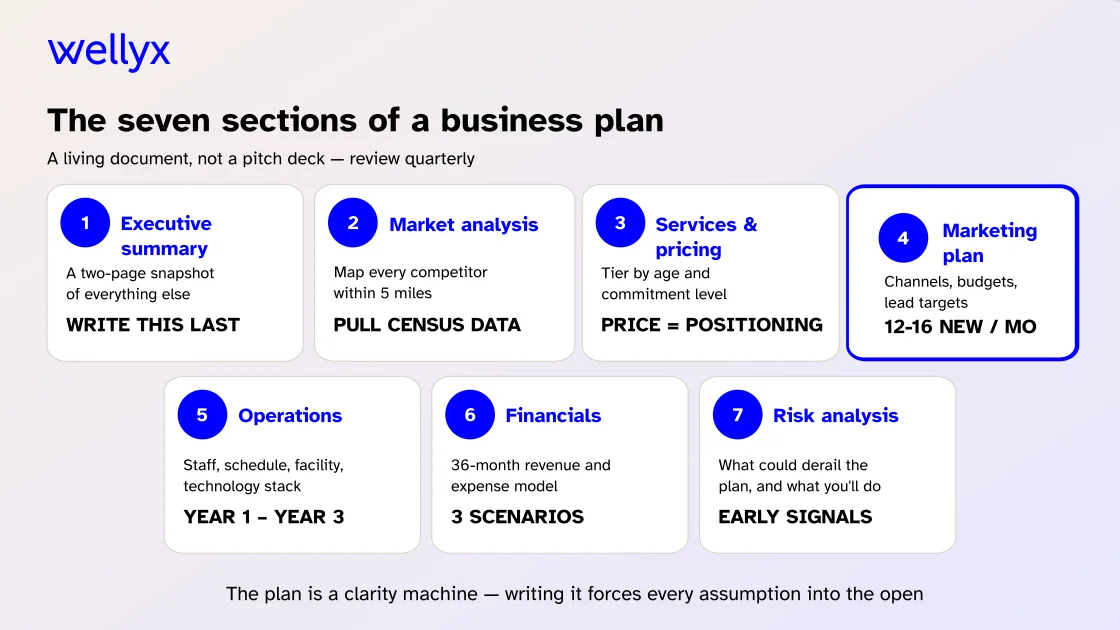
Successful school owners treat it as a living document, reviewed quarterly. A complete martial arts business plan has seven core sections:
Why a business plan is non-negotiable
The best business plans are living documents, not static files. It is your business blueprint that you’ll write in your initial plan before launch, but you should review and update it quarterly as you learn more about your market, your customers, and your business.
Successful school owners we’ve interviewed maintain active business plans that guide quarterly decisions about marketing spend, pricing adjustments, location expansion, and new programming.
- Executive summary
Write this last. It is a two-page snapshot of your entire plan: your vision, target market demographics, unique value proposition, startup capital requirement, break-even timeline, and profit targets for years one through three. It should be compelling enough that someone could read it and understand your entire business without seeing another page.
- Market analysis and local competitor mapping
Identify every competing martial arts school, gym or facility offering similar programming within a 5-mile radius.
For each competitor analysis, you’ll research your target demographic. If you’re planning a kids’ karate dojo, you’ll pull census data for your area:
- How many households have children ages 5–15?
- What’s the median household income in your area?
- What’s the education level?
- What’s the ethnic/cultural composition?
Understand where demand exists before committing to a niche.
- Services & pricing
Describe exactly what you’ll offer and at what price. Don’t be vague.
Write out each class tier, age group, price point, and add-on (belt tests, merchandise, family plans). Your pricing must align with your positioning, your target market’s ability to pay, and your cost structure. If rent is $4,000 per month and you charge $50 per month, you need 80 members just to cover rent alone.
Owner perspective: Price signals quality
“We were charging $110 a month and wondering why half our new students quit after six weeks. We raised to $155, tightened our positioning around adult BJJ, and redid the welcome sequence. Trial-to-member conversion went up noticeably, but more importantly, the students who joined actually stayed. A higher price filtered out people who were just browsing. Our revenue per active student nearly doubled within a year.” — West End Martial Arts
- Marketing plan
A real marketing plan specifies channels, budgets, lead targets, and monthly new-member projections. Local SEO, referral programs, school partnerships, and paid advertising are among the martial arts marketing ideas worth considering when building your acquisition strategy. Set a target, then allocate your budget based on your audience, local competition, and expected enrollment.
For example, during months 1–3, focus on local SEO and Google Business Profile optimization (10 hours of internal effort); launch a referral program offering free classes; run Facebook and Instagram ads at $200 per week; and plan two EDDM campaigns targeting 5,000 households at an estimated $1,500 each. Use your expected lead volume, trial-booking rate, and trial-to-member conversion rate to forecast enrollment, then adjust your spending based on actual results.
- Operations plan
This section covers how you will actually run this business day-to-day: every task, activity, and class. It covers who teaches classes and when; who handles scheduling, billing, communications, and facility maintenance; your systems and facility layout; instructor-to-student ratio; your staff plan for years one through three; and what
technology, such as martial arts management software, you will implement and when.
- Financial projections
Build a 36-month revenue and expense model across three scenarios: conservative (slower growth, higher churn), moderate (your target assumptions), and optimistic (faster growth, lower churn). Show the break-even point in each. Most schools need 60–80 active students at $120–$150 per month to break even with standard overhead.
- Risk analysis
This seventh section is risk analysis and contingency planning. It covers: what could derail your plan? Slower-than-expected growth? Higher rent increases? Loss of a key instructor? Competition moving into your area? For each significant risk, identify early warning indicators and what you will do if that risk materializes.
Business plan at a glance (for infographic)
| # | Section | What It Covers | Key Questions to Answer |
| 1 | Executive Summary | 2-page snapshot of vision, market, UVP, investment, break-even, and 3-year profit targets. Write this last. | Who are you serving? Why will they choose you? When do you break even? |
| 2 | Market Analysis | Competitor audit within a 5-mile radius + target demographic research (census data, family income, school partnerships). | Are there gaps in local supply? What does your target customer look like demographically? |
| 3 | Service & Pricing Strategy | Exact class offerings, age tiers, price points, add-ons (belt tests, merchandise, family plans). | Does your pricing cover fixed costs at realistic enrollment? Is it aligned with positioning? |
| 4 | Marketing Plan | Channel-by-channel plan with budgets, lead targets, conversion assumptions, and monthly new-member projections. | How will you generate 12–16 new members per month in year one? |
| 5 | Operations Planning | Class schedule, instructor roster, facility layout, technology systems, staff plan for years 1–3. | Can you actually execute this plan with the hours and people you have? |
| 6 | Financial Projections | 36-month revenue and expense model. Three scenarios: conservative, moderate, optimistic. Break-even analysis. | How much startup capital do you need? When do you hit profitability? |
| 7 | Risk Analysis | Top risks (slow growth, rent increases, competitor entry, key instructor loss) with early warning signals and contingency plans. | What will you do if growth is 30% slower than projected? |
Typical startup cost breakdown
Budget realistically before you sign anything. Here are typical startup cost ranges for a mid-sized operation:
| Cost Category | Low Estimate | Mid Estimate | High Estimate |
| Facility lease deposit + first 3 months | $10,000 | $15,000 | $20,000 |
| Equipment and mats | $5,000 | $10,000 | $15,000 |
| Technology setup (software, POS, access control) | $3,000 | $5,500 | $8,000 |
| Insurance (first year) | $2,000 | $2,750 | $3,500 |
| Signage and branding | $1,000 | $2,000 | $3,000 |
| Initial marketing | $2,000 | $3,500 | $5,000 |
| Working capital (covers losses before ramp-up) | $5,000 | $10,000 | $15,000 |
| TOTAL STARTUP CAPITAL NEEDED | $28,000 | $48,750 | $69,500 |
How to start a martial arts business
Once you have your business plan, the real work begins. The temptation is to do everything at once: lease space, buy equipment, hire staff, launch social media, and run ads simultaneously. Founders who follow a deliberate sequence build faster and waste less money.
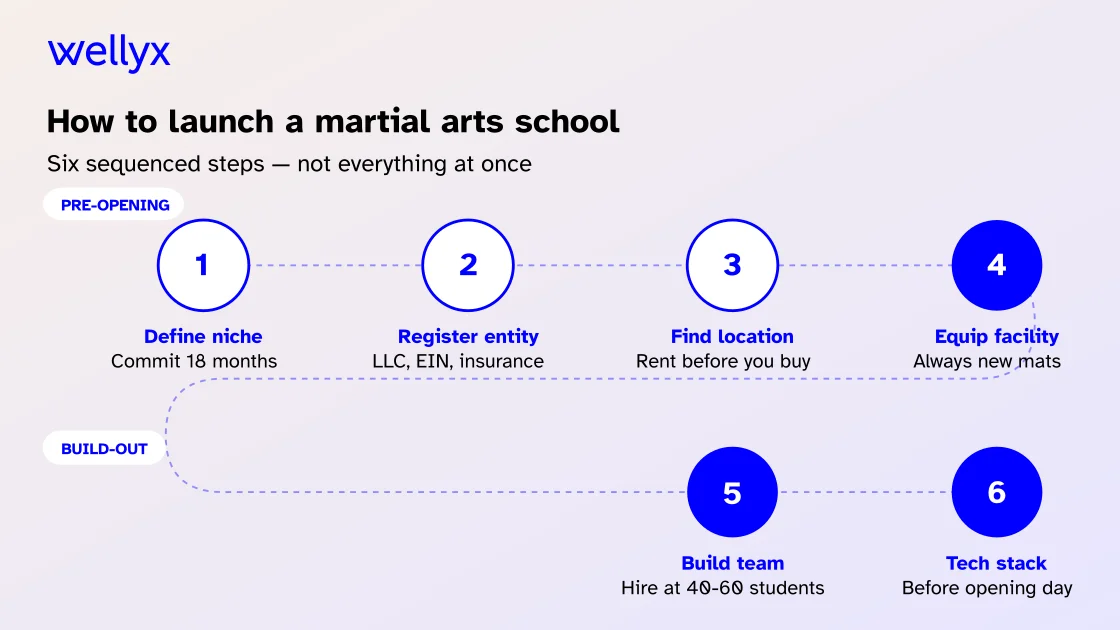
Step 1: Define your niche and target market
Your niche determines everything downstream: location choice, pricing, marketing channels, instructor hiring, and facility design. Schools that dominate locally are niche specialists, not generalists.
How to choose and commit to your niche:
- Start with honest self-assessment: what art do you genuinely love? You’ll teach it hundreds of hours per year.
- Validate local demand: check Facebook groups, competition results and census data for your target demographic.
- Audit competitors honestly, where are the genuine gaps? Not just where competitors are weak, but where you can be genuinely better.
- Commit for at least 18 months. Branding, marketing, and reputation take time to compound.
Effective niche positioning sounds like: “The best BJJ academy for serious competitors in [City]”, “The only dedicated facility for kids’ traditional karate in [Area]”, “MMA for fitness-focused adults who hate boring gyms.”
Step 2: Choose a legal structure and register
An LLC (Limited Liability Company) is the standard choice for a martial arts school. With contact sports, injury liability is real. A sole proprietorship exposes your personal assets. An LLC limits exposure to business assets. Formation costs $300–$800. You will also need a federal EIN (free, 10 minutes via the IRS website) and a business bank account.
| Insurance Type | What It Covers | Annual Cost | Required? |
| General Liability | Injuries during class; up to $1–2M coverage | $1,500–$2,500 | Yes, non-negotiable |
| Property Insurance | Equipment and facility improvements | $500–$1,500 | Yes |
| Workers’ Compensation | Employee injuries; required if you have staff | 15–18% of payroll | Mandatory with employees |
| Professional Liability | Claims of negligence in instruction | Often bundled | Strongly recommended |
| TOTAL ANNUAL BUDGET | Comprehensive coverage for a typical school | $3,000–$4,000 | Do not under-insure |
Warning: Under-insuring is a false economy. If someone is seriously injured and sues for more than your coverage, you are personally liable for the difference. Get proper insurance from day one.
Have all students sign detailed liability waivers before their first class. Waivers do not eliminate liability, but they demonstrate reasonable precautions and deter frivolous claims. Have a lawyer review your waiver language; it varies significantly by state.
State licensing note: Instructor and facility licensing requirements vary significantly by state and discipline. Several states including California, New York, and Texas, regulate combat sports schools separately from general fitness facilities, and MMA-specific instruction may require additional permits or registration with a state athletic commission. Before signing a lease, verify your state’s requirements with your Secretary of State’s office or a local business attorney familiar with the fitness industry. Non-compliance can result in fines or forced closure regardless of your LLC status.
Step 3: Find and set up your location
Location is one of your only permanent marketing assets. A visible, well-located facility generates awareness passively; passers-by see your sign, your brand registers, and awareness compounds over the years. A hidden, cheap location requires constant paid advertising to generate that same awareness.
| Factor | What to Look For | Why It Matters |
| Visibility | Street-level, signage visible from the road, not hidden on upper floors | Invisible location = invisible school |
| Parking | Free, abundant, easy to find | Parking friction is enrollment friction |
| Proximity to the target market | Near schools + neighborhoods (kids); near business districts/highways (adults) | Your customers won’t drive 20+ minutes |
| Minimum space | 2,500–3,500 sq ft; 12–14 ft ceiling height minimum | Below minimum = safety and experience problems |
| Flooring | Concrete or hardwood is ideal; carpet is problematic | Mats must adhere properly and be cleanable |
| Locker rooms | Separate male/female; showers matter more for adults than kids’ programs | Adults expect showers; parents expect a waiting area |
An ideal location search should take 4-8 weeks and involve visiting multiple properties, talking to landlords, and understanding neighborhood dynamics. Evaluate the neighborhood for safety, foot traffic patterns, demographic alignment, and competitor proximity.
When it comes to lease terms, you have two options: rent or buy. Most early-stage operators should rent. Buying requires substantial capital and locks you into a location. Renting gives you flexibility and lower upfront costs. Negotiate your lease strategically. And here are the key lease terms to negotiate:
- Length: Seek 3–5 years for stability and to reduce the landlord’s risk (gives you leverage)
- Rent: Typical range $2,000–$5,000 per month, negotiable, especially in suburban markets
- Rent increases: Try to lock in the same rate for the full term rather than annual escalations
- Build-out allowance: Standard is $20–$40/sq ft from landlord, negotiate to cover mat installation
Cost-Saving Strategy
Sublease space from an existing gym, yoga studio, or community center ($500–$1,500 per month for off-peak hours). Your startup cost drops from $30,000+ to $5,000–$15,000. Validate your concept first, then graduate to your own facility once you have 80–100 students.
Step 4: Equip your facility
Buy equipment aligned to your discipline. A BJJ academy does not need heavy bags; a karate dojo does not need power racks. Always purchase new mats (hygiene and student safety are non-negotiable) and invest in mirrors, a quality sound system, and professional signage. For strength equipment in MMA gyms, quality used gear from Facebook Marketplace or Craigslist is perfectly acceptable.
Facility aesthetics communicate quality. A clean, well-lit space with clear signage signals credibility. You do not need expensive furnishings; you need immaculate cleanliness, professional presentation, and thoughtful layout (clear traffic flow, separate waiting area, adequate locker rooms).
| Equipment Item | MMA Gym | BJJ Academy | Karate Dojo | Cost Range | Buy New or Used? |
| Martial arts mats (2″ grappling) | Essential | Essential | Optional (1.5″) | $2,000–$8,000 | Always new |
| Full-length mirrors | Recommended | Recommended | Essential | $1,000–$2,500 | New |
| Sound system | Yes | Yes | Yes | $1,500–$3,000 | New or near-new |
| Heavy bags | Essential | Not needed | Recommended | $500–$2,000 | New or used |
| Cage / fenced area | Optional (competition gyms) | Not needed | Not needed | $3,000–$8,000 | New |
| Power racks / barbells | For conditioning | Not needed | Not needed | $3,000–$8,000 | Used excellent |
| Kicking shields / pads | Essential | Optional | Essential | $300–$1,000 | New or used |
| Grappling dummies | Recommended | Recommended | Not needed | $100–$400 | New or used |
| Lockers & benches | All | All | All | $1,200–$4,000 | Used acceptable |
Step 5: Build your instructor team
Your instructors are your product. Poor hiring decisions are among the most costly mistakes a school owner makes. Evaluate every candidate on three criteria: genuine martial arts expertise (black belt minimum for credibility), teaching ability (observe them teach a class, can they break down technique for mixed skill levels?), and values alignment (patience, respect, commitment to student growth).
| Compensation Model | Structure | Best For |
| Salaried | $30,000–$50,000/year (full-time); $15,000–$25,000 (part-time) | Stability: good for core teaching staff |
| Per-class pay | $30–$60 per class, depending on experience and market | Part-time or specialist instructors |
| Hybrid (base + commission) | Guaranteed base + 40–50% commission on private lessons they teach | Most common; aligns incentives well |
When to hire your first instructor?
When you have 40–60 students and feel stretched, you’ll take a short-term revenue hit, but you’ll gain 15+ hours/week to focus on marketing and business development. That time is worth far more than the saved salary.
Managing staff and instructors
Staff management is an area many owner-operators struggle with. Successful schools create clear systems around it. Document everything: class schedules, compensation structures, expectations for class preparation, curriculum standards, attendance policies for instructors and how performance feedback works. Have regular (monthly minimum) meetings with your instructor team to align on curriculum, student progress, and school direction.
Owner perspective: The hiring turning point
“I ran everything myself for the first two years, teaching every class, handling all the admin, doing my own marketing. I hit a ceiling at around 50 students and couldn’t work out why I wasn’t growing. The answer was simple: I had no time left. The moment I brought in a part-time instructor, I got my evenings back. I used that time to visit two local schools and set up an after-school program. Within eight months, we were at 90 students. Hiring felt like spending money. It was actually buying growth.” — Bay Area PDT Silat School
Step 6: Set up your tech stack before you open
Manual systems like spreadsheets, WhatsApp groups, and Venmo payments will break down at 50 students. You will spend 12–15 hours per week on admin that software handles automatically.
Implement martial arts management software before you open: scheduling, automated billing, member communications, attendance tracking, and progress records. The $300 monthly cost is returned many times over in reclaimed time and reduced errors.
What Wellyx users say: Systems free your time
“I started using Wellyx for my gym, and the 24/7 access control has been a game-changer. Members check in and out at any time from their phones, and the system integrates directly with membership plans, so only authorized students can access the facility. What really stood out was how much it reduced the need for front desk oversight, which alone has saved us real time and resources every week.” — Elite Kickboxing Fitness, Wellyx customer
The martial arts marketing framework
Most school owners approach marketing as a series of disconnected tactics: post on Instagram, run a Facebook ad, ask for referrals. This is why they plateau. A framework replaces guesswork with a system. The four-stage model maps directly to how prospective students actually move from first awareness to long-term membership.
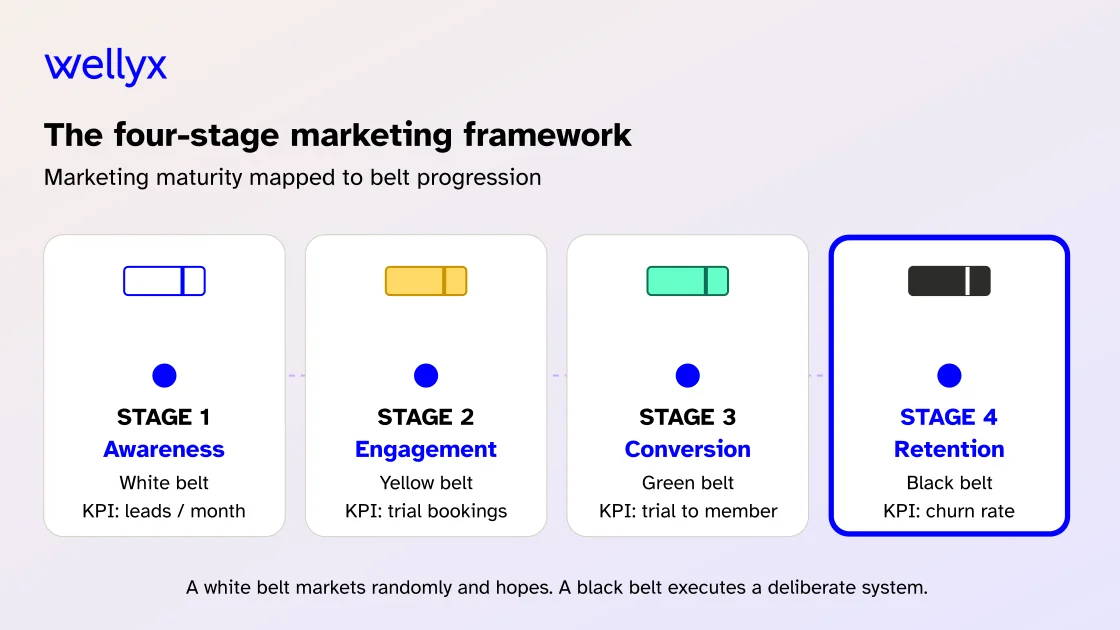
Think of your marketing maturity like your students’ belt progression. A white belt throws punches randomly and hopes something lands. A black belt internalizes every movement and executes a deliberate system. The four-stage framework below is your black belt marketing system: Awareness, Engagement, Conversion, Retention, each stage requiring specific skills and consistent practice before advancing to the next.
The four-stage growth model: Awareness → Engagement → Conversion → Retention
Stage 1 — Awareness (white belt): Prospective students cannot choose you if they do not know you exist. Awareness channels include local SEO, Google Business Profile, social media reach, community partnerships, and direct mail. Your goal here is visibility within your target demographic.
Stage 2 — Engagement (yellow belt): Once aware, prospects need a reason to engage. Short form video demonstrating the technique, student progress stories, and community content build the interest that moves someone from scrolling past your school to considering it seriously. Engagement is where trust begins.
Stage 3 — Conversion (green belt): A compelling trial offer, a clear landing page, fast lead response, and a structured follow-up sequence are what move an engaged prospect to a paying student. The most common failure points here are responding too slowly or having no systematic follow-up.
Stage 4 — Retention (black belt): A retained student is worth 10-20 times more than an acquired one. Retention systems include belt progression ceremonies, community events, recognition programs, and regular check-ins. Schools that invest here see churn drop from 10% to 2–4%, which significantly changes their unit economics.
| Stage | Belt Analogy | Primary Channels | KPI to Track | Warning Threshold |
| Awareness | White Belt | Local SEO, GBP, social reach, direct mail | Leads per month | Below 20 leads/month |
| Engagement | Yellow Belt | Short-form video, content, email | Trial bookings per month | Below 40% booking rate |
| Conversion | Green Belt | Trial offer, follow-up, onboarding | Trial-to-member % | Below 30% |
| Retention | Black Belt | Belt ceremonies, events, recognition | Monthly churn rate | Above 6% |
The weekly measurement habit
Every week, track five numbers: leads generated → trials booked → trials attended → trials converted → students who churned.
This gives you a complete picture of where your pipeline breaks. If you have strong lead volume but low trial bookings, your offer or response time is the problem. If trials attend but do not join, your conversion experience needs work. If members churn quickly, your retention systems are inadequate.
Retention insight from group fitness
“For the first 18 months, we kept pushing for new students, ads, demos, free trials. We were always at around 55–60 members and couldn’t understand why. When we actually tracked it, we were losing about 8–9 students a month. We rebuilt our progression system so every student had a visible path, added monthly training milestones between gradings, and started doing proper belt ceremonies with family invited. Churn dropped, and within three months our headcount started climbing without changing the ad spend at all.” —Bay Area PDT Silat School
How to grow a martial arts school: Enrollment and retention
Growth is not primarily an acquisition problem. Most schools that plateau have a retention problem disguised as an acquisition problem. They acquire students at high cost, lose 40–50% within six months, and then spend more on acquisition just to replace the departing students. Before scaling your marketing spend, audit your retention systems.
Student retention framework
Retention is engineered, not assumed. Build three systems explicitly:
- Progression tracking: Every student should know exactly where they are, what they need for their next belt, and roughly how long a typical student takes to reach it. At a minimum, this means logging core techniques required per rank, attendance hours toward next promotion, and a monthly check on who has stalled. The tracking itself does not have to be complex, but it does have to be consistent. Wellyx’s progression tracking feature automates the data capture and makes it visible to students, parents, and instructors, which is where most of the retention value comes from.
- Belt promotion ceremonies: Make promotions feel meaningful, not mechanical. Invite family. Award certificates. Post video highlights. The ceremony reinforces the emotional investment that keeps students enrolled through the inevitable motivation dips.
- Community building: Regular in-house tournaments, partner drills, and social events create friendships inside the school. Students with social connections churn at a fraction of the rate of those who train in isolation.
Target a monthly churn rate below 4%. At 120 students and 4% churn, you need 5 new students monthly to maintain enrollment. At 10% churn, you need 12. The difference in required marketing spend is enormous.
How to track belt and skill progression in your school
Most school owners understand that progression drives retention. Fewer understand that progression tracking is what makes progression actually work. Ceremonies are the visible output. Tracking is the engine.
Schools that rely on “the instructor remembers” lose data every time a coach takes a holiday, a student transfers classes, or a family forgets when their child last tested. More importantly, they lose the ability to spot students stalling before those students quietly churn out.
At 40 students, memory works. At 80 students, it breaks. At 120+ students, it becomes a liability.
Why is progression tracking an operational system?
Belt promotions are moments. Progression tracking is the continuous record that supports those moments. Done well, it gives you three things no manual system can: visibility into who is ready to test, early warning on at-risk students, and a defensible basis for every promotion decision you make.
The HFA 2025 Fitness Industry Benchmarking Report, drawn from 175 companies and more than 17,000 facilities, puts industry-average annual retention at 66.4%. Martial arts schools with strong progression tracking consistently outperform that benchmark. The mechanism is simple. Students who can see their progress stay engaged through the motivation dips that cause casual attrition.
What to track
The following data points form the minimum viable tracking layer for any school, regardless of discipline.
| Data Point | Significance | Capture Cadence |
| Current rank, belt, or stripe | Baseline for every progression decision | Real-time, updated on promotion |
| Required techniques for next rank | Defines the student’s visible goal | Set at enrollment; updated per rank |
| Technique-level assessment grade | Identifies skill gaps early | Every class or weekly |
| Attendance hours at current rank | Most disciplines require minimum mat time | Automated, per class check-in |
| Sparring or rolling performance notes | Qualitative readiness signal | Monthly |
| Testing eligibility date (projected) | Anchors student motivation to a visible horizon | Reviewed monthly |
| Last promotion date | Flags students stalled beyond average time-in-rank | Real-time |
| At-risk flag (stalled, absent, regression) | Triggers instructor intervention before churn | Reviewed weekly |
Capturing these eight data points per active student converts progression from an instructor’s mental model into a reviewable, shareable, and defensible system.
Discipline-specific progression structures
Tracking must match the native structure of your discipline. A BJJ academy running a karate-style kyu system will confuse students and dilute the native belt culture. A karate dojo imposing BJJ-style stripes on children will lose the ceremonial weight that drives youth retention. Match the system to the discipline.
Brazilian Jiu-Jitsu uses five adult belts with four stripes per belt, giving roughly 20 micro-milestones between white and black. Stripes are the retention lever, not belts. A student earning a stripe every 3–4 months stays engaged even though the next belt is 18 months away. Track attendance, technique competency, and sparring readiness at the stripe level.
Karate and Taekwondo use structured kyu or geup systems, typically 8–10 ranks before black belt. Promotion cycles are shorter, running 2–6 months, and ceremonies are family-facing events. For youth-heavy schools, the belt ceremony is the retention engine. Time-in-rank must be tracked carefully so promotions feel earned, not automatic.
MMA has no universal belt system. Most schools design internal level systems or track discipline-specific progressions such as BJJ belts combined with Muay Thai armbands. Because MMA lacks cultural ceremonial weight around promotion, internal progression tracking becomes even more important as a retention tool. Without it, MMA students have no visible progress markers between “new student” and “competitor.”
Krav Maga uses level-based systems such as P1–P5 Practitioner and G1–G5 Graduate levels, with 6-month cycles. Assessments are skill-based rather than ceremonial. Tracking focuses on technique proficiency and time-in-level.
Manual vs. digital tracking: when to transition
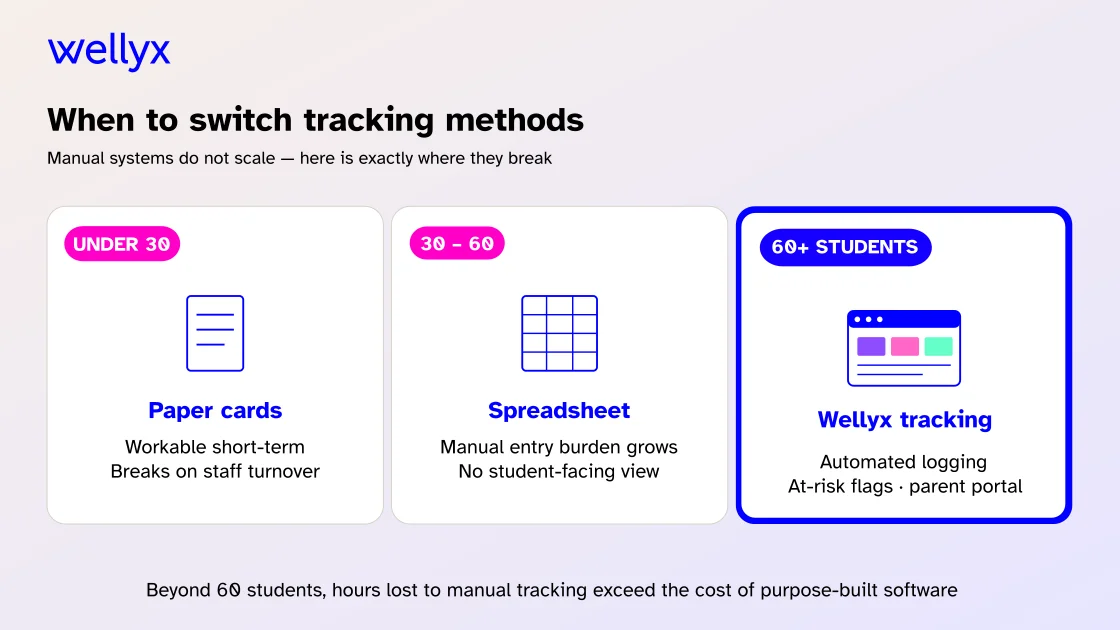
Manual tracking is not wrong. It is size-limited. The transition point from paper to software is not a preference; it is a function of student count.
| School Size | Viable Tracking Method | Limitations |
| Under 30 students | Paper cards, instructor notebook | Workable short-term; breaks on staff turnover |
| 30–60 students | Spreadsheet per student, shared drive | Manual entry burden; no automation; no student-facing visibility |
| 60+ students | Purpose-built software | Upfront setup effort; requires ongoing logging discipline |
Beyond 60 students, the hours lost to manual tracking and the students lost to missed interventions both scale faster than the cost of purpose-built software. Wellyx’s progression tracking gives instructors an at-a-glance view of each student’s current rank, completed requirements, attendance toward next test, and projected testing date.
The instructor assessment workflow
A working progression tracking system needs a repeatable weekly rhythm, not just a database.
Before class, the lead coach reviews the tracking dashboard to identify students approaching testing eligibility, students flagged as at-risk, and any techniques to emphasize during the session. This takes five minutes.
During class, instructors capture brief assessment notes via mobile entry rather than trying to recall details at the end of the day. After class, any significant progress milestones, regressions, or concerns get logged against the student’s profile. This takes another five minutes.
Once a month, the head instructor runs a 30-minute rank review covering all students approaching testing eligibility. Promotion decisions are made from the data, not from gut feel alone. Once a quarter, the head instructor reviews every student who has not progressed in 1.5x the average time-in-rank and initiates personal check-ins.
The total instructor time required is 15–20 minutes per week. The payback shows up in reduced churn and higher conversion at promotion moments.
Student- and parent-facing visibility
Progression tracking is most powerful when students and parents can see it. Visible progress is one of the highest-leverage retention levers in the entire business. When a parent can log in and see that their 9-year-old has completed 18 of 24 techniques required for their next belt, the perceived value of the membership compounds every month, even in weeks when the student does not advance.
For youth programs, parent visibility is especially important. A common cause of youth attrition within the first 6 months is the parent’s perception that the child is “not really progressing.” That perception is rooted in the absence of visible evidence, not the absence of actual progress. Wellyx’s member portal surfaces progress natively. Schools running manual systems should, at minimum, send monthly progress emails summarizing where each student stands.
How progression data feeds retention decisions
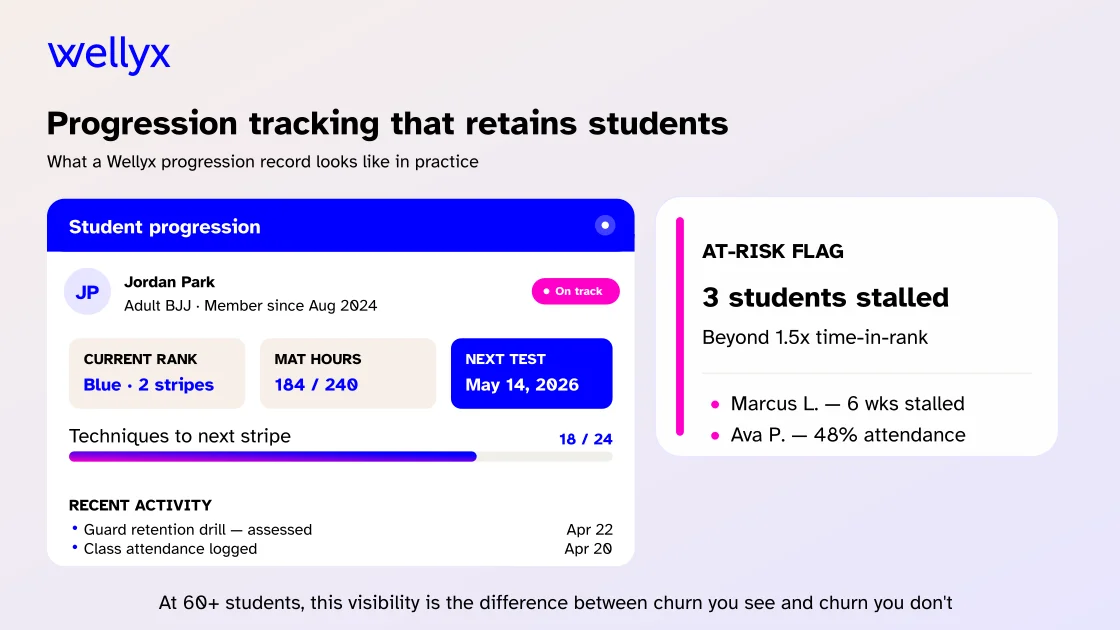
The real payoff from tracking is the ability to trigger specific actions from specific data patterns. Four triggers belong in every school’s operational rhythm.
- When a student has not progressed in 1.5x the average time-in-rank, an instructor initiates a personal check-in. A short conversation is often enough to re-engage a student who was about to drift.
- When a student’s 4-week rolling attendance drops below 50% of their baseline, an automated SMS goes out. This catches passive attrition before it becomes cancellation.
- When a student has earned a rank in the last 14 days, they receive a referral request. This is the moment of peak satisfaction and the single highest-converting window for referral asks in the student lifecycle.
- When a student is approaching testing eligibility, they receive a heads-up communication about testing fees, preparation sessions, and what to expect. This converts progression into a planned revenue event rather than an ad-hoc surprise.
Schools that implement these four triggers consistently see measurable improvements in retention and in testing fee revenue within 90 days.
Scaling enrollment without scaling ad spend
The most efficient enrollment growth lever is trial conversion optimization, not increased ad spend. If your current trial-to-member conversion is 25%, improving it to 40% delivers 60% more members from identical ad spend. Focus on the trial experience: structured induction, personal follow-up within 24 hours, and a clear, pressure-free membership invitation.
After-school programs are the highest-leverage growth channel for children’s dojos. Partnering with two or three local primary schools to deliver after-school sessions can add 20–40 students per term with no paid advertising. These students typically convert at higher rates because parents already trust the program.
Expert tip: Referrals from group fitness
“The students who stay longest are never the ones training in isolation. They’re the ones who’ve made friends here, who ask after each other when someone misses a week. We started running a monthly open mat and an in-house competition every quarter, nothing expensive, just reasons to show up together outside of regular class. Referrals went up, and students who came through referrals stayed significantly longer than those from paid ads. Your belt system already builds investment in the school. Community is what makes that investment social.” — West End Martial Arts
Satellite programs and partnership growth
Once your core school reaches 100+ students, satellite programs create a second revenue stream without proportional overhead increases. Options include: partnering with community centers to run classes in their facilities on a revenue-share basis (typically 70/30 in your favor), launching after-school programs at partner schools, or subletting mat time to independent instructors for disciplines that complement your core offering.
These partnerships extend your geographic reach, build brand recognition in new neighborhoods, and can generate 30–50 additional students without requiring a second facility.
How to increase martial arts school revenue
A school generating all its revenue from group class memberships has a low ceiling and high risk. If enrollment dips, revenue drops immediately. Schools that diversify across multiple revenue streams create more stable businesses with significantly higher monthly revenue per student.
Core revenue: Memberships and tiered pricing
Structure memberships in tiers that serve different customer needs. A basic tier (two sessions per week, standard pricing) captures price-sensitive students. A premium tier (unlimited classes, priority booking, monthly workshops) commands 30–40% higher pricing and attracts the most committed students. A family plan drives household enrollment. Target $200 average revenue per student per month across all tiers.
Private lessons: The highest-margin revenue stream
Private instruction generates $75–$150 per hour with margins of 50–70% (versus 30–40% for group classes). Accelerate adoption by including one complimentary private session in your premium membership tier. Students who experience the benefits of personal instruction convert to regular private clients at a high rate. A school with 120 members averaging even 0.5 private lessons per month at $80 each generates $4,800 in monthly high-margin revenue.
Belt testing fee: a natural revenue stream
Belt testing fees are a natural revenue line that most schools under-monetize. At typical rates of $40–$75 per test and an average of 2–3 promotions per student per year, a 120-student school generates $9,600–$21,600 annually from testing alone, at near-full margin.
Testing is typically conducted during existing class hours, so there is no incremental facility or staffing cost. Schools running structured progression tracking capture this revenue more reliably because eligibility is visible and communicated in advance, converting each promotion into a planned billing event rather than an administrative afterthought.
Workshops, seminars, and guest instructors
Host monthly skill workshops (sparring strategy, competition preparation, self-defense fundamentals) at $40–$80 per attendee. Bring in high-profile guest instructors twice yearly at $80–$150 per attendee for premium positioning and enrollment spikes. These events generate one-time revenue, attract trial prospects, and provide content for social media, three returns from one activity.
After-school programs and holiday camps
After-school programs generate $500–$800 per child per term through school partnerships, often at 90% retention term-over-term. Holiday camps at $150–$300 per week generate revenue during periods when standard class attendance drops. Both channels target the same children’s demographic you are already serving, dramatically increasing revenue per family relationship.
Online classes and video-on-demand
An online membership at $30–$50 per month serves students who travel frequently, have irregular schedules, or live outside your immediate area. Wellyx’s video-on-demand feature enables you to monetize recorded content passively. Start by recording your existing workshops and technique series. At 50 online subscribers paying $40 per month, this adds $2,000 monthly with near-zero incremental cost.
Retail: Gear, apparel, and merchandise
Retail positioned near the entrance and exit generates 15–20% additional monthly revenue for schools that execute it well. Use Wellyx’s inventory management to track stock and purchasing patterns. Prioritize products students actually need (uniforms, protective gear, branded training apparel) over generic merchandise. Purchase on consignment where possible to minimize stock risk. Branded apparel worn by students outside the school is also free marketing.
Facility monetization
Unused mat time is revenue you are not capturing. Rent space through Wellyx facility rental management to independent instructors teaching complementary disciplines (yoga, boxing, dance) during your off-peak hours. Host grading events, in-house tournaments, and fitness testing sessions with entry fees. A facility generating $3,000–$5,000 per month from rentals and events significantly improves overall economics.
| Revenue Stream | 120 Students | 200 Students | Margin |
| Group Memberships | $18,000/mo | $30,000/mo | 40% |
| Private Lessons | $2,400/mo | $5,000/mo | 60% |
| Belt Testing Fees | $600/mo | $1,500/mo | 75% |
| Workshops & Seminars | $800/mo | $2,000/mo | 70% |
| Retail & Merchandise | $250/mo | $500/mo | 50% |
| Online / Video Content | $1,000/mo | $2,500/mo | 80% |
| After-School Programs | $2,000/mo | $4,000/mo | 50% |
| Facility Rentals | $500/mo | $1,500/mo | 85% |
| Total | $25,000/mo | $45,500/mo | ~50% |
Should your BJJ or MMA academy sell supplements?
BJJ academies and MMA gyms with adult demographics sit in a natural position to retail supplements, the training culture already supports it, and students spend on protein, recovery, and hydration outside the gym. Done correctly, supplements can add a meaningful high-margin revenue stream; done poorly, they create stock waste, liability exposure, and distraction.
- The Opportunity: Adult BJJ and MMA schools typically have members who already purchase protein powder, BCAAs, and electrolyte products. Stocking these at the front desk captures spend that would otherwise go to online retailers or supermarkets. Margins of 30–50% are achievable on quality supplement products.
- Product Fit: The highest-demand products in training environments are protein powder, BCAAs, electrolytes/hydration tablets, pre-workout, and creatine. Branded merchandise (shakers, gym bags) doubles as free advertising. Stick to products your members already use or would naturally try, and only stock what is consistent with your school’s training philosophy.
- Margin and Stock Risk: Supplements carry real shelf life and spoilage risk. Over-investing in inventory before validating demand is the most common mistake. Start with 3–5 SKUs, stock to observed demand, and reorder frequently rather than in bulk. Consider consignment arrangements with distributors for your first 60–90 days.
- Compliance and Liability: In the US, supplement sales by gyms do not require a special license, but you must sell only products from reputable, third-party-tested brands (NSF Certified for Sport or Informed Sport are the benchmarks). Avoid products with banned substances claims. Display only factual product information and never make health or medical claims in your signage. Ensure your general liability insurance covers retail activity.
| Product | Margin | Demand Fit (BJJ/MMA) | Stock Risk | Recommended? |
| Protein powder (whey/plant) | 30–45% | Very high | Medium (shelf life) | Yes, start here |
| BCAAs / EAAs | 35–50% | High | Low | Yes |
| Electrolytes / hydration tabs | 40–55% | High, especially in hot climates | Low | Yes |
| Pre-workout | 30–45% | Moderate | Medium | Validate demand first |
| Creatine | 35–50% | High (competitive adults) | Low | Yes |
| Branded merchandise (shakers, bags) | 50–70% | High (doubles as marketing) | Low | Yes |
| Fat burners / weight-loss products | 40–60% | Low | Medium | Avoid liability exposure |
| Meal replacement / diet products | 30–40% | Low | High (short shelf life) | Avoid until 200+ members |
Implementation tip
Launch with 3–5 SKUs only. Position the display near the front desk or exit. Price 10–15% above online retail to reflect convenience, not premium. Introduce products through instructor recommendations, “this is what I use” converts significantly better than signage alone.
Common mistakes martial arts business owners make
Most school failures trace back to a small number of avoidable mistakes. Recognizing these patterns before you make them is worth significantly more than any individual tactic.
| Mistake | Impact | Fix |
| Opening without a defined niche | Weak positioning, poor conversion, difficulty commanding premium pricing | Define your niche in 10 words before signing a lease |
| Underpricing memberships | Requires high volume to break even; attracts less-committed students; poor unit economics | Price 10–15% above commodity competitors; justify through positioning |
| Ignoring local SEO until year two | Invisible to prospects searching organically; over-reliance on paid ads | Set up Google Business Profile and city-specific pages before opening |
| No lead response system | Leads go cold within hours; cost per acquisition spikes | Automate SMS response within 5 minutes of every lead inquiry |
| Treating retention as automatic | High churn creates an enrollment treadmill; marketing spends funds on replacement, not growth | Build belt ceremonies, recognition programs, and community events into a monthly rhythm |
| Scaling ad spend before fixing retention | Expensive lead acquisition funds, temporary enrollment that quickly churns out | Achieve <6% monthly churn before increasing marketing spend |
| Selling supplements without vetting margin and compliance first | Stock waste, unsold inventory, potential liability exposure, and damage to school credibility | Start with 3–5 tested SKUs: Choose third-party certified brands (NSF/Informed Sport); validate demand before expanding inventory |
The most expensive mistake: Confusing activity with progress
Many owner-operators are extraordinarily busy teaching classes, managing staff, handling admin, and posting on social media, but are not growing. The discipline to step back weekly and measure what is actually working (leads, conversions, churn) versus what simply feels productive is what separates schools that scale from schools that plateau.
Build a 30-minute weekly review into your schedule. Measure your five key metrics (leads, trial bookings, trial attendance, conversions, churn). Identify the one metric furthest from the target. Focus on your improvement effort there. Repeat every week.
Warning sign:
If your monthly churn is above 6%, you have a structural retention problem, not an acquisition problem. Stop increasing ad spend. Build retention systems first. The HFA 2025 Fitness Industry Benchmarking Report puts industry-average annual retention at 66.4% (roughly 2.8% monthly attrition), drawn from 175 companies and 17,000+ fitness facilities. A healthy martial arts school should sit below 4% monthly churn; above 7%, no amount of new leads fixes the economics. Measure again in 60 days.
Case study: From 40 to 200 students in 18 months
A suburban gym opened in 2023 with strong instruction and weak systems. By month six, enrollment sat at 40 students, monthly churn exceeded 8%, and the owner was spending evenings on billing instead of coaching.
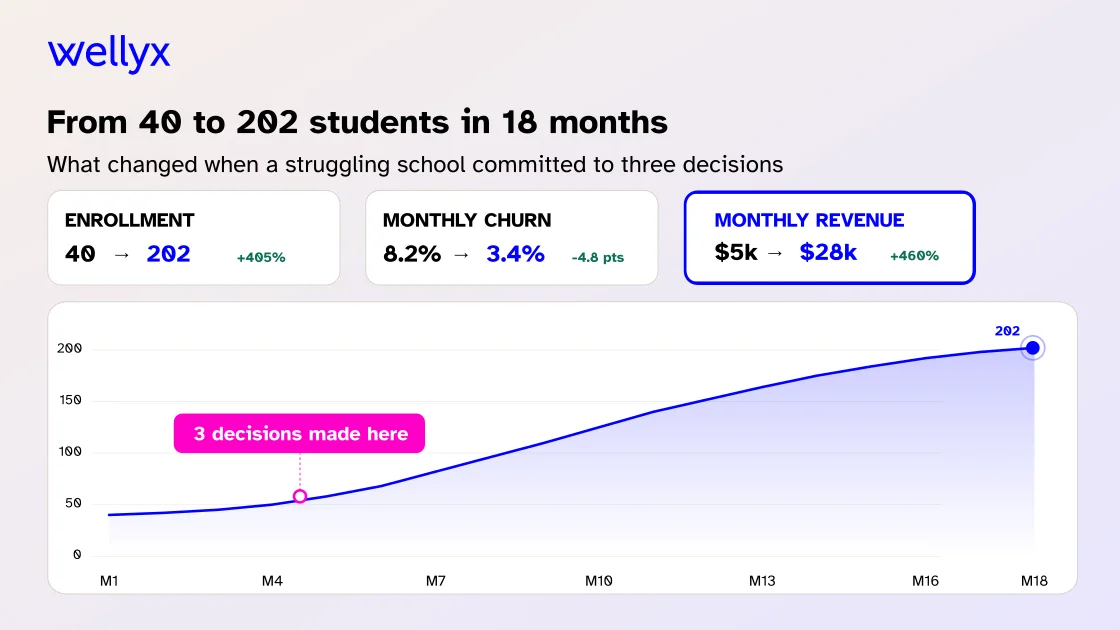
Three decisions reversed the trajectory.
- First, the school tightened its positioning to adult competitive MMA and dropped the vague “martial arts for everyone” message entirely.
- Second, the owner relocated to a visible strip-mall space, paying $800 more in monthly rent but cutting the paid ad budget by $1,200, because the visible location generated consistent walk-in inquiries.
- Third, they launched a school partnership stream, adding a kids’ program at two local middle schools through after-school agreements.
The results over 18 months: enrollment grew from 40 to 202 students. Monthly churn fell from 8.2% to 3.4%. Revenue grew from $5,000 to $28,000 per month.
The lesson
Niche clarity, a visible location, and a retention system compounded faster than any single marketing tactic. None of it required extra capital, only deliberate decisions made before the school got too comfortable doing things the hard way.
Tools and automation for martial arts schools
With 50+ students, manual systems, spreadsheets, WhatsApp scheduling, cash collection, and notebook attendance records become a liability. They consume 10–15 hours per week of owner time, create errors in billing and scheduling, and degrade the member experience. Every hour spent on admin is an hour not spent on marketing, coaching, or business development.
Martial arts management software eliminates these hours and simultaneously improves the experience your students receive: automated billing means no missed payments or awkward conversations, online booking means convenience, and digital progress tracking means you always know which students are at risk of churning before they do.
What to look for in martial arts software
| Business Need | Feature Required | Wellyx Solution |
| Class scheduling | Bookings, waitlists, class management | Scheduling & bookings platform |
| Billing | Recurring charges, payment processing | Integrated billing management |
| Lead & member comms | Email, SMS, WhatsApp automation | Marketing automation suite |
| Retention & progression | Belt and rank tracking, attendance toward next rank, student facing progress view, parent notifications, at-risk flagging, testing eligibility triggers | Wellyx progress tracking & member portal |
| Staff management | Payroll, instructor app, shift management | Staff & payroll management |
| Access control | Keyless entry, attendance tracking | Integrated access control |
| Revenue growth | Online classes, retail, workshop bookings | Video on demand + POS |
Implement software before you open, or before you hit 50 students, if you are already operating. The 10–12 hours per week you reclaim pay for the platform many times over. Budget $300–$500 per month for a specialist platform.
Key metrics every martial arts owner should track
| Metric | Target Benchmark | Warning Threshold | How to Improve |
| Monthly student churn | 2–4% | Above 6% | Belt ceremonies, community events, check-in calls |
| Trial-to-member conversion | 35–50% | Below 30% | Faster follow-up, structured trial experience |
| Revenue per student per month | $150–$200+ | Below $120 | Raise pricing, add private lessons, tiered memberships |
| Lead response time | Under 5 minutes | Over 30 minutes | Automated SMS response on form submission |
| Student Lifetime Value (LTV) | $2,500–$4,000+ | Below $1,500 | Reduce churn, increase monthly revenue per student |
| Cost per new member | Below $100 | Above $150 | Improve trial conversion rate; invest in referral program |
Wrap up
The martial arts industry presents a clear and expanding opportunity for school owners who approach it with structure rather than instinct. At this scale, success is not driven by technique alone, but by how effectively the business is built around it. Schools that define their positioning early, price with intent, and prioritize retention before chasing growth consistently outperform those that rely on volume alone.
The fundamentals are straightforward, but execution is where most studios fall short. Revenue is lost in untracked churn, underpriced memberships, and operational inefficiencies that compound over time. The difference between a stable school and a scalable one is rarely demand; it is the systems supporting it.
Platforms like Wellyx exist to solve that layer, giving owners visibility and control over the metrics that actually drive growth.
In the end, the schools that grow are the ones that treat operations with the same discipline as training.
Frequently Asked Questions
How much does it cost to start a martial arts business?
Typical startup capital ranges from $28,000 (lean operation, subletting space) to $69,500 (mid-sized commercial facility). The largest variable is your facility arrangement: subletting an existing space costs $5,000–$15,000 to launch, while signing a commercial lease with a build-out requires $30,000–$50,000 before opening day.
How many students do you need to be profitable?
Most schools need 60–80 active students at $130–$150 per month to break even with standard overhead ($4,000–$6,000 per month). A school targeting $150 per month with 80 students generates $12,000 per month in membership revenue, which covers overhead and provides modest owner income. True profitability, covering all costs plus a market-rate owner salary, typically requires 100–120 students.
What is the best martial arts discipline for profitability?
BJJ academies currently achieve the highest per-student revenue through premium adult pricing and high-margin private lessons. Traditional children’s dojos achieve the highest total volume. The most profitable discipline is ultimately the one you can teach at the highest level and position most distinctly in your local market.
Should I start with a commercial lease or subleasing?
If you have fewer than 40 committed students, sublease first. Validate demand, build your systems, and grow to 80–100 students before committing to a commercial lease. The risk reduction far outweighs the flexibility cost.
How long does it take to grow to 100 students?
With deliberate marketing execution, most schools reach 100 students within 12–18 months of opening. Schools that invest in local SEO, school partnerships, and a referral program from day one consistently achieve this faster than those relying on organic word-of-mouth alone.
Should my academy sell supplements?
BJJ and MMA academies with adult demographics can profitably retail protein, BCAAs, and electrolytes aligned with training culture. Margins of 30–50% are achievable. Start with three to five SKUs from reputable brands, display at the front desk, and stock to demand before expanding. Avoid over-investing in inventory before validating demand.
What software do martial arts schools use?
Purpose-built platforms like Wellyx handle scheduling, billing, member communications, access control, and retention tracking in one integrated system. Generic solutions (Mindbody, GoHighLevel) require more customization to handle martial arts-specific workflows like belt tracking and grading management.
How do I market a martial arts school with no budget?
Start with Google Business Profile optimization (free), school partnership outreach (free), a structured referral program (free to launch), and consistent short-form video content on Instagram Reels and TikTok (free). These four channels can generate 10–15 inquiries per month with zero ad spend, giving you the runway to invest in paid channels once revenue allows.
How do I track belt progression without spending hours on admin?
Under 30 students, paper cards or a shared spreadsheet work fine. Between 30 and 60 students, you will start feeling the admin burden. This is when schools transition to purpose-built software. Above 60 students, manual tracking becomes a liability because you lose the ability to spot at-risk students before they churn.
Platforms like Wellyx automate attendance capture, flag students approaching testing eligibility, and surface progress to students and parents. Instructor admin time drops to 15–20 minutes per week and retention improves as a direct result.
When should a student be eligible for their next belt?
Eligibility should rest on three factors, not one: minimum time-in-rank, minimum attendance hours at the current rank, and demonstrated technique proficiency assessed by an instructor. Time alone devalues the belt. Technique alone creates inconsistency across students. A tracked three-factor model is defensible, repeatable, and gives students a clear answer to “what do I need to do to test?” That clarity is itself a retention driver.