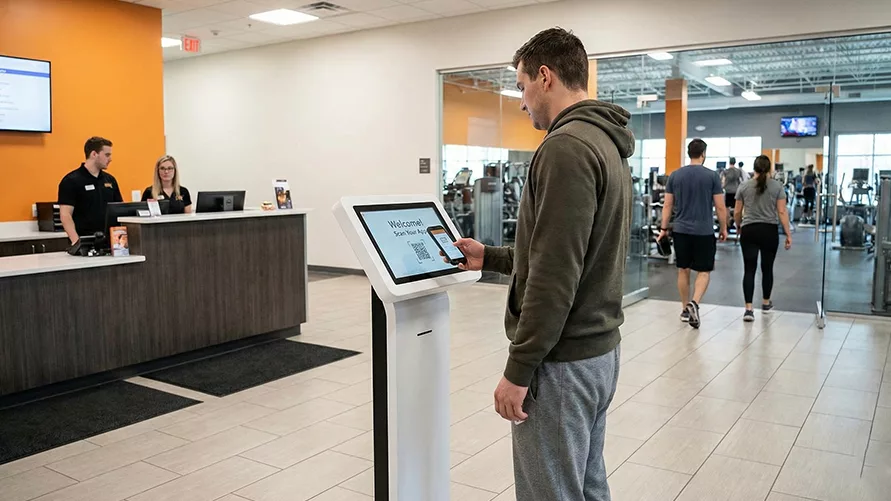
Payroll is one of the fastest ways to either build trust in your gym or quietly damage it. When staff are paid correctly and on time, they focus on coaching, member experience, and sales. When payroll is late, inconsistent, or confusing, you see it in missed shifts, lower energy on the floor, and higher turnover.
Gym payroll is uniquely demanding because gyms rarely run on one simple wage model. You may have hourly front desk coverage, salaried management, trainers paid by sessions or revenue splits, instructors paid per class, and sales staff on commissions, all in the same pay period.
This guide gives you a clear system you can run every pay period: how to set up payroll legally, whether you have to pay employees hourly or monthly, classify staff correctly, build pay rules that prevent disputes, track time and sessions reliably, handle deductions and taxes, keep records properly, and scale payroll as you grow.

1. Payroll in a gym is a system, not a single task
A strong payroll process has three goals:
- Accuracy: Everyone is paid the correct amount, every time, with clear math you can explain.
- Compliance: You meet federal and state wage-hour rules, tax rules, and record-keeping requirements.
- Stability: Your process works even when schedules change, instructors swap classes, trainers split packages, or you add a second location.
In practice, gym payroll succeeds when you control four inputs:
- Time worked (hours for hourly staff).
- Services delivered (training sessions, packages redeemed).
- Classes taught (including substitutions and cancellations).
- Sales/bonuses (membership commissions, performance incentives).
If those inputs are clean and approved before payroll runs, most payroll stress disappears.
2. Legal payroll setup: What must be in place before you pay more
To set up your gym payroll system, you have to take the following steps:
- Get your EIN and register as an employer
Most gyms need an Employer Identification Number (EIN) to run payroll and file employment taxes. The IRS provides a free online EIN application and explicitly warns against third-party sites that charge a fee for an EIN.
- Set up state employer accounts and wage requirements
In addition to federal setup, you typically need state accounts (withholding and unemployment, among others). You should also confirm your state’s payday rules. The U.S. Department of Labor maintains a state payday requirements reference that outlines pay frequency rules and other state-specific details.
- Establish a payroll calendar that your gym actually follows
Payroll issues often come from “floating deadlines” (cutoffs that change weekly). A gym should operate with a fixed payroll rhythm:
- Pay period end (the last day hours/sessions count).
- Timesheet and session submission cutoff (when staff must finalize).
- Manager approval deadline (when leads/GM approve exceptions).
- Processing day (when payroll is run).
- Pay date (when funds land).
If you run commissions or bonuses, you also need a separate calendar rule: when commissions are earned versus when they are paid. That distinction prevents disruption caused by refunds, chargebacks, and cancellations.
- Document your payroll policies in writing
You do not need a long employee handbook to run payroll correctly, but you do need clear written rules. At minimum, document:
- Pay schedule and pay dates.
- How time is recorded and corrected.
- How sessions/ classes are counted.
- How commissions are calculated (including refunds/chargebacks).
- Overtime approval rules.
- How payroll errors are corrected (and how quickly).
Written policies are your first line of defense when someone challenges a paycheck.
3. Employee vs contractors: the gym owner’s highest-risk decision
Misclassification is one of the most expensive payroll failures in fitness. The reason is simple: gyms often want flexibility, but their operations create the kind of control that points toward employee status.
- The IRS standard: control and independence
For federal employment tax purposes, the IRS applies common-law rules and focuses on the degree of control and independence in the relationship. The IRS groups the relevant evidence into three categories:
- Behavioral control
The IRS explains that a worker is an employee when the business has the right to direct and control the worker; the business does not need to actively supervise every detail if it retains the right to do so.
In gym terms, behavioral control increases when you dictate program delivery, require exact scripts, control how sessions must be run, mandate staff meetings, or require a specific method beyond reasonable safety and brand standards.
- Financial control
Financial control looks at whether the payer controls business aspects, how the person is paid, whether expenses are reimbursed, who provides tools/supplies, and similar factors.
In gym terms, if you set prices, control client billing, assign clients, reimburse expenses, and provide all tools, the relationship often looks more employment-like.
- Relationship of the parties
This category includes how the parties view the relationship, whether it is expected to continue, and whether benefits or long-term integration exist.
- Gym-specific reality checks
A trainer or instructor can be a legitimate contractor in some setups, but gyms often unintentionally operate like an employer while paying like a contractor. Common high-risk patterns include:
- The gym sets the trainer’s schedule and required hours.
- The gym sets pricing and collects all payments.
- The gym assigns clients and controls communications.
- The trainer is presented as staff (email, uniform, mandatory meetings).
- The trainer cannot work elsewhere in practice.
- If you need an IRS determination
The IRS provides Form SS-8 to request a determination of a worker’s status for federal employment taxes and income tax withholding.
You do not need to file SS-8 for every role, but it is a useful tool when the relationship is complex or unclear.
4. Designing pay structures that prevent disputes
Payroll disputes in the gym rarely happen because people do not understand “hourly pay.” They happen because variable pay is not defined tightly enough. The fix is to define the earning rules in a way that can be audited.
- The key concept: define the “earn event.”
For every variable component: commission structure for gym, per-class pay, package splits, and bonuses. You need a single sentence that defines what earns the pay. Examples:
- Training commission is earned when the session is delivered and marked complete in the booking system.
- Class pay is earned when the class is taught, including approved substitutions logged before the payroll cutoff.
- Membership commission is earned when payment clears, and the refund window has closed.
The goal is not to be strict for its own sake. The goal is to avoid arguments like “I sold it, but they refunded.” or “I coached it, but it wasn’t recorded.”
- Trainers: how to structure pay cleanly
Common trainer models include:
- Per-session flat rate: Predictable payroll, straightforward accounting.
- Revenue split: Aligns incentives with pricing and service quality.
- Base + Commission: Supports floor coverage while rewarding delivery.
- Tiered commission: Encourages volume while protecting margin at low volume.
Whatever model you choose, define:
- How cancellations count (and what timeframe is a no-charge cancellation).
- Whether late cancellations are paid, partially paid, or unpaid.
- How packages are handled when purchased under promotions.
- Whether the commission is based on sales, deliveries, or collections.
- Group instructors: substitutions and cancellations must be formal
Instructors are often paid per class, which creates a simple core rule: “Paid per class taught.” But gyms struggle with the exceptions:
- Last-minute instructor substitutions.
- Class cancellations due to low attendance or maintenance.
- Coverage swaps that are agreed verbally but not recorded.
To keep payroll clean, require substitutions to be recorded in the schedule system before the class starts, except for genuine emergencies.
- Sales staff: commission rules must match your refund policy
If you pay commission at the time of sale but allow refunds, you need one of these structures:
- Commission is paid only after the refund window closes, or,
- Commission is paid immediately, but subject to clawback (and you document clawback rules clearly).
Clawbacks are operationally possible, but they create morale issues if they are frequent. Many gyms reduce disputes by tying commission to a stable event, such as “payment collected and refund window closed.”
5. Pay frequency and payday compliance
How often you pay affects cash flow and staff stability. But compliance comes first: State rules govern pay frequency in many cases, and the Department of Labor provides a state payday requirements reference you can use to verify what your state requires.
For an operational standpoint:
- Weekly payroll can reduce disputes for hourly and variable-schedule teams, but increase admin work.
- Biweekly is the most common pay period among U.S. private establishments and is a practical default for many gyms.
- Semi-monthly can work well for salaried managers, but it can create friction for hourly staff unless handled carefully.
Whatever schedule you choose, lock the payroll calendar and communicate it in onboarding.
6. Time, session, and class tracking: where gym payroll usually breaks
Gym payroll depends on accurate inputs. Manual tracking often fails because gyms operate at a high pace during peak hours, and exceptions happen when staff are busy.
- Time tracking for hourly staff
A reliable gym workflow has three steps:
- Staff clock in/out consistently.
- Staff review time entries before the cutoff.
- A manager approves exceptions before payroll is processed.
Your biggest payroll protection is not the tool. It is the approval workflow. Approval creates accountability and prevents last-minute edits.
- Session tracking for trainers
Sessions should be recorded as they are delivered, using a single source of truth. If your pay depends on delivery, the completion record is effectively a payroll document.
If you allow manual adjustments, require:
- A dated note with the client’s name, session time, and trainer’s name.
- Manager approval before payroll cutoff.
- A weekly audit of manual adjustments.
- Class tracking for instructors
Group fitness tracking must include:
- Scheduled instructor.
- Actual instructor.
- Class status.
- Attendance if pay depends on headcount.
If attendance affects pay, define how attendance is measured and set a cutoff for attendance edits.
7. Overtime and multi-rate pay: the compliance traps in gyms
If you employ non-exempt staff, overtime is not optional. The Department of Labor states that, unless exempt, covered employees must receive overtime pay for hours worked over 40 in a workweek at a rate not less than time and one-half their regular rate of pay.
- Why gyms struggle with overtime
Gyms commonly schedule staff across multiple roles and rates: front desk at one rate, class coverage at another, sales support at another. This creates “multi-rate” weeks. If you are not careful, you can underpay overtime without realizing it.
- Multi-rate weeks require correct “regular rate” handling
When an employee works at more than one rate in a workweek, overtime calculations may require a weighted approach to determine the regular rate. This is exactly the kind of scenario where using proper payroll software (or a knowledgeable payroll provider) matters: the math must be correct, and your records must show how it was computed.
- Exempt vs non-exempt is not a job title decision
Many gym owners assume “manager” equals exempt. Federal and state rules use tests based on duties and other criteria; exemption mistakes are common in the service business. If you are unsure, confirm using authoritative state and federal guidance or professional advice; do not rely on job titles.
8. Deductions, withholding, and net pay
Payroll deductions include W-4-based tax withholding, accurate FICA calculations, and consistent benefit deductions with reconciliations.
- Employee withholding starts with Form W-4
Employees complete Form W-4 so the employer can withhold the correct federal income tax from pay.
Operationally, this means W-4 must be part of onboarding and entered correctly into payroll before the first paycheck.
- Social Security and Medicare (FICA) withholding
The IRS explains that employers generally must withhold Social Security and Medicare taxes from employees’ wages and pay the employer share of these taxes.
These taxes appear on pay stubs and must be handled precisely; payroll software generally calculates them automatically when configured correctly.
- Benefits and voluntary deductions
If you offer health insurance, retirement contributions, or other benefits, your payroll must apply those deductions consistently and in line with benefit enrollment records.
The operational best practice is to run a monthly reconciliation between benefit invoices and payroll deductions.
- Garnishments
If you receive a court-ordered garnishment (e.g., child support), treat it as a compliance obligation. Keep the order, follow the instructions precisely, and document each deduction.
9. Running payroll: A repeatable process that works every pay period
A gym payroll run should feel like a standard operating procedure, not a scramble. The cleanest approach is to separate payroll into three phases.
- Pre-payroll validation
Before processing payroll, confirm:
- New hires are properly onboarded (including W-4).
- Pay rates and commissions match written agreements.
- Time entries are complete and approved.
- Sessions/classes are finalized and approved.
- Any one-off payments (bonus, back pay) have written approval.
This is also when you catch the most common gym payroll issues: missed punches, unrecorded substitutions, and disputed session counts
- Payroll processing
When you process payroll:
- Calculate gross pay (hours, sessions, classes, commissions, bonuses).
- Apply tax withholding and deductions.
- Review a payroll summary report for anomalies (unusual spikes, negative checks, missing employees).
- Finalize and submit payroll.
- Post-payroll reconciliation
After payroll runs:
- Save payroll reports and pay stubs securely.
- Reconcile payroll totals against expected labor costs.
- Document corrections needed for next cycle.
- Track recurring exceptions (who is always missing punches, which classes are always adjusted).
This is how you stop the same payroll errors from repeating indefinitely.
10. Payroll taxes and filing deadlines: what gym owners must know
Most gyms use payroll software or providers to produce forms, but you still need to understand what is being filed and when.
- Form 941 (quarterly)
The IRS explains that employers use Form 941 to report federal income tax withheld and both the employee and employer shares of Social Security and Medicare taxes.
The IRS also provides quarterly due dates: generally April 30, July 31, October 31, and January 31 (with an extension if deposits were timely, in certain cases).
- W-2 and W-3
The IRS guidance on filing Forms W-2 and W-3 states that they are due to the SSA by January 31 for the applicable tax year.
- 1099-NEC
For qualifying contractor payments, Form 1099-NEC is used to report nonemployee compensation, and IRS instructions include a January 31 filing deadline in relevant cases.
- Employment tax recordkeeping
The IRS states you should keep all records of employment taxes for at least four years after filing the 4th quarter for the year, and those records should be available for IRS review.
Separately, the Department of Labor explains that employers should preserve payroll records for at least three years, and records used for wage computations for two years.
A practical approach for gyms is to keep payroll records in an organized, searchable format for at least four years, while ensuring you meet the DOL categories and retention periods.
11. Choosing software vs outsourcing payroll
The question is not “software or outsourcing?” The question is: how do you reduce errors, compliance risk, and owner stress while keeping payroll transparent for staff?
- When payroll software is usually enough
Software is often sufficient when:
- You have one location.
- Pay structures are defined and stable.
- Time tracking is consistent, and manager approvals are reliable.
- You have someone accountable for payroll each cycle.
The must-have capability for gyms is support for multiple earnings types and audit-friendly reporting (hours, sessions, classes, commissions).
Different payroll software is available in the market. But Wellyx software for gyms is the one that gives the best payroll feature for gyms.
- When outsourcing becomes the safer option
Outsourcing is often worth it when:
- You have multiple locations or rapid growth.
- You have complex commission logic and frequent exceptions.
- You have limited in-house payroll expertise.
- You want support on filings and compliance monitoring.
Even with outsourcing, your input data (time, sessions, classes, commissions) must be clean. Outsourcing cannot fix inconsistent source records.
- Internal controls: protect your gym from fraud and mistakes
As you grow, you should separate responsibilities:
- One person prepares payroll inputs.
- Another person approves payroll changes (rates, bonuses, new hires).
- Bank access is limited and reviewed.
This is not about distrust. It is standard business control.
12. Using payroll to improve profit and staff retention
Payroll is also a management tool because it tells you the truth about labor.
- Labor cost as a percentage of revenue
Track total payroll costs relative to revenue over time. If payroll rises faster than revenue, you need to understand why:
- Too many low-attendance classes?
- Over time, from poor scheduling?
- Trainers paid for floor hours that do not convert to sessions?
- Sales commission paid on refunds?
Once you can see the driver, you can adjust schedule design, pay rules, or operational processes.
- Scheduling decisions backed by payroll data
With clean payroll data, you can match staffing to demand:
- Increase coverage where conversions happen.
- Reduce coverage where traffic is consistently low.
- Redesign class timetables based on profitability and retention impact.
- Retention starts with payroll trust
Staff may tolerate a busy season. They do not tolerate unpredictable pay. Clear earning rules, consistent processing, and fast correction of mistakes build credibility. Over time, that credibility lowers turnover and increases discretionary effort, coaches upsell more naturally, instructors cover shifts more willingly, and front desk teams retain members better.
Final thoughts
If you want payroll to run without headaches, focus less on “processing pay” and more on building a disciplined system: correct legal setup, correct classification, defined earning rules for every pay component, reliable time/session/class tracking, manager approvals before cutoff, compliant overtime handling, and strong recordkeeping.
The compliance rules are clear at the federal level; EIN setup, overtime standards, payroll tax filings, and record retention are not optional.