



Almost every gym sends a fitness newsletter with good intentions. Then it lands halfheartedly and gets buried in the trash without ever being opened. I’ve watched gym owners pour an afternoon into one, hit send, and get nothing back. So they ask me the same question every time: how do you create a fitness newsletter your gym members will actually love?
The simplest answer is that you have to entertain and educate without sounding like one more promotional email sliding into their inbox. You make the message easy to scan, humanize the connection, and deliver something worth their ninety seconds. That’s the whole game. Most gym newsletters fail because they skip straight to selling and forget there’s a person on the other end who already pays you every month.
Let me help you through what to get right before you write a word, the content ideas that genuinely earn an open, and the 2026 realities almost nobody in this niche is talking about.
Do gym newsletters still work in 2026?
Yes, and more than you’d think, but not for the reasons most blogs tell you.
You’ll see the fitness industry quoted at a glowing open rate. MailerLite’s 2026 benchmark puts health and fitness at a 47.81% open rate with a 1.45% click rate. But there’s a catch nobody ever mentions: the number is largely fiction now. Apple’s Mail Privacy Protection can preload tracking pixels whether someone reads your email or not, which makes open rates less dependable. Industry analysts estimate open rates are inflated by 15 to 20 percentage points, which means real human engagement sits closer to 25-30%. With around 64% of Apple Mail users on this feature, your dashboard is lying to you in the nicest possible way.
So why bother? Because email is still the only channel you own. An Instagram post may reach only a small fraction of your followers, depending on the algorithm. Your newsletter lands directly in the inbox of every member who joined your list on purpose. That direct line is worth protecting, and it’s worth doing well.
What should I never take for granted in a fitness newsletter?
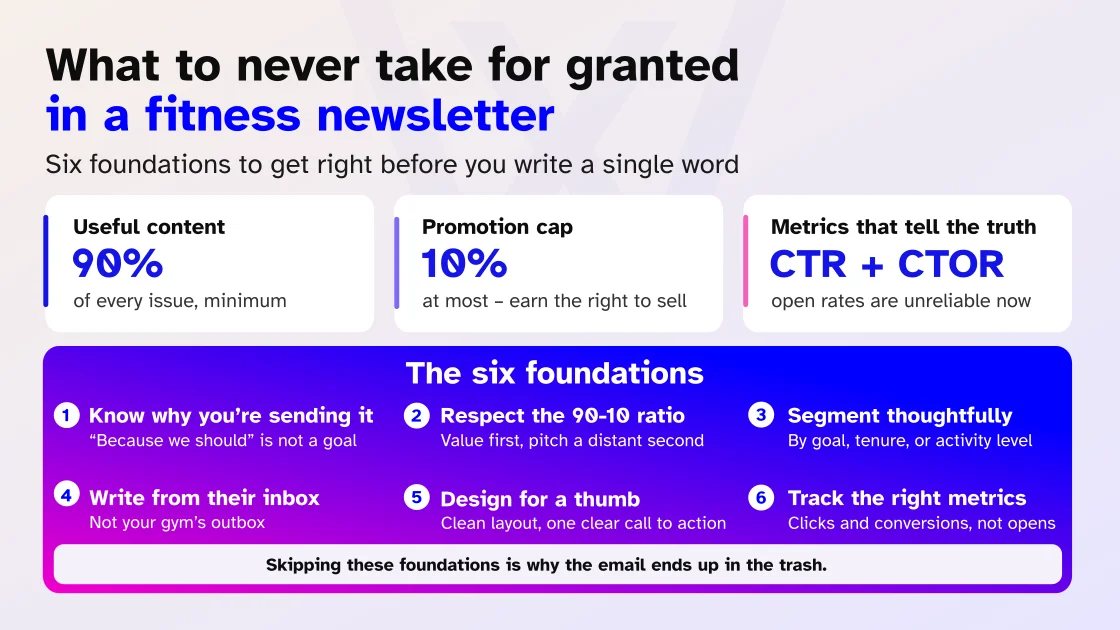
Before the content ideas, get the foundation right. These are the things I see gyms skip, and skipping them is why the email ends up in the trash. So here’s what to get right before you create your email newsletter:
- Know exactly why you’re sending it: “Because we should” is not a goal. Are you driving class bookings, reducing churn, or positioning your trainers as experts? The purpose decides the content. A newsletter written for no particular reason gets read by no one in particular.
- Respect the 90-10 ratio: Roughly 90% of every issue should be genuinely useful, and at most 10% promotional. Your members already gave you their money. They opened your email looking for value, not a second pitch. Earn the right to sell by being worth reading first.
- Segment your audience thoughtfully: A beginner who joined last week and a five-year regular training for a competition need completely different emails. You don’t have to build twenty lists, but a few segments by goal, tenure, or activity level turn a generic blast into something that feels personal.
- Write from your members’ inbox, not your gym’s outbox: This is the mindset shift that fixes everything. Before you send, read it as the person receiving it. Would you open this? Would you click? If you would not, rewrite it or at least restructure your message. Every word should sound like it came from a human who knows them, not a marketing department.
- Design for a thumb, not a desktop: Most of your members open email on a phone between sets or on the sofa. Keep the email visually clean, with one or two brand colors, clear section headers, images with alt text, and one obvious call to action.
- Track the right campaign metrics: Since open rates are now unreliable, watch click-through rate, click-to-open rate, and conversions instead. Those require a deliberate human action, so they tell you the truth. Good gym management/marketing software lets you see all of this in one place without bolting on a third-party tool.
What should I actually put in a gym newsletter?
Here is where most competitor lists fall apart. They dump fifty interchangeable newsletter content ideas into a list and call it a day. After more than 20 years in gym owners’ shoes, I’ve seen the highs, lows, and odd little patterns of this industry. I’d rather give you a dozen that actually entertain, educate, and offer enough value to get opened, read, and remembered. I’ve also included a few I’ve never seen anyone else write down.
- Gym news worth knowing
New equipment, a new face on the team, an upcoming event, a special offer, or the class of the week. When you spotlight a class, explain what it actually involves and nudge people to try something outside their usual routine. An influencer or community meetup belongs here, too. Keep members in the loop, and they feel connected to the place.
- Caught on camera
Share a funny, candid moment from the week. A recurring bit calling out wholesome gym moments by name (with permission): who reracked everything without being asked, who hit a PR and quietly walked away as though nothing happened, who’s been here at 5 a.m. every day this month. It’s gossip, but kind. People read to see if they’re in it. Send light, human moments your members will want to share. It reminds people your gym is a community, not a facility.
- One thing to try this week
Give exactly one tiny actionable cue. One mobility drill, one form fix, one recovery tip, one swap. Not ten, which only overwhelms the member. Competitors flood members with “10 expert tips,” and the gap is restraint, because one thing actually gets done. Ten things get ignored or saved for later that never come.
- What we changed because you told us to
A standing section that visibly closes the feedback loop. “You said the AC was brutal at 6 pm. Here’s what we did.” Almost nobody ever does this, and it’s one of the fastest trust-builders a gym has. It proves you’re listening, in public.
- A member’s-eye review of a new class
Instead of you promoting the new class, a real member who tried it writes three honest sentences, including the part they didn’t love. Honesty is exactly what makes the promotion work. It’s a success story and a credibility play at once.
- The 90-second comeback
Content aimed at people who’ve drifted. Not a guilt-trippy “we miss you,” but one genuinely easy re-entry plan for someone who hasn’t shown up in three weeks and feels weird about walking back in. This audience is invisible in every competitor list, and they’re the ones closest to canceling.
- Recipe of the week
Something simple and healthy, like what to throw in a hotpot or how to make a fast salad, with a rough calorie count. Nutrition is half the result your members are chasing, and they’ll thank you for making it easy.
- The thing nobody tells beginners
One piece of inside gym-culture knowledge per issue. You’re allowed to ask someone if you can work in on a machine. Nobody is watching you. The smell is normal. It is genuinely useful and almost never written down anywhere, which is exactly why it lands.
- Field notes
Your honest take on one fitness trend in the news, including when you think it’s nonsense. A real point of view is rare. Everyone else aggregates and hedges. Members trust a coach who’ll tell them what’s overhyped.
- Anonymous gym stats
Share fun aggregate data only you have. The whole gym lifted more than a blue whale weighs last month. The busiest ten minutes of the week. Collective treadmill miles. People love seeing themselves as part of a number.
- Real member content
Self-recorded clips and progress posts from your members, used (with permission) to motivate the newer ones. Nothing sells the next rep like watching someone like you do it.
- Answer their actual questions
Pull the top ten things members ask at the front desk and answer them in the newsletter, then invite them to send the next one. You turn a support burden into content and make people feel heard.
How often should I send a gym newsletter?
The standard advice is “weekly or monthly, just be consistent.” That’s incomplete and slightly dangerous.
Frequency is not a calendar decision; it’s a content-supply decision. One of the most common reasons people unsubscribe is email volume. Sending weekly only works if you genuinely have something worth reading every single week. Most gyms don’t, and pushing a thin email every seven days trains members to ignore you, then to leave.
My advice: Start monthly with one strong issue you’re proud of solving. If your open and click rates hold, and you’ve got richer content than you can fit, move to every two weeks. Pick a consistent day and time so members know when to expect you. Predictability is what turns a newsletter into a habit.
Why do my gym emails go to spam?
This is the part of the conversation that didn’t exist a few years ago, and it’s now the most important one. No other fitness newsletter guide I’ve read even mentions it.
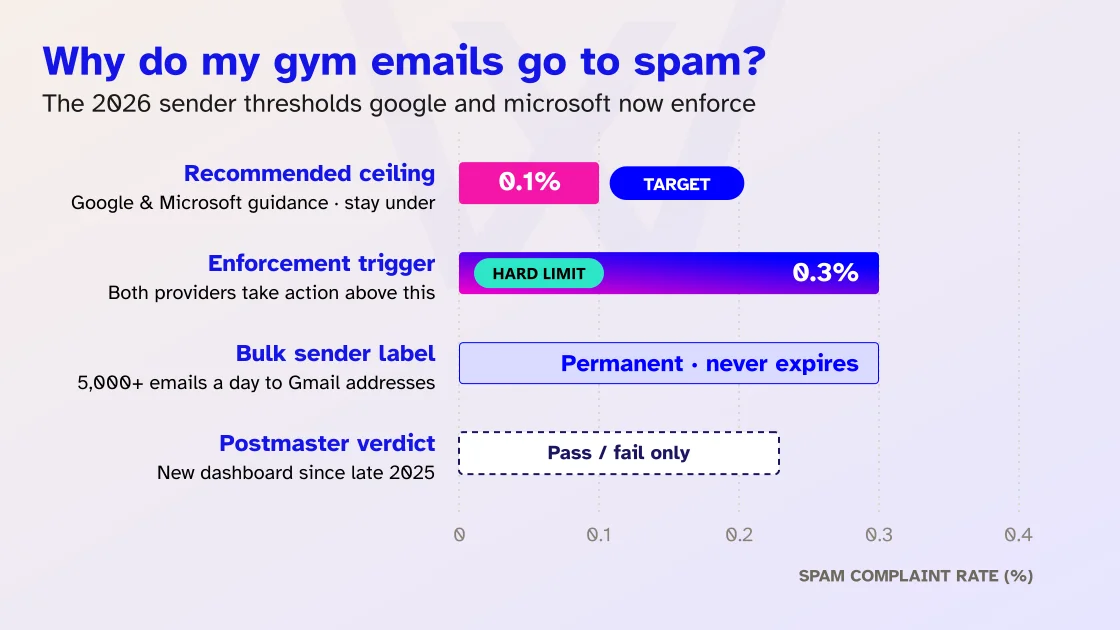
In 2026, deliverability is a compliance requirement, not a best practice. Google and Microsoft have tightened sender requirements, so high bounce rates, spam complaints, and poor authentication can seriously hurt deliverability. A spam-complaint rate over 0.3% triggers enforcement from both, and they recommend staying under 0.1%. Any domain sending 5,000 or more messages a day to Gmail addresses is permanently classified as a bulk sender, and that label doesn’t disappear if your volume drops later. Google also retired its old Postmaster Tools dashboard in late 2025 for a version that simply tells you pass or fail.
What this means for you in plain terms: Only email people who opted in, include a one-click unsubscribe link in every issue, keep your list clean, and never buy or scrape addresses. If you run multiple locations, you can cross that 5,000-a-day line faster than you’d expect, so the infrastructure behind your send genuinely matters. This is one area where the email tools inside your gym management platform quietly earn their keep by handling authentication and unsubscribes for you.
How do I segment members without it feeling like a blast?
Segmentation sounds technical, but it’s just sending the right email to the right person. Group your members in a way that maps to how they think about themselves: new joiners, long-timers, class regulars, the goal-driven, and the quietly drifting. Then tailor the lead content. The 90-second comeback goes to people who’ve gone quiet. The honest class review goes to members who haven’t tried it yet. The beginner insider tip goes to your newest faces. The same effort, aimed properly, feels like you wrote it just for them.
Can I use AI to write my fitness newsletter?
You can, and you should, for the grunt work, but be careful. AI is brilliant for a first draft, ten subject-line options, or untangling a clumsy paragraph. It’s terrible at sounding like you. The moment a newsletter reads like a press release, your members feel it and tune out.
So use it as a sparring partner, not a ghostwriter. Feed it your real stories, your actual opinions, the genuine question a member asked you yesterday, and let it help you shape them. Then read the whole thing aloud. If a sentence is something you’d never say to a member over coffee, cut it. Your voice, your in-jokes, your honest takes, that’s the part no tool can fake, and it’s the entire reason someone opens your email instead of one from the gym down the road.
Does a newsletter actually improve retention?
It does, and this is where the effort pays for itself. A member who hears from you between visits stays connected to the place even on the weeks they don’t show up. That connection is what keeps a wobbling membership alive.
But a newsletter can’t save a member whose card silently declined three weeks ago, and nobody followed up. That person is already gone, and no amount of lovely content reaches them. This is where the newsletter and your back-office work together: the email keeps engaged members engaged, while your gym software catches the failed payments and quiet drop-offs before they become cancellations. Automated, well-timed emails consistently punch above their weight on revenue precisely because they reach the right person at the right moment, something a once-a-month blast never could.
Wrap up
A fitness newsletter your members love is not sending more gym newsletters every week. It is all about sending what’s worth opening. Get your purpose clear, hold the 90-10 line, segment with care, write from their inbox instead of your outbox, and design for a thumb. Then fill it with the kind of content competitors are too busy padding their lists to write, the one honest tip, the visible feedback, the easy way back in.
Track the metrics that survived 2026, stay on the right side of the deliverability rules, and let the tools handle the parts that don’t need your voice so you can focus on the parts that do. Do that, and your newsletter stops being something members trash and starts being something they wait for.
If you’d like to see how Wellyx handles the email, segmentation, and payment-recovery side of all this in one place, book a demo, and we’ll walk you through it.
Frequently Asked Questions
What is a fitness newsletter?
It’s a regular email sent to your gym members and prospects with useful content, club news, and the occasional offer. Done well, it keeps members engaged between visits and builds loyalty. Done badly, it’s just another unread promo.
What’s a good open rate for a gym newsletter?
Benchmarks show health and fitness around 47.81%, but Apple’s privacy features inflate that heavily, so real engagement is closer to 25–30%. Track click-through and conversion rates instead, since those reflect genuine human action.
How often should I send it?
Start monthly with one strong issue, then move to fortnightly only if you have enough quality content to sustain it. Sending too often is one of the most common reasons people unsubscribe, so consistency beats frequency.
Why do my gym emails land in spam?
Usually, a mix of poor list hygiene, missing authentication, no one-click unsubscribe, or a high complaint rate. In 2026, Gmail and Microsoft will enforce hard thresholds, so only email people who opted in, and keep your list clean.
Can AI write my gym newsletter for me?
It can draft and brainstorm, but don’t let it write the final voice. Use it for subject lines and first drafts, then rewrite in your own words so it sounds like a human your members know, not a robot.