




A fitness franchise can look successful long before its financials do.
The parking lot is busy. Classes are full. Membership is climbing. New members keep signing up, and the brand already has recognition in the market. From the outside, everything seems to be working.
Then the bills arrive.
Rent, payroll, royalties, marketing, software, equipment maintenance, debt payments, and member churn all sit between sales and the cash an owner can actually keep. That is where the difference between a busy gym and a good investment starts to show.
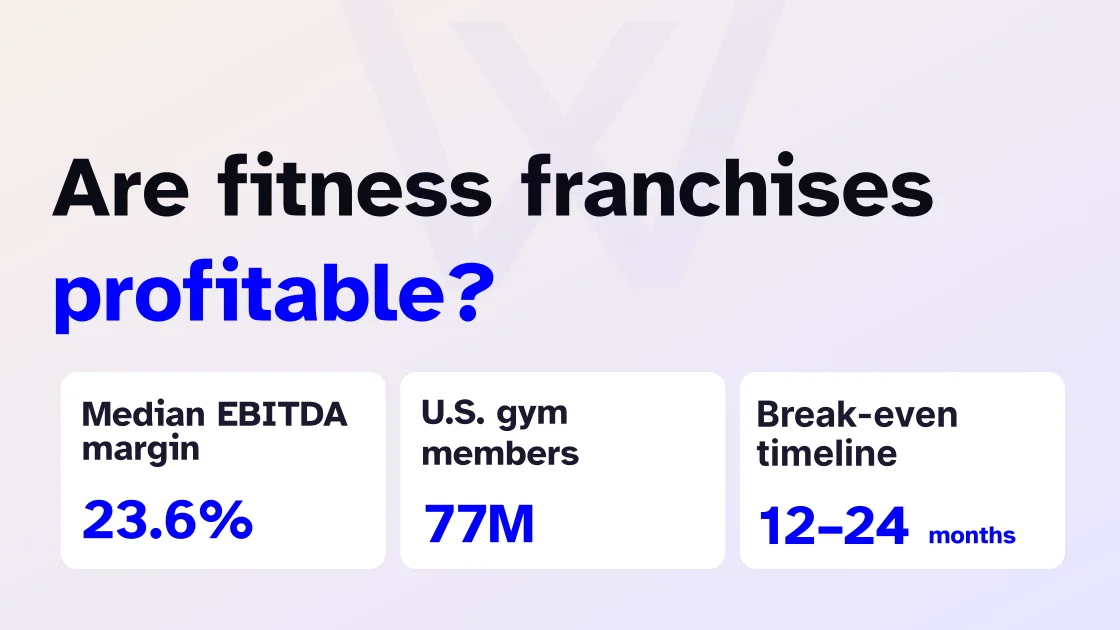
The broader fitness industry provides encouraging financial context. The Health & Fitness Association’s 2025 benchmarking report found a 23.6% median EBITDA margin, with two-thirds of surveyed clubs reporting positive EBITDA. However, these are broader industry benchmarks, not guaranteed margins for fitness franchises.
Franchise profitability still depends heavily on member retention, local demand, rent, staffing, pricing, royalties, financing, and the amount invested upfront.
A franchise generating $1 million in revenue can therefore be a weaker investment than a smaller studio producing less revenue but carrying lower fixed costs and debt.
The better question is:
How much sustainable cash flow can this business produce relative to the capital and risk required to own it?
How profitable are fitness franchises in 2026?
Fitness franchises can produce healthy operating profits, but there is no reliable universal profit margin that applies across every franchise model.
A 24/7 access gym, boutique studio, and large-format fitness club can have very different investment requirements, staffing models, membership prices, occupancy costs, and revenue structures. That makes a single “average franchise margin” misleading.
| Franchise model | Capital intensity | Main profit lever | Main financial pressure |
| 24/7 access gym | Medium | Member scale and lean staffing | Churn and occupancy |
| Boutique studio | Low–medium | Revenue per member and retention | Labor and utilization |
| Large-format/HVLP gym | High | Scale and cost control | Fixed costs and capital |
Burn Boot Camp’s 2026 FDD Item 19 provides a useful franchise-specific example. Across 307 franchised outlets with complete 2025 results, average gross revenue was $732,444, average net operating income was $121,679, and average net operating margin was 17%. The reporting group excluded corporate-owned locations, outlets open for less than one year, and locations without complete financial data.
Those exclusions matter because franchise averages depend heavily on which locations are included.
Burn also states that its net operating income calculation does not deduct owner compensation, income taxes, or debt service. So the reported $121,679 should not be treated as the amount an owner takes home.
The financial path is better understood as:
Revenue → operating expenses → reported operating earnings → debt and reinvestment → potential owner cash flow
That is why high franchise revenue alone does not prove that an investment is attractive. Investors need to understand how much revenue survives the operating costs, franchise obligations, financing, and reinvestment required to keep the location running.
For broader owner-income context, see how much gym owners earn per year in the USA. General gym-owner earnings, however, should not be treated as franchise-specific owner income.
Can you afford a fitness franchise?
Profitability comes after capital capacity.
A prospective owner can have a healthy net worth while still lacking enough liquid cash for deposits, payroll, construction delays, and a slower membership ramp.
| Brand | Minimum net worth | Liquid capital | Estimated initial investment |
| Anytime Fitness | $380,000 | $225,000 | $397,537–$973,142 |
| JETSET Pilates | $500,000 | $200,000+ | $525,540–$749,575 |
| Crunch Fitness | $2.5 million combined | $500,000 | $668,000–$3.488 million, excluding real estate |
The lesson is simple:
Fund the ramp, not just the opening.
The FTC warns that opening may take several months, break-even may take more than a year, and some franchises never reach it. It recommends estimating first-year operating costs and personal living expenses for up to two years.
That reserve matters because a franchise can open on schedule and still run short of cash before its membership base becomes large enough to carry the monthly cost structure.
How much does it cost to open a fitness franchise?

The franchise fee is one line in a much larger startup budget.
Initial investment can include the franchise fee, lease deposit, build-out, equipment, signage, software, insurance, professional fees, launch payroll and marketing, and working capital.
That is why FDD item 7-Estimated Initial Investment matters more than the headline franchise fee.
The FTC says Items 5-7 cover many opening and ongoing costs, including fees, equipment, leases, royalties, and advertising. Investors still need to investigate costs outside those disclosures.
For example, Anytime Fitness lists a $42,500 franchise fee inside a total estimated initial investment of $397,537–$973,142.
For a broader startup-cost framework, see how much it costs to open a gym.
Facility scale matters too.
Crunch says its clubs range from 20,000 to 40,000 square feet, with 25,000–30,000 square feet its preferred range and at least 125 parking spaces.
A footprint like that carries very different rent, construction, utility, and equipment economics from a boutique studio.
So ask not only which franchise generates more revenue, but:
How much physical infrastructure does it need to generate that revenue?
A larger revenue number becomes much less impressive when producing it requires several times the capital.
What ongoing costs reduce fitness franchise profit?
Opening costs decide how much money you need to get in. Recurring costs decide how much revenue survives.
Ongoing expenses include rent and CAM charges, payroll, royalties, brand-fund contributions, local marketing, payment processing, software, utilities, insurance, repairs, equipment replacement, and loan payments.
Franchise structures make these costs look very different.
Crunch currently lists a 5% royalty on monthly gross sales plus a 2% Brand Marketing Fund contribution. It also requires at least $15,000 per month in local advertising during the first year. After that, the requirement becomes the higher of $10,000 per month or 7% of gross sales.
That marketing requirement is particularly useful for investors to notice. Looking only at the 5% royalty would miss a meaningful part of the recurring cost structure.
Anytime Fitness takes a different approach. Its live page lists a $799 monthly royalty per center for owners with one to nine gyms, citing its 2024 FDD.
Burn Boot Camp’s 2026 disclosure lists a 6% royalty on gross revenue and a 2% System Brand Fund contribution.
Those examples show why there is no useful universal “average royalty.”
Rent deserves the same scrutiny. A great-looking site can become a burden if the membership base cannot outrun its occupancy cost.
This guide on how to negotiate a gym lease goes deeper into that decision.
The question is how much revenue remains after paying the costs required to generate it.
How do fitness franchise ROI, break-even, and payback work?

These measures are related, but they answer different questions.
Profit margin
Profit margin expresses a defined measure of profit as a percentage of revenue. Gross, operating, EBITDA, and net margins are not interchangeable.
That is why a 17% “net operating margin” from one franchisor should not automatically be compared with a 23.6% industry EBITDA margin.
ROI
Return on investment compares the annual return with the capital invested.
ROI = Annual return ÷ Total invested capital × 100
Suppose an investor puts $750,000 into a location and eventually receives $150,000 in annual cash return.
$150,000 ÷ $750,000 × 100 = 20%
That is a 20% illustrative ROI.
Illustrative example only, not a franchise earnings claim.
Operating break-even
Break-even asks when current revenue covers current operating costs.
A simplified member-based formula is:
Break-even members = Fixed monthly costs ÷ Contribution margin per member
Suppose:
- Fixed monthly costs = $50,000
- Average monthly membership revenue = $100
- Variable cost per member = $10
- Contribution margin = $90
The simplified break-even point becomes:
$50,000 ÷ $90 = approximately 556 members
Then ask whether the local market can realistically support 556 paying members at that price.
For a fuller model, see the gym break-even analysis.
Payback period
Payback estimates how long it may take to recover the original capital.
Payback period = Initial investment ÷ Annual cash return
Using the same illustration:
$750,000 ÷ $150,000 = 5 years
Again, that assumes a stable annual return and is not a prediction.
Operating break-even is not investment payback.
A location may cover monthly costs years before the owner recovers the original capital.
That difference matters when a franchise presentation talks about reaching “break-even” quickly. Always establish which break-even it means.
What actually makes a fitness franchise profitable?
Profitability improves when recurring revenue grows faster than occupancy, labor, acquisition, and financing costs.
Site economics
Rent, demographics, competition, access, and visibility shape the membership level needed to cover fixed costs. A strong brand cannot rescue a lease built on unrealistic demand.
Retention
HFA’s 2025 benchmarking report found 66.4% average member retention for 2024 across its wider fitness-industry sample. That is not a franchise target, but it is financially relevant.
When members leave faster, the business has to spend more to replace recurring revenue it already won once.
Member scale and revenue per member
Member count matters only alongside revenue and cost per member.
Burn’s 2026 FDD provides an interesting example: 50 locations with more than 500 members averaged $1,126,414 in annual gross revenue, compared with $732,444 across the wider group of 307 reporting outlets.
That is historical Burn data, not a target. It shows why member count must be read alongside revenue per member and cost to serve.
More members help when the added revenue grows faster than the costs required to serve them.
Labor and pricing
Payroll needs to follow demand. Boutique concepts depend more on coaching hours and class utilization; access-focused gyms may run leaner.
Heavy discounting can also make a gym look busy while increasing the membership count required to break even.
Personal training, premium classes, recovery services, retail, and other add-ons can raise revenue per member, but they should be modeled from actual demand rather than assumed.
Business maturity
New and mature units may not produce the same economics.
Burn’s 2026 disclosure reports a 9% average net operating margin for one-year outlets and 18% for mature outlets.
That is not a forecast for every franchise, but it shows why mature-unit averages should not be used as year-one assumptions.
A franchise may eventually become financially attractive while producing much thinner returns during its early ramp.
Financing
Similar operating earnings can produce very different owner cash flow when debt loads differ, so model the business both before and after financing.
Why do some fitness franchises lose money?
A weak investment does not always begin with one dramatic mistake. Sometimes it is a collection of smaller decisions.
Too much space. A lease that looked manageable before the membership ramp slowed. Staff hired for demand that has not arrived. Discounts added to keep sales moving.
A loan payment built around the best-case forecast.
Individually, each choice can look reasonable. Together, they can squeeze the cash out of a business that still looks busy from the outside.
Common failure points include undercapitalization, oversized premises, excessive debt, slow membership growth, high churn, weak collections, heavy discounting, and optimistic revenue assumptions.
A recognizable brand can provide systems and awareness. It cannot repair weak site economics.
Once the financial model passes scrutiny, execution becomes the next question. The Wellyx guide on how to run a gym franchise covers that operational side separately.
For this investment decision, the test remains financial:
Can the gym be operated at a cost structure that leaves enough cash flow to justify the capital at risk?
Which financial metrics should you check before investing?
Revenue gets attention because it is easy to understand. These measures tell you more about the health of the investment.
| Metric | What it tells you |
| Operating or EBITDA margin | Operating earnings power under the stated definition |
| Monthly recurring revenue | How predictable the membership base is |
| Revenue per member | Membership yield |
| Retention | Durability of recurring revenue |
| Payroll as % of revenue | Labor efficiency |
| Acquisition cost | Cost of adding members |
| Break-even point | Minimum operating requirement |
| Owner cash flow | Cash available after relevant obligations |
| Payback period | Time needed to recover invested capital |
| Debt-service burden | Financing pressure |
Do not force universal “good” benchmarks onto every model. A boutique Pilates studio and a large high-volume gym need different assumptions.
Revenue growth is more valuable when retention holds, payroll stays controlled, debt remains manageable, and operating earnings convert into usable cash.
How do you verify whether a fitness franchise is actually profitable?
The Franchise Disclosure Document helps test the sales story.
Under the FTC Franchise Rule, a prospective franchisee must receive the FDD at least 14 days before being asked to sign a contract or pay money to the franchisor or an affiliate. It contains 23 disclosure items.
For investment analysis, pay particular attention to:
- Item 5: Initial fees
- Item 6: Other fees
- Item 7: Estimated initial investment
- Item 12: Territory
- Item 17: Renewal, termination, and transfer
- Item 19: Financial performance representations
- Item 20: Outlets and franchisee information
Item 19 deserves more than a glance at the largest number.
The FTC says franchisors are not required to provide sales or earnings information. When they make financial performance claims, those claims generally must appear in Item 19 and have a reasonable factual basis.
Ask:
- How many units were included?
- What percentage of the system do they represent?
- Were company-owned locations included?
- How mature were the units?
- Were closed or incomplete locations excluded?
- Is the figure an average or median?
- Is it revenue, NOI, EBITDA, or another measure?
- What do lower-performing locations look like?
An average can be lifted by a handful of strong units. Gross sales can also look impressive while high rent and overhead leave little profit. The FTC specifically warns prospective franchisees to look beyond those headline figures.
Item 20 also shows system growth and owner turnover and provides contacts for current and former franchisees. Those conversations can test whether the sales pitch matches reality.
Then build three forecasts:
| Scenario | What to test |
| Strong ramp | Faster membership growth with planned costs |
| Expected ramp | Realistic growth with ordinary delays |
| Slow ramp | Delayed growth, higher costs, and greater cash pressure |
The slow case may be the most revealing.
If the deal only works when growth is fast and costs land perfectly, there is little room for error.
How fitness studio software fits into the economics
Software cannot fix weak unit economics, but it can make the numbers easier to see.
Billing affects collections, CRM affects follow-up, scheduling affects capacity, and staff management affects labor visibility.
Wellyx fitness studio software brings memberships, billing, CRM, scheduling, POS, staff management, communication, automation, and reporting together in one connected platform.
It does not guarantee profit or ROI. Its role is to make the activities behind revenue, cost, and cash flow easier to see.
That becomes particularly useful when the business grows beyond one location and financial leakage becomes harder to spot manually.
Are fitness franchises a good investment in 2026?
Fitness franchises can be good investments when the economics still work after the excitement of the brand fades.
A strong opportunity needs adequate capital, sustainable rent, manageable debt, realistic membership assumptions, controlled payroll, and a credible payback path.
The most useful question is not:
“Which franchise makes the most revenue?”
It is:
“How much sustainable cash flow can this specific location produce relative to the capital, debt, time, and risk I am taking on?”
A profitable franchise is not automatically a good investment.
The better investment is the one whose numbers still make sense when the forecast becomes a little less perfect.
Are fitness franchises profitable?
Fitness franchises can be profitable, but results vary by concept, location, startup capital, rent, staffing, royalties, financing, retention, and local demand. Broader industry benchmarks provide context, but the current FDD and a location-specific financial model are more useful for evaluating a particular franchise.
What is the average profit margin for a gym franchise?
There is no reliable universal franchise-specific average. HFA reported a 23.6% median EBITDA margin across its broader fitness-industry sample for 2024, but that should not be treated as the expected margin for an individual gym franchise.
How much does a fitness franchise owner make?
There is no dependable universal owner-income figure. Franchise revenue must first cover operating expenses, debt service, reinvestment, taxes, and other obligations. Two owners can run locations with similar revenue and still receive very different cash flow.
How long does it take a gym franchise to break even?
There is no guaranteed timeline. The FTC says a franchise may take more than a year to break even and some never do. Operating break-even also differs from investment payback: covering current expenses does not mean the original investment has been recovered.
How much does it cost to open a fitness franchise?
Costs vary widely by model. Current public examples in this guide range from several hundred thousand dollars to several million dollars. The relevant brand’s current FDD, particularly Item 7, should be the primary source for the estimated initial investment.