



Search “Google Business Profile tips for martial arts schools,” and you’ll find the same four bullets everywhere: keep your name, address, and phone number consistent, upload good photos, post updates, respond to reviews. None of that is wrong. None of it tells you which one actually moves the needle, or by how much. A dojo owner with an hour to spend on their profile this week has no way to know whether that hour is best spent picking a category, writing a post, or chasing down five more reviews.
This guide answers that specifically, using a real, current, primary data source instead of repeating the same generic checklist.
Why “just fill out your profile” isn’t a strategy
Whitespark’s 2026 Local Search Ranking Factors report, published November 6, 2025, asked 47 local SEO experts to score 187 individual ranking factors on a 0-5 scale across local pack impact, organic impact, conversion impact, and AI search visibility. It’s been running since 2008 and is the closest thing local SEO has to a primary source: not a single agency’s opinion, but a pooled, scored consensus from the people who test this for a living. The combined scores rank every factor from most to least impactful.
That ranking is what this piece follows. Instead of a flat checklist, every recommendation below is tied to where it actually landed, out of 187, so you can spend your first hour on the highest-leverage item instead of whichever one happens to be listed first in someone else’s blog post.
Number one: get your category right
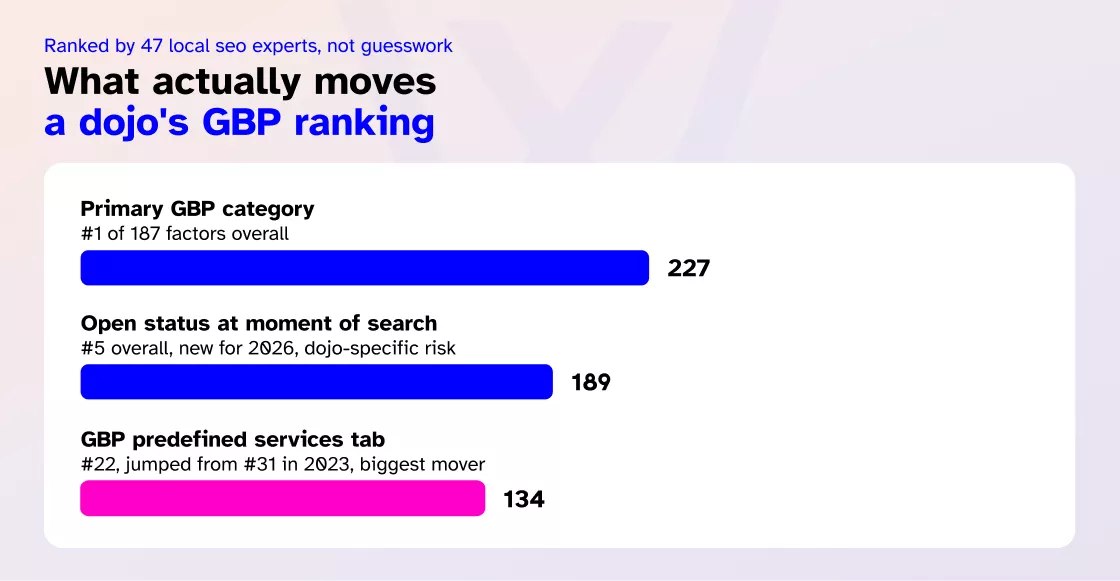
Primary GBP category is the single highest-scoring local pack ranking factor in the entire study, 227 points, ahead of every other factor including proximity to the searcher. For a martial arts school, Google’s own category list includes “Martial arts school” and “Martial arts club” as distinct options, along with discipline-specific alternates such as karate school, taekwondo school, and self-defense school, depending on what you primarily teach. Picking the closest match, not just the first one that sounds right, is the single highest-leverage five minutes you can spend on your profile.
Additional categories matter too. They ranked 8th overall at 173 points. Most schools claim “Martial arts school” and stop there. If you also run fitness classes, youth programs, or self-defense seminars, adding accurate secondary categories for each is a confirmed ranking factor that most competing dojos in your area are skipping entirely.
This week: audit your current category selection. Confirm the primary category is the closest match to what you actually teach, then add two or three accurate secondary categories based on real programs you run, not aspirational ones.
Number two: your open status at the moment someone searches
This is the most counter-intuitive finding in the entire study, and it’s specifically relevant to how dojos schedule. “Business is Open at Time of Search” ranked 5th overall at 189 points, a factor added to the survey after local SEO researcher Joy Hawkins identified it in December 2023. Google now weighs whether your listed hours show you as open at the exact moment someone searches, and businesses that appear closed lose visibility during that window, even if they’re perfectly legitimate and simply between appointments.
For a gym with continuous open-floor hours, this barely matters. For a dojo running class blocks, a 4 p.m. kids’ class, a 6 p.m. adult class, and nothing in between, it’s a real, specific risk. A parent searching at 5 p.m. during that gap could see your school listed as closed and move to the next result, even though you’d happily book them for the 6 p.m. class.
This week: set your GBP hours to reflect when someone can actually reach or book you, not just when the building happens to be occupied. If front-desk coverage genuinely stops between classes, consider whether a phone forwarding service or an always-available online booking link during those gaps is worth it, since the alternative is disappearing from search at exactly the moment a prospective student is looking.
Number three: list your actual services, not just your description
This is the single biggest mover in the 2026 study compared to the last edition. “Presence of GBP Predefined Services” jumped from around 81st place in 2023 to 22nd overall at 134 points in 2026, after Joy Hawkins’ independent research confirmed that the specific services listed in a Google Business Profile’s dedicated Services tab, not just mentioned in your description, directly affect rankings.
Most martial arts schools write one paragraph describing what they teach and never touch the Services tab. Google’s own service taxonomy for this business category includes specific, selectable line items: Adult Martial Arts Classes, Children’s Martial Arts Classes, Self-Defense Classes, Martial Arts Belt Testing, Martial Arts Birthday Parties, Martial Arts Summer Camps, Private Martial Arts Lessons, and discipline-specific classes like Brazilian Jiu-Jitsu or Kickboxing where applicable. Each one is a distinct, addable entry, not a sentence buried in a paragraph.
This week: open the Services section of your profile and add every program you actually run as its own entry, with a short, specific description for each. If belt testing or birthday parties generate real revenue, they deserve their own line item, not a mention in your bio.
Number four: reviews, but the specific kind that counts
Reviews show up across several of the highest-ranked factors, and the details matter more than the headline advice to “get more reviews.” Quantity of native Google reviews with text scored 170 points (9th overall), meaningfully ahead of star rating alone. Recency of reviews scored 164 points (11th), and a sustained trickle of reviews over time outscored a single burst at 154 points (14th). A school that got 40 reviews in its opening month and none since is scored differently than one adding two or three a month, consistently.
Dojos have a real advantage here that most local businesses don’t: built-in milestone moments. A belt promotion, a first competition, a birthday party, or a completed summer camp can all be natural points where a parent or student is already feeling good about the school, which is exactly when a review request lands best. That beats a generic “please review us” email sent to your whole list at once.
This week: identify the next three belt testing or milestone events on your calendar and build a simple, immediate review request into that moment, not a separate campaign.
Number five: photos and completeness, plus a tactic the data says doesn’t work
Two supporting areas are worth addressing, at lower priority than everything above: overall profile completeness scored 147 points (16th), and photo quantity scored 84 points (96th), a real but modest factor. Photo and video quality, meaning genuine, well-lit, non-stock images relevant to your actual category, mattered more than sheer volume.
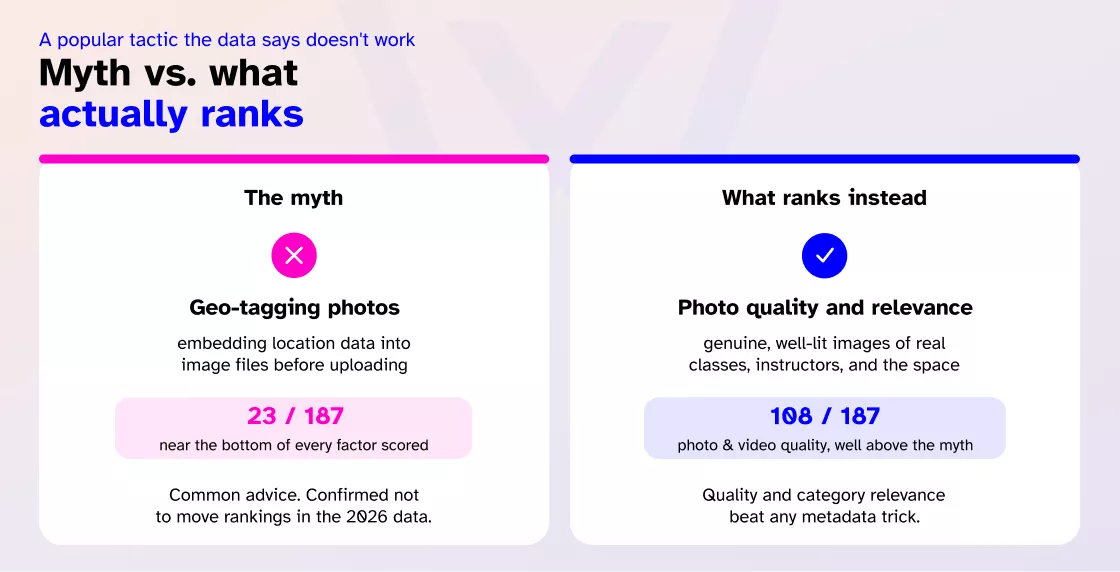
Here’s the one worth calling out directly: geo-tagging photos, embedding location data into image files before uploading, is a piece of advice that shows up constantly in local SEO content, including some martial-arts-specific guides. The data says it doesn’t work. Presence of geo-tagged photos scored 23 points out of a possible high score in the 220s, effectively at the bottom of the entire 187-factor list. If you’ve spent time on this, that time is better spent elsewhere on this list.
This week: skip geo-tagging entirely. Instead, add five to ten genuine photos of actual classes, instructors, and the space itself, prioritizing clarity and authenticity over any metadata trick.
Lower priority, but still real: Q&A, posts, and booking
Three more factors are worth addressing, roughly in this order, once everything above is in place.
Owner-seeded Q&A scored 60 points (142nd). Anyone can post a question on your profile, and if you don’t answer it, a stranger sometimes will, with inaccurate information. Pre-seeding your own Q&A with questions parents actually ask, such as minimum age, trial class cost, and what to wear to a first class, closes that gap before it opens.
Google Posts frequency scored 55 points (148th), real, but far less than the volume of advice around it would suggest. Posting once a week for the sake of posting isn’t worth much; posting when you actually have something worth seeing, a new session starting, an open house, a tournament result, is a reasonable use of ten minutes a month, not a priority to obsess over.
GBP’s built-in booking feature scored 51 points (158th). Modest on its own, but it removes a step between someone finding your profile and actually booking a trial class, which matters more for conversion than for ranking. If you’re using Wellyx’s online trial booking, linking it directly from your GBP profile turns that lower-ranking feature into a more direct path to a trial booking.
A one-week priority order
If you’re doing this in order of actual measured impact, not alphabetically or randomly:
- Confirm your primary category and add accurate secondary categories
- Set your hours to reflect real, bookable availability, not just building access
- Build out the full Services tab with every program you run
- Build review requests into your next three belt testing or milestone events
- Add genuine, high-quality photos, skip geo-tagging
- Seed your own Q&A with the questions you already get asked
- Post when you have something real to share, not on a forced schedule
- Enable and link your booking option
How this connects to actually filling the mats
A higher-ranked profile only matters if it leads to a booked trial class and, ultimately, an enrolled student. None of the work above changes what happens once someone lands on your profile and decides whether to reach out; that’s a separate problem, covered in Wellyx’s broader SEO strategy for martial arts schools, which walks through keywords, content, and backlinks alongside the basics of local SEO. This piece is specifically about the one asset, your Google Business Profile, that most schools already have and most are leaving on the table.
Frequently asked questions
What’s the best Google Business category for a martial arts school?
“Martial arts school” or “Martial arts club” are the closest general-purpose matches in Google’s own category list. If your school focuses primarily on one discipline, karate, taekwondo, or self-defense specifically, a discipline-specific category can be a stronger primary match, with “Martial arts school” added as a secondary category.
Does posting on Google Business Profile actually help rankings?
Yes, but modestly. It ranked 148th out of 187 factors in the 2026 Whitespark study, far behind category selection, hours accuracy, services, and reviews. Post when you have something genuinely worth sharing rather than on a forced weekly schedule.
Do geo-tagged photos help local SEO?
No, based on the current data. It scored near the very bottom of 187 ranking factors in the 2026 study, suggesting little to no meaningful ranking impact. Time spent geo-tagging photos is better spent adding services to your Services tab or requesting reviews around belt testing events.
How many Google reviews does a dojo need to rank well?
There’s no fixed number, but the data favors a steady pace of reviews with actual text over a single large burst. Recency matters too, with newer reviews carrying more weight than a large batch from a year ago. Tying requests to natural milestones, belt promotions, competitions, and birthday parties tends to produce a steadier pace than a one-time request campaign.
Should a dojo’s GBP hours match its class schedule exactly?
They should match when someone can actually reach you or book a class, which for many dojos means class blocks rather than continuous hours. Since Google now factors in whether you appear open at the exact moment of a search, a school with real gaps between classes should consider phone coverage or an always-available booking link during those windows rather than leaving hours generic.
The bottom line
A complete Google Business Profile is table stakes. A profile with the right category, accurate real-time hours, a fully built-out Services tab, and a steady flow of genuine reviews is a different thing entirely, and the gap between them is measurable, not a guess. Work through the priority order above in sequence, and skip the geo-tagging.
If you want to see how Wellyx’s martial arts school management software connects trial bookings, class schedules, and student records to the marketing side of running a dojo, book a demo.