





Search this question, and you’ll find the same range repeated across a dozen sites: martial arts school owners make somewhere between $30,000 and $100,000 a year. That figure isn’t fabricated, but it’s also not really answering the question, because it quietly blends three different numbers into one: what an employed instructor earns, what a school’s owner actually takes home, and what the school itself brings in before anyone gets paid. Those are three separate figures with three separate data sources, and conflating them is exactly why the range feels so wide and so unhelpful.
This piece keeps them apart, with real percentile data for each, and then walks through the actual math that explains why owner take-home varies as much as it does.
Three different numbers, not one blended average
Fitness trainers and instructors broadly (the U.S. government’s closest occupational category, which doesn’t break out martial arts specifically) had a median annual wage of $46,180 as of May 2024, according to the Bureau of Labor Statistics. This provides a broad employee-wage baseline, not an owner’s income, and it is not specific to martial arts.
Martial arts instructors specifically earn more than that broader category suggests. Glassdoor’s data, based on 143 self-reported salaries, puts the average at $73,494 a year ($35/hour), with a 25th-to-75th percentile range of $56,021 to $96,784, and the top 10% clearing $123,648.
Martial arts school owners specifically, as distinct from employed instructors, average higher still. ZipRecruiter’s 2026 data puts gym and martial arts school owner income at an average of $86,197 a year, with the 90th percentile reaching $242,000. That last figure offers a clearer answer to the question, ‘How high can it go?’ It is not a marketing estimate, but a reported percentile.
Stacking these three next to each other tells a clearer story than any single average:
- $46,180 (broad fitness-instructor floor)
- $73,494 (martial-arts-specific instructor average)
- $86,197 (school owner average, with real upside toward $242,000 at the top end)
Ownership pays more than employment, and martial arts pays more than the broader fitness-instructor category, but none of that upside is guaranteed. It’s a function of the same math every small business runs on: revenue minus costs.
Why the range is so wide: the revenue-to-take-home math
A school’s revenue and an owner’s take-home pay are not the same number, and the gap between them is where most of the variation in the reported range of $30,000 to $242,000 actually comes from.
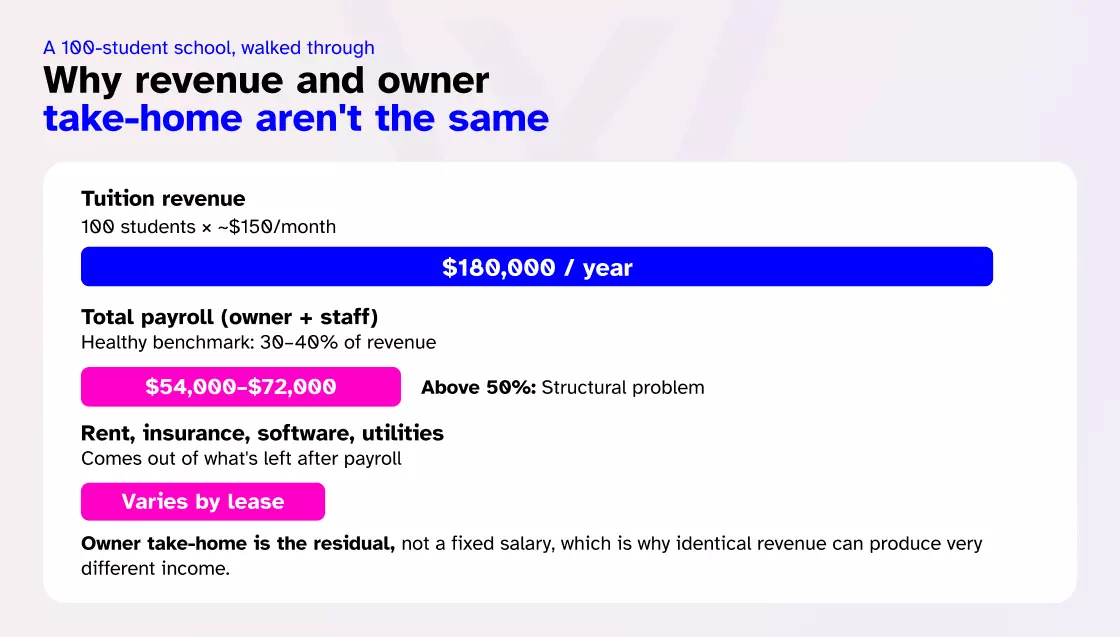
Start with revenue. The average U.S. martial arts studio pulls in roughly $150 a month per active student in tuition alone, before testing fees, gear sales, or camps. A school with 100 active students is therefore looking at roughly $15,000 a month, or $180,000 a year, in tuition revenue before a single expense is subtracted.
From there, the biggest single line item is payroll. According to an industry benchmark report compiled from surveys, consultants, and platform data across the U.S., Canada, and Puerto Rico, total payroll (owner and staff combined) should sit between 30% and 40% of revenue for a healthy school; above 50% signals a structural problem. On that $180,000 example, healthy payroll would run $54,000 to $72,000, and that pool has to cover every instructor on staff before the owner’s own draw is counted.
Staffing itself scales in steps, not smoothly. The same benchmark data suggests an owner plus one part-time instructor can cover most operations under roughly 75 students; between 75 and 150 students, one to two full-time instructors become necessary on top of the owner; growth beyond that requires a real staffing plan, not just adding hours. Cross a staffing threshold before your revenue supports it, and the owner’s own pay is what absorbs the difference.
Rent, insurance, software, and utilities come out of what’s left after payroll. In many small studios, owner take-home is closer to residual income, meaning whatever remains after the school’s bills are paid, than to a fixed salary. That’s the mechanical reason the same “$150,000 revenue” school can produce a $95,000 owner income in one location and a $35,000 owner income in another: two schools with identical top-line revenue can have completely different cost structures underneath it.
What the math looks like at three different stages
A newly opened school, under 75 students. Revenue in the ballpark of $60,000 to $135,000 a year (75 students x ~$150/month, before ancillary revenue). Staffing is typically just the owner plus a part-time assistant instructor, so payroll stays lean, but rent and startup debt are proportionally heavier. Owner take-home in this stage is often at or below the BLS instructor floor, which matches the “give it 18 to 36 months to break even” guidance repeated across the industry.
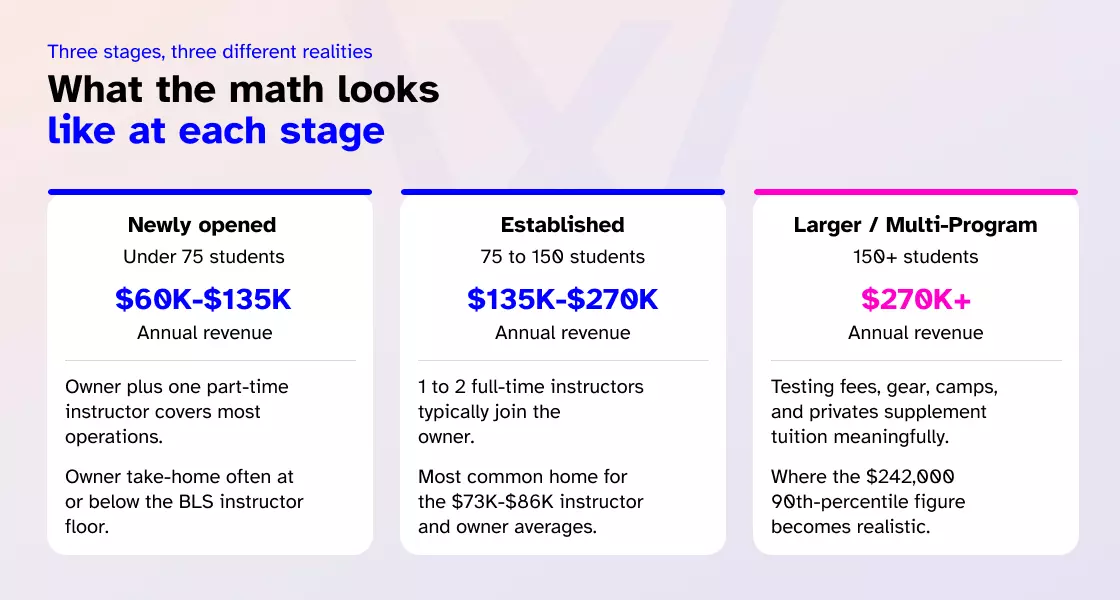
An established single-location school, 75 to 150 students. Revenue in the range of $135,000 to $270,000 a year. This is where one to two full-time instructors typically join the owner, and where payroll discipline (staying within the 30% to 40% range) starts to determine whether growth translates into owner income or just into higher fixed costs. This stage is the most common home for the $73,000-to-$86,000 instructor-and-owner averages cited above.
A larger or multi-program school with more than 150 students. Revenue above $270,000 a year, often supplemented meaningfully by testing fees, gear sales, camps, and private lessons rather than tuition alone. This is the stage where the ZipRecruiter 90th-percentile figure of $242,000 becomes realistic, but it requires the staffing and systems to support that volume without payroll creeping past the healthy band.
What actually moves the number
A few levers show up across almost every credible source on this, and they matter more than location or square footage alone:
- Retention, not just enrollment. Across health clubs generally, average annual member retention sits at 71.4%, according to IHRSA, meaning close to three in ten members leave every year. A school that keeps students longer needs fewer new sign-ups just to stay flat, which directly protects the revenue side of the math above.
- Household income fit. Pew Research survey data indicates households earning $50,000 to $100,000 a year are the most likely to enroll in martial arts programs. Pricing well above or below that bracket narrows the addressable market in ways that show up directly in enrollment.
- Ancillary revenue. Testing fees, gear, camps, and private lessons sit on top of tuition rather than replacing it, and they carry a different cost structure than adding another instructor does.
- Payroll discipline. Staying inside the 30-40% payroll-to-revenue band, and only crossing a staffing threshold once enrollment actually supports it, is the single clearest lever an owner controls directly.
Where software changes the math
Every lever above depends on knowing the numbers first, including retention rate, revenue per student, and payroll as a percentage of revenue. Those figures are difficult to manage without consistent tracking. A POS and billing software for martial arts schools specifically ties tuition, testing fees, and retail sales to the same student record automatically, and family and multi-student billing plus belt and rank progression tracking reduce the manual admin time that otherwise eats into the hours an owner could spend teaching or selling. None of that changes the underlying economics: rent is still rent, but it changes how much of the owner’s own time gets absorbed by administration instead of the parts of the business that actually grow revenue.
Frequently asked questions
How much do martial arts school owners make a year?
Three different figures answer three different questions: employed martial arts instructors average $73,494 (Glassdoor), school owners specifically average $86,197 with the 90th percentile reaching $242,000 (ZipRecruiter), and the broader fitness-instructor category (BLS, not martial-arts-specific) has a median of $46,180. Owner take-home depends heavily on school size and payroll discipline, not just location.
What’s a healthy profit margin for a martial arts school?
Industry benchmark data points to keeping total payroll, owner and staff combined, between 30% and 40% of revenue; above 50% is flagged as a structural problem in most reporting. Margin isn’t a single fixed target so much as a function of staying inside that payroll band while rent and overhead stay proportional to revenue.
How many students does a martial arts school need to be profitable?
Benchmark data suggests a school can operate with just the owner and one part-time instructor under roughly 75 students. Between 75 and 150 students, one to two full-time instructors typically become necessary, which is also the range where reported instructor and owner income averages cluster.
Do martial arts school owners make more than employed instructors?
On average, yes. ZipRecruiter’s data puts school owner income at $86,197 versus $73,494 for employed martial arts instructors (Glassdoor), but ownership also carries the business’s costs and risks that an employed instructor’s paycheck doesn’t.
How long does it take a martial arts school to become profitable?
Most sources converge on roughly 18 to 36 months to reach break-even, depending on starting enrollment, rent, and how quickly staffing scales relative to student growth.
The real answer
The honest answer to “how much do martial arts school owners make” isn’t a single number; it’s $46,180 to $242,000 depending on whether you’re asking about an employee, an owner, or the top of the distribution, and the actual figure for any specific school comes down to enrollment, retention, and staying inside a healthy payroll band rather than location alone. The range is wide because the question is really three questions.