



A Pilates studio is ready for a second location when the first is profitable after paying the owner a market-rate salary, waitlists persist across multiple months, a specific new catchment shows clear purchase intent, and daily operations no longer depend on owner presence. Ten readiness tests across financial, operational, and market fit separate real expansion signals from a full class or a promotional bump.
A packed evening reformer class may start the conversation, but it does not automatically justify signing a second lease. The waitlist proves interest. The signature commits capital, staff, and a decade of complexity to a plan that has not yet been tested against the hard questions.
The U.S. Pilates industry remains substantial in 2026, with estimated revenue of $19.2 billion in 2025. However, the market remains highly fragmented, with most operators running a single location. Studios that expand successfully tend to pass the same set of internal tests before signing a second lease. This piece uses readiness tests instead of universal benchmarks because Pilates studio economics vary widely by city, format, and studio size.
The 10 readiness tests at a glance
| Category | Test | What good looks like |
| Financial | Owner-adjusted profit is real | Studio no. 1 is profitable after paying a market-rate salary |
| Financial | Capital sits in three separate pools | Protect studio no. 1, build studio no. 2, operate for 6 to 12 months |
| Financial | Financial model survives stress | Plan holds under delays, transfers, and cost overruns |
| Operational | Studio no. 1 runs without you | Business continues for weeks without your intervention |
| Operational | Client experience is documented | Standards stored in systems, not habits |
| Operational | Instructor pipeline exists | Structured sourcing, training, and coverage |
| Market and growth | Waitlists show sustained demand | Consistent unmet demand after schedule optimization |
| Market and growth | Demand sits in a specific catchment | Geographic evidence, not general brand popularity |
| Market and growth | Property supports Pilates | HVAC, floor loading, egress, and permitting confirmed |
| Market and growth | Systems scale to two locations | Multi-location software, insurance, and reporting all set |
How should you use these tests?
Consider these tests to make decisions, not as universal benchmarks. A private-apparatus studio, an eight-reformer neighborhood studio, and a large urban group concept can all reach readiness in different ways. Rent, pricing, instructor pay, equipment, class mix, and local demand change the numbers.
Use these tests to find evidence in your own business rather than borrowing a percentage that does not fit your studio. The useful question is not whether your studio matches someone else’s ideal margin or fill rate. It is whether your own data shows stable demand, real profit, management depth, and enough resilience to absorb an imperfect opening.
Financial readiness: Can the business afford it?
The first three tests decide whether the business can afford to open, operate, and survive a slow ramp at studio no. 2 without endangering the first one.
Test 1: Is studio no. 1 profitable after paying yourself fairly?
Reported profit at a single-location Pilates studio is usually overstated because the owner is doing unpaid work. Teaching a handful of classes each week, covering sick leave, running consultations, handling client complaints, posting to Instagram, and cleaning the reformers on Sunday all carry a real labor cost that payroll never captures.
Recalculate profit after assigning market-rate compensation to every hour spent on:
- Teaching
- Studio management
- Sales
- Consultations
- Admin
- Marketing
- Instructor supervision
The number that remains is the profit that should be used to model expansion.
Aim for a full seasonal cycle of data, not one strong quarter. Cash flow, revenue per reformer, retention curves, and introductory-offer conversions all matter more than a single margin percentage. Although many U.S. businesses do not reach their fifth anniversary, survival alone does not prove expansion readiness. Consider a second location only when the first studio produces stable, owner-adjusted profit.
Test 2: Do you have capital in three separate pools?
This test is critical, yet many Pilates studio owners overlook it. Expansion capital is not one bucket. The plans that work usually split it into three:
- A protection pool for studio no. 1, with enough cash to run the original location for at least six months without borrowing, in case rent, payroll, or a repair cycle turns bad.
- A build pool for studio No. 2, covering lease deposit, professional fees, permits, construction, HVAC and electrical work, reformers, insurance, software, hiring and training, presale marketing, and signage.
- A working capital pool for the ramp, covering payroll, rent, utilities, marketing, and supplies from lease commencement until studio no. 2 covers its own costs, typically 6 to 12 months.
The Association of Fitness Studios estimates that a well-planned studio buildout runs around $50 to $70 per square foot for standard finishes, with complex buildouts reaching $100 to $125 per square foot and premium urban markets running 50 to 100 percent higher.
Reformers are typically the single largest equipment line item, with commercial-grade beds from manufacturers such as Balanced Body, Merrithew, BASI Systems, and Peak Pilates ranging roughly $3,500 to $5,500 per unit for contemporary studio-grade equipment, with premium classical beds running higher. Landlord tenant improvement allowances and second-generation fitness spaces can reduce these numbers, and both are worth negotiating hard for.
For example, the build pool for a 1,500-square-foot second studio in a midsize U.S. market with eight reformers might include roughly $90,000 for a $60-per-square-foot buildout, $32,000 to $44,000 for 8 contemporary studio-grade reformers, plus $25,000 to $40,000 for professional fees, permits, insurance, presale marketing, and signage.
Add a protection pool covering six months of studio no. 1 operating costs, and a working capital pool covering 6 to 12 months of studio no. 2 operating costs. Every studio’s numbers will differ. The point is that the three pools are calculated separately and funded separately.
Test 3: Does your financial model still work under stress?
A plan that only works when everything goes right is not a plan. Before signing, rerun the model with realistic pressure:
- Construction runs 60 to 90 days longer than promised.
- Membership grows at half the rate projected.
- Reformer costs rise 15 percent.
- Some studio no. 1 members transfer to studio no. 2, taking revenue with them.
- Instructor payroll runs higher than expected due to a competitive local hiring market.
If the plan collapses under any one of these, it is fragile. If it collapses under two, it is a plan built for a version of the world that does not exist.
Operational readiness: Can the studio run without you?
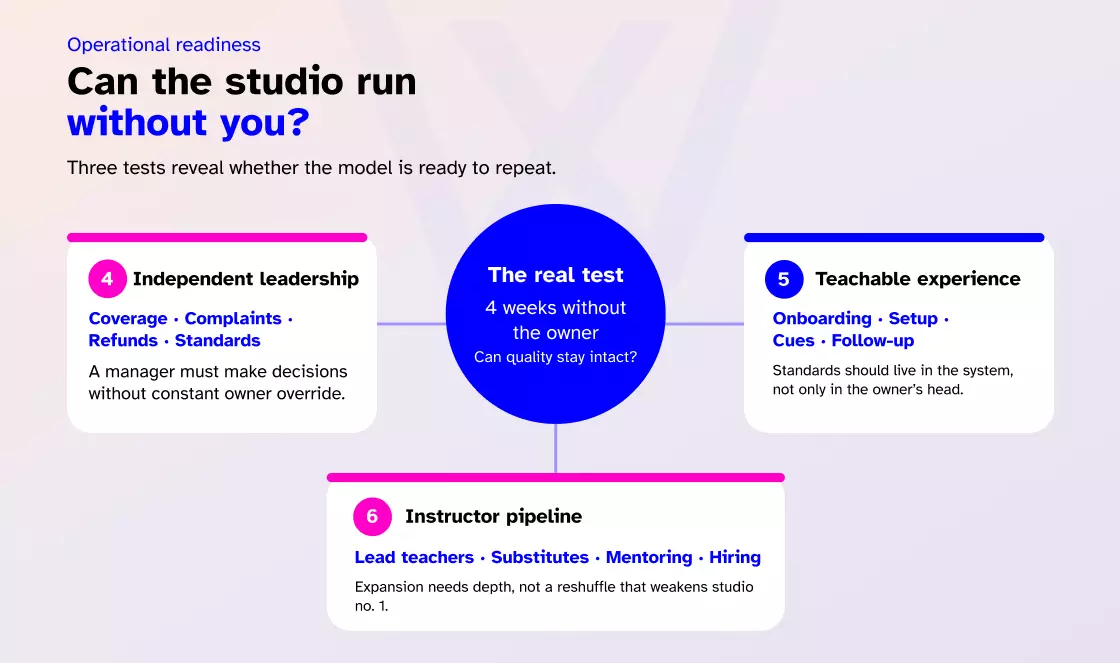
Even a well-funded expansion fails if the business depends on the owner personally holding everything together. Tests 4 to 6 measure whether the operating model can be repeated.
Test 4: Can studio no. 1 run without your daily presence?
The harder version of this test is uncomfortable. Ask what would actually happen if the owner were unavailable for four weeks starting Monday.
The studio should be able to handle class coverage, client complaints, refunds and freezes, instructor performance issues, cleaning and maintenance, sales follow-up, and daily quality checks without owner intervention. Documented SOPs help, but they do not replace judgment. A manager or lead instructor is needed who can make decisions, lead the team, hold the standard, and protect the client experience while the owner is away.
The willingness to let that person lead without repeatedly taking control back matters just as much. The most common failure mode here is not the absence of a capable second-in-command. It is an owner who cannot stop overriding one.
Test 5: Is your client experience documented and teachable?
If the feel of the studio depends on the owner personally greeting clients at the door and knowing which regulars are pregnant, managing an injury, or fresh off a hard week, that experience does not yet exist outside the owner’s head. Studio No. 2 will inherit whatever has not been translated into teachable standards.
Before expansion, document new-client onboarding, reformer setup and safety checks, class programming principles and instructor cues, modifications and contraindication protocols, cleaning and maintenance standards, music and room setup, complaint handling, and follow-up after introductory sessions. Storing these inside Pilates studio management software that both locations can reference beats a Google Doc nobody opens after month three. Then teach the standards, watch someone else deliver them, and revise. If the first person who inherits the documentation cannot produce the same experience, the documentation is not finished.
Test 6: Do you have an instructor pipeline, not just current hires?
Every Pilates operator can name their current instructors. Far fewer can name the pipeline. The two are not the same thing.
Studio no. 2 will need lead instructors, part-time and full-time teachers, a substitute bench, vacation and sickness cover, an ongoing training rhythm, and a plan for when someone leaves. If the only staffing plan for the new studio is to move a strong instructor from studio no. 1 and hire two more, the pipeline does not exist. What exists is a way to weaken the original location.
Structured pipelines look like relationships with certification programs such as STOTT PILATES, BASI Pilates, Peak Pilates, or Pilates Method Alliance-registered training providers; internal mentorship for newer teachers; auditions and observation stages; and a clear reason for strong instructors to want to teach at these studios rather than the one on the next block. Building this before expansion is one of the most impactful moves a Pilates owner can make.
Market and growth readiness: Will the second studio grow or divide the business?
The last four tests decide whether the second location will grow the business or fragment it.
Test 7: Do waitlists reflect sustained, structural demand?
Occasional sellouts are not enough. Full classes after a January resolution surge, a competitor closing nearby, or a viral social post are promotional bumps, not structural demand.
The signal to look for is different: peak classes reaching capacity month after month, waitlists holding steady across at least two full quarters, private-session inquiries being turned away, and demand that persists after the schedule has already been optimized.
Before assuming studio no. 1 has been outgrown, exhaust the cheaper interventions first. Here’s how:
- Add an early-morning or late-evening slot.
- Shift underused off-peak classes toward the peak.
- Introduce membership tiers that spread demand.
- Improve waitlist management so the empty seat is filled reliably.
A useful rule of thumb: if new revenue can be added at studio no. 1 for less than 10 percent of what a second location would cost, do that first. Expansion is justified when the existing location genuinely cannot absorb the demand, not when the schedule has never been tuned.
Test 8: Is demand coming from a specific new catchment?
The second most common reason a new studio underperforms is that it followed a hunch rather than evidence. The most common is cannibalization. Test 8 addresses both.
Review client ZIP codes, inquiry locations, website traffic by area, and commute times. If a meaningful portion of existing clients live or work in a specific neighborhood that would be inconvenient for the current studio but perfect for a new one, that is the location signal. If the demand map is just “everywhere within 30 minutes of the current studio,” the signal points to a cannibalization problem rather than an expansion opportunity.
Test the second market before signing anything. Options that work include a location-specific landing page collecting a local interest list, pop-up classes in the target neighborhood, a founding-member campaign with clear refund terms, short-term space rental to run a small schedule, and community, corporate, or wellness-partnership outreach in the new area. Waitlists show interest. Deposits and conversions show purchase intent. Design the validation around the latter.
Then model overlap explicitly against the two profiles below.
| Signal | Healthy expansion catchment | Cannibalization risk catchment |
| Client ZIP distribution | Distinct cluster in a new area | Overlap with studio no. 1’s core catchment |
| Travel time to studio no. 1 | Current members find it inconvenient | Members could easily use either location |
| Schedule and format differentiation | Different peak windows or formats | Same schedule and formats as studio no. 1 |
| Expected member switching | No more than 15% of existing members are expected to switch | 25% or more of existing members are likely to switch |
| Local demand evidence | Clear geographic waitlist or inquiry pattern | Diffuse demand across the whole city |
| Instructor sourcing | Fresh hires available in the new area | Requires moving studio no. 1’s lead instructors |
Test 9: Can the property physically support a Pilates studio?
A well-lit, character-filled unit on a walkable street can still be operationally unsuitable for a reformer studio. Before signing, arrange a professional assessment of the following:
- HVAC capacity and air-change rates for a class-sized room.
- Electrical supply and dedicated circuits for reformers, sound, and lighting.
- Ceiling height for taller reformer accessories and towers.
- Floor loading and vibration transmission.
- Accessibility and ADA compliance.
- Fire safety, egress, and occupancy classification.
- Restrooms and plumbing.
- Sound transmission to adjacent tenants.
- Delivery access for reformers, Cadillac units, and chairs.
- Permitted property use, parking, and transit access.
HVAC and electrical are the two line items most often underestimated in Pilates buildouts, and reformer delivery access is not something to discover after the lease is signed. Get bids from at least three mechanical and electrical contractors before committing.
Build a site-specific construction and permitting plan with the landlord, contractor, architect, engineer, local permitting authorities, and equipment supplier. Ask the commercial real estate broker or attorney about lease protections such as landlord work commitments, rent commencement tied to permits and inspections, and rent-abatement clauses that protect against construction delays. Every market handles these differently, so this is where professional advice earns its fee.
Test 10: Can software, insurance, and reporting support two locations?
A second location doubles the operational complexity. It should not double the reporting effort.
A multi-location Pilates platform should provide consolidated and location-level reporting, shared client profiles that follow members across locations, cross-location bookings, and memberships that can be used at either studio. It should support permissions that vary by role and location. It should also manage location-specific schedules and pricing, calculate payroll or commissions according to where an instructor taught, and provide one consistent app experience. If the current system requires spreadsheets to combine two locations into a single view, plan the transition before the expansion, not after.
Insurance needs its own review before signing. Ask the broker whether adding a location changes liability limits, property coverage, equipment schedules, employee coverage, aggregate limits, and business-interruption protection. Run this conversation while still evaluating the lease so any policy requirements can be built into the buildout.
The final reality check: expansion from strength, not escape
There is one more test, and it is the one owners are least likely to run on themselves.
Is expansion happening because studio no. 1 is genuinely ready, or because the owner is trying to escape a plateau at the first location?
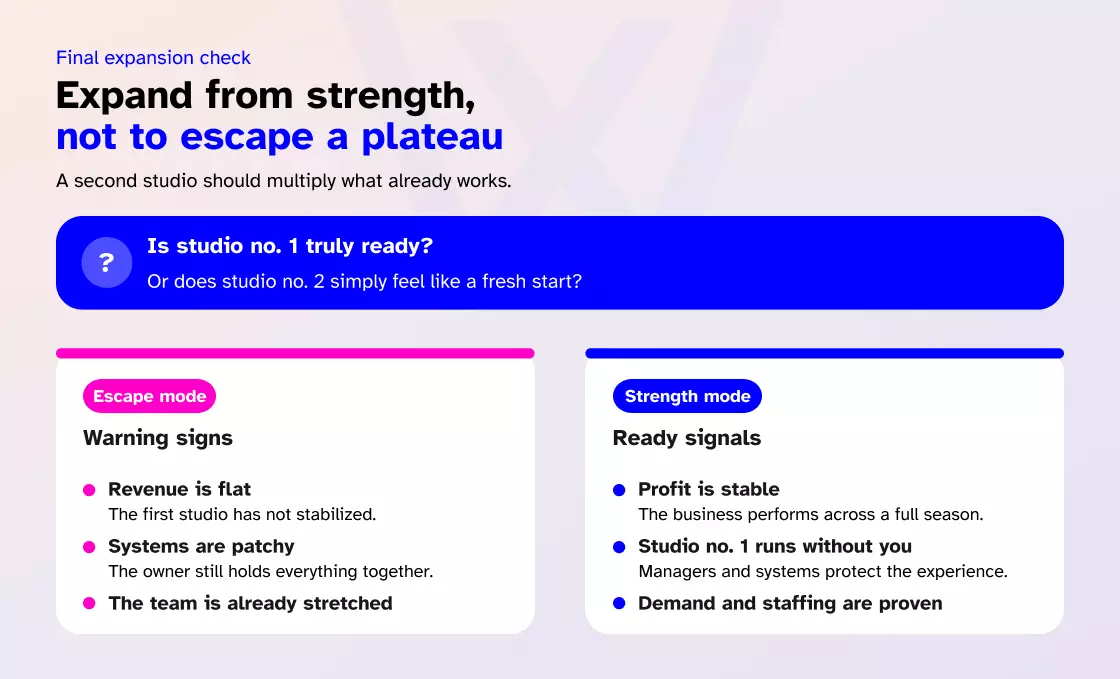
The plateau version looks like this: revenue is flat, the work feels stale, systems are patchy, the owner is already tired, and opening a second studio feels like a fresh start. But it rarely is. A second location does not fix cash flow problems at the first. It multiplies them. It does not build systems where none exist. It exposes their absence to a new team, a new market, and a new landlord.
The strength version looks different. The original studio runs without the owner for weeks at a time. Real profit is stable across a full season. The waitlist is structural. A specific catchment is asking. The instructor pipeline can staff a second location without weakening the first. The owner wants to be a multi-location operator, not just an owner of two studios.
Honest answers to that single question make the rest of the decision much easier.
Your first 90 days of expansion planning
Once most of the readiness tests have been passed, the next 90 days convert intent into a plan.
| Phase | Timeframe | Key actions |
| Diagnose and decide | Days 1 to 30 | Recalculate owner-adjusted profit; pull fill rate, waitlist, and revenue per reformer for 6 to 12 months; build the client ZIP heatmap; draft the three-pool capital plan and stress-test it; list every task that depends on owner presence; decide if studio no. 1 is ready or needs more time. |
| Validate and prepare | Days 31 to 60 | Test catchment demand with a landing page, pop-up, or paid campaign; interview leadership candidates for studio no. 1; document the client experience end to end and hand a test section to another instructor; meet the insurance broker; confirm software supports multi-location reporting; shortlist properties and commission professional HVAC, electrical, floor-loading, and accessibility assessments. |
| Decide, sign, staff | Days 61 to 90 | Confirm the location; negotiate lease protections and tie rent commencement to a permit-and-inspection trigger; finalize buildout budget, contractor, architect, and timeline; confirm the instructor pipeline; launch the presale and founding-member campaign with clear refund terms; publish the reporting cadence for both studios; take one deliberate week fully away from studio no. 1 as the final independence test. |
Any step that cannot be completed cleanly within 90 days reveals an area of the business that needs more work before expansion becomes viable.
Readiness checklist
Your studio may be ready to expand when:
- Studio no. 1 is profitable after paying the owner fairly.
- Cash reserves protect the original studio through six months of pressure.
- The capital plan has three separate pools and survives stress-testing.
- The current schedule has already been optimized.
- Waitlists remain consistent over multiple months, not just seasonal peaks.
- Demand comes from a specific new catchment, not a general area.
- Cannibalization has been modeled with actual client data.
- A named leader can run studio no. 1 without daily owner involvement.
- Teaching and service standards are documented and taught, not habits.
- Both studios can be staffed properly without weakening the original.
- The property has passed professional HVAC, electrical, and accessibility assessment.
- Construction and permitting risks are understood and priced in.
- Software supports true multi-location reporting and memberships.
- Insurance has been reviewed for two-location exposure.
- The expansion is coming from stability, not exhaustion.
Wrap up
A packed class may begin the conversation, but it should not make the decision. The right time to open studio no. 2 is when demand is proven, the financial model remains healthy under pressure, and studio no. 1 can protect its clients and instructors without your constant presence.
The second location should feel like a careful extension of what already works: the same respect for the method, the same attention to safety, and the same steady client experience, carried by a larger team rather than one increasingly tired owner. That is the kind of growth I would trust.
FAQs
1. When should you open a second Pilates studio?
When studio no. 1 has been consistently profitable for a full seasonal cycle after paying the owner fairly, waitlists show sustained unmet demand, a specific new catchment has evidence of purchase intent, and the business can operate without daily owner presence. Timing is a function of readiness, not calendar age.
2. How much profit does a Pilates studio need to justify expansion?
There is no single margin figure that applies across markets. What matters is that profit is real after owner labor is properly costed, that it holds across a full year rather than one strong quarter, and that it can absorb a 6- to 12-month ramp at studio no. 2 without endangering the original.
3. How much capital do you need to open a second Pilates studio?
Capital needs vary widely by city and format, but plan for three separate pools: cash reserves to protect studio no. 1, buildout and equipment capital for studio no. 2, and working capital to run the new studio through its ramp. Buildout runs around $50 to $70 per square foot on average; contemporary studio-grade reformers land around $3,500 to $5,500 per bed, and premium urban markets can push totals meaningfully higher.
4. How do you avoid cannibalizing your first Pilates studio?
Map where current clients live and work using ZIP or ZIP code data, model how many would realistically switch locations, and choose a catchment far enough away to reach a new audience while close enough to defend the brand. Differentiated schedules and location-specific formats also help. The comparison table in Test 8 shows the signals that separate a healthy expansion catchment from a cannibalization risk.
5. What are the biggest mistakes Pilates owners make when opening a second studio?
Treating reported profit as real without costing owner labor, assuming the second location will fix a plateau at the first, relying on a hunch about location rather than client-location evidence, underestimating property readiness including HVAC and floor loading, and moving strong instructors from studio no. 1 rather than building a genuine pipeline.
6. Do you need multi-location software before opening a second Pilates studio?
Before, not after. If the current platform requires spreadsheets to combine two locations into one view, the transition only gets harder once the second studio is live. Look for consolidated and location-level reporting side by side, cross-location bookings and memberships, role-based staff permissions, and a consistent client app across sites.
7. How long does it take to open a second Pilates studio?
A realistic timeline is 6 to 12 months from decision to opening, depending on lease negotiation, permitting, construction, and hiring. The 90-day readiness roadmap sits at the front of that timeline, before the buildout begins.