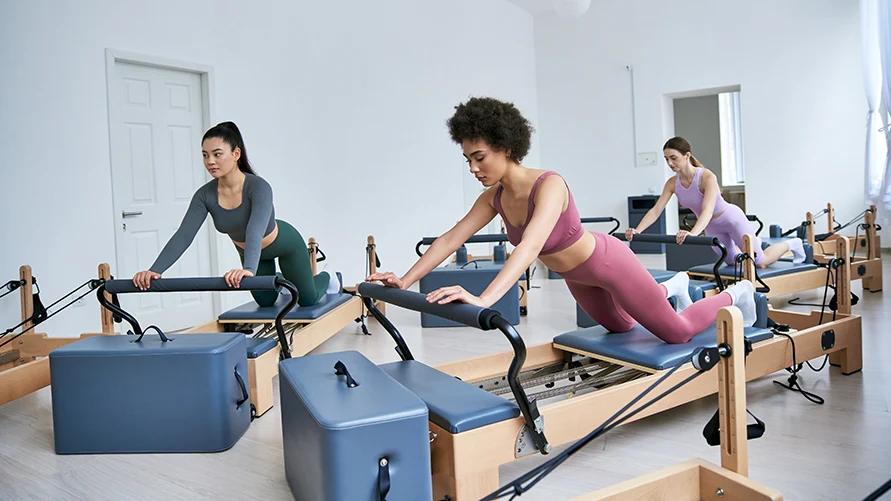
Pilates industry statistics in 2026 show a large and active market, strong client demand, and rising pressure from costs and competition. These numbers matter because they help studio owners see where growth is real and where profit leaks happen.
In 2026, the Pilates industry sits inside a billion-dollar fitness economy where demand is proven, but survival depends not on numbers, but on smart pricing, strong retention, and efficient systems. Remember, studios do not fail because Pilates demand disappears. They fail because costs rise faster than decisions improve.

Pilates industry growth at a glance in 2026
In 2026, competition is tighter, clients have more choices, and costs move faster than prices. Studios that grow are not guessing. They are measuring. Numbers show what is working and what is quietly breaking. They also protect owners from copying nearby studios that may not be as profitable as they seem.
Pilates industry data helps a studio owner see beyond one street or one month. Demand statistics confirm whether Pilates’ interest is real or just online noise. Cost benchmarks show when pricing is too low or payroll is too high. Without benchmarks, busy studios often mistake full schedules for healthy businesses. Retention data exposes problems early, before revenue drops.
In 2026, statistics aren’t just promising to look at; they’re a way to navigate toward a healthier business.
How big is the Pilates studio market?
The Pilates industry in 2026 is large at both the U.S. and global levels, giving studios long-term demand support.
In the United States, Pilates studios are commonly grouped with yoga studios for industry tracking. This gives the clearest available benchmark for studio-based Pilates revenue.
Here are key market size statistics for you to understand the market dynamics:
- U.S. Pilates & yoga studios market size: $19.0 billion.
- Number of Pilates & yoga studio businesses in the U.S.: 37,377.
- Estimated global Pilates & yoga studios market (low range): $187 billion.
- Estimated global Pilates & yoga studios market (high range): $195 billion.
- An aggressive long-term forecast projects the market exceeding $500 billion by 2035.
These numbers show one thing clearly. Demand is not the problem. Execution is. Global market size signals opportunity, not protection. Local pricing, instructor supply, and retention still determine survival. For owners, global numbers show direction, not guarantees.
How fast are Pilates studios growing year-over-year
Pilates studio growth in 2026 is steady but uneven, with studio counts rising faster than total revenue. Growth is happening, but not evenly across all operators. This creates pressure. Growth and competition statistics:
- U.S. studio count growth from 2025 to 2026: +0.2%.
- U.S. industry revenue growth in 2026: -0.8%.
- Boutique fitness studios in North America saw 10.1% annual growth in earlier years.
These numbers explain why many owners feel busy but stressed. More studios exist, but revenue growth is tight. Discounting, promotions, and rising costs eat margins.
When the studio count rises faster than revenue, pricing discipline becomes a survival skill, not a preference. In this environment, pricing discipline and utilization matter more than ever.
How many Pilates clients exist and who they are?
Pilates demand in 2026 is supported by millions of active participants, with women forming the majority of the audience. However, participation data does not equal memberships; it shows the size of the addressable market.
Here are the Pilates participation statistics:
- Estimated U.S. Pilates participants: 12.9 million.
- Participation growth since 2019: nearly 40%.
- Female participation share: about 70%.
These numbers guide real decisions. Scheduling, branding, onboarding, and class levels should reflect who actually shows up.
Studios that try to serve everyone often struggle to retain everyone. Pilates may be for everyone, but studios grow faster when they clearly serve a defined group first.
What does the typical Pilates studio business look like in 2026?
In 2026, most Pilates studios operate as boutique businesses with moderate membership and high service expectations.
Boutique studio research offers the clearest picture of day-to-day reality.
Boutique studio profile statistics to know:
- Estimated boutique fitness studios in the U.S.: ~40,000.
- Studios earning at least $250,000 per year: 83%.
- Studios with 100-399 active members: 54%.
Pilates studios fit this model closely. Small classes. Premium feel. High touch. High expectations. This is not a volume business. It is a capacity-constrained service business. This is why retention and schedule efficiency decide profit more than marketing hype.
Average revenue, profit margins, and operating costs of Pilates studios
Pilates studios in 2026 show strong revenue potential, but profit depends on cost control.
Using industry totals gives a useful benchmark, not a promise. For a deeper financial breakdown, see the cost to open a Pilates studio
Revenue and margin statistics:
- Average revenue per studio (industry average): ~$508,000.
- Estimated industry profit margin benchmark: ~6–7%.
- Staff wages as a share of revenue: ~44%.
Payroll is the largest expense. When wages approach half of revenue, pricing mistakes hurt fast. At these margins, a 5-10% underpricing error can erase profitability entirely.
Class pricing, session frequency, and retention of Pilates classes
In 2026, strong studios price based on demand and retention, not fairness or tradition.
There is no universal class price. Cities, formats, and positioning vary too much. But demand behavior tells a clear story.
Demand and retention signals:
- Reformer Pilates bookings growth year-over-year: +66%.
- Pilates ranked as the most booked fitness category for 3 consecutive years.
- Pilates ranked as the most rebooked fitness category on ClassPass.
Once a client starts Pilates, many stick with it. Retention is possible. It just needs structure.
Churn benchmarks from boutique studios:
- Studios with annual membership turnover of 30% or more: ~50%.
- Studios reporting turnover above 50%: ~19%.
Retention failures cost more than marketing ever will. Every retained client reduces pressure on pricing, staffing, and marketing simultaneously.
Private vs. group Pilates demand
Group Pilates drives stability, while private Pilates drives margin in 2026.
There is no clean national split, but studio behavior shows how owners adopt. Personalization and service mix indicators:
- Studios offering personalized fitness plans: 49%.
Group classes fill schedules. Private sessions deepen results and revenue. Treating them as separate products improves clarity and profit.
Studios that rely only on group classes often cap their earning potential. Private Pilates should be a planned upgrade, not an afterthought.
Instructor pay, staffing trends and certification growth
Staffing remains one of the biggest growth limits for Pilates studios in 2026. Demands exist, but qualified instructors are not unlimited. However, here are some staffing and labor statistics:
- Median annual pay for fitness instructors (U.S.): $46,480.
- Studio owners reporting hiring and retention challenges: 62%.
- Studio owners reporting staff culture challenges: 61%.
Instructors’ retention protects revenue. Stable schedules, fair pay, and growth paths matter more than constant recruiting. Instructor shortages turn demand into lost revenue, not waitlists.
Home Pilates vs. studio Pilates
In-studio Pilates remains strong in 2026 despite the rise of home workouts. Convenience exists at home, but habit and coaching keep studios relevant. Behavior indicators:
- Pilates remains the most booked in-person fitness category.
- Reformer Pilates bookings continue to rise.
- Studios report pressure from at-home fitness options.
Studios win by offering structure, progression, and accountability. Not by being cheaper. Competing on price against home workouts is a losing strategy.
Marketing and lead generation benchmarks for Pilates studios
In 2026, proven marketing channels still outperform trends. Owners should focus on where conversion is real.
The most effective Pilates marketing ideas are not about being everywhere. They are about being present where high-intent prospects are already looking.
Top client acquisition channels:
- Instagram: 63%.
- Word of mouth: 46%.
- Facebook: 42%.
- Google Search/SEO: 42%.
- Email marketing: 21%.
- TikTok usage among studios: ~7%.
Traffic does not matter if it does not convert. Tracking lead source and return rate matters more than views. High-intent leads beat high-volume attention every time.
Client retention and churn statistics
Churn is one of the highest hidden costs for Pilates studios in 2026. Retention determines stability.
Retention and churn statistics:
- Studios reporting 30%+ annual turnover: ~50%.
- Studios reporting turnover above 50%: ~19%.
- Studios using personalized outreach for retention: 56%.
- Studios using discounted packages for retention: 40%.
- Studios using loyalty programs: 21%.
Retention is built early. The first two weeks decide most outcomes. Poor onboarding silently destroys lifetime value.
Pilates studio software statistics
Studio software is now an operational infrastructure, not a luxury.
Automation protects revenue and time.
Software adoption statistics:
- Studios using a CRM system: 86%.
- Studios using CRM for reporting and analytics: 46%.
- Studios tracking client communication in a CRM: 44%.
- Studios using automated check-in and attendance tracking: 44%.
- Studios offering live streaming or digital classes: 39%.
- Studios planning new tech investment within a year: 49%.
Pilates studio management software ROI shows up in saved hours, captured bookings, and reduced churn, not just dashboards. Manual systems scale stress faster than revenue.
How to use Pilates studio statistics to build a smarter business
Statistics help owners reduce risk and focus effort where it matters most. Use demand data to justify expansion. Use cost benchmarks to protect margins. Use churn data to fix onboarding. Use software adoption stats to modernize operations. Numbers do not remove risk, but they prevent blind decisions.
Key priorities Pilates studio owners should focus on
The Pilates industry statistics across pricing, staffing, retention, and software point to a clear set of priorities. Studios that perform well in 2026 tend to focus on fundamentals rather than expansion for expansion’s sake.
- Retention before acquisition
Replacing lost clients is more expensive than keeping existing ones. Improving onboarding, early engagement, and progression clarity often produces more revenue than increasing marketing spend.
- Pricing discipline over popularity
When payroll approaches 45% of revenue and margins sit near 6–7%, underpricing is not a branding choice; it becomes a financial risk. Studios must price based on demand, capacity, and outcomes, not local comfort levels.
- Capacity planning over aggressive growth
Instructor availability and reformer count limit growth more than demand. Expanding schedules without staffing depth can lead to burnout, inconsistency, and lost revenue.
- Clear positioning over broad appeal
Studios that clearly define who they serve retain clients longer and market more efficiently. Pilates for everyone kind of messaging often weakens retention rather than strengthening it.
- Systems over hustle
Software, automation, and clear processes protect revenue and time. Manual operations scale stress faster than profit. Work smartly and make your operations and overall management more efficient and organized.
Lastly, new studio owners must take Pilates industry stats into consideration, not just to validate their business idea’s demand, but to make strategic moves throughout. Remember, studios that ignore these priorities might feel busy, booked, and exhausted, yet they stay financially fragile.
What do the Pilates industry statistics suggest about the future of Pilates?
Pilates studios are positioned to grow. Competition is real. Systems decide outcomes.
Studios that treat retention as a product, pricing as a strategy, and software as infrastructure will find 2026 more predictable and less stressful. The numbers are already clear. The advantage goes to owners who act on them.
Wrap up
The Pilates industry in 2026 is strong, established, and full of opportunity, but it rewards thoughtful operators. Demand is no longer the question. How a studio prices, retains clients, supports instructors, and manages costs now determines whether that demand turns into a sustainable business.
The Pilates industry statistics don’t point to hype or shortcuts. They point to patience, clarity, and systems. Studios that build with intention will find Pilates not just popular, but reliably profitable for years to come.