




Learning how to run a gymnastics studio means confronting a set of operational realities that most business guides underestimate. Class structures need to make sense across age and ability. Safeguarding rules are not optional and vary by country. Enrollments don’t arrive steadily; they spike, especially around September. Parents expect clarity on progress, even when development takes months. The strongest operators address all of this through five consistent practices: designing clear rec-to-comp pathways; banding classes by both age and ability; building enrollment systems before the September rush; documenting progression instead of relying on coach memory; and using connected software so parent communication, payments, and reporting don’t live in separate tools.
This guide is for studio owners and program managers who need something practical to work from. It covers the full picture, from whether the business makes sense in your market to how you set up your facility, manage finances, and keep things running as the program grows. Whether you’re opening your first club or trying to bring more structure to an existing one, the focus here is on what actually works.
The approach is based on how gymnastics clubs operate day to day across the US, UK, and Australia. That includes how national frameworks are applied in practices, not just how they are written. It also deals with the parts most guides skip: what happens after the busy enrollment period, how to track progression without relying on memory, and why communicating with parents often matters more than any equipment you invest in.
Is a gymnastics studio business viable?
Yes, gymnastics is a structurally strong youth-sport business with recurring revenue, long customer lifetimes, and high parental loyalty when managed well. The longer answer requires understanding the market dynamics, demand curves by age groups, and realistic startup cost ranges, before you commit capital
Market size and growth trends
The global gymnastics equipment market was valued at approximately USD 16.04 billion in 2022 and is projected to grow at a compound annual growth rate (CAGR) of 5.3% through 2030, according to Grand View Research. In the United States alone, the gymnastics participation market encompasses an estimated 5 million recreational gymnasts and more than 200,000 competitive gymnasts registered with USAG. In the UK, British Gymnastics reported over 300,000 affiliated members as of 2023, making it one of the most popular participation sports for girls aged 5–14.
Demand is particularly resilient in the 4–12 age bracket, where gymnastics competes directly with swimming, dance, and martial arts for after-school spend. However, gymnastics has a structural advantage over most competitors: progression pathways. A child who begins recreational gymnastics at age 5 can be retained within your club as a competitive gymnast through their mid-teens, creating a customer lifetime of up to a decade, something very few youth-sport businesses can match.
Startup cost ranges
Startup costs vary dramatically based on facility size, location, and program model. Whether you are starting a gymnastics club from scratch or expanding an existing one, the table below provides indicative ranges for a mid-sized recreational-to-competitive club in an urban market.
| Cost Category | Low Estimate (USD) | High Estimate (USD) | Notes |
| Facility Lease (12 months) | $36,000 | $120,000 | Warehouse/industrial space preferred; ceiling height critical |
| Fit-Out and Flooring | $25,000 | $80,000 | Sprung floor, foam pits, wall padding |
| Apparatus and Equipment | $30,000 | $150,000 | Depends on program level (rec vs. competitive) |
| Insurance (Annual) | $5,000 | $18,000 | Liability, equipment, professional indemnity |
| Technology and Software | $2,000 | $8,000 | enrollment, communications, scheduling, payment processing |
| Staff and Certifications | $15,000 | $40,000 | First-year coaching costs; cert fees vary by country |
| Marketing and Launch | $3,000 | $15,000 | Digital, community outreach, open-day events |
| Working Capital Buffer | $20,000 | $50,000 | Minimum 3 months of operating costs in reserve |
| TOTAL (Indicative) | $136,000 | $481,000 | Most mid-market studios launch between $180K–$280K |
The single largest cost variable is the apparatus. A recreational-only studio can launch with modest equipment, a trampoline or two, gymnastics mats, and a basic beam, at the low end. Adding a competition-standard floor exercise area, uneven bars, pommel horse, vault, and full foam pit system rapidly escalates costs toward the higher range.
Business financing
A $136K–$481K launch range is not capital most founders have sitting in a current account. Four funding routes cover the majority of gymnastics studio launches.
- Self-funding and partner capital: Most common route for smaller recreational-first launches. No debt service pressure in year one, full operational control, but caps your launch scale and leaves a minimal working capital buffer.
- Government-backed small business loans:
- USA: SBA 7(a) loans (up to $5M) and SBA microloans (up to $50K)
- UK: Start Up Loans scheme, £500–£25,000 at a fixed 6% rate with free mentoring
- Australia: State-level small business grants + federal Business Loan Guarantee (where applicable), via ASBFEO
- Equipment finance and lease-to-own: Given apparatus alone ranges $30K–$150K, this is often the single most useful instrument for a new studio. Most major gymnastics equipment suppliers offer 3–5 year lease-to-own structures, preserving working capital for fit-out and first-year coach salaries. Pair this with the equipment priority sequencing table, but Phase 1 outright and finance Phase 2 and 3 as the business matures.
- Landlord fit-out contributions: Overlooked by most first-time operators, industrial and warehouse landlords will frequently contribute toward fit-out costs in exchange for a longer lease (typically 7–10 years). Negotiate this explicitly before signing.
Expert tip on working capital
Gymnastics studios have a fee-in-advance model: most clubs charge term fees at the beginning of each term, creating positive cash flow at the start and a cash cliff mid-term if retention is not managed. Maintain a minimum of three months of operating costs in liquid reserves before opening, and build your financial model around a conservative 60% capacity utilization in year one.
Legal structure and club registration
Before you sign a lease or take deposits, your studio needs a legal entity, and your club needs to be registered with the national body that governs the sport in your country. These are two separate decisions, and both matter on day one.
- Choosing a legal entity: In the U.S., most independent gymnastics studios operate as an LLC (limited liability company), which separates personal assets from business liability, critical in a sport with an elevated injury exposure profile. In the U.K., the equivalent is a private limited company (Ltd), registered with Companies House. In Australia, a proprietary limited company (Pty Ltd) registered with ASIC is the standard structure. Sole-trader or partnership structures are legal but expose personal assets to claims; given gymnastics insurance premiums and the injury risk profile, a limited-liability structure is almost always the right choice.
- Business registration: Alongside entity formation, you will need a federal EIN (US), company registration, and VAT consideration (UK, required above the VAT threshold) or an ABN and GST registration (Australia). These take days to weeks and should be completed before you open a business bank account or sign supplier contracts.
- Club affiliation as a legal operating requirement: Separate from coach certification, your club itself must be affiliated with the national body: USA Gymnastics (member club registration), British Gymnastics (club registration), or Gymnastics Australia (club affiliation). Without club-level affiliation, your insurance may be invalidated, your gymnasts cannot compete in sanctioned events, and in some jurisdictions, you cannot legally advertise yourself as a gymnastics club.
Jurisdiction-specific rules around tax, employment law, and licensing vary significantly. Engage a qualified accountant and attorney in your market before incorporation.
Gymnastics studio business plan essentials
Before committing capital, you need a gymnastics studio business plan that reflects the specific financial and operational structure of this sector, not a generic small business template. Four components distinguish a gymnastics business plan from a standard fitness business plan.
Revenue model by program stream
Map revenue separately for recreational term fees, squad fees, competition levies, holiday camps, and any facility hire. Each stream has a different margin, different seasonality, and a different churn risk. A plan that treats all income as a single line will produce misleading projections by month six.
Capacity model
Work backward from your facility: how many class slots per week, at what coach-to-gymnast ratio, at what price per term, produce your target revenue? Recreational classes typically run at a 1:8 coach ratio; development squads at 1:5. Your physical capacity ceiling is not your enrollment target; build in a 15–20% buffer for absences, late enrollments, and class structure adjustments.
Seasonal cash flow projection
Model month-by-month rather than annually, explicitly accounting for the June–August trough and the September spike. Most gymnastics studios that run into cash flow problems in year two do so because their annual business plan looked healthy, while their July bank balance did not.
Coach cost escalation
Coaching is your highest variable cost and the one most likely to be underestimated. Factor in certification renewal fees, safeguarding refreshers, CPD costs, and the salary premium required to prevent turnover, not just base wages at launch.
A business plan built on these four components will serve as both a funding document and an operational reference as the studio grows.
Is demand consistent year-round?
No, and this is one of the most dangerous assumptions new studio owners make. Gymnastics enrollment follows a strongly seasonal curve, peaking in September (back-to-school) and January (New Year’s resolutions/post-Christmas signups), with a significant trough in June-August. Studios that are not prepared for this seasonality can enter summer with fixed overheads and dramatically reduced fee income.
Recreational vs Competitive, which program model is right for your club
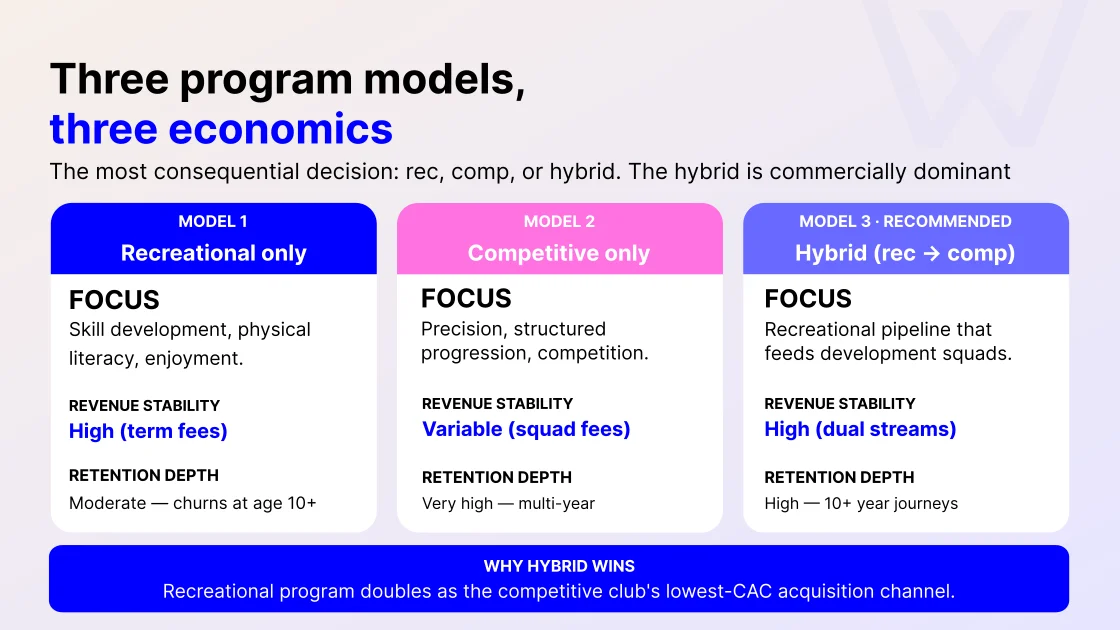
The most consequential decision you will make as a gymnastics studio owner is whether to operate a recreational program, a competitive program, or a hybrid. This choice shapes your facility requirements, staffing model, parent expectations, competition schedule, and financial structure. Most clubs begin recreational and evolve toward a hybrid; very few successfully pivot from pure competitive to recreational, as the cultures are difficult to merge in reverse.
The recreational program model
Recreational gymnastics focuses on skill development, physical literacy, and enjoyment rather than competition preparation. Classes are grouped by age (typically 18 months–3 years per group) rather than ability level, and gymnasts generally do not progress to club teams or compete at sanctioned events.
Advantages: Lower equipment standards, simpler insurance requirements, higher class volumes, consistent term fees, minimal parent-communication demands around selections and squad placements.
Risks: Lower retention past age 10 as children seek more structured challenge, no pathway to convert engaged gymnasts into higher-value competitive members, and commoditized by competitor studios.
The competitive program model
Competitive gymnastics emphasizes skill precision, technique development, and structured progression through nationally recognized levels or grades. Classes are organized by age bands and ability level, with progression to competitive squads requiring formal selection and commitment to competition schedules. Gymnasts train multiple sessions per week, often specializing in artistic, rhythmic, acrobatic, or trampoline disciplines.
Advantages: Higher-value gymnasts, strong retention through teenage years (8–10 year customer journeys), lower customer acquisition cost, significant word-of-mouth referral from competitive families, and prestige in the regional gymnastics community.
Risks: Requires higher-specification facilities, significantly higher coach expertise and certification standards, complex competition administration and traveling commitments, and intensive parent communication around selections and development decisions. The market is smaller (typically 15–25% of overall enrollment).
Hybrid model: The strongest commercial position
The hybrid model, recreational classes that feed into development squads, which in turn feed into competition squads, is the commercially dominant structure for sustainable gymnastics clubs. It creates a natural internal customer journey: a child enters at age 4 in a recreational class, shows aptitude, transitions to a pre-squad development pathway around age 7–9, and enters competitive gymnastics by age 10–12.
This funnel structure means your recreational program is not just a standalone revenue stream. It is also your talent pipeline and your competitive club’s top-of-funnel acquisition channel. A studio that runs this model well achieves the lowest customer acquisition cost in youth sport: most new gymnasts enter through a sibling referral or a parent who already trusts the club.
A quick note on Xcel vs the development program
For U.S. clubs, it helps to explain the difference clearly to families. The Xcel pathway is designed as a flexible competitive track with an emphasis on technique, form, performance, teamwork, and enjoyment. At the same time, the Development Program follows the more traditional level-based route that feeds higher-level progression. If your club operates in the U.S., define in writing which track your pre-squad and squad pathways lead into, and when that decision is made.
If your club serves more than artistic gymnastics
Artistic gymnastics may be the commercial center of many clubs, but it is not the whole discipline map. Depending on your market, you may also see demand for acrobatic gymnastics, trampoline and tumbling, rhythmic, parkour, TeamGym, or related development formats. That affects equipment, coach qualifications, competition calendars, and how you explain pathways on your website and enrollment forms.
Model comparison matrix
| Model | Revenue Stability | Retention Depth | Facility Complexity | Admin Burden |
| Recreational Only | High (term fees) | Moderate (churns age 10+) | Low | Low |
| Competitive Only | Variable (squad fees) | Very High (years) | Very High | Very High |
| Hybrid (Rec to Comp) | High (dual streams) | High (10+ year journeys) | Moderate–High | High |
Expert tip: Hybrid program design
Design your hybrid pathway so that progression between levels requires a formal invitation to the trial process rather than automatic advancement. This creates both genuine quality control and a sense of achievement that parents share socially, one of the most effective word-of-mouth mechanisms in youth sport. Document the criteria for each transition point clearly and communicate them to families from Day One.
Setting up age groups and level-based class structures
A well-designed class structure is the invisible architecture of a successful gymnastics studio. Get it right, and your coaches teach effectively, gymnasts progress meaningfully, and parents see clear value. Get it wrong, and you have mixed-ability groups that frustrate experienced gymnasts and overwhelm beginners.
Age-group frameworks across major national bodies
The three dominant national frameworks: USAG, British Gymnastics (BG), and Gymnastics Australia (GA) each provide age-groups and level structures that clubs can adapt:
| Framework | Entry level | Development | Competitive pathway |
| USAG | Xcel Bronze/Preschool | Xcel Silver–Platinum, Levels 1–4 | Levels 5–10/Elite |
| British Gymnastics (BG) | FUNdamentals / Foundation | Grades 1–6 / Club Level | Regional/National Grades |
| Gymnastics Australia (GA) | Tiny Tots / Junior | WAG/MAG Development | National Development / Elite |
For most clubs, the practical class groupings look as follows:
- Mini Movers / Tiny Tots (ages 18 months–3 years): Parent-and-child sessions, gross motor development, basic body awareness. Revenue contribution is high (premium pricing, short sessions), but progression is slow by design.
- Beginner Recreational (ages 3–6): Core gymnastics vocabulary — forward rolls, cartwheels, balance — in a group of 6–10. Classes run 45–60 minutes.
- Intermediate Recreational (ages 6–10): Skill-to-skill connection, cartwheel–round-off combinations, back support rolls, introductory bar and beam. 60–75 minutes.
- Advanced Recreational / Pre-Squad (ages 8–12): Evaluation point for competitive pathway. Gymnasts assessed for squad invitation. Handspring and basic flyaway work commences.
- Development Squad (ages 9–14): Competition preparation under national framework (USAG Xcel / BG Grades / GA Development). Minimum two sessions per week.
- Competitive Squad (ages 10–18): Full national-pathway training, 3–6 sessions per week, competition schedule commitment required.
The ability-banded classes vs the age-only classes
Most gymnastics studios group solely by age. This is the single biggest structural error in recreational program design. A 9-year-old who has trained for three years will share a class with a 9-year-old who has just enrolled, creating frustration on both ends. The most progressive clubs use a dual-axis grouping system: age band plus ability band. A child enrolls into an age group first and then, after an initial three-session assessment, is placed into an ability stream within that group.
Expert tip: Class structure
Run a three-session assessment window at the start of each term rather than placing every gymnast into the beginner class by default. This reduces the frustration of experienced gymnasts who have rejoined after a gap, prevents coaches from teaching to the lowest common denominator, and produces placement data that is invaluable for capacity planning. The assessment window also creates a natural conversation opportunity with parents, one of the most powerful trust-building interactions a studio can have early in a family’s journey.
Setting up your gymnastics studio
Apparatus and facility planning
Gymnastics is one of the most facility-intensive youth-sport businesses. Ceiling height, floor loading, ventilation, and apparatus spacing are non-negotiable; failing to account for them before signing a lease is a common and expensive mistake.
Minimum facility requirements
- Ceiling height: Minimum 5.5m (18ft) for recreational; 7.5m+ for competitive bars and vault.
- Floor area: Minimum 400 sq m for a functional recreational studio; 700–1,200 sq m for a full hybrid program.
- Floor loading: Minimum 5 kN/m² confirmed by a structural engineer before apparatus installation.
- Foam pit: Minimum 1.2m fill depth; not optional for any club teaching back salto or flyaway elements.
- Viewing area: A dedicated parent gallery, separate from the training floor, prevents coaching disruption and creates a community space.
- Changing facilities: Separate male and female changing rooms with individual cubicles are a compliance requirement under most national safeguarding frameworks.
Equipment priority sequencing
When launching on a constrained budget, sequence equipment purchases to match your program rollout rather than buying everything at once:
| Phase | Equipment Priority | Approx. Cost (USD) | Program Unlocked |
| Phase 1 (Launch) | Sprung floor, gymnastics mats, floor bars, low beam, trampoline | $18,000–$40,000 | Recreational (ages 3–10) |
| Phase 2 (6–12 months) | Foam pit, vault table/springboard, standard beam, horizontal bar | $20,000–$55,000 | Pre-squad, Development |
| Phase 3 (12–24 months) | Uneven bars (competitive spec), pommel, still rings, parallel bars | $25,000–$60,000 | Competitive squad |
| Phase 4 (Growth) | Additional mats, competition-standard vault, second pit | $15,000–$40,000 | Increased volume + events |
Insurance: The non-negotiable you cannot under-buy
Gymnastics carries one of the highest injury exposure profiles of any youth sport. Coverage must include:
- Public and products liability, minimum £5m / $10m AUD / $5m USD per incident
- Professional indemnity for coaching decisions
- Equipment insurance for apparatus damage
- Employer’s liability if you employ staff directly. National bodies (USAG, BG, GA) all require affiliated clubs to carry specific minimum coverage levels.
Check your affiliation conditions before purchasing a policy. Work exclusively with a broker who specializes in gymnastics or youth sports. Generic commercial insurance policies routinely exclude aerial activities and contact gymnastics, leaving clubs exposed.
Coach recruitment and certification requirements
Your coaching team is your product. In gymnastics, parents are not paying for apparatus; they are paying for the expert hands and eyes of coaches who can safely progress their child. Recruiting, certifying, retaining, and fairly compensating coaches is the highest-leverage activity in gymnastics club management, and it is also the area most commonly underinvested.
Certification requirements by country
| Country | Required Certification | Safeguarding Requirement | Renewal |
| USA | USAG Professional Member; Level-appropriate coaching credential | SafeSport Training (mandatory, annual refresher) | Annual membership + cert cycles |
| UK | British Gymnastics Coach License (L1–L4) | UK Coaching Certificate + Safeguarding & Protecting Children (SPC) | 3-year BG license cycles |
| Australia | Gymnastics Australia Coaching Accreditation (CAI–CA4) | Working With Children Check (WWCC) — state-specific | WWCC varies by state (3–5 years) |
Certification is not a one-time event. USAG SafeSport must be renewed annually; British Gymnastics licenses require CPD hours; Gymnastics Australia accreditation involves regular reassessment. Build certification renewal tracking into your studio calendar and coach contracts from day one. A lapsed certification can void your insurance.
Club affiliation is non-negotiable
Club affiliation has to be treated as a live operating requirement. In the U.S., clubs operate through the USA Gymnastics member-club structure. In the UK, registration sits with British Gymnastics. In Australia, affiliation requires completion of the current club membership form, acceptance of terms and conditions, and compliance with national affiliation standards. Put renewal dates, document storage, and policy checks into the same compliance calendar as coaching credentials.
Coach compensation and retention, and the employee vs contractor decision
Coaches are the lifeblood of the business. You have to pay them fairly and empower them; the moment they feel undervalued, your program starts to decline, whether you notice it straight away or not.
Thamar, Asylum Fitness, Gymnastics Studio Director
Employed coaches are more expensive but easier to direct, certify centrally, and carry lower misclassification liability. Self-employed contractors are only appropriate where the coach genuinely sets their own hours, uses their own materials, and works for multiple clients. UK and Australian studios face strict HMRC/ATO tests on contractor status.
Expert tip: Coach retention
Create a structured coaching progression pathway within your club, even if it only has three tiers. A coach who can see a clear route from assistant coach to lead coach to head of program has a reason to invest in the club’s success. Pair this with a CPD budget (cover one national certification upgrade per year per full-time coach) and a transparent pay scale. These two investments cost less than recruiting and retraining a replacement coach after a resignation.
Managing enrollments: The September problem and how to survive peak sign-up periods
September enrollment in gymnastics is not merely a busy period; it is the primary revenue event of the club’s year. In the UK, up to 70% of annual new enrollments occur in the September–October window. In the US, this concentrates around late August through mid-September (back-to-school) with a secondary peak in January. In Australia, the pattern follows the academic year calendar with a February primary peak.
“We had a period where managing enrollments was taking up nearly two full working days every week in September. Half of that was just following up on inquiries that had gone cold because we responded too slowly. We needed the process to work faster than we could manually manage it.”
Danielle, Grit to Greatness Performance Center
The solution is not more staff during peak periods; it is a system that works automatically. This is where gymnastics club management software becomes essential: automated inquiry capture, online class booking, real-time capacity management, and waitlist progression without manual intervention.
The pre-launch waitlist strategy
- In late May: Priority re-enrollment window (2–3 weeks) for existing families to secure their spot before public release.
- In June: Open a public waitlist registration (interest only, no booking). Collect name, child’s age, preferred day, and contact details.
- In August (4 weeks before term start): Open new spot bookings to waitlisted families first, for a 72-hour window.
- In late August: Open remaining spots publicly. By this point, most classes will be 60–80% booked from the priority phases.
Expert tip: Enrollment capacity planning
Run a capacity analysis every March and August. Map every class slot against enrolled gymnasts and your safe coach-to-gymnast ratio (1:6–8 for recreational; 1:4–6 for squad). Calculate exactly how many new spots are genuinely available before opening enrollment. Overselling and then turning enrolled families away generates the most damaging social media complaints a studio can receive.
Parent communication: Why it makes or breaks a gymnastics club
Parent communication in gymnastics clubs covers every touchpoint between the studio and enrolled families: enrollment confirmations, progress updates, selection decisions, schedule changes, and development pathway conversations.
Parent communication is the single most underrated operational function in gymnastics club management. Studios invest tens of thousands in apparatus and coaching, then lose families not because the coaching was poor, but because a parent felt uninformed about a selection decision, didn’t receive a clear answer about a rescheduled class, or felt excluded from a club culture that seemed opaque.
The emotional stakes in gymnastics amplify every communication failure. When parents don’t understand why their child wasn’t selected for the development squad, or what a conditioning session is for, or what the progression criteria actually are, anxiety builds, resentment follows, and cancellations come next.
The five communication touchpoints that matter most
- Enrollment confirmation: A warm, detailed welcome message explaining what the first class will look like, what to wear, where to park, and who to ask for. Most studios send a transactional booking confirmation. Studios that retain families send a welcome that makes parents feel their child is expected.
- First-class follow-up: A message within 24 hours of a child’s first session, acknowledging their attendance and sharing one specific observation from the coach. This is the highest-ROI communication a studio can send.
- Term progress updates: A structured update at minimum once per term, telling parents what skills their child has been working on and what the next development focus will be. This is not a report card; it is a narrative that makes parents feel like informed partners.
- Selection and pathway communications: Any message related to squad selection, development pathway invitations, or a child not progressing requires careful drafting, a personal tone, and a clear explanation of the decision criteria. Templated rejection emails destroy family loyalty faster than almost anything else.
- Schedule changes and cancellations: These must arrive with maximum notice via the channel parents actually check (often SMS or push notification), with a clear make-up or refund policy attached.
“The families who stayed with us longest were always the ones who felt like they knew what was happening. If parents feel left in the dark, they start imagining the worst.” — Sarah Chaplin, Apex Fitness.
Clubs that use a parent portal and communications platform can automate the consistent touchpoints while freeing coaches and admin staff to invest time in high-stakes personal conversations, selection discussions, development pathway meetings, and incident follow-ups, where a human voice is irreplaceable.
The parent education program opportunity
Consider running an annual Parent Gymnastics Evening: a 60–90 minute session where a coach demonstrates skill progression from beginner through to competition level and answers questions in an open format. Parents who understand the framework are more patient with slow progress, less likely to push coaches toward inappropriate acceleration, and far less likely to leave after a selection disappointment.
Tracking gymnastics progression from recreational through to competitive pathways
Tracking gymnast progression means recording skill development against defined criteria for each class level, referenced to the national framework your club operates under (USAG, BG, or GA). Understanding how to manage a gymnastics program rigorously is the difference between a studio and an institution. The failure mode is almost always the same: a club relies on individual coaches to track gymnasts informally, through personal observation and memory. This creates three critical problems: coach dependency (knowledge leaves when coaches leave), inconsistency across groups (two coaches apply different standards for ‘ready to advance’), and no pathway visibility for families.
Building a structured skill assessment system
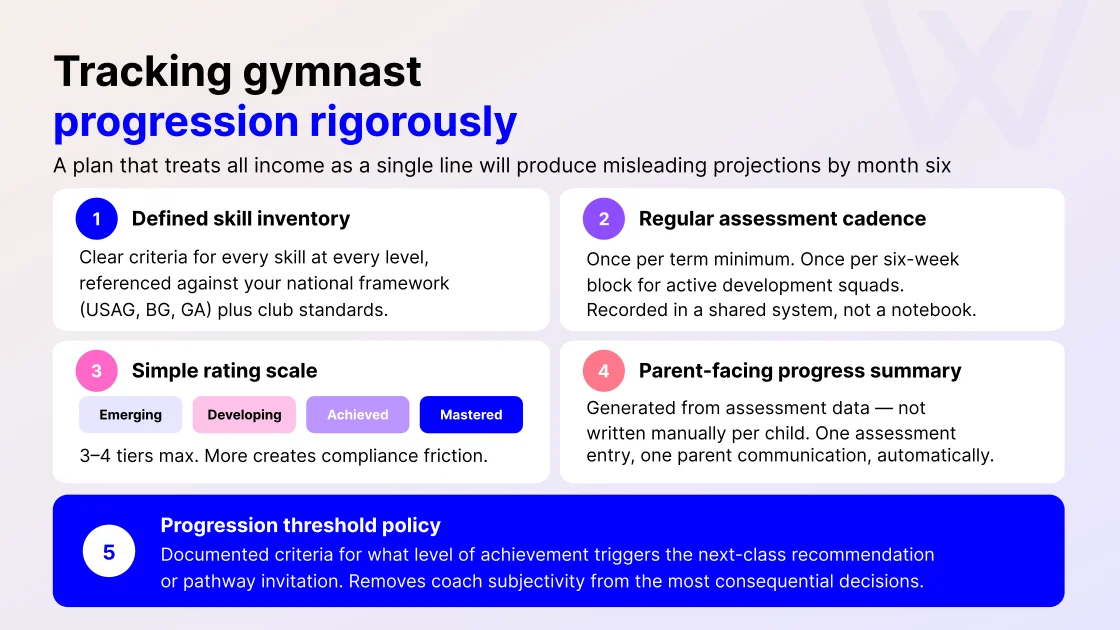
A functional skill assessment system needs five components:
- A defined skill inventory for each class level, with clear criteria for each skill referenced against your national framework (USAG, BG, or GA) and supplemented by club-specific standards.
- A regular assessment cadence at minimum once per term, ideally once per six-week block for active development squads — recorded in a shared system, not a notebook.
- A simple rating scale with three or four tiers (Emerging / Developing / Achieved / Mastered) is sufficient. More complex scales create compliance friction, and coaches stop using them.
- A parent-facing progress summary, generated from assessment data rather than written manually per child. One assessment entry generates the parent communication automatically.
- A progression threshold policy with documented criteria for what level of achievement triggers a recommendation for the next class level or pathway invitation, removing coach subjectivity from the most consequential decisions.
“The biggest shift we made was treating our class program like a living, breathing document, not something you set up once and leave. Every term, we reviewed what was working and updated accordingly.” — Danielle, Grit to Greatness Performance Center.
Implementing this with Wellyx gymnastics software means coaches log skill assessments digitally after each session, progress reports generate automatically, and studio owners have a real-time view of which gymnasts are approaching readiness for pathway transitions.
The pathway conversation
The moment when a recreational gymnast is identified as a competitive pathway candidate is one of the most important interactions a club manages. Best practice is a formal 20–30 minute scheduled meeting between the child’s lead coach and the parents, at which the coach presents assessment data and explains what the development squad pathway looks like (time commitment, costs, competition expectations). Clubs that conduct these conversations formally report significantly higher acceptance rates and lower attrition in the first competitive year.
Running competitions and grading events: The admin you need to get right
Hosting a gymnastics competition or grading event is the highest-prestige activity a club can undertake and one of the most administratively complex. Clubs that host well build enormous brand equity. Clubs that host poorly face parental complaints and potential national body sanctions.
The pre-event checklist
- Submit your national body sanction application (USAG, BG, or GA) a minimum of eight weeks in advance; without a sanction, results cannot be officially recorded, and competitor insurance may be void.
- Have all competition apparatus inspected by a qualified equipment technician and document this with a written certificate.
- Book qualified judges and verify their credentials with the national body.
- Verify every participating gymnast holds a current national body membership at least four weeks before the event.
- Complete a written risk assessment for the venue, apparatus, and event format.
- Distribute a detailed parent information pack two weeks before the event, covering: schedule, warm-up procedures, spectator guidelines, gymnast kit requirements, results publication timeline, and safeguarding contacts.
Day of logistics and results management
The pre-event checklists get you to the morning of the competition. What happens across the next 6–10 hours determines whether parents leave talking about how well the club ran the event, or how chaotic it felt.
- Build a 60-minute buffer before the first warm-up: Apparatus checks, judge briefings, and scoring system tests always overrun. Build the buffer in deliberately; do not treat it as slack that can be absorbed if you start on time.
- Assign a floor manager separate from the head coach: The head coach needs to coach. The floor manager handles judge queries, apparatus issues, gymnast withdrawals, and parent concerns, insulating the coaching function from operational interruption.
- Run scoring on a dedicated system, not a spreadsheet: Most national bodies now provide or endorse digital scoring platforms. Manual scoring is where errors happen, and a disputed score published to parents is the single worst reputational outcome of a competition day.
- Publish results within 24 hours. Best practice:
- Same day: Provisional results at the venue
- Within 24 hours: Confirmed results pack emailed to all families
Any longer and the competitive energy dissipates: any shorter risks publishing uncorrected errors.
- Send a post-event communication within 48 hours to every family, regardless of placement. A two-paragraph note thanking parents, acknowledging preparation, and previewing what the coaching team will focus on next is one of the highest retention touchpoints a club can send.
- Families who medalled: Warm congratulations
- Families who placed lower: Encouragement and next-focus framing
Internal grading events: The underused retention tool
Internal grading events are one of the most underexploited retention strategies in club management.
Unlike external competitions, club-run assessments against your own skill framework, presented with competition-style ceremony, require no national body sanction, no third-party judges, and minimal logistical overhead. Run one at the end of each term, keep it to 90 minutes, celebrate every gymnast regardless of skill level, and make the atmosphere genuinely celebratory rather than evaluative. Parents who attend internal grading events report dramatically higher satisfaction, and gymnasts who perform publicly for the first time are measurably more likely to continue toward competitive pathways.
Choosing gymnastics club management software
At some point in the growth of a gymnastics studio, the spreadsheets, WhatsApp groups, paper registers, and email waitlists reach their limits. The question is not whether to invest in gymnastics studio management software; it is which platform fits your program model, your budget, and your team’s technical comfort level.
What gymnastics-specific software must handle?
| Feature Need | Generic Gym Software | Gymnastics-Specific Need |
| Enrollment model | Rolling monthly memberships | Term-based enrollments with waitlists per class |
| Class management | Drop-in/session booking | Fixed class groups with age/ability banding |
| Payment structure | Monthly direct debit | Term fees in advance + competition levies |
| Progression tracking | Attendance only | Skill-level assessment linked to student profile |
| Parent communications | Generic email / SMS | Athlete-specific progress reports and portal access |
| Competition management | Not applicable | Event registration, fee collection, results distribution |
| Multi-squad management | Single program | Recreational + multiple squad levels simultaneously |
“We tried a tool that was a powerful general gym management platform, but almost too much. I don’t have time to learn the ins and outs of something that wasn’t built for what we do. I needed something that understood classes, terms, and parent communication out of the box.”
Danielle, Grit to Greatness Performance Center, Studio Operations Manager
Danielle‘s experience is characteristic of the gymnastics sector’s relationship with technology: the tools that exist for fitness gyms are designed around a different business model, and forcing a gymnastics club to operate within them creates friction that staff notice, parents notice, and the bottom line reflects.
Key software selection criteria
- Term-based enrollment engine: Can the system handle start/end dates by term, automatic re-enrollment prompts, and waitlist management that does not require manual intervention?
- Age-group and class-level structure: Can you create class groups that combine age banding and ability level, with separate capacity management for each?
- Parent portal: Do parents have access to their child’s profile, booking history, upcoming class schedule, and progress notes, without having to contact the studio directly?
- Automated communications: Can the system send term reminders, payment notifications, progress updates, and schedule changes automatically based on triggers you set?
- Payment flexibility: Does it support term-fee invoicing, direct debit, competition levy collection, and payment plans, or only recurring monthly membership billing?
- Progression tracking integration: Is gymnast skill assessment data stored in the system, linked to each athlete’s profile, and accessible to parents and coaches?
- Reporting: Can you see real-time enrollment numbers by class, revenue by program stream, and retention rates by age group, without exporting to a spreadsheet?
Expert tip: Software selection
Before committing to any gymnastics management software platform, map out your five most time-consuming admin tasks and ask each vendor to demonstrate, live, not in a pre-recorded demo, how the software handles each one. Pay particular attention to how the system manages your September enrollment spike. If the demonstration involves manual steps at any point, that manual step will cost you hours at your busiest moment of the year.
Financial management: Term fees, competition levies, and keeping cash flow positive
Gymnastics studio financial management has a distinctive structure that differs from most fitness businesses. The combination of term-based fees, seasonal enrollment patterns, competition levies, squad fees, and equipment depreciation creates a financial model that requires active management, not just bookkeeping.
Revenue stream architecture
| Revenue Stream | Typical Margin | Seasonality | Notes |
| Recreational Term Fees | 55–70% | High (Sept/Jan peaks) | Highest volume; set pricing at cost + target margin |
| Development/Competitive Squad Fees | 45–60% | Moderate (year-round) | Lower margin due to coaching intensity; higher absolute revenue per gymnast |
| Competition Levies and Event Fees | 20–35% | Seasonal (comp calendar) | Often underpriced; factor in judge fees, venue costs and admin time |
| Merchandise and Retail (leotards, bags) | 30–50% | Sept peak, Christmas | Low volume but high loyalty signal; branded kit builds club identity |
| Workshops, Intensives, Holiday Camps | 40–60% | School holidays | Excellent cash-flow smoother for the summer trough; high parent demand |
How much do gymnastics studio owners make?
Typical owner income at operational maturity:
- Mid-sized hybrid program (150–300 gymnasts): $45,000–$85,000 annually, typically reached in year 2–3.
- Multi-site or strong competitive program (400+ gymnasts): $120,000+, usually supported by a second revenue stream such as facility hire or holiday camps.
Treat the owner’s salary as a fixed cost in the P&L from day one. Drawing an irregular salary based on what’s left is one of the most common financial errors in small studio management. If the business cannot sustain a market-rate salary for the owner, the financial model needs revision before the business scales.
Competition levies: The most commonly underpriced item
Competition levies, fees charged to squad gymnasts to cover the cost of entering, hosting, and traveling to competitive events, are systematically underpriced in most gymnastics clubs.
The error is consistently in the same direction: clubs include the national body entry fee and the travel cost, but forget to factor in the coach’s time (at their contracted hourly rate), the admin time to submit entries and collect results, the cost of any equipment transport, and the club’s overhead contribution for competitions hosted in-house.
A more rigorous approach to levy calculation:
- List every cost associated with a competitive season (entry fees, travel, accommodation, judge fees for home events, admin hours, equipment hire).
- Divide the total by your competitive gymnast headcount.
- Add a 15–20% buffer for late entries, last-minute withdrawals, and logistical contingencies.
- Review annually. Competition costs trend upward, and clubs that have not raised their levies for 3+ years are subsidizing competitive gymnastics from their recreational revenue.
Financial transparency builds trust
“Financial reporting has to be clear enough that you can have an honest conversation with the team about what’s being invested in each part of the program. If the numbers are hidden, trust breaks down, both within the team and with gymnasts’ families.”
Thamar, Asylum Fitness, Club Director
Thamar’s point about financial transparency extends to parent relationships as well as internal dynamics. Clubs that publish a clear fee schedule, including what competition levies cover and how they are calculated, experience fewer payment disputes and a far greater understanding when levies need to increase.
Cash flow smoothing: Surviving the summer trough
June, July, and August present a structural cash-flow challenge for gymnastics studios in the northern hemisphere. Enrollments are at their annual low; many families suspend membership, fixed costs: lease, insurance, and permanent staff, continue regardless. The studios that navigate the summer trough without crisis use one or more of the following strategies:
- Holiday gymnastics camps: 3–5 day camps during school holiday periods generate revenue from your existing families and attract new families as a low-commitment trial. Margin is strong because sessions are intensive rather than term-long.
- Facility hire: If your studio is unused on certain days during the summer, hire the space to other sports or activity providers. A gymnastics facility with a foam pit and sprung floor is valuable to dancers, parkour athletes, and cheer teams.
- Adult gymnastics: Adult recreational gymnastics is a growing market segment that operates independently of the school-year calendar. Running one or two adult classes per week throughout the summer provides a base-level revenue that is completely counter-cyclical to your junior program.
- Prepaid annual memberships at a discount: Offer families a 10–12% discount on the following year’s term fees if paid in full in May. This brings forward September revenue into your weakest cash-flow month.
Growing your gymnastics club: Marketing to parents, retention strategies, and facility expansion
Growth in a gymnastics club is not primarily a marketing problem; it is a retention and referral problem. The average gymnastics studio loses 20–35% of its recreational enrollment per year through natural attrition and preventable churn. Addressing retention before marketing investment is always the higher-ROI activity.
The retention math
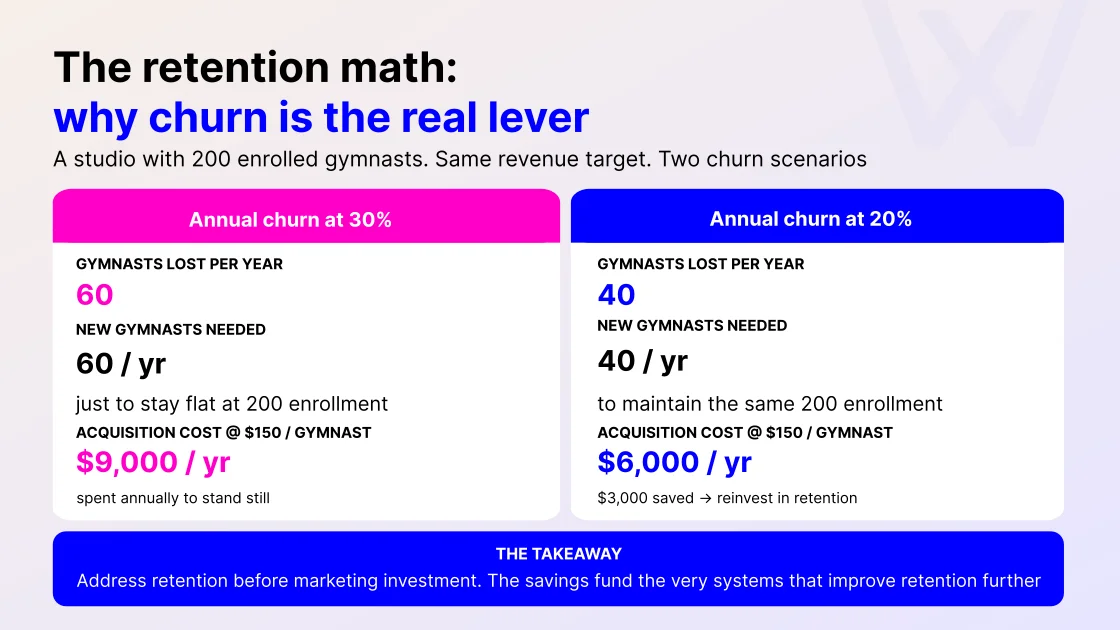
A studio with 200 enrolled gymnasts and 30% annual churn must recruit 60 new gymnasts per year just to stay flat. At a $150 average customer acquisition cost, that is $9,000 per year to stand still. Reduce churn from 30% to 20%, and the studio needs only 40 new gymnasts, reducing acquisition spend to $6,000. The $3,000 saved is more than enough to fund the parent communication improvements, progress tracking systems, and staff training that would produce the retention improvement.
Across gymnastics clubs that have consolidated fragmented systems, separate tools for bookings, payments, communications, and reporting, onto a single platform, the consistent finding is that retention improves not because of any single feature but because friction is removed from the experience families and staff have every week. When a parent can view their child’s schedule, receive a progress update, and pay a competition levy without contacting the studio, their sense of being looked after rises, and with it, their likelihood of re-enrolling the following term.
Marketing strategies that work in gymnastics
- Open days and taster sessions: The highest-converting single marketing activity for gymnastics studios. A child who attends a 30-minute taster class converts to an enrolled gymnast at a rate of 35–55% in most clubs, dramatically higher than any digital advertising campaign.
- School partnerships: Establish gymnastics as a curriculum or extra-curricular activity in local primary schools. One well-managed school partnership can generate 15–30 new enrollments per term.
- Sibling referral incentives: The most cost-efficient acquisition channel in gymnastics is a sibling of an existing gymnast. A formal sibling discount (10–15% on the second child’s term fee) generates far more goodwill than the cost of the discount.
- Social media: Gymnastics is one of the most visually compelling youth sports, and short-form video is the natural format. Three content types consistently outperform polished produced video:
- Skill progression clips: A gymnast attempting a skill over 4–6 weeks, cut together to show development
- Behind-the-scenes coaching moments: A coach spotting a first handspring, a squad warming up, a pit-session attempt
- Milestone celebrations: First cartwheel, first back handspring, level promotion
All require written parental consent and a focus on progression rather than performance judgment.
Realistic cadence: 3–4 posts per week on Instagram and TikTok, one longer-form reel per week, and a monthly YouTube upload for parents searching the studio by name. An iPhone clip posted weekly outperforms a professionally edited reel posted monthly.
Google Business Profile: The majority of gymnastics studio searches are local (‘gymnastics classes near me,’ ‘kids gymnastics [town]’). An optimized, actively managed Google Business Profile, with current hours, photos, and parent reviews, is the most cost-effective digital marketing investment a local studio can make.
Facility expansion signals
Expansion decisions in gymnastics are among the highest-stakes a studio owner makes. Unlike a yoga studio that can add classes in an existing space, gymnastics expansion usually means a larger facility, more apparatus, higher insurance, and more coaches, a step-change in cost structure.
The signals that a gymnastics studio is genuinely ready to expand:
- Sustained waitlist depth: A waitlist of more than 20% of current enrollment, consistently across two or more terms, indicates genuine unfulfilled demand rather than a seasonal spike.
- Coach pipeline: You have at least one assistant coach ready to step into a lead role, and at least one lead coach who can take on increased hours or a senior coaching responsibility.
- Financial reserves: At a minimum of 6 months of projected new-facility operating costs in liquid reserves before signing a new lease.
- Operating system scalability: Your current management software, communication systems, and financial processes can handle double the enrollment without proportionally doubling admin time.
Role of operational clarity in growth
The moment we got all our systems under one roof: bookings, payments, communications, reporting, was the moment expansion felt possible rather than terrifying. Before that, we couldn’t see clearly enough to make good decisions.
Anmarie, KokoBeenz, Multi-Discipline Studio Owner
Anmarie’s insight is the defining principle of sustainable gymnastics club growth: operational clarity precedes strategic confidence. Studios that try to expand while still managing on fragmented systems consistently underestimate the admin burden of growth and burn out their management team in the process.
If you are ready to build a gymnastics studio that can genuinely scale, from 100 gymnasts to 300, from one program stream to three, from a single facility to a second site, the foundation is a management system that grows with you.
Book a free Wellyx demo to see how gymnastics-specific management software handles the operational complexity from every aspect of a gymnastics studio.
Wrap up
Running a gymnastics studio successfully requires mastery across disciplines that most business-building frameworks do not address in combination: the safety and compliance demands of a regulated youth sport, the emotional complexity of parent relationships, the operational precision of term-based program management, and the financial discipline of a business with pronounced seasonal cash-flow cycles.
The clubs that endure, the ones that build genuine community institutions rather than transient activity providers, are those that treat every chapter of this guide as a continuous practice rather than a one-time setup task. They revisit their class structures every term. They invest in their coaching team as a primary business asset. They communicate with parents as partners, not as customers. They measure gymnast progression rigorously. And they build their operational infrastructure, their software, their processes, their communication systems to scale before they need to scale, not after.
If you are at the beginning of this journey, use this guide as your framework. If you are scaling an established program, use it as an audit tool, identify the chapters where your practice is strongest, and be honest about the ones where the gaps are costing you retention, revenue, or coach goodwill.
Build the systems that let your coaches coach. Build the communication habits that keep parents informed and confident. Build the financial structures that let you invest in the program rather than merely survive from term to term.
Book a free demo to see how purpose-built gymnastics management software can unify every operational function: enrollments, parent communications, progression tracking, financial reporting, and more.
Frequently Asked Questions
How much does it cost to start a gymnastics studio?
Starting a gymnastics studio typically costs between $136,000 and $481,000 USD, depending on location, facility size, and program model. The largest variable is the apparatus. A working capital buffer of at least three months of operating costs is essential before opening.
What certifications do gymnastics coaches need?
In the USA, coaches must be registered USAG Professional Members and complete USAG SafeSport training annually. In the UK, coaches require a British Gymnastics Coach License (L1–L4) with current safeguarding certification. In Australia, coaches must hold Gymnastics Australia accreditation and a valid Working With Children Check (WWCC) for their state.
How do I handle the September enrollment spike?
The most effective strategy is a phased enrollment process: priority re-enrollment for existing families in May, a waitlist registration open to the public in June, and staggered booking releases in August (waitlisted families first, then public). Pair this with gymnastics management software that automates waitlist progression and online booking.
Should I run a recreational program, a competitive program, or both?
Most commercially successful gymnastics studios operate a hybrid model: a recreational program that feeds into a development squad, which in turn feeds a competitive pathway. This model maximizes customer lifetime value, provides a natural internal acquisition channel, and generates dual revenue streams with different seasonal profiles.
How do I price gymnastics term fees?
Price term fees by calculating your total cost base per class (facility cost allocation, coach wages, insurance, equipment depreciation, admin overhead) and then applying a target margin of 55–70% for recreational classes. Competition levies require separate modeling: calculate all costs for a competitive season per gymnast head, add a 15–20% buffer, and review annually.
What software do I need to manage a gymnastics club?
Gymnastics clubs need software that handles term-based enrollment, age-group and ability-band class management, parent portal access, automated communications, competition levy collection, and gymnast progression tracking. Generic gym management platforms often lack term-based enrollment structures and skill assessment modules.
How do I retain gymnasts and reduce churn?
The primary drivers of gymnast retention are parent communication quality, perceived progression, and social belonging. Invest in structured progress updates (at minimum once per term), a formal parent communication calendar, in-club grading events that celebrate achievement, and a clearly articulated development pathway so families always understand where their gymnast is headed.