



The best personal trainer scheduling apps under $200/month in 2026 are Wellyx ($99/month Excel; $199/month Exceed) for PT studios that need scheduling, packages, payments, reminders, and client records in one place; Acuity Scheduling ($20/month) for standalone booking; Vagaro ($23.99/month US base) for solo trainers who want booking, reminders, POS, and marketplace visibility; Fitli ($49/month Solo) for budget-friendly PT scheduling; and ABC Trainerize ($79/month Small Business) for coaching-first trainers who need workouts and scheduling together.
Before comparing individual tools, it helps to understand how personal training software streamlines the business end-to-end; scheduling is only the entry point.
Most trainers I’ve met chose their scheduling software badly. They went for the cheapest plan, or copied a friend’s setup, or picked the first name that came up on Google. Sometimes a sales rep called at the right moment and won by default. Six to twelve months in, the same issues keep surfacing: prepaid packages don’t deduct properly, the SMS bill lands a hundred dollars higher than expected, Calendar sync causes a double booking on a Tuesday morning. So the owner switches, and clients get another app to download.
With more than 15 years of experience in gym and studio operations, this is still one of the most expensive mistakes I watch owners repeat, and it’s usually not the software’s fault. Nobody sat with the owner for an hour and asked how the business actually runs before recommending an app. Scheduling is not only admin; it sits between you and your revenue. A missed session is a lost billing event. A forgotten reminder empties a slot you’ve already paid a trainer to hold. That reality carries more weight in 2026 than it did five years ago.
According to the Health & Fitness Association’s 2025 US Health & Fitness Consumer Report, 23% of US fitness facility members used a personal trainer in 2024, but the average sessions per member fell from 28 in 2019 to 21 in 2024. Fewer sessions per client mean each booked slot carries more revenue weight, and each miss costs more.
How were these personal trainer scheduling apps chosen?
Every app had to clear four filters:
- Public pricing under $200/month in USD, on a plan a real operator would actually pick.
- Scheduling or appointment booking as a core feature, not a bolt-on to something else.
- Automated reminders, email at minimum, SMS strongly preferred.
- A real fit for solo personal trainers or PT studios in the US market.
Every price in this article is verified directly against the vendor’s live pricing page in July 2026. Where I couldn’t confirm a claim publicly (SMS included versus metered, package auto-deduction, no-show automation), I wrote that out plainly instead of guessing. I did not use vendor-supplied comparison charts, affiliate summaries, or third-party review roundups as sources of truth on pricing or features.
However, three tools you’ll see recommended elsewhere were considered and left off on purpose:
- Mindbody Starter sits under $200 on the surface, but Mindbody’s own comparison doesn’t clearly show email or SMS marketing on the Starter tier, and the total cost stacks transaction fees and text costs on top. For a reminder-first article, that made it too messy to recommend cleanly.
- PushPress and TrueCoach are strong in the wider fitness market. Their publicly available sub-$200 plans did not clearly combine scheduling with automated reminders, so I could not include them confidently.
The 8 best personal trainer scheduling apps under $200/month
Wellyx: Best all-in-one for PT studios that want scheduling, packages, POS, and reminders in one system. Excel from $99/month; Exceed at $199/month.
Setmore: Best for a free starting point with paid team features. Free plan available; Pro from $12/user/month (monthly billing).
Acuity Scheduling: Best for standalone booking with strong appointment controls. Starter at $20/month (monthly); Standard at $34/month (monthly) for SMS reminders and packages.
Vagaro: Best for solo or mobile trainers who also want POS and marketplace visibility. $23.99/month US base (limited-time pricing).
Fitli: Best budget-friendly scheduling with clean tier growth. Solo from $49/month.
ABC Trainerize: Best for coaching-first trainers who deliver programming, habits, and nutrition alongside sessions. Small Business from $79/month.
Zen Planner: Best for structured membership studios under 100 active members. From $99/month for 0–45 members.
TeamUp: Best for small studios that want active-customer-based pricing. $119/month for 0–100 active customers.
1. Wellyx
Starting price: Excel at $99/month; Exceed at $199/month
Best for: PT studios that want scheduling, packages, POS, payments, and reminders in one system. Suitable for small and growing PT studios, hybrid gyms with a personal training arm, and even facilities that want scheduling, packages, payments, reminders, and reporting inside one system.
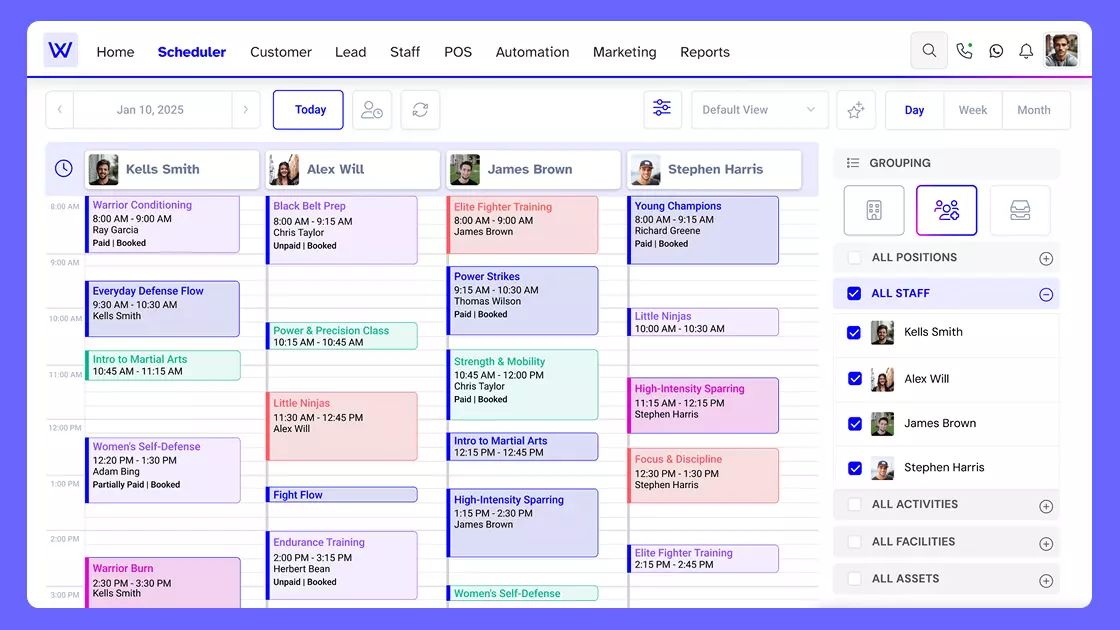
Wellyx is an all-in-one personal training management platform built for fitness businesses that need more than a booking calendar. Scheduling, packages, POS, billing, and communication share the same client record.
For a solo trainer with 30 clients, that’s more than the business needs. For a small PT studio with 2–5 trainers running mixed offerings (1:1 PT sessions, semi-private, memberships, drop-ins), the connected workflow is where the value shows. Excel at $99/month covers what most smaller studios actually use. Exceed at $199/month stretches into more advanced operations without leaving the $200 frame.
What’s in it
- Membership and package management.
- Personal training appointments and class bookings.
- Online booking and client self-service.
- Email, WhatsApp, SMS, and push notifications.
- POS, billing, invoices, and payment processing.
- Google Calendar sync.
- Member and staff mobile apps.
- Lead management and client profiles.
- No-show fees and guest accounts.
Pricing
| Plan | Monthly price | Best fit |
| Excel | $99/month | Small PT studios and growing solo trainers |
| Exceed | $199/month | PT studios with more advanced operations |
| Ultimate | $299/month | Above the $200 scope of this article |
Wellyx PT studio management software is more platform than a solo trainer with 15 clients needs. If your business needs more than basic booking, payments, and text reminders, Wellyx becomes a more relevant option. Exceed also sits right at the $200 ceiling, so compare Excel and Exceed carefully; most small studios can start on Excel and upgrade when the operational load justifies it.
2. Setmore
Starting price: Free plan available; Pro at $12/user/month (monthly), $5/user/month (annual).
Best for: Solo trainers who want a free starting point and straightforward booking tools.
Setmore is a general appointment scheduling tool that is not fitness-specific but handles booking-page basics well. The free plan covers up to 4 users, 200 appointments per month, and email reminders. Pro adds unlimited appointments, SMS reminders, 2-way calendar sync, recurring appointments, and the ability to remove Setmore branding from your booking page.
What’s in it
- Branded booking page with a custom URL.
- Unlimited appointments on Pro; 200/month on Free.
- Email confirmations and reminders on both plans.
- SMS reminders on Pro.
- 2-way calendar sync on Pro.
- Recurring appointments on Pro.
- Payments via Stripe, Square, and PayPal.
- iOS and Android apps.
Where it falls short: Setmore is not purpose-built for personal training, since it caters to barbershops, automotive and photography businesses. Before you commit to using it for your PT business, test how it handles prepaid session packs (auto-deduction, expiration prompts), no-show fees, and trainer-specific availability. If any of those feel bolted on, you’ll outgrow the tool within a year.
3. Acuity Scheduling
Starting price: Starter at $16/month (annual), $20/month (monthly); Standard at $27/month (annual), $34/month (monthly).
Best for: Solo trainers, consultation-based PTs, and coaches who want a professional booking page with tight appointment rules and don’t need front-of-house software behind it.
Acuity is a Squarespace-owned scheduling tool that does client self-scheduling very well. It is not fitness-specific, but for a PT who needs a professional booking link, payment collection, intake forms, and reminders, it’s one of the cleanest options here. Standard is the realistic starting tier for a trainer because that’s where SMS reminders and appointment packages/memberships begin.
What’s in it
- Client self-scheduling with automatic time-zone conversion.
- Payments via Stripe, Square, and PayPal.
- Email reminders on all plans.
- SMS reminders from Standard upward.
- Appointment packages, memberships, subscriptions, and gift certificates from Standard upward.
- 1 calendar on Starter, up to 6 on Standard, up to 36 on Premium.
- Custom intake forms.
Where it falls short: Acuity is a scheduling tool, not a studio operating system. It won’t cover staff management, POS, commission tracking, or deeper studio reporting. If you have a front desk taking in-person payments or multiple trainers running packages, the gap shows fast.
4. Vagaro
Starting price: $23.99/month US base subscription (limited-time pricing).
Best for: Solo trainers, mobile trainers, and appointment-first wellness-style studios that also want POS and some organic marketplace reach.
Vagaro is an appointment-led platform built for wellness, fitness, salon, and spa businesses. For a solo personal trainer, the entry point is genuinely low. The base subscription includes one calendar license, online booking, appointment reminders, packages, memberships, POS, and a listing on Vagaro’s marketplace that occasionally sends walk-ins.
But the real catch is that most of Vagaro’s power lives in premium features priced separately. So the sticker price tells you very little about the real monthly cost.
What’s in the base
- 1 calendar; additional calendars at $10/month each (up to 7).
- Online booking.
- Appointment reminders (SMS, email, push).
- Packages and memberships.
- POS.
- Vagaro Marketplace listing.
- Customer waitlists.
What’s extra
- SMS Small plan: $20/month for 1,000 credits
- Forms: $10/month
- Branded App: $100/month
- Vagaro MySite (website): $20/month
- Payroll: $34/month + $5/employee
Where it falls short: Vagaro is wellness-first, not fitness-first. It works for a solo PT or mobile trainer. For a PT studio with multiple trainers, recurring package workflows, and no-show fee automation, test package tracking and trainer-specific scheduling on a trial before committing.
5. Fitli
Starting price: $49/month Solo
Best for: Budget-friendly scheduling for solo trainers, small studios, and operators who want clear pricing and useful tools without paying for depth they’ll never touch.
Fitli is a no-nonsense scheduling and booking platform. Clear plans, useful features, no attempt to be an operating system. Its four tiers, Solo at $49/month, Grow at $89/month, Expand at $109/month, and Enterprise at $149/month; all sit under the $200 frame, so you can grow with it without a hard cliff.
What’s in it
- Unlimited appointments, classes, and workshops.
- Online and mobile booking.
- Recurring bookings.
- Cancellation policies.
- Session banks with expiration tracking.
- Automated reminders (email and/or SMS).
- Integrated payments (fees priced separately).
- Client purchase and booking history.
Where it falls short: Payment processing fees sit outside the subscription, so model your real monthly cost against transaction volume. Fitli is more practical than polished. If you need advanced reporting, multi-location management, or deeper marketing automation, you may grow past it. For a solo PT or a 2-trainer studio, that’s not a problem.
6. ABC Trainerize
Starting price: Small Business from $79/month (for up to 30 clients)
Best for: Coaching-first trainers who deliver programming, habits, and nutrition alongside sessions. Online-plus-in-person trainers, hybrid coaches, and PTs who sell programming as a core part of the offer.
Trainerize is different from every other tool on this list, and you should be clear about that going in. It is not primarily a booking app. It’s a coaching platform where scheduling lives alongside workout programming, habit tracking, nutrition guidance, and client messaging, all inside a client-facing app.
If your paid offer is just the session, it’s overkill. If your paid offer is a coaching relationship where the session is one component of a bigger client experience, it’s one of the strongest sub-$200 options.
What’s in it
- Workout programming and delivery.
- iOS and Android client app.
- Appointments and classes.
- Calendar sync.
- Consultation forms.
- Product sales.
- Session packs.
- Stripe payment processing.
- Habit and nutrition tools.
Where it falls short: Trainerize is coaching-first, not front-desk-first. It won’t run a multi-trainer studio with POS, cross-trainer memberships, and deeper reporting. Some advanced business tools sit behind add-ons, so run the real setup cost before you buy.
7. Zen Planner
Starting price: $99/month for 0–45 active members; scales to $189/month for 76–100 active members
Best for: Small studios with structured memberships, martial arts-style facilities, and PT operations that sit inside a broader membership model.
Zen Planner is a studio management platform used mostly by martial arts schools, CrossFit-style boxes, and small fitness studios with a defined member base. Pricing is member-count-based, which is fair; you pay for the size of your business, not per staff seat.
The sub-$200 fit depends on where you sit in that count. Under 45 members: $99/month. 46–60: $133/month. 61–75: $155/month. 76–100: $189/month. Once you cross 100 active members, standalone Zen Planner pricing moves above the $200 limit used in this article. Trainers weighing it against the alternatives usually work through the same Zen Planner FAQs on member-count pricing and add-on costs first.
What’s in it
- Online scheduling.
- Automations.
- Billing and payments.
- Reporting and dashboards.
- Member app and staff app.
- Member self-service.
- Attendance tracking.
- Retail and POS.
Where it falls short: Add a website bundle, an engagement bundle, or a branded app, and the total monthly cost can move above $200 quickly. For studios expecting to grow past 100 active members inside 12 months, the pricing runway needs modeling before you buy.
8. TeamUp
Starting price: $119/month for 0–100 active customers
Best for: Small PT studios with 50–150 active clients, semi-private training, and membership-based facilities.
TeamUp is a strong fit for small fitness studios that sell a mix of memberships, packs, appointments, and classes. Pricing is based on active customers. The $119 monthly plan covers 0–100 active customers and includes the core feature set: memberships and packs, appointments, instructor availability, waivers, online booking, payments, and messaging.
What’s in it
- Memberships and packs.
- Appointments and instructor availability.
- Online booking.
- Waivers and forms.
- 2-way calendar sync.
- Email messaging and SMS notifications.
- POS, online, and in-person payments.
- Gift cards and penalty (no-show) system.
Where it falls short: $119/month is a real entry point for a solo trainer with a small book; it can feel expensive until you cross 30–40 active clients. SMS usage stacks on top of the subscription, and the Custom Branded App is +$99/month. Model your real cost with reminders and, if relevant, the branded app before you commit.
Personal trainer scheduling apps compared side by side
| App | Starting price | Automated reminders | Calendar sync | Session packages | Payments | Best fit |
| Wellyx | $99/mo Excel | Email, SMS, WhatsApp, push | Google Calendar | Yes | POS, billing, online | PT studios |
| Setmore | Free / $12/user/month (Pro monthly) | Email; SMS on Pro | 2-way on Pro | Limited; verify | Stripe, Square, PayPal | Low-cost solo start |
| Acuity Scheduling | $20/mo Starter monthly ($34 Standard for SMS) | Email; SMS from Standard | Google, iCloud, Outlook | Yes (Standard+) | Stripe, Square, PayPal | Booking-link PTs |
| Vagaro | $23.99/month US base | Email, SMS, push | Calendar and resource tools | Yes | Vagaro payments | Solo/mobile trainers |
| Fitli | $49/mo Solo | Email and/or SMS | Google Calendar | Yes | Integrated (fees separate) | Budget PTs |
| ABC Trainerize | $79/mo Small Business | Auto messages | Calendar sync | Yes | Stripe | Coaching-first PTs |
| Zen Planner | $99–$189 under 100 members | Automations | Online scheduling | Yes | Billing and payments | Membership studios |
| TeamUp | $119/mo, 0–100 customers | Email; SMS usage-based | 2-way sync | Yes | Online, in-person, POS | Small studios |
Why does this decision need proper guidance?
Let me put the choice in context, because the industry has shifted in a way that changes what your scheduling app needs to do.
According to the U.S. Bureau of Labor Statistics, employment of fitness trainers and instructors is projected to grow 12% from 2024 to 2034, much faster than the 3% average across all occupations. The BLS expects approximately 74,200 openings each year during that period. The pool of trainers is growing. The competition for the same client attention is growing with it.
At the same time, the Health & Fitness Consumer Report shows something quieter and more important. US fitness facility membership hit a record 77 million in 2024. Of those members, 23% used a personal trainer that year and 32% took part in small-group training. But members averaged 21 PT sessions per year, down from 28 in 2019.
Sit with that shift for a second. More people are interested in coaching. Each session carries more revenue weight than it did before the pandemic reset. A forgotten appointment, an expired package, or a payment that never gets collected is not a small admin miss anymore; it’s a bigger share of your annual client value than it was five years ago.
So the app you pick in 2026 is a business decision, not just a workflow decision.
What features to look for in PT scheduling software?
Before we get to the trade-offs by business type, here are the essential features for PT scheduling software to look for in the plan itself.
- Online client self-booking: A client should be able to pick a service, choose a trainer, select a time, use a session credit or pay, and get a confirmation without texting you or creating an account before they see availability. If your booking page asks for a phone number and a signup before showing the calendar, clients drop off. You pay for that friction whether you see it or not.
- Automated reminders that connect back to the booking: A confirmation at booking. A 24-hour reminder. A 1–2-hour nudge. What matters most is what happens after the reminder. If a client replies “cancel,” does the calendar update? Does the no-show fee trigger? Does the waitlist fill the slot? If those workflows don’t share a system, you’re paying for a reminder tool, not a business tool.
- Two-way calendar sync: A trainer’s schedule rarely lives in one place: Google Calendar for personal commitments, Outlook for business, and a studio calendar for staff availability. One-way sync can work in a pinch. Two-way sync is the only real protection against double-booking. Check whether the app supports Google, Outlook, or iCal, and whether sync goes both ways.
- Session package tracking: This is where general appointment apps quietly fall apart. A proper PT scheduling app tracks 5-, 10-, and 20-session packs, drop-ins, semi-private packs, expiration dates, renewal prompts, and remaining balances automatically. If you still need a spreadsheet to know whether a client has 2 sessions left or 6, the software is not doing its job.
- Payments that stay tied to bookings: Payment should be part of the booking, not a separate flow. What you want is a system where a booking, a package deduction, and a payment record are the same event. Stripe, Square, PayPal, or built-in processors all work; the question is whether payment, session credit, and booking stay linked.
The real cost of ownership
The sticker price is not the price you pay. I’ve watched more studios get burned by $29/month tools that turned into $180/month than I’ve watched pick the wrong platform outright. Here are the five cost categories to check on every vendor:
- SMS credits: Is SMS included, or usage-based? Is there a monthly minimum or a credit pool? Are reminders billed separately from marketing texts? What happens when you go over? A trainer sending three texts per session (confirmation, 24-hour, 2-hour) burns credits faster than the demo makes obvious.
- Payment processing fees: Check the gateway rate, any platform surcharge on top, card-on-file handling, failed payment retries, refund fees, and no-show fee triggers. If you process $10,000/month in packages and PT payments, a 0.3% platform surcharge adds $30/month you weren’t planning on.
- Per-calendar or per-staff fees: A solo trainer only needs one calendar today. Price the tool at two or three calendars if you’re planning to hire in six months. This matters most on platforms that charge per additional calendar and least on customer-count platforms.
- Add-on modules: SMS marketing, forms, branded apps, advanced reporting, website tools, payroll, nutrition, video coaching, marketing automation. Ask for the add-on catalog on the demo call. If the vendor is coy about it, you already have your answer.
- Tier jumps. Active-member and active-customer pricing is fair, but you need to know where the jumps are. The four questions I ask on every demo: what do I pay at 50 clients, at 100 clients, at 150 clients, and what features move behind a higher tier as I grow?
Automated reminders in practice
I’ve watched studios debate reminder timing for hours. What actually works in the field:
- Booking confirmation, sent immediately after the client books. Email is fine; keep it clean.
- 24-hour reminder: this is your cancellation window. Give the client time to move the session inside your policy.
- 1–2-hour reminder, short SMS. This is the one that saves the session.
- Staff alert: notify the trainer if a client cancels or replies late, so nobody’s waiting.
- No-show rule, tied to your payment policy. Automatic, or you won’t enforce it.
Channel by purpose: SMS works best close to the appointment because it’s short and hard to miss. Email is better for anything the client might need to reference later, forms, receipts, and preparation notes. Push notifications only matter if the client already uses your app.
Easy booking in practice
Your booking flow should feel almost invisible. A client shouldn’t have to wonder where to book, how many sessions they have left, whether they can pay now, whether they can move Thursday’s session, or whether the booking went through. The path should be obvious: pick the service, choose the trainer, select a time, use a credit or pay, get a confirmation.
- Test the mobile experience first: Most clients book from their phone. If your booking page is slow, cramped, or asks for account creation before showing availability, you’re leaking bookings you’ll never see.
- Test the package purchase flow next: A client buying a 10-pack should be able to buy the pack and book their first session on the same path. If they have to buy the pack, wait for an email, come back later, and try again, you’ve added friction where revenue should be easy.
- Behind the scenes, easy booking needs real control:
- Buffer time between sessions
- Trainer-specific availability
- Room or equipment limits
- Cancellation windows
- Recurring session logic
- Waitlist rules
- Payment policies
Simple for the client. Controlled for you.
How to choose the right app for your business
Three questions usually determine the right type of scheduling app:
- Are you a solo trainer or managing a team?
- Do you need in-app workout delivery and nutrition tracking, or just scheduling and billing?
- Do you offer 1:1 sessions, group classes, or both?
Based on your answers:
- Solo + scheduling-only + 1:1 → Setmore, Acuity, Vagaro, or Fitli lane.
- Solo + programming + hybrid → Trainerize lane.
- Team + mixed offerings → Wellyx, TeamUp, or Zen Planner lane.
More detail by business type
Solo PT with under 50 clients. Prioritize simplicity and low real cost. Compare Fitli, Acuity Scheduling, Setmore, and Vagaro. You need booking, reminders, payments, package tracking, and calendar sync. Not much else. With the admin handled, the leverage shifts back to the coaching itself, where the right personal trainer tips do more for retention than any feature list.
Solo PT selling coaching, not just sessions. ABC Trainerize becomes more relevant when your paid offer includes programming, habits, nutrition, and remote check-ins alongside in-person work. Scheduling is one piece of a bigger client experience.
Small PT studio with 2–5 trainers. Compare Wellyx, TeamUp, and Zen Planner. You need staff calendars, trainer availability, package tracking across trainers, shared client records, payments, and reporting. A simple appointment app will get you started, then start to leak. As a studio scales past a couple of trainers, the operational setup, from staff calendars to personal training studio design ideas, starts to matter as much as the booking flow.
Growing past 5 trainers. The sub-$200 category narrows fast. Wellyx Exceed at $199/month stays inside the budget while supporting broader operations. TeamUp works too, but model active-customer pricing, branded app cost, and SMS usage carefully. Cost per active client becomes more useful than sticker price.
Five questions to ask on every scheduling app demo
If the vendor is clean and clear, that tells you something. If they’re vague, that also tells you something.
- Is SMS included at this tier, or is it usage-based?
- Can clients buy a package and book their first session in the same flow?
- Do session credits auto-deduct when a client books or attends?
- Can trainers sync external calendars without double-booking?
- What will my real monthly cost be with 2 trainers, SMS reminders, payments, and 100 active clients?
Bottom line
The best scheduling app for your PT business is not the one with the longest feature list. It’s the one that takes the most friction out of your week, for your clients and for you.
For a PT studio, the better answer is usually one connected system where bookings, packages, payments, staff schedules, and client communication stay linked as the business grows. Wellyx sits at $99/month on Excel and $199/month on Exceed, both under the $200 frame, both built to keep the moving parts connected.
For a solo trainer, that usually means a clean booking link, reliable SMS reminders, and simple payment collection. Fitli, Acuity, Setmore, and Vagaro all do this well.
For a coaching-first trainer, ABC Trainerize fits better because workouts, habits, messages, and appointments sit inside one client relationship.
When your calendar starts holding more of the business than your memory can safely carry, better software stops being optional. If you want to see how Wellyx would fit your specific business, book a demo, and we’ll walk through the setup with a real person on the other end.
Frequently asked questions
1. What features should a personal trainer scheduling app include?
At a minimum: online client self-booking, automated SMS and email reminders, two-way calendar syncing (Google, Outlook, or iCal), session package tracking, and built-in payment processing to collect deposits or full payment at booking. Recurring session management, no-show fee automation, and multi-trainer availability matter more once your business grows past a solo book.
2. How much do personal trainer scheduling apps cost in 2026?
The tools in this guide range from free (Setmore Free) to $199/month (Wellyx Exceed). Solo trainers typically spend $30–$120/month once SMS reminders and packages are added. PT studios spend more because staff calendars, POS, billing, and reporting cost more to deliver.
3. Do personal trainer scheduling apps send automated SMS reminders?
Many do, though not always on the lowest plan. Wellyx, Fitli, Vagaro, Acuity (from Standard), Setmore (on Pro), and TeamUp publicly list SMS features. TeamUp and Vagaro treat SMS as usage-based or a separate plan, so check the exact reminder setup and cost before you buy.
4. What’s the difference between scheduling software for solo PTs and PT studios?
Solo PTs need a clean booking link, reminders, payments, and session tracking. PT studios need multi-trainer calendars, staff roles, recurring packages, memberships, POS, billing, reporting, no-show policies, and client records shared across the team.
5. Can personal trainer scheduling apps take payments and manage session packages?
Yes. Most tools in this guide support payments and some form of packages, memberships, or session packs. The real question is whether payment, booking, and session credit tracking are automatically linked. If those three don’t connect, you’ll reconcile by hand.
6. Which personal trainer scheduling app is best for solo trainers under $200/month?
For solo trainers with a small book, Setmore (free or $12/user/month Pro), Acuity Scheduling ($34/month Standard for SMS reminders), and Fitli ($49/month Solo) are among the most affordable and straightforward options. Vagaro ($23.99/month base) fits if you also want POS and marketplace visibility. ABC Trainerize ($79/month Small Business) fits if you’re delivering programming alongside sessions.
7. Which personal trainer scheduling app is best for small studios under $200/month?
For small PT studios with 2–5 trainers, Wellyx ($99/month Excel or $199/month Exceed), TeamUp ($119/month for 0–100 active customers), and Zen Planner ($99–$189/month for under 100 members) are the strongest sub-$200 platforms. Each fits a slightly different structure: Wellyx for connected all-in-one operations, TeamUp for customer-count pricing, and Zen Planner for membership-first studios.