





Hard skills like curriculum architecture, Yoga Alliance compliance, and anatomy expertise form the baseline of any Yoga Teacher Training. But true YTT leadership is defined by somatic self-regulation, cohort facilitation, holding space through trainee life transitions, delivering actionable feedback, enforcing scope-of-practice boundaries, and preparing trainees for long-term career sustainability.
Hard skills help your YTT program meet its registration and training requirements. Leadership skills help your trainees transform. That distinction separates a serviceable training from a program graduates recommend for the next decade. The modern trainer’s role has moved past the content-holder model. Trainees today are not paying primarily for information they could pull from a textbook. They are paying for guidance through vulnerability, identity formation, and the practical craft of teaching.
What follows are the leadership skills that make that passage possible.
A trainer is a group facilitator, not just a curriculum holder
Teaching a public yoga class and leading a teacher training are structurally different jobs. Public classes ask you to hold a room for an hour. Trainings ask you to hold people for months, through personal disclosures they did not plan to make, through fatigue by module six, and through the friction of a group learning something hard.
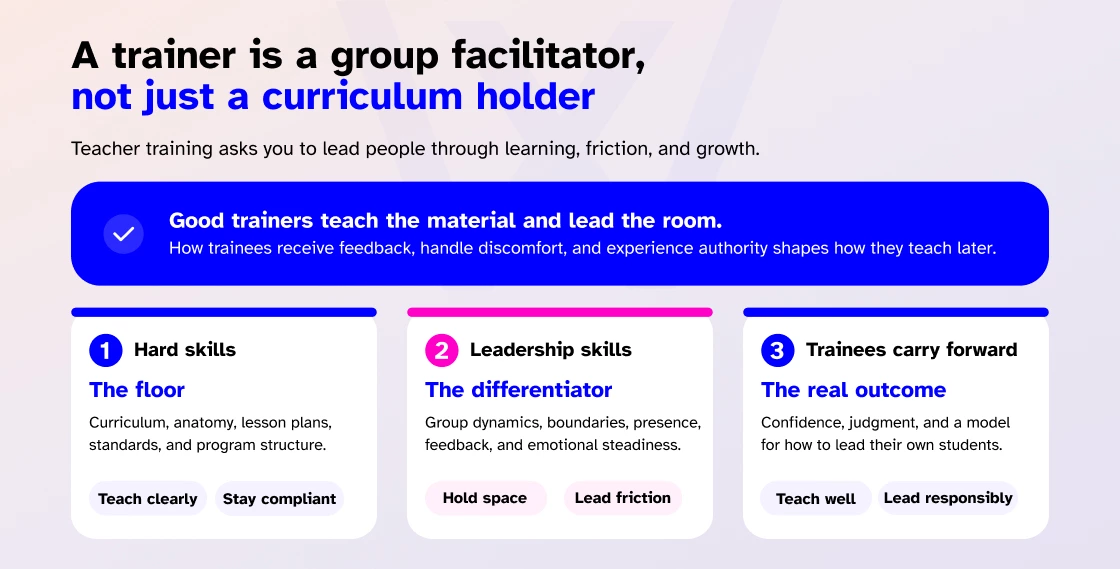
Trainees remember how they were taught to process discomfort, receive critique, and hold authority. That memory shapes every student they teach in the future.
Hard skills vs. leadership skills
Both categories are non-negotiable. Neither is sufficient on its own.
| Dimension | Hard Skills (The Floor) | Leadership Skills (The Differentiator) |
| Primary Focus | Instructional mechanics, standards compliance, curriculum delivery | Group dynamics, somatic presence, trainee transformation |
| Development Route | Certification, manual study, regulatory research | Repeated cohort facilitation, mentorship, honest debriefs |
| Tactical Examples | Lesson planning, anatomy modules, financials, Yoga Alliance logging | Self-regulation under friction, holding space, boundary enforcement |
| Systemic Impact | Ensures legal, financial, and accredited program survival | Produces confident, emotionally intelligent teachers who actually teach |
The technical foundation: Hard skills every yoga teacher trainer needs
Before addressing leadership, name the floor. Without these hard skills, no facilitation talent will save a program from failing by its second cohort.
Curriculum architecture and andragogy. Design modules grounded in adult learning theory, not rote memorization. Structure around problem-based learning cycles, practice-teaching loops, real-time application to observable outcomes, and reusable yoga class plan templates trainees can adapt after graduation.
Compliance and accreditation. Know the current hour, curriculum-category, and Lead Trainer requirements for the relevant Yoga Alliance credential. Understand Lead Trainer requirements for RYS registration. Communicate yoga instructor certification pathways clearly so trainees know what their credential will authorize.
Objective assessment protocols. Build rubrics that evaluate cueing, alignment, sequencing, and hands-on judgment against specific criteria. Cueing has observable components that can be scored consistently.
Financial and legal literacy. Understand cohort break-even math, refund policy design, and liability waiver requirements. Know when your program’s income triggers additional tax obligations.
These are the containers. What fills them with value is everything below.
Somatic self-regulation: Lead yourself before leading the room
Core principle: Your nervous system is the loudest thing in the room. If you cannot regulate yourself, it becomes much harder to steady and lead the cohort effectively.
Trainees read your state of regulation before they read your syllabus. When you are anxious about time, the cohort gets anxious. When you are frustrated by a repeated question, trainees retreat and stop asking. When you are grounded, the group tends to settle. Adults orient to the nervous system carrying the most authority, whether you intend it or not.
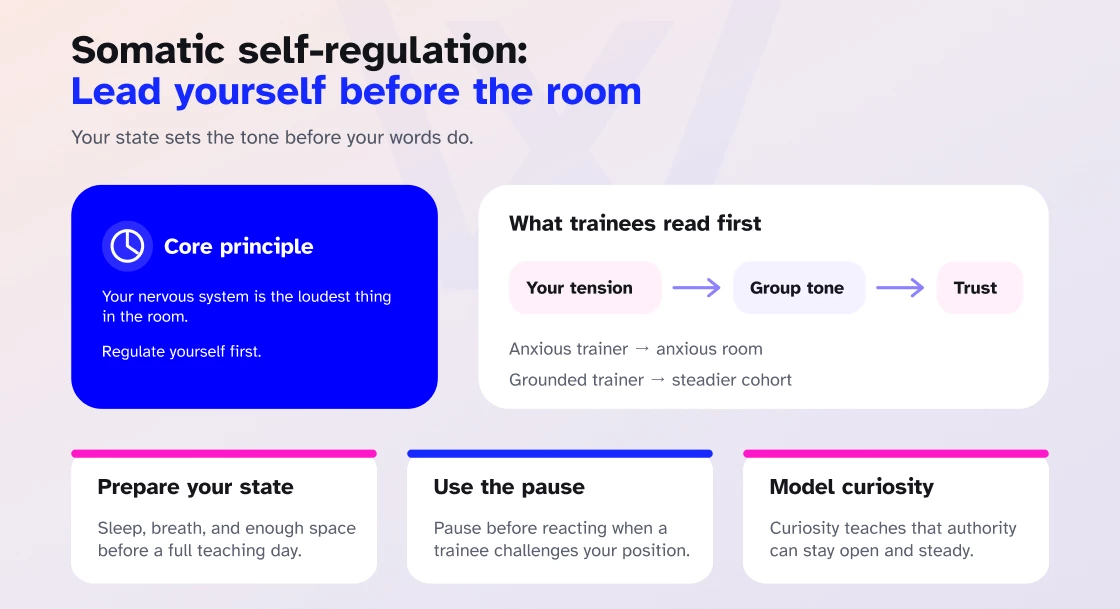
Self-regulation is not a soft skill. It is the operational foundation of everything you do as a trainer. In practical terms, that looks like protected sleep before a full teaching day, a breath practice you actually use when the room goes sideways, and a habit of pausing before responding when a trainee challenges your position.
The pause is the discipline. Public defensiveness from a trainer teaches the cohort that authority is fragile. Curiosity as a first response teaches the opposite: that even the person at the front of the room is willing to remain a learner. That is the modeling that lands.
Holding space in 200-hour and 300-hour cohorts
Most 200-hour and 300-hour trainees are navigating more than a course. Many are working through career shifts, divorces, retirement, grief, or a quieter reevaluation of what the second half of life should look like. That context does not appear on the enrollment form, but it walks into your room on day one.
Holding space has a specific meaning here. It means creating enough structure that trainees can risk something meaningful, without adding so much structure that nothing real happens. If the space is held too loosely, the training can become an unstructured therapy session. If it is held too tightly, it can become a lecture nobody remembers.
The leadership demands shift by training level.
The 200-hour container: Safety scaffolding
Trainees at this level need:
- Clear cueing frameworks and sequencing basics.
- Confidence to teach a beginner-friendly class safely.
- Predictable structure that lets first-time teaching risks feel survivable.
The 300-hour container: An honest mirror
Trainees at this level need:
- Space to refine their teaching voice.
- Support in developing subject specialization.
- Direct feedback on what kind of teacher they want to become.
Your role shifts from safety scaffolding to honest mirror. Both containers require honoring the human without derailing the curriculum. That balance is the skill.
The 3-step feedback loop: Constructive feedback trainees can use
Feedback is where most trainings silently fail. It is either too gentle, and nobody improves, or too harsh, and trainees stop taking risks. The middle is learnable.
Vague praise like “Great job!” teaches nothing. Harsh critique like “Your cues were wrong” produces shame without direction.
The 3-step feedback loop provides a repeatable structure:
- Observe: State neutral, specific facts. “When you cued the left foot forward, three of us hesitated.”
- Impact: Attach the observation to what happened next. “The hesitation broke the flow, and one trainee stepped into the wrong pose.”
- Re-try: Offer a concrete adjustment for the next attempt. “Name the leg that stays back first, then the leg that steps. Give it another go now.”
The structure does specific work. It names what happened. It attaches the problem to a visible effect. It offers a concrete alternative. It ends with an invitation, not a verdict. Normalize mistakes as data. When you frame feedback that way, trainees stop hiding their weaker moments and start bringing them to you.
Navigating YTT group dynamics and archetypes
Every cohort arrives with recognizable archetypes. Naming them privately helps you respond instead of react.
The over-talker: Usually anxious rather than dominant. Give this trainee a small structural role: timekeeper, opener of the check-in, note-taker. The energy has somewhere to go, and the room recalibrates.
The silent perfectionist: She has erased her lesson plan three times the night before her practice teach. She needs one small public risk-taking moment that turns out fine. Assign her the first micro-teaching slot after a low-stakes activity so the preparation-to-exposure ratio works in her favor.
The resistant veteran: This trainee has done nine other trainings and mentions each one. Integrate her experience into peer feedback roles rather than fighting for authority. When you make her a resource, the resistance usually resolves.
Peer-to-peer tension: Intervene privately and early. Group-level lectures about respect do not fix specific interpersonal conflicts. A brief one-to-one with each party, followed by a facilitated conversation if needed, keeps friction from becoming a cohort-wide morale issue.
The pattern: watch, name what you see privately, and choose the smallest intervention that keeps each trainee engaged in their learning.
Ethical boundaries & scope-of-practice leadership
Two boundaries define the ethical baseline for any lead trainer.
Scope of practice
A yoga teacher trainer is not a therapist. When a trainee’s psychological distress falls outside your educational role, your responsibility is a compassionate referral to appropriate mental health care, not deeper engagement with the material yourself. Have a written referral protocol in place before the training begins. Know who you refer to. Communicate the referral privately and without shame.
Gatekeeping integrity
Not every trainee who completes the required hours should receive certification. A trainer who signs off on someone not ready to teach safely is passing the problem downstream to that person’s future students. Withhold or delay certification when standards are not met. Design a documented extended mentorship plan rooted in the specific gaps identified in your rubrics. Communicate the decision early and privately, not on graduation day.
Both boundaries require ethical courage, which is why they distinguish serious programs from certificate mills.
Manage authority transparently. Establish clear touch and consent protocols. Avoid favoritism, even the subtle kind. Trainees notice which voices matter to you and draw conclusions.
Building trainee teaching confidence through strategic scaffolding
Trainees confuse confidence with the absence of fear. Every experienced teacher still gets a small pulse of nerves before a class they care about. Confidence is the willingness to teach anyway. Real confidence is forged by navigating discomfort with guidance, not by having discomfort removed.
Scaffold exposure deliberately: A useful progression is pair teaching first, followed by small-group micro-teaching, half-cohort teaching, full-cohort teaching, and finally a public class with the trainer observing but not intervening. Each step is small enough that no single one becomes existential, and cumulative enough that by the final phase, the trainee has built genuine competence rather than simply performed confidence.
Address imposter syndrome directly: Name it in the room. Trainees carrying the belief that they are frauds waiting to be exposed will teach from that belief unless it is surfaced.
Encourage trainees to drop the perfect-teacher facade: Trainees who study one influential teacher too closely often mimic voice, pacing, and phrasing that were never theirs. Your role is to help them find their authentic voice, which usually means teaching from what they actually know.
The modern YTT trainer’s expanded role
The trainer’s role has widened over the past decade. Three shifts matter most.
Trauma-informed facilitation: Yoga Alliance now accredits trauma-informed continuing education, and trainees increasingly ask whether a program covers the material. Integrate choice-based language into every module (“if it feels available today”), maintain transparent touch and consent protocols, keep schedules predictable, and normalize opt-out without explanation. If trauma-informed teaching exceeds your training, bring in a qualified specialist rather than approximating it yourself.
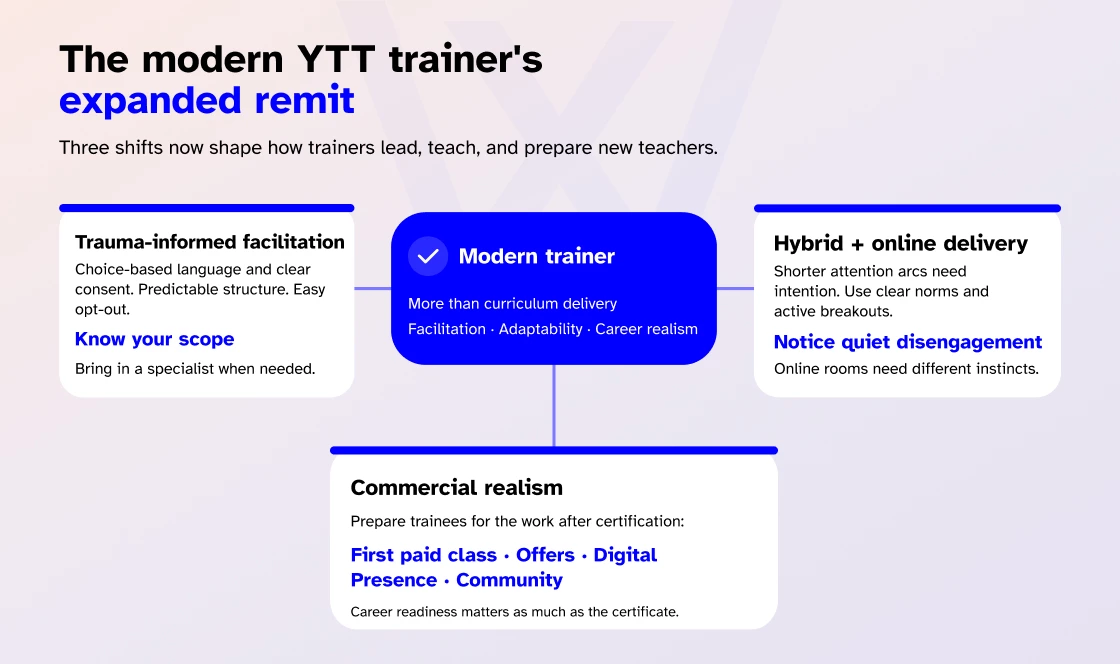
Hybrid and online delivery: Fully in-person cohorts are no longer the default. Leading a screen-facing group demands different skills: shorter attention arcs, deliberate camera-on norms during discussion, breakout rooms that do not collapse into silence, and a way to notice the trainee who is quietly not okay when you cannot see her posture. Trainers who translate in-person instincts directly to online rooms usually fail.
Commercial realism: Trainees graduate into a saturated market where a certificate alone does not build a career. A modern training addresses the challenges new yoga teachers face at the beginning of their careers: teaching a first paid class, designing offers beyond hourly rates, and helping trainees think clearly about content creation, digital presence, and community-building without becoming full-time influencers.
Operational infrastructure and cohort governance
Leadership happens in the room. Systems around the room decide how much energy remains for leading.
A single 200-hour cohort produces significant administrative volume. Registration and payment plans. Contracts and waivers. Hours logged against Yoga Alliance categories. Practice-teaching evaluations. Attendance records. Certificate issuance. Mentorship scheduling for graduates. Post-training surveys.
Aligning co-trainers and guest faculty is its own operational skill. Set expectations before the cohort begins: shared group norms, consistent feedback style, aligned assessment standards, and weekly co-trainer debriefs. Trainees notice when guest faculty assess them more strictly than the lead trainer, and inconsistency undermines the rubrics.
Handled manually, this workload lands on the trainer in the two hours after every teaching day. That is the window where recovery, personal practice, and preparation should be happening. This is not a scheduling inconvenience. It is how trainer burnout begins.
Sustaining your leadership energy across multiple cohorts requires an administrative system that can operate without your constant involvement. Studio management platforms can consolidate registration, course bookings, payments, scheduling, and attendance tracking into one connected system. Wellyx is one such yoga software, built for studios running cohort-based programs alongside membership classes. The principle matters more than the software: unloading the admin is what keeps you leading well in year five, not just year one.
Self-audit checklist for lead trainers
Ask yourself, honestly, after your next cohort:
- Do you have clear, objective assessment rubrics for every practice-teaching module?
- Can you remain somatically calm when a trainee expresses frustration or defensiveness in a group setting?
- Is there a documented referral protocol for trainees experiencing mental health crises?
- Are you delivering feedback using observable facts rather than subjective opinion?
- Does your curriculum address career sustainability and business model diversification?
- Do you know why each trainee enrolled and what they came to change?
- Are you modeling the standard of practice you want your trainees to hold?
Owner action checklist for studio owners
If you own the studio and hire trainers to lead your YTT:
- Audit lead trainers on facilitation dynamics, not just content expertise.
- Implement software tools to streamline YTT attendance, payments, and compliance logging.
- Establish clear gatekeeping guidelines for certification readiness before the cohort opens.
- Host co-trainer alignment meetings every two weeks to keep feedback consistent.
- Budget for a co-lead or specialist to cover trauma-informed content properly.
- Track post-graduation outcomes six months out, not just satisfaction surveys.
Closing thought
Exceptional YTT programs are not defined by the thickness of their manuals. They are defined by the steadiness of their leadership. When you pair operational discipline with compassionate facilitation, you build something more than a curriculum. You build a training program that transforms trainees into resilient, career-ready teachers who will carry your standards into thousands of classes over the next decade.
The curriculum can be bought. The leadership has to be built. Streamline your YTT admin, scheduling, and cohort tracking with Wellyx so you can spend less time managing paperwork and more time leading your trainees.
Frequently Asked Questions
1. What is the difference between a yoga teacher and a yoga teacher trainer?
A yoga teacher guides students through practice. A yoga teacher trainer mentors future facilitators by teaching instructional mechanics, group dynamics, assessment methodology, and adult learning strategies. The teacher’s audience wants to practice; the trainer’s audience wants to teach.
2. What is the difference between hard skills and leadership skills for a YTT trainer?
Hard skills cover curriculum design, anatomy modules, and Yoga Alliance compliance. Leadership skills involve group facilitation, somatic self-regulation, constructive feedback, and holding space during trainee transformation. Hard skills keep the program structurally sound and aligned with applicable training requirements. Leadership skills determine whether it produces teachers who last.
3. How do you handle a trainee who is not ready to graduate?
Rely on objective rubrics established at the start of the program. Provide clear written feedback mid-training so the concern does not arrive as a surprise. Offer targeted re-assessment. If the gap remains, design an extended mentorship plan rather than certifying against your judgment.
4. What does trauma-informed leadership look like in a teacher training?
Trauma-informed leadership uses choice-based language throughout the curriculum, transparent touch and consent protocols, predictable schedules, clear emotional boundaries, and an environment that normalizes mistakes without public humiliation. Yoga Alliance accredits continuing education in trauma-informed practice for trainers who want to lead the material.
5. How do experienced yoga teacher trainers avoid burnout?
Set strict scope-of-practice boundaries. Delegate administrative logistics to management software. Use co-trainers or guest faculty for portions of the curriculum outside your specialty. Maintain a personal practice separate from YTT delivery. Limit the number of cohorts per year to allow adequate recovery. Schedule genuine recovery periods, including sabbaticals where practical.