



Dance studios can increase revenue in three main ways: fill more of the capacity they already pay for, build more predictable recurring income, and add services that make sensible use of existing instructors, rooms, students, or events. Private lessons, camps, workshops, rentals, merchandise, recitals, and digital training can all contribute, but only when the numbers and the workload actually make sense.
Running a dance studio looks promising until a slower season arrives. Profitability does not stay constant throughout the year, which is pretty normal. Studio owners still have utilities, staff, and rent to pay. In such slow seasons, owners start looking for revenue-boosting ideas for their dance studios. But this doesn’t necessarily mean the studio needs another side hustle. It means that there may already be revenue sitting inside the space, schedule, team, and audience you have.
Start with the revenue you already have room to earn
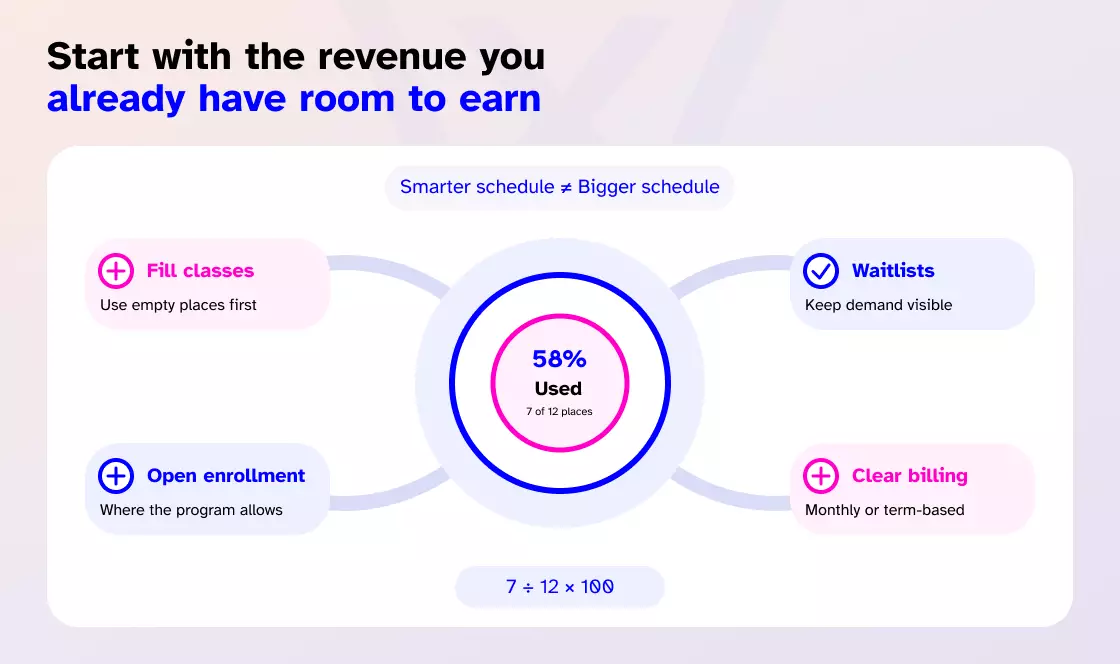
A new revenue stream usually requires setup, promotion, staffing, and admin. But filling the unused capacity you already have is much simpler, and it’s the first place to look before adding anything new.
1. Fill existing classes before adding more
Owners should still know how much capacity is being used. There is a simple way to check the class capacity:
Class capacity utilization = Enrolled students ÷ available places × 100
If a room safely holds 12 students and seven are enrolled, utilization is about 58%. That number does not tell you to cancel the class. It tells you where to look.
Look across the full schedule:
- Are three beginner classes competing for the same small pool of students?
- Is one slot consistently full while a similar time stays quiet?
- Could two fuller sessions work better than three half-full ones?
Sometimes revenue improves because the schedule gets smarter, not bigger.
2. Use waitlists instead of losing demand
A full class is good news until the next interested family has nowhere to go when a place opens. A class waitlist keeps the demand visible when a new spot opens or a spot in a similar class becomes available. If one beginner class repeatedly has a waitlist while a similar class down the hall runs half-empty, that’s a pattern worth acting on before you add another new offer.
3. Keep enrollment open where the program allows it
Year-round, rolling enrollment works well for beginner classes built around repeatable fundamentals. It allows a new student to join without holding anyone back. But it works far less well for competition teams, recital choreography, examination tracks, or progressive programs where new students cannot join midstream.
The useful question is:
Which programs truly need a cutoff, and which are closed because that is simply how they have always run?
Removing an unnecessary enrollment barrier can increase revenue without creating a new product.
4. Make billing more predictable
Predictable billing helps the studio forecast revenue and helps families understand what they are committing to. Monthly recurring tuition can work well for ongoing programs. Term-based pricing may suit studios built around school calendars, recitals, or examinations. Neither is automatically better; what matters here is clarity around:
- What the family is paying.
- How often they are billed.
- What the payment includes.
- What happens during breaks.
- How cancellations or changes work.
Moreover, clear dance studio sibling discounts and family pricing can support multi-child enrollment without turning every registration into a new discount conversation. Using a defined discount structure benefits both families and the dance studio.
Build more value around students you already serve
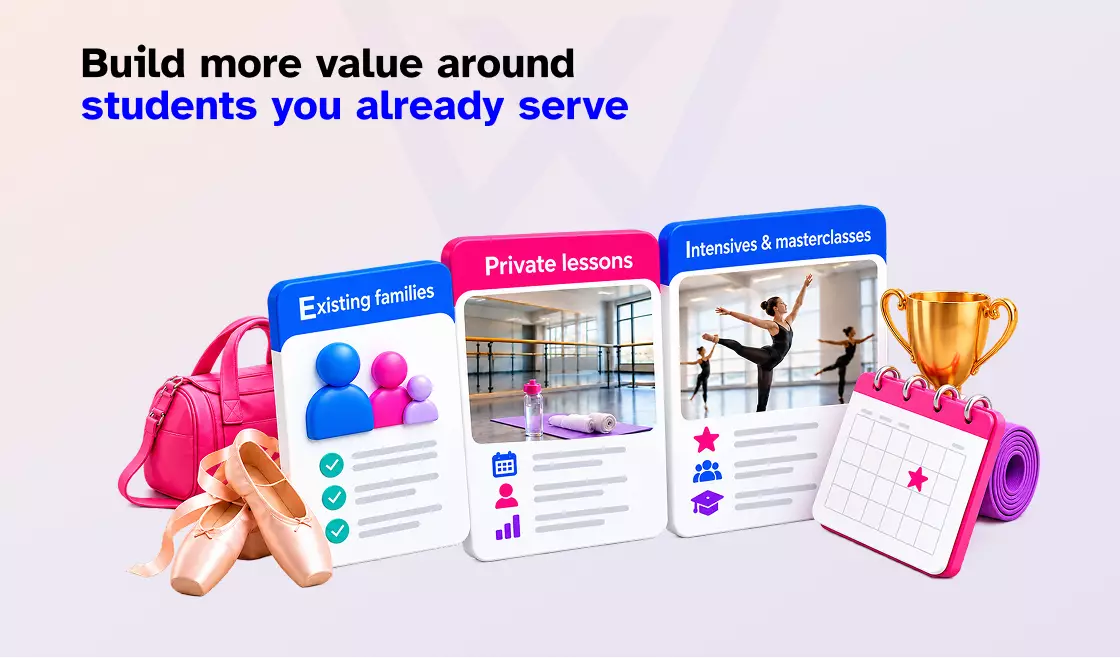
A family already enrolled is different from a cold lead. They know the teachers, the building, and already trust the studio enough to show up. This trust creates real room for multi-class participation or additional siblings when the programs genuinely fit, without needing to start every conversation with a discount.
5. Add private lessons where there is a clear need
Private lessons can support audition preparation, competition coaching, technique correction, catch-up work, individual performance goals, and wedding dance preparation where relevant.
Price should reflect more than the instructor’s hour. Consider:
- Is the instructor already on site?
- Is the room otherwise unused?
- What will the instructor be paid?
- Does the lesson block a higher-value group class?
- Is demand likely to repeat?
A private lesson slotted into a dead afternoon hour has very different economics from one that displaces your busiest evening class.
6. Use intensives and masterclasses for premium demand
Short programs can justify different pricing when they offer something outside regular tuition. For example, technique intensives, audition clinics, guest choreography sessions, conditioning workshops, and specialty masterclasses can bring in more revenue.
But a sold-out event is not automatically a profitable one. Even here you can’t risk overlooking the calculations. If a workshop collects $2,000 but spends heavily on the guest instructor, travel, extra staffing, and promotion, the event can still land with a disappointing margin. Remember to price the premium programs around the whole delivery cost, not just the instructor fee.
Use seasonal revenue to smooth uneven months
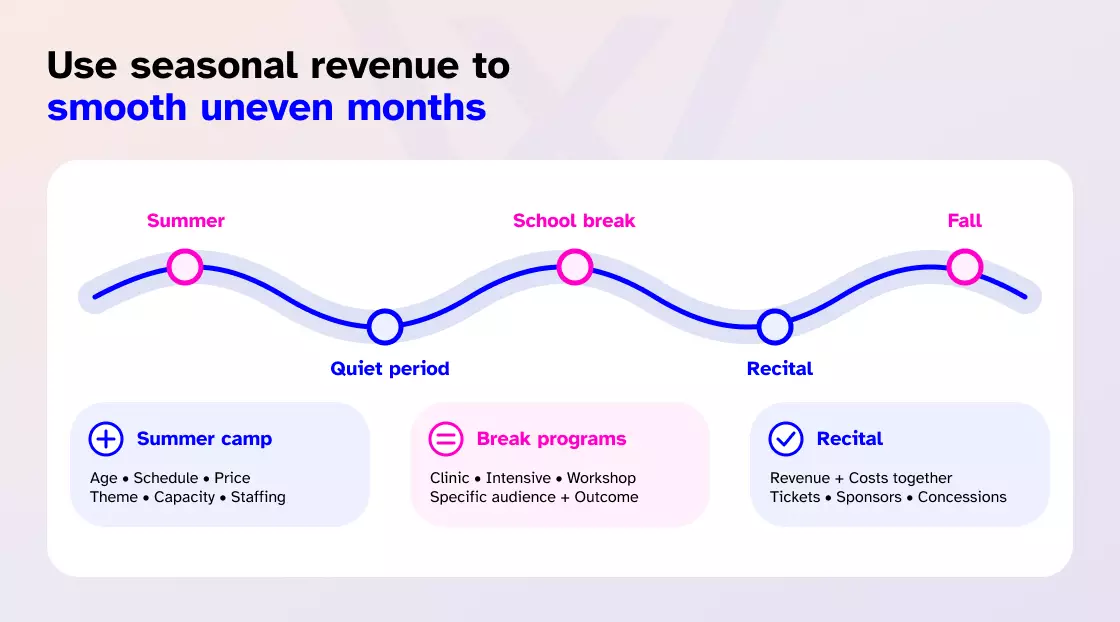
Dance studios do not earn the same amount every month. Build around those patterns instead of treating every quiet period like a surprise.
7. Turn summer into a defined product
Summer can soften regular attendance while opening daytime capacity. Camps work best as proper products rather than extra classes with a seasonal label. A good summer dance camp should have a clearly defined:
- Age group
- Capacity
- Schedule
- Theme
- Staffing plan
- Price
- Parent experience
A three-day beginner camp, choreography week, or acro intensive gives families something specific to understand and book while keeping them connected before fall.
8. Add short school-break programs
Technique clinics, audition prep, acro intensives, beginner workshops, and conditioning sessions give families a short yet specific commitment to book during breaks. A clear audience and a clear outcome sell better than a vague “special workshop.” “Two-hour beginner turns and spotting clinic for ages 10–13” is much easier for a parent to evaluate.
9. Treat recital revenue separately from recital costs
Recitals bring families around something they already care about, and they can generate revenue through tickets and, where appropriate:
- Merchandise
- Program advertising
- Sponsorship
- Concessions
- Photography or video arrangements
But recital revenue should be kept separate from recital operations. Ticket sales can look strong while venue, production, staffing, and processing costs can rise underneath the sales number. This shows that a recital can collect a lot of money and still leave a weak margin.
Pricing is also only one part of dance recital ticketing management. Seating, release windows, refunds, scanning, check-in, and parent communication determine whether the revenue arrives without creating operational problems. Keep event revenue visible, but keep the costs beside it.
Make the studio’s physical assets work harder
The studio is already paying for rooms and utilities. Some of that capacity may be able to earn more without changing the core program.
10. Rent unused studio hours
If a room regularly sits empty, rental income can help monetize an asset the studio already carries. You can rent out the space to independent instructors, rehearsal groups, performing arts teachers, photographers, wellness instructors, and community groups.
Before renting space, check the lease and insurance requirements. Also consider access, cleaning, security, noise, equipment use, and scheduling conflicts. The best rental income comes from hours that were truly idle. If a renter starts displacing one of your stronger programs, the economics have changed.
11. Sell merchandise without filling reception with unsold boxes
Merchandise can add revenue and deepen studio identity, but inventory is the risk. Start with items families have shown interest in rather than ordering a full range upfront, and lean on preorders and limited runs to reduce inventory risk.
A $40 hoodie is not $40 of contribution once wholesale cost, payment processing, replacements, unsold inventory, and staff handling are taken out. Merchandise works best when demand is visible.
Use digital revenue where dance translates well online
Digital offers remove one obvious limit, the number of people who fit in the room, but introduce different costs in their place
12. Use live virtual classes selectively
Some dance-related training works better online than others. Live virtual delivery may fit conditioning, flexibility, some technique work, and theory. It can also be a substitute in case of weather closures, long travel distances, or students who are temporarily unable to attend in person.
But virtual dance classes become less suitable when the class depends heavily on flooring, space, close correction, or movement that is difficult to assess through a screen. Use virtual classes because the format suits the training, not because “online” sounds scalable.
13. Build recorded products around real demand
Recorded training can include technique drills, flexibility programs, conditioning sessions, practice videos, or choreography breakdowns. These products can be sold without booking a room every time someone uses them, but that does not make them passive income.
Recording, editing, hosting, updates, instructor agreements, support, payment costs, and promotion are all ongoing costs. A small library built around questions students already ask is a stronger starting point than a large public catalog created on hope.
Use partnerships only when there is a revenue model
Local partnerships can create awareness or income. Paid school programs, corporate dance sessions, joint workshops, instructor hire, revenue-share events, sponsorship, and suitable retail arrangements all have a commercial exchange behind them.
If the main purpose is attracting new families, that belongs inside the wider dance studio marketing ideas strategy. If the purpose is revenue, ask four questions:
- What are we selling?
- Who pays?
- What does it cost to deliver?
- What remains afterward?
Run every new idea through the same operator test
Compare every new revenue idea using the same questions.
| Operator test | Question to ask |
| Demand | Do students or local customers actually want this? |
| Capacity | Do we have the room and instructor time? |
| Setup cost | What must be spent before the first sale? |
| Direct cost | What does each sale cost to deliver? |
| Margin | What remains after direct costs? |
| Recurrence | Is the income recurring, seasonal, or one-time? |
| Retention value | Does it strengthen the student relationship? |
| Lead value | Could it introduce future students? |
| Operational load | How much extra admin or staffing does it create? |
| Repeatability | Would we willingly run it again? |
An idle room points toward one opportunity. An instructor with strong audition expertise points toward another. A large preschool base may create a completely different one.
Measure what the new revenue stream leaves behind
Revenue tells you what came in, not if the idea was worth doing. But here are a few calculations for you to check this.
| Incremental revenue Number of sales × selling price Twenty students buying a $75 workshop creates: 20 × $75 = $1,500 |
| Contribution before overhead Incremental revenue − direct delivery costs If the same workshop carries $700 in instructor, staffing, and event costs: $1,500 − $700 = $800That $800 is more useful than saying the workshop “made $1,500.” |
| Revenue per room-hour Revenue generated ÷ room-hours used This helps compare different uses of the same studio space. |
| Revenue per active student Total revenue ÷ active students Track it over time to see whether additional services are meaningfully increasing the value generated around the current student base. |
| Add-on attach rate Students buying the add-on ÷ eligible students × 100 If 25 of 100 eligible families buy recital merchandise, the attach rate is 25%. |
You need enough information to answer one question:
Is this offer creating useful contribution, or just making the studio busier?
Know when revenue diversification has gone too far
While revenue-boosting ideas for dance studios bring in more money, they also create more operational work. Another camp means another schedule, another product means another payment process, and another workshop means more staffing and promotion. Watch for:
- New programs pulling students out of existing classes.
- Discounts becoming necessary to make offers sell.
- Merchandise sitting unsold.
- Workshops filling but leaving little after costs.
- Staff stretched across too many small programs.
- Events requiring weeks of admin for a modest return.
Revenue diversification should make the studio operations more manageable without demanding a separate tool. That is where full-featured dance studio software can become especially useful, because revenue still has to fit alongside staffing, scheduling, retention, payments, facilities, and the day-to-day experience of running the business. Knowing how much dance studio software costs under subscription and per-student pricing helps you weigh that tool against the revenue it supports.
The bottom line
Healthy revenue growth usually starts with what the studio already has. Fill the seats you can fill using the waitlist. Use quiet hours better. Make recurring income easier to predict. Rent your unused space to solo instructors and community groups. Let good instructors offer more where demand exists. Build seasonal products around real gaps, not random ideas.
Then keep the costs beside the sales numbers. A dance studio does not need every possible source of income. It needs the ones that make the business stronger. To implement these revenue-boosting ideas, dance studio owners need their billing system to be flexible enough to support the studio’s growing revenue mix. Platforms like Wellyx dance studio management software can support these additional revenue streams within the same system. Dance studio owners can rent out the facility, manage class waitlists, sell merchandise and inventory, and deliver recorded products through VOD.
FAQs
1. How do dance studios make money besides tuition?
Dance studios can earn additional revenue through private lessons, camps, intensives, workshops, studio rentals, merchandise, recital-related sales, commercial partnerships, live virtual classes, and recorded training. The strongest options usually use existing space, staff expertise, or current student demand more effectively.
2. What is the easiest way to increase dance studio revenue?
Start with existing capacity. Filling empty class places, keeping suitable programs open to enrollment, using quiet studio hours, and adding higher-value services for current students often require less setup than launching a completely new product.
3. What are the best revenue streams for a dance studio?
There is no universal best stream. Compare demand, capacity, instructor availability, setup cost, direct costs, margin, seasonality, and operational load. A good idea for a large children’s studio may be a poor fit for a smaller adult-focused one.
4. Can a dance studio make money from renting its space?
Yes, if unused studio hours can be rented without disrupting core programs and the lease, insurance, access, and local requirements allow it. Judge rental income after cleaning, access management, staff time, and other direct costs.
5. Are virtual dance classes profitable?
They can be, but profitability depends on demand, pricing, instructor time, technology, production costs, platform expenses, and customer acquisition. Virtual classes work best when the training itself suits online delivery.