





A parent mentions your studio to another parent after pickup. They say their daughter loves the class, the teachers are great, and the recital somehow made all those late-night costume adjustments worthwhile. Everything in this recommendation was genuine, but it missed the simplest next step: a referral.
A useful dance studio referral program gives existing families a clear reason to recommend the studio and prospective families a reason to try it. At the same time, it gives the business a way to see whether word-of-mouth is actually turning into enrollment.
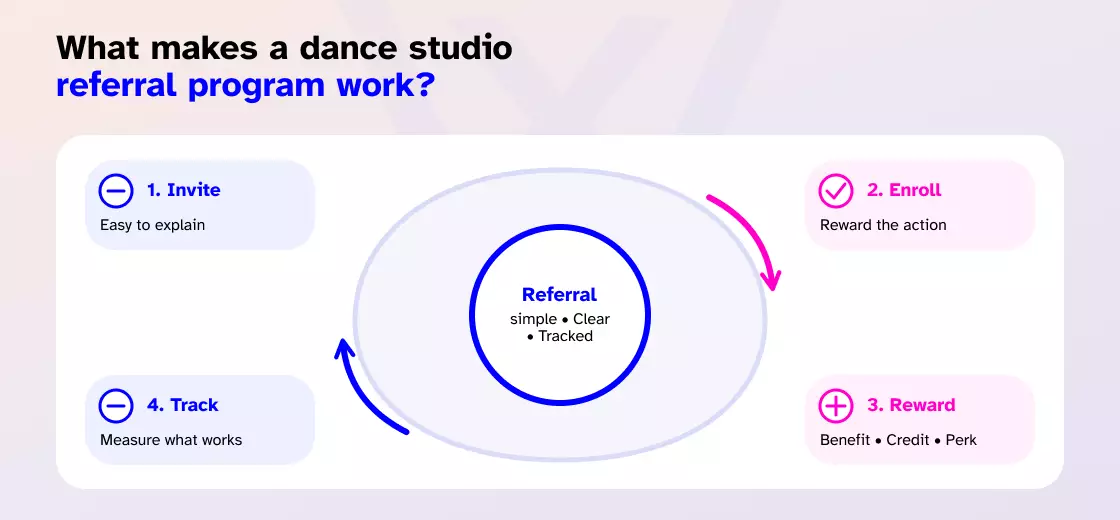
What makes a dance studio referral program work?
The strongest dance studio referral programs are easy to explain, reward a meaningful action such as enrollment or retention, and give both families a clear next step. Start with one or two offers, track the results, and only add more complexity when the basic program is working.
The reward does not always need to be cash. You can offer benefits, tuition credits, recital perks, merch, private coaching, trial experiences, or longer-term loyalty rewards. But the important part is matching the incentive to the behavior you want.
12 dance studio referral program ideas at a glance
The most suitable referral structure depends on tuition, instructor pay, available class capacity, and how each studio runs its events. Use this table as a decision guide rather than a fixed structure.
| # | Referral idea | Best for | Reward trigger | Cost exposure |
| 1 | Double-sided tuition credit | New enrollments | Student enrolls | Controlled |
| 2 | Family growth reward | Household expansion | Family member enrolls | Low–moderate |
| 3 | Milestone tuition reward | Repeat referrals | Referral target reached | Delayed |
| 4 | Recital VIP perks | High perceived value | Successful referral | Usually low |
| 5 | Referral-only merchandise | Recognition | Milestone reached | Controlled |
| 6 | Bring-a-bestie event | More trial visits | Guest attends | Low–moderate |
| 7 | Private lesson credit | Ambitious dancers | Student enrolls | Moderate |
| 8 | Golden ticket trial | Easy sharing | Ticket redeemed | Low |
| 9 | Seasonal prize draw | Ongoing participation | Qualified referral | Capped |
| 10 | Tiered referral rewards | Repeat advocates | Milestones reached | Scalable |
| 11 | Dance bestie reward | Retention | Both dancers stay | Controlled |
| 12 | Age-stage referral | Beginner enrollment | New dancer enrolls | Low |
Financial referral ideas: Make the value obvious
Financial rewards work because families do not need much explanation. A tuition credit or registration benefit has an immediate and understandable value. The key is paying the reward after the result, not before it.

1. Double-sided tuition credit
Best when: You want a referral offer that can be explained in one sentence.
A current family refers a friend. The friend enrolls. Once that enrollment meets the studio’s qualifying rules, both families receive a benefit. For example, the current family could receive a tuition credit while the new family receives a registration credit.
The strength of this model is that the referring parent is not simply saying, “Join because I get something.” They are giving their friend something useful too.
Reward trigger: After confirmed enrollment or another clearly defined qualifying point.
Watch for: Rewarding inquiries or free trials before they become paying customers. Give every family a referral code, tracked link, or referral field during registration. Staff memory is not a tracking system.
2. Family growth reward
Best when: Existing households contain realistic opportunities for another enrollment.
Sometimes the next student is already sitting in the lobby. A younger sibling may have spent months watching through the studio window. A parent might have considered an adult class. Another child may finally be old enough to join a beginner class.
A family growth reward can encourage that next enrollment without treating it like a completely new acquisition channel.
Keep temporary referral rewards separate from the studio’s permanent pricing structure. If multiple children already receive family pricing, make sure extra incentives do not quietly erode the value of every class. To structure this right, understand dance studio sibling discounts and family pricing to offer value without losing revenue.
Reward trigger: When the additional family member becomes a paying student.
3. Milestone tuition reward
Best when: You already have loyal families who regularly recommend the studio.
One referral can earn a modest reward. Several can unlock something more meaningful. A studio might offer a larger tuition credit only after a family reaches a defined number of successful referrals. That turns referrals from isolated transactions into something families can build toward.
The milestone should reflect your own pricing and economics. A generous reward makes sense only when the qualifying enrollments have created enough value to support it.
Watch for: Setting the milestone so high that nobody expects to reach it.
Status-based ideas: Offer something money does not replace
Some rewards feel valuable because they create access or recognition rather than another discount. Dance studios have several natural opportunities for this.
4. Recital VIP and priority perks
Best when: Recitals are a major part of the studio experience.
Recital season creates benefits families may genuinely value. A successful referral could unlock priority ticket access, reserved seating, early entry, a digital recording, or another event perk the studio can reliably provide.
The direct cost may be small, but only promise benefits your venue and ticketing process can support. Your dance recital ticketing management system needs to support coordinated ticketing, seating, and capacity management. Otherwise, a referral reward is not worth creating confusion on recital night.
Watch for: Announcing VIP benefits before venue rules and capacity are confirmed.
5. Referral-only merchandise
Best when: Students enjoy studio identity and branded gear.
A hoodie anyone can buy is merchandise. A hoodie only referral ambassadors can earn feels different.
Create a limited shirt, jacket, bag, bottle, or other branded item that becomes available after a successful referral or referral milestone. The value comes partly from exclusivity, and the item remains visible long after the campaign ends.
Keep the economics disciplined. Know what the item costs, when it will be ordered, and what result must happen before the studio pays for it. That same thinking applies to the wider revenue-boosting ideas for dance studio owners.
Watch for: Ordering inventory before anybody has earned it.
Experiential ideas: Let the friend experience the studio first
A referred family may like the recommendation but still be unsure about committing to a term. In that situation, the best incentive may simply make the first visit easier.
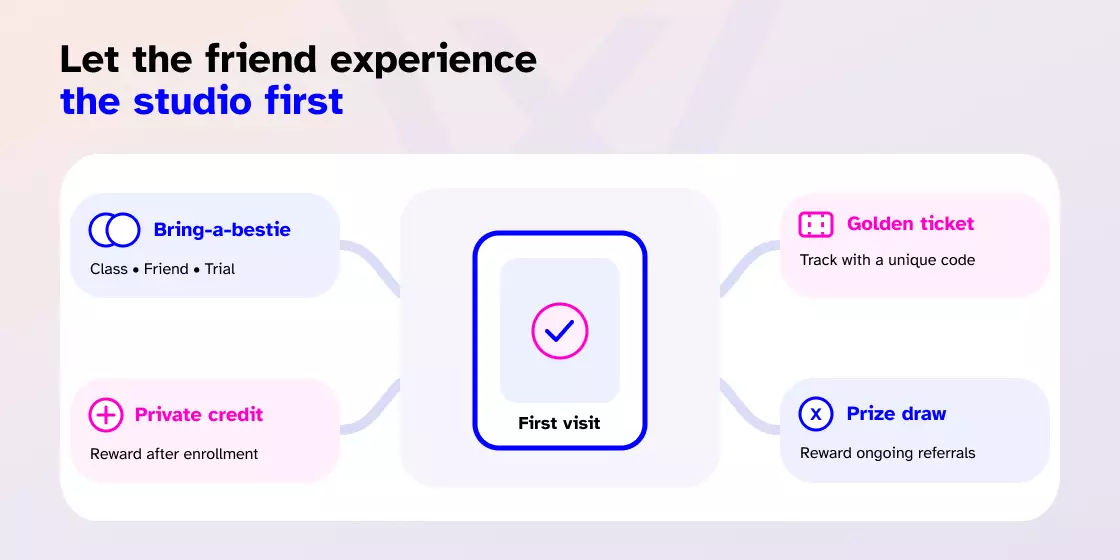
6. Bring-a-bestie event
Best when: You need more trial participation.
Run a class or workshop where current dancers can invite a friend who does not already attend the studio.
The guest gets to participate without making a large commitment. The current student gets to dance with someone they know. Parents get to see the studio in action.
But the event is only the first half of the process.
Collect appropriate contact details, explain suitable classes, and have a clear follow-up process after the event. A room full of happy guests means little if nobody knows what happens next.
This is where referrals connect naturally with broader dance studio marketing ideas: the referral gets someone through the door; the enrollment process helps them decide whether to stay.
Watch for: Running a good event with no follow-up.
Best when: Your students value individual coaching.
7. Private lesson credit
For a dancer working on technique, auditions, turns, or a solo, individual instructor time may feel more valuable than another small discount. A successful referral could earn a short private coaching session.
Schedule these rewards carefully. Instructor time is not free simply because the studio already exists. A complimentary session placed in an otherwise quiet hour has a different cost from one that replaces a paying booking.
Reward trigger: After the referred student enrolls.
Watch for: Promising sessions during your busiest teaching hours.
8. The golden ticket trial
Best when: Word-of-mouth already happens, but referrals are difficult to track.
A referral link is efficient. A physical invitation can be more memorable.
Give students a small number of well-designed “golden tickets” they can hand to friends. Each ticket might provide a trial class or another clearly defined introductory experience.
Use a unique code so the studio knows which student generated the referral. The real value is not the paper. It is the handoff.
“You should come to dance sometime” becomes an invitation the other family can actually use.
Watch for: Open-ended trials with no expiration or eligibility rules.
9. End-of-season referral prize drawing
Best when: You have ongoing referral participation.
Not every referral needs its own large reward. Instead, each qualified referral could earn an entry into a season-end prize draw for a predefined studio benefit.
This keeps the maximum reward cost controlled while giving families a reason to participate throughout the season. Publish clear eligibility and prize rules, and confirm any applicable local requirements before using raffles, sweepstakes, or similar promotions.
Retention-based ideas: Reward students who stay
A registration looks good on an enrollment report. A student who enjoys the studio and remains enrolled is more valuable. That is why some referral rewards should wait.
10. Tiered referral rewards
Best when: You have enough referral activity to support repeat milestones.
A tiered program becomes more valuable as a family generates more successful referrals over a defined period. One referral might bring a small perk. Later milestones could earn a larger tuition credit, merchandise, priority registration, or coaching time. The advantage here is momentum, but the risk is complexity.
If front-desk staff need several documents to explain the program, it is probably too complicated.
11. Dance bestie buddy reward
Best when: Stable enrollment matters more than a short registration spike.
This version rewards retention rather than the initial signup. A current student refers to a friend. The friend joins, but the reward unlocks once both students (current and new) remain enrolled for a defined period.
That helps distinguish strong-fit referrals from registrations that cancel almost immediately. It also connects referrals with long-term engagement, making the program a natural complement to your student retention tips.
Watch for: Delaying the reward so long that families forget what it was for.
12. Age-stage transition referral
Dance studios naturally serve students at different stages. Some arrive as beginners. Dancers move through levels. Some join competitive programs. Older dancers eventually reduce classes or graduate. This creates a natural mentorship opportunity.
A senior dancer might introduce a younger sibling or family friend to a beginner class. The studio can recognize that introduction with a small reward or ambassador perk. This works best when it feels like mentorship rather than a sales tactic.
Which referral program should you choose?
Start with the enrollment problem you actually have and want to resolve.
| If your studio needs… | Referral program ideas | Significance |
| More enrollments | Double-sided credit | Easy to understand |
| More trial visits | Bring-a-bestie event | Reduces commitment |
| More family enrollment | Family growth reward | Builds from current households |
| Better retention | Buddy reward | Rewards staying |
| Repeat advocates | Tiered rewards | Encourages multiple referrals |
| Low-cost rewards | Recital or status perks | Uses existing studio value |
| Better attribution | Golden tickets/codes | Makes referrals trackable |
A newer studio probably does not need an elaborate loyalty ladder. Start with one enrollment-focused offer and perhaps one experience-based reward. Add tiers only when real referral activity justifies them.
Set the rules before launching the offer
Referral programs become messy when simple questions have no clear answer. Think through the situations that could arise in your referral program. Ask yourself:
- Does a trial count?
- What if the person was already in your CRM?
- What if two families claim the same student?
- When does the credit appear?
- Does the reward expire?
Answer them and define the rules before the promotion begins:
- Who can refer?
- Who counts as a new student?
- What action earns the reward?
- When are rewards issued?
- Can offers be combined?
- When do rewards expire?
- How are referrals attributed?
The policy does not need to feel legalistic. Parents and staff just need clear, consistent answers.
Promote referrals when families already have something worth sharing
The right time to promote referrals matters as much as the offer itself. Do not rely on one email announcing the program on a random Tuesday. Rather, mention the referral program at natural moments and specifically after positive interactions.
Natural moments include completing a strong first term, receiving positive parent feedback, sharing recital photos, opening fall registration, or announcing a bring-a-friend workshop.
The family already has a reason to talk about the studio. The referral offer simply makes the next step clearer. That keeps referrals connected to your marketing rather than turning them into another isolated promotion.
How to track a dance studio referral program
Do not measure success by how often parents mention the program. Measure what happens afterward.
| Metric | Formula | What it tells you |
| Referral enrollment rate | Referred enrollments ÷ total new enrollments × 100 | Share of enrollment coming from referrals |
| Cost per referred enrollment | Total rewards ÷ referred enrollments | Acquisition cost |
| Referred-student retention | Referred students retained ÷ referred students × 100 | Quality of referral enrollment |
Suppose the studio spends $600 on rewards linked to 15 successful enrollments. $600 ÷ 15 = $40 per referred enrollment.
The $40 figure becomes useful only when compared with other acquisition channels and retention. A low-cost referred student who leaves quickly may be less valuable than a more expensive student who stays for several terms.
Tracking also becomes much easier when referral sources, enrollment, payments, and retention data live in an organized system rather than notes at the front desk. With Wellyx dance studio software, you can track referrals alongside enrollment, payments, and other studio operations in one place.
Keep referral rewards separate from review incentives
Referrals and public reviews are not the same. Rewarding a family when a new student enrolls is a referral incentive. Offering payment, discounts, free products, or services specifically in exchange for a Google review is different. Google prohibits businesses from incentivizing reviews on its platform.
The FTC’s Consumer Reviews and Testimonials Rule addresses deceptive practices involving reviews and testimonials, including certain incentives tied to positive or negative sentiment. A practical rule for studios: reward genuine referrals.
Social endorsements can create separate disclosure requirements when someone receives something of value for posting publicly. Keep those campaigns clearly documented rather than treating reviews, referrals, and influencer activity as the same thing.
Wrap up
Most good referrals begin before the studio creates a program.
They start when a dancer comes home excited after class. When a parent feels looked after. When recital night goes smoothly. When another family asks, “Where is your kid learning dance from?”
A referral program does not create that trust. It gives the trust somewhere to go. Choose one or two offers families can understand without needing the owner to explain them. Reward the result you actually care about. Track what happens after the introduction. Then let referrals become one measurable part of your dance studio management software.
FAQs
1. What is a dance studio referral program?
A dance studio referral program rewards current students or families for introducing someone who completes a qualifying action, such as a trial, enrollment, or retention milestone.
2. What is the easiest referral program for a dance studio?
A double-sided tuition credit is one of the simplest because both families understand the benefit. A bring-a-friend event is another practical option when the goal is generating trials.
3. How much should a dance studio referral reward be?
There is no universal amount. Base the reward on tuition, class capacity, acquisition costs, margins, and expected retention. It should feel worthwhile without consuming most of the value created by the enrollment.
4. When should a referral reward be issued?
For enrollment-focused programs, issue it after the new student reaches the studio’s defined confirmed-enrollment point. Retention programs can delay the reward until the student stays for a specified period.
5. Can dance studios reward customers for Google reviews?
Google prohibits businesses from offering incentives such as payments, discounts, free goods, or services in exchange for reviews on Google. Keep referral rewards separate from review requests.
6. How do you know whether a referral program works?
Track referred enrollments, total rewards, cost per referred enrollment, and retention. Compare those numbers with other acquisition channels rather than judging the program by trial bookings or conversations alone.