




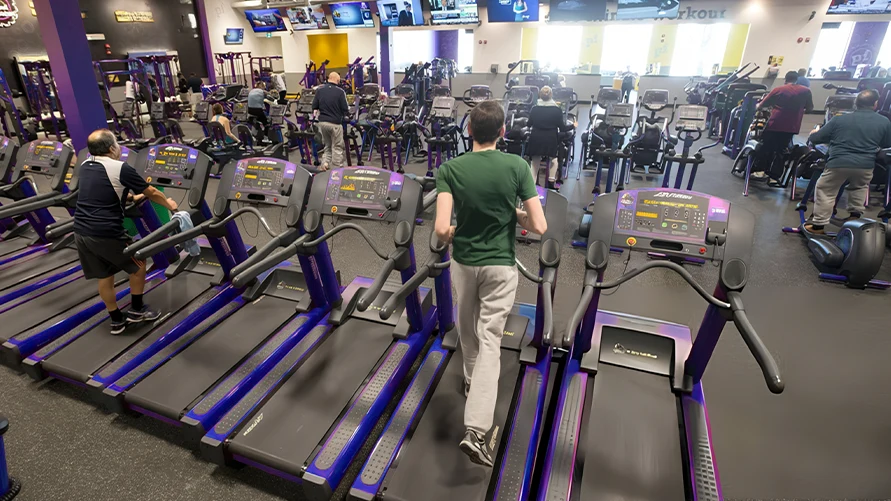
The best gym franchises to invest in are not necessarily the biggest brands or the ones with the lowest startup costs. A Planet Fitness can require more than $5 million at the upper end of its current investment range. A Burn Boot Camp can cost as little as under $300,000. Some UFC GYM formats begin lower still. Though they all come under the gym franchise label, they are very different investments.
The right choice depends on matching the gym business model to your capital, market, operating experience, and preferred level of involvement. Large-format clubs like Planet Fitness usually need substantial real estate, equipment, staffing, and development capital. Boutique studios like F45 or RockBox Fitness depend more on local demand, coaching quality, and retention.
To help narrow the options, we compared eight leading gym franchises by investment, ongoing fees, financial disclosures, system trends, and the type of investor each may suit.
| Franchise | Category | Estimated initial investment | Franchise fee | Main ongoing fee | Best suited to |
| Planet Fitness | Big-box | $1.28M–$5.39M | $40,000 | 7% royalty + advertising | Well-capitalized operators |
| Crunch Fitness | Big-box | $2.15M–$5.37M | $35,000 | 5% royalty + 2% brand fund | Large-format investors |
| Gold’s Gym | Full-service | $2.36M–$5.16M | $40,000 | 5% royalty + marketing | Experienced operators |
| Anytime Fitness | 24/7 | $539K–$905K | $42,500 | Fixed monthly franchise, marketing, and technology fees | Smaller-footprint operators |
| Burn Boot Camp | Boutique | $291K–$678K | $60,000 | 6% royalty + 2% brand fund | Community-focused owners |
| F45 Training | Boutique HIIT | $362K–$858K | $60,000 | 7% or minimum + brand fund | HIIT-focused investors |
| RockBox Fitness | Boxing boutique | $399K–$794K | $59,900 | 7% royalty + 2% brand fund | Hands-on operators |
| UFC GYM | Multi-format | $155K–$6.21M | $30K–$50K | 4%–6% + 2% marketing | Investors comparing formats |
These are estimated ranges, not guaranteed opening budgets. Local construction, financing, equipment, and real estate can change the final cost.
Big-box and full-service gym franchises
These models are built around scale, with larger facilities, more equipment, higher membership volume, and greater capital needs. They suit investors prepared for real estate, staffing, financing, and operational complexity.
1. Planet Fitness: Best for large-scale operators
- Estimated investment: $1,282,500–$5,386,000
- Standard initial franchise fee: $40,000
- Royalty: 7% of qualifying membership dues
- Advertising: National fund contributions apply under the current FDD
- System size: 2,709 U.S. clubs at the end of 2025
- Best fit: Investors with substantial capital and high-volume ambitions
Planet Fitness remains the scale benchmark in this group. Its 2026 FDD reported 2,432 franchised and 277 company-owned U.S. clubs at year-end 2025. Its Item 19 also gives investors a useful revenue reference. The middle third of qualifying franchised clubs reported median Annual EDT Revenue of about $1.86 million for 2025.
But this number is not profit. It does not account for everything a gym must pay, including payroll, occupancy, equipment, debt service, utilities, local expenses, and maintenance. Planet Fitness is therefore a volume-and-capital decision. The local market must support enough memberships to justify a development that can run into several million dollars.
2. Crunch Fitness: Best for large-format growth
- Estimated investment: $2,147,500–$5,367,000
- Initial franchise fee: $35,000
- Royalty: 5% of gross sales
- Brand marketing fund: 2%, with additional local advertising requirements
- System size: 486 locations in the latest FDD context
- Best fit: Well-funded investors considering large facilities or multi-unit growth
Crunch Fitness is one of the simplest examples of why current franchise data is important to consider. Because older public material shows a much lower investment range, while the 2026 FDD puts the estimate above $2.1 million at the low end. The system has also been expanding, which gives prospective owners a different signal from brands currently reporting contraction.
Crunch provides detailed financial-performance information for qualifying domestic clubs, giving investors more to examine than a system-wide revenue claim. Still, the market must support the size and cost of a format that may require several million dollars before opening.
3. Gold’s Gym: Best for experienced full-service operators
- Estimated investment: $2,356,000–$5,162,000
- Initial franchise fee: $40,000
- Royalty: Greater than 5% of gross revenue or the applicable minimum
- Marketing: 2% contribution, with other cooperative requirements possible
- U.S. system size: 182 locations at the end of 2025
- Best fit: Experienced owners prepared for full-service health-club economics
Gold’s Gym still carries strong recognition in strength training, but the current economics are more demanding than older franchise comparisons suggest.
Its 2026 FDD places the investment firmly in the multimillion-dollar category. Item 19 also provides gross-revenue information, but the recent outlet trend deserves equal attention. The domestic system contracted during the latest reporting period.
That does not make every Gold’s Gym a weak investment. It means investors should understand why locations left the system and how comparable clubs perform in similar markets. At this capital level, local economics matter more than brand history does.
24/7 and lower footprint gym franchises
A 24/7 gym uses a smaller footprint and a different staffing model than a full-service club. That may appeal to investors who want an established brand without moving immediately into a multimillion-dollar development.
4. Anytime Fitness: Best for a 24/7 neighborhood model
- Estimated investment: $539,329–$905,482
- Standard franchise fee: $42,500
- Current franchise fee structure: $842 monthly franchise fee
- Marketing and technology: $900 monthly advertising fee plus a $799 base technology fee
- U.S. outlets: 2,282 total at the end of 2025
- Best fit: Investors wanting an established 24/7 brand with a smaller footprint
Anytime Fitness sits between boutique studios and large-format health clubs. Its fee structure needs to be read carefully because it is easy to oversimplify. The current disclosure uses fixed monthly fees rather than simply charging the often-repeated 8% royalty. The FDD does, however, reserve the ability to move the franchise fee to a percentage of gross revenue of up to 8% under its terms.
Anytime Fitness does disclose Item 19 financial performance information. The 2026 FDD reports median revenue of $398,982 across 1,683 franchised centers in the relevant AF Coaching cohort. That is a revenue figure, not a guarantee of profitability or owner income. However, Anytime’s appeal is that its investment can stay below the big-box category while providing an established 24/7 model and large operating network.
Boutique and group fitness franchises
Boutique franchises usually require less capital than full-service clubs, but rely heavily on local acquisition, coaching quality, pricing, and retention. They often suit hands-on owners.
5. Burn Boot Camp: Best for community-led boutique fitness
- Estimated investment: $291,145–$678,003
- Initial franchise fee: $60,000
- Royalty: 6% of gross revenue
- Brand fund: 2%
- System size: 395 locations at the end of 2025
- Best fit: Boutique owners who want a community-centered group-training model
Burn Boot Camp stands out because its Item 19 goes beyond top-line revenue.
For 307 locations supplying complete 2025 financial results, average gross revenue was $732,444. Average Net Operating Income was $121,679, representing an average Net Operating Margin of 17%.
That $121,679 figure is Net Operating Income, not EBITDA, and it should not be treated as owner take-home pay. Burn’s calculation excludes expenses such as owner compensation, income taxes, and debt service. Even with those limits, the disclosure gives investors more operating context than revenue alone. Burn may suit an owner who wants group training and boutique economics without large-format capital requirements.
6. F45 Training: Best for investors comfortable with a mature HIIT system
- Estimated investment: $362,300–$857,700
- Standard franchise fee: $60,000
- Royalty: 7% of gross sales or the applicable monthly minimum
- Brand fund: Generally 2%, subject to current FDD terms + $500 technology fee
- Latest FDD outlet count: 708
- Best fit: Investors who like HIIT but are prepared to investigate recent system contraction
F45 built its name around 45-minute team-based functional training.
Its current financial disclosure is useful. The 2026 filing reports average annual gross sales of about $480,832 and median gross sales of $429,222 for 676 franchised studios in the relevant population.
The outlet trend changes the conversation, however. The latest filing reports fewer outlets than the previous one. A contracting system is not automatically a poor investment, but it makes due diligence more important. Investors should understand closures, territory quality, mature-unit performance, and local demand.
7. RockBox Fitness: Best for a hands-on specialty operator
- Current published investment: $399,211–$794,400
- Initial franchise fee: $59,900
- Royalty: Greater of 7% of monthly gross sales or the applicable minimum
- Brand fund: 2% under the latest clearly verifiable FDD
- Latest clearly reported system size: 52 locations
- Best fit: Hands-on owners interested in boxing, kickboxing, and functional training
RockBox Fitness is smaller than the major systems above, and that changes the decision. An investor may value open territory and a focused specialty concept, while another may prefer the operating history of a larger network. Member acquisition, class utilization, coach quality, and retention remain central, making RockBox better suited to a hands-on operator.
Martial arts and multi-format franchises
Some franchises cannot be judged through one standard format. UFC GYM changes dramatically between compact concepts and large Signature/UFC FIT facilities.
8. UFC GYM: Best for investors comparing multiple formats
- Overall investment: Approximately $155,388–$6.21 million across formats
- Initial franchise fee: $30,000–$50,000 depending on format
- Royalty: Generally 4%–6% depending on the concept
- Marketing contribution: 2%
- System size: 59 total outlets at the end of 2025
- Best fit: Investors who want martial arts positioning and multiple facility choices
The wide investment range needs context. Compact formats sit at the lower end, while a Signature or UFC FIT development can require several million dollars, closer to Planet Fitness, Crunch, or Gold’s Gym economics.
The 2026 FDD also reports a smaller system than two years earlier. Its Item 19 includes revenue information for a limited group of managed Signature/UFC FIT locations, rather than a broad franchisee-only sample across every format. Investors therefore need to evaluate the specific UFC GYM format, not only the brand name.
Which gym franchise fits your investment profile?
The simplest way to narrow the list is to start with the business you can realistically fund and operate.
| If you are looking for… | Franchises worth comparing |
| Lowest starting investment | Smaller UFC GYM formats |
| Boutique model under roughly $700K | Burn Boot Camp, RockBox Fitness |
| Established 24/7 model | Anytime Fitness |
| Large-format high-volume gym | Planet Fitness, Crunch Fitness |
| Full-service strength brand | Gold’s Gym |
| Boutique HIIT | F45 Training |
| Specialty boxing/kickboxing | RockBox Fitness |
| Multiple facility formats | UFC GYM |
Capital is only the first filter. Boutique studios may cost less but place more pressure on local lead generation and retention, while large gyms carry much larger real estate, staffing, equipment, and financing commitments.
For the broader financial picture, Wellyx’s guide to fitness franchise profitability explains how revenue, margins, royalties, retention, and operating costs interact after opening.
Things to look at beyond the headline investment
Strong revenue can still hide a poor investment. Revenue does not show what remains after payroll, rent, debt service, royalties, marketing, utilities, maintenance, insurance, taxes, and owner compensation. That is why Item 19 should be read beside Item 20.
Item 19 shows the financial-performance information the franchisor chooses to disclose. Item 20 shows movement across the system, including openings, closures, transfers, and terminations.
The Federal Trade Commission’s consumer guide to buying a franchise explains what prospective U.S. franchise buyers should review before signing or paying a franchisor.
A brand may work nationally and still struggle with rent, competition, demographics, or pricing in one trade area. For big-box concepts, property economics can shape the P&L for years. Consider negotiating a gym lease to start safe before signing.
What to check before choosing a gym franchise
Before narrowing the list, compare the most suitable fitness franchise options on the basis of:
- Total investment, not just the franchise fee: Construction and equipment can make a small headline fee part of a multimillion-dollar project.
- Royalty and marketing obligations: A few percentage points of gross revenue matter every month.
- Item 19 population: Check whether the numbers represent franchisees, company-owned clubs, selected cohorts, mature units, or the full eligible network.
- Item 20 movement: Openings matter, but closures, transfers, and terminations deserve attention too.
- Local economics: Rent, wages, competitors, pricing, and territory quality can change the business case.
- Owner involvement: A hands-on boutique operator needs a different model from an investor building a management team.
Current and former franchisees can put those numbers into context. Ask what opening really cost, where the budget missed, how long member acquisition took, and whether operating costs matched expectations. Once the doors open, the problem becomes running the franchise.
Wrap up
When looking at fitness franchise opportunities, brand recognition can help, but it cannot fix an expensive lease, weak local demand, or poor economics. Planet Fitness, Crunch, and Gold’s Gym require serious large-format capital. Anytime Fitness offers a different 24/7 footprint. Burn, F45, and RockBox sit in boutique economics. UFC GYM stretches across several formats and investment levels. Once those differences are clear, the decision becomes less about finding the biggest name and more about finding the business you can realistically fund, operate, and sustain.
Lastly, many gym franchises also provide their own technology stack as part of the franchise system, so software may already be included in the model you choose. However, if you need a separate gym management software solution or want to compare your options, Wellyx provides tools for managing memberships, payments, bookings, staff, access, and day-to-day operations from one platform.
FAQs
- What’s the best gym franchise to invest in?
There is no single best option. Planet Fitness and Crunch suit well-capitalized large-format operators; Anytime Fitness offers a smaller 24/7 model, while Burn Boot Camp and RockBox are more accessible boutique options. The right fit depends on available capital, local market conditions, operating experience, and desired level of involvement.
- What’s the cheapest gym franchise on this list?
UFC GYM has the lowest starting point because some compact formats begin around $155,000. That does not make every UFC GYM inexpensive. Its large Signature/UFC FIT formats can require several million dollars.
- What’s the most profitable gym franchise?
There is not enough directly comparable public data to name one. Burn Boot Camp discloses Net Operating Income, while several other brands mainly disclose revenue. Investment size and operating costs also vary too much for a fair one-number ranking.
- Do gym franchises disclose how much owners earn?
Sometimes, but not always. Item 19 may disclose revenue, expenses, operating income, or another performance measure. The population and calculation method differ by brand, so it is important to read the figures in context.
- Is a gym franchise suitable for a first-time owner?
It can be. Smaller boutique and specialty franchises may be more financially accessible, but they still require sales, staffing, marketing, retention, and operational discipline. The franchise should match the owner’s capital, experience, and desired level of involvement.