


The latest trends in the fitness industry are being shaped by a wider mix of people, goals, technologies, and expectations. You can see several versions of the fitness industry operating in the same gym at the same time.
One member is checking a readiness score before deciding how hard to train. Another is taking a GLP-1 medication and wants to keep getting stronger while losing weight. Someone in their 60s is learning to lift for the first time. Across the room, a Pilates class is full, and there is already a waitlist for the next one.
This tells us more about fitness in 2026 than whichever workout happens to be trending on social. For gym owners, this makes the real challenge less about being trendy and more about understanding member behavior and pivoting the gym around it.
What are the biggest fitness industry trends in 2026
The strongest fitness industry trends in 2026 are:
- Wearables and data-led training
- GLP-1-aware weight-management fitness
- Active aging
- Strength and functional training
- AI in coaching and gym operations
- Recovery-focused fitness
- Pilates and low-impact training
- Exercise for mental well-being
- Social and competitive fitness
- Hybrid and flexible fitness
ACSM’s 2026 Worldwide Fitness Trends survey puts wearable technology at No. 1, followed by fitness programs for older adults and exercise for weight management. Mobile exercise apps, balance and core work, exercise for mental health, traditional strength training, data-driven technology, recreational sports, and functional fitness also make the top 10. The survey draws on responses from about 2,000 clinicians, researchers, and fitness professionals.
Fitness industry market research on these trends
The fitness market is not shrinking into one dominant format. In fact, it is widening. HFA reported that 81 million Americans belonged to a gym, studio, or other fitness facility in 2025, up 5.2% from the year before. Membership penetration reached 26.1% of the U.S. population age six and older, and more than 100 million people used a fitness facility when day-pass and other non-member visits were included. Nearly 7 billion visits were recorded during the year. A few signals stand out:
| Trend signal | What it suggests for operators |
| Wearables remain ACSM’s No. 1 trend | Members increasingly arrive with their own fitness data |
| Adults 65+ posted the strongest membership growth | Older adults are becoming a larger mainstream customer group |
| Free-weight use continues to rise | Strength space and equipment capacity matter more |
| Yoga, Pilates, and mobility participation rose 27% from 2022 to 2024 | Mind-body and lower-impact formats have sustained demand |
| Recovery is highlighted as a major 2026 trend by ACE | Recovery is moving closer to the core fitness offer |
| GLP-1 use is now widespread | Weight-management programming needs a more thoughtful approach |
Put these signals together and the operational tension becomes clearer. Members want more specialized experiences, but gyms still have limited floor space, staff hours, and capital. The challenge in 2026 is not simply offering more. It is deciding which forms of variety the business can support well.
1. Wearables are changing the coaching conversation
Wearables have evolved past counting footsteps. Members can now walk in with sleep data, heart-rate trends, recovery scores, and other numbers already sitting on their wrist. ACSM ranks wearable technology first for 2026 and data-driven technology eighth.
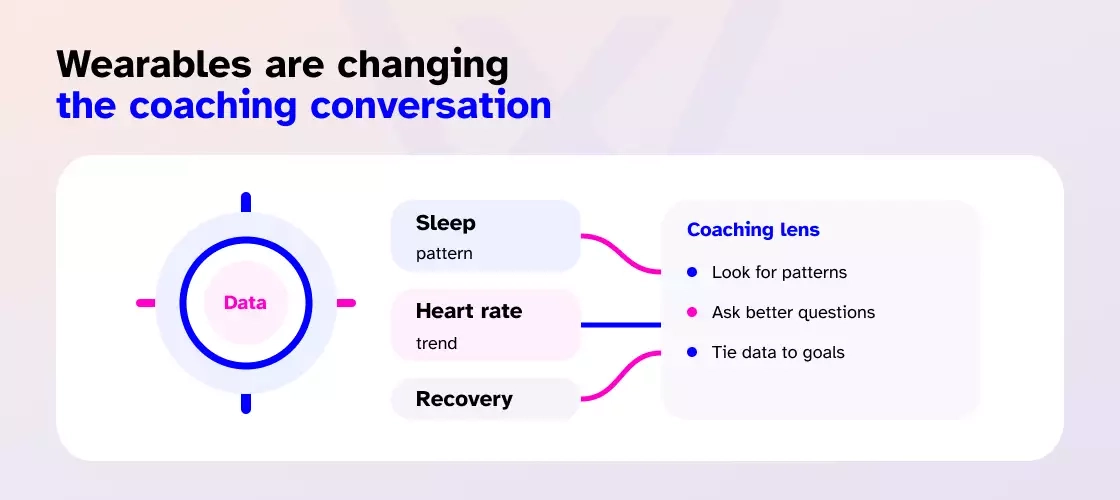
That changes the trainer-member conversation. A coach may no longer be starting with a blank page. The member already has data and, sometimes, a fairly strong opinion about what it means.
The challenge is knowing when the data is useful and when it is just noise.
For operators, the sensible response is fairly simple:
- Ask what members already track during onboarding.
- Teach staff to look at patterns, not single-day scores.
- Keep consumer wearables in their lane. They can inform a conversation, but they are not a substitute for clinical assessment.
- Tie useful numbers back to the goal the member actually cares about.
Better coaching does not come from having more dashboards. It comes from knowing what deserves attention.
2. GLP-1 use is changing weight-management fitness
This is one of the clearest differences between a 2026 fitness article and one written even two years ago. A KFF poll from November 2025 found that 12% of U.S. adults were currently taking a GLP-1 drug, while 18% had used one at some point.
ACSM now ranks exercise for weight management third for 2026 and specifically acknowledges the growing use of GLP-1 medications alongside exercise. HFA has also published 2026 research examining the value of structured exercise alongside GLP-1 therapy.
If you’re wondering what gym owners should do, the answer is not to invent an Ozempic workout. The more useful shift is toward strength, function, mobility, and consistency rather than talking about weight loss only in terms of calories burned.
A gym serving these members may need stronger beginner resistance programs, better progress measures, and clearer boundaries around what trainers can and cannot advise on. Medication decisions stay with healthcare professionals, but exercise remains the gym’s thing.
3. Active aging is becoming mainstream fitness
Older adults are no longer a side market. Latest HFA U.S. data show adults over 65 as the fastest-growing fitness-facility membership group. But this does not mean every gym needs a class called senior fitness. Older members may be training for strength, balance, mobility, independence, recreation, or simply for the confidence to keep doing everyday tasks.
The simplest approach gym owners can adopt to support this significant fitness group is:
- Offer approachable strength, balance, and mobility options.
- Review physical and digital accessibility.
- Avoid patronizing age-based messaging.
- Make it easy for staff to provide help without taking over.
- Help senior members get familiar with gym technology.
Digital accessibility matters too. Booking, payments, apps, and check-ins should be straightforward enough that technology supports independence rather than becoming another barrier.
4. Strength training is pulling in a wider crowd
The image of the free-weight area as a corner for serious lifters only is getting harder to defend. ACSM ranks traditional strength training seventh for 2026. HFA also reports that free-weight use, including dumbbells, barbells, and kettlebells, has outgrown that of any other equipment in U.S. facilities.
The people using that space are more varied too: first-time lifters, older adults, women, recreational athletes, members focused on longevity, and people trying to maintain strength during weight loss. Functional training has broadened in the same way. It does not have to mean tire flips and battle ropes. Squatting, carrying, pushing, pulling, hinging, and balancing all fit the idea.
The practical question for owners is whether the floor still matches the way people train and what they can do about it:
- Measure rack and free-weight congestion at peak times.
- Build a real onboarding path for beginners.
- Check whether floor space reflects how members now train.
- Test coached small-group strength programs where demand supports them.
This is no longer only a programming trend. For many gyms, it is a capacity-planning issue.
5. AI is moving out of the novelty phase
AI now sits on both sides of the front desk: for members and staff. On the member side, it can help with workout suggestions, progress analysis, digital coaching, and movement feedback. Behind the scenes, it is being used for communication, lead handling, scheduling, admin, marketing, segmentation, and member analysis.
ACE’s 2026 trends work describes AI as moving deeper into programming, personalization, communication, staffing, and operations. The difficult part is that being AI-powered does not tell you whether a product is actually useful. What gym owners can do is:
- Ask what evidence supports the promised result.
- Pilot tools before changing core workflows.
- Check how they integrate with existing member data.
- Keep human judgment in coaching and member relationships.
That is the line running through AI tools for gyms and the wider future of artificial intelligence in gyms. AI matters most when it reduces friction. A flashy feature that creates another disconnected system is not much of an upgrade.
6. Recovery is becoming part of what members buy
Recovery is moving closer to the core fitness offer. ACE identifies recovery methods among the notable fitness trends for 2026, including compression, sauna, cold exposure, mobility, and other recovery practices. But this does not mean every facility needs an expansive recovery suite.
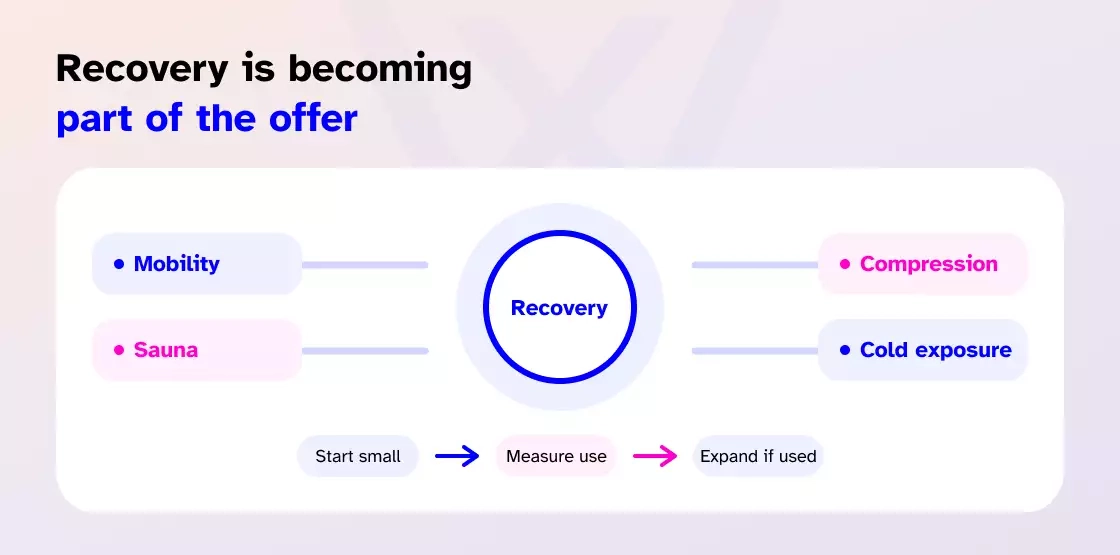
A gym might find that members use guided mobility sessions every week but barely go for recovery services. Instead of adding anything new, gym owners can:
- Start with lower-cost recovery formats.
- Ask members what they would actually use or pay for.
- Measure repeat usage before expanding.
- Compare demand against floor-space and staffing requirements.
Recovery becomes a useful business category when people repeatedly use it, not simply because it looks good on a tour.
7. Pilates and low-impact training are holding their ground
Contrary to what most gym owners thought, Pilates has moved past a short boutique trend. ACSM reports that participation in yoga, Pilates, and mobility-focused classes rose 27% between 2022 and 2024, while HFA data also shows continued growth in Pilates participation among fitness-facility members.
The useful question for an operator is not whether Pilates is popular, but whether it fits the facility. Gym owners can:
- Track waitlists and unsuccessful booking attempts.
- Test mat-based formats before buying reformers.
- Compare potential demand with the space required.
- Confirm qualified instructor availability before expanding.
Popularity creates an opportunity. It does not automatically make the investment work.
8. Mental well-being is becoming a clearer reason to train
People have always exercised because it affects mood positively. What has changed is how openly mental and emotional well-being are given equal importance to performance, appearance, and weight as a reason to train. ACSM ranks exercise for mental health sixth in its 2026 trends.
For some members, exercise supports routine, social connection, stress management, confidence, or general well-being.
Fitness professionals still need clear boundaries. A gym can support exercise habits, but it should not present a workout as treatment for a diagnosed mental-health condition. Instead, gym owners can:
- Talk about well-being alongside performance goals.
- Make beginner experiences less intimidating.
- Offer lower-pressure ways to start exercising.
- Give staff clear guidance on professional boundaries.
Sometimes the most valuable experience is simply creating a place that feels easy to return to.
9. Social fitness is becoming its own product
Fitness is getting more personalized, but it is also getting more social. That sounds contradictory until you look at what people are booking.
Social fitness is becoming more visible in mainstream participation data. ACSM added adult recreation and sport clubs to its 2026 top trends, reflecting growing interest in running clubs, cycling groups, recreational leagues, pickleball, and other formats that combine exercise with connection.
Run clubs, in-house competitions, lifting groups, recreational leagues, challenges and some small-group training all fit under the same wider shift. Gym owners can leverage this trend by:
- Creating events that beginners can join comfortably.
- Rewarding participation, not only leaderboard winners.
- Running recurring clubs rather than relying only on one-off events.
- Measuring whether participants attend more consistently afterward.
Gamification can reinforce that sense of progress through streaks, milestones, rewards, and team challenges, but it works best when it supports participation rather than turning every workout into a competition.
10. Hybrid fitness now means flexibility
Hybrid fitness has moved past its pandemic definition. It no longer needs to mean livestreaming a class. A member may train inside the gym twice a week, follow a remote program while traveling, book sessions through an app, message a coach between visits, and take part in a digital challenge.
To the member, those may not feel like separate services at all. But from a gym owner’s perspective, this fitness format allows them to:
- Find out what members need when they cannot visit.
- Avoid building large content libraries without proven demand.
- Keep digital and in-person activity connected.
- Use online services to extend the member experience rather than recreate the entire gym digitally.
That is also why the hybrid fitness business model is now less about recreating the gym online and more about removing the gaps between visits.
Not every facility needs hundreds of on-demand videos. Sometimes better booking, clearer communication, remote programming, and a useful member app solve the problem more cleanly.
What can these fitness trends cost to implement?
Following a fitness trend can mean anything from training one staff member to redesigning part of the gym floor. That is why cost needs to be considered alongside demand. Current U.S. prices give a useful sense of scale:
| Area | Current reference price | Other costs to consider |
| Weight-management education | ACE program: about $495 list | Staff time and additional education |
| Active-aging education | ACE program: about $595 list | Accessibility and equipment changes |
| Basic strength expansion | Squat stand $435, bar about $285, bumper plates from about $180 | Benches, additional plates, flooring, freight |
| Compression recovery | About $550–$1,150 | Cleaning, replacement, staff oversight |
| Commercial cold plunge | From about $12,990 | Site preparation, sanitation, maintenance |
| Commercial sauna | From about $13,990 | Electrical work, ventilation, maintenance, insurance |
| Professional Pilates reformer | Around $5,699 | Instructor training, freight, floor space |
| Pilates studio equipment package | Around $30,799 | Build-out, staffing, launch costs |
These are current public U.S. reference prices, not industry averages or product recommendations. Shipping, installation, taxes, promotions, construction, utilities, and local requirements can significantly change the final cost.
The point is not that a gym should spend at any of these levels. It is that two trends can look equally attractive while requiring very different commitments. A run club or mobility session can be tested with little new equipment. A reformer studio, sauna, or cold-plunge area needs a much stronger business case.
Before spending, look for actual demand first: waitlists, member requests, repeated bookings, congestion, or services members are already paying for elsewhere.
New fitness trends worth watching
Some newer fitness trends are worth watching without yet carrying the same evidence or demand as the ten shifts above.
- Micro-workouts fit people whose workday no longer leaves a neat 60-minute block for training.
- Outdoor fitness continues to show up through run clubs, walking groups, boot camps, and community events.
- Gamification can make attendance and progress more visible through streaks, milestones, challenges, and rewards.
- Biohacking and personalized wellness remain popular, but the evidence varies sharply depending on the practice, so broad claims should be treated carefully.
- Immersive and VR fitness is still interesting, especially as hardware improves, but it does not yet carry the same broad market signal as wearables, active aging, strength, or Pilates.
This difference matters. A new idea appearing repeatedly in gym industry news may be worth watching. It is not automatically worth building a business plan around.
Which fitness trends are actually worth following?
A list of trends is useful only if it helps someone make a better decision. Before adding a new class, technology, service, or piece of equipment, look at five things.
- Member demand. Are people actually asking for it, booking it elsewhere, joining waitlists, or searching for it?
- Fit. A martial arts academy and a full-service health club can look at the same trend and reach completely different conclusions.
- Real cost. Equipment is only one part. Add instructors, training, floor space, maintenance, insurance, software, and admin time.
- A small test. Four weeks of real member behavior is usually more useful than a confident forecast.
- A success measure. Decide in advance what matters: repeat bookings, utilization, attendance, retention, revenue per square foot, or program conversion.
That keeps trends in proportion. The goal is not to be first. It is to know whether the idea earns its place.
Wrap up
The fitness industry is not moving toward one perfect workout. It is spreading out. Members are mixing strength, classes, recovery, social exercise, personal data, apps, coaching, and flexible access in ways that fit their own lives.
That gives gym owners more ways to serve people. It also creates more opportunities to spend money on something nobody ends up using. The stronger approach is to do the opposite. Watch what members are already doing. Notice where capacity starts to pinch. Test the idea before committing heavily. Then look at what actually changed. The next fitness trend will come soon enough. Knowing your members will still matter more than any trend does.
One way to grow safely is to ensure that any trending class format you introduce is supported by your current fitness studio software. Remember, it needs to improve the member experience without making them download another app. And if you’re considering switching to software that understands these nuances and supports the growing needs of gyms, Wellyx is a good option. You can create classes, build your content library, add health-related notes, and manage access to recovery zones.
Frequently asked questions
1. What are the latest trends in the fitness industry?
The leading fitness trends in 2026 include wearable technology, active aging, GLP-1-aware weight-management fitness, strength training, AI, recovery, Pilates and low-impact exercise, mental well-being, social fitness, and flexible hybrid training.
2. What is the biggest fitness trend in 2026?
Wearable technology ranks No. 1 in ACSM’s 2026 Worldwide Fitness Trends survey. Fitness programs for older adults rank second, while exercise for weight management ranks third.
3. How is AI changing the fitness industry?
AI is being used in workout recommendations, communication, scheduling, marketing, lead management, data analysis, and some coaching applications. Its value varies by use case, so the practical question is whether it solves a specific problem reliably.
4. How are GLP-1 medications affecting gyms?
More members are combining GLP-1 medication use with exercise. That puts more emphasis on appropriate strength work, conditioning, mobility, and sustainable exercise habits, while medication and clinical nutrition decisions remain with qualified healthcare professionals.
5. Is strength training still growing?
Yes. Traditional strength training remains in ACSM’s 2026 top 10, while HFA reports strong growth in free-weight use in U.S. fitness facilities.
6. Which fitness trend should a gym invest in?
There is no universal answer. The right investment depends on member demand, audience fit, available space, staff expertise, implementation cost, and whether it improves a measurable business or member outcome.