




A packed evening schedule can make a dance studio look healthy. The harder part is making sure the finances behind those classes are just as strong. Good dance studio financial management comes down to three things: budget around realistic collections, understand when cash actually moves, and control costs without damaging the student experience.
Opening a studio quickly becomes about much more than teaching. As this video on how to start a dance studio business shows, the move from instructor to owner brings business planning, space and equipment decisions, staffing, dance studio software, marketing, and the systems needed to keep the studio running. That is why most new owners start with a solid business plan for a dance studio.
And once those pieces are in place, the financial pressure becomes very real.
Payroll is due Friday. Tuition has been billed, but several family payments have not cleared. The recital venue needs another deposit, and a repair has appeared earlier than expected.
Meanwhile, the evening classes are full.
That is the uncomfortable contradiction: a busy dance studio is not automatically a financially healthy dance studio.
The real questions are quieter but more important:
- What has actually been collected?
- What is already committed?
- What expenses are coming next?
- How much cash is genuinely safe to spend?
Good financial management gives you those answers before a busy studio starts feeling financially tight.
What is dance studio financial management?
Dance studio financial management is broader than bookkeeping. It is the process of planning income and expenses, controlling costs, managing cash timing, reviewing financial results, and adjusting before a small problem becomes an expensive one.
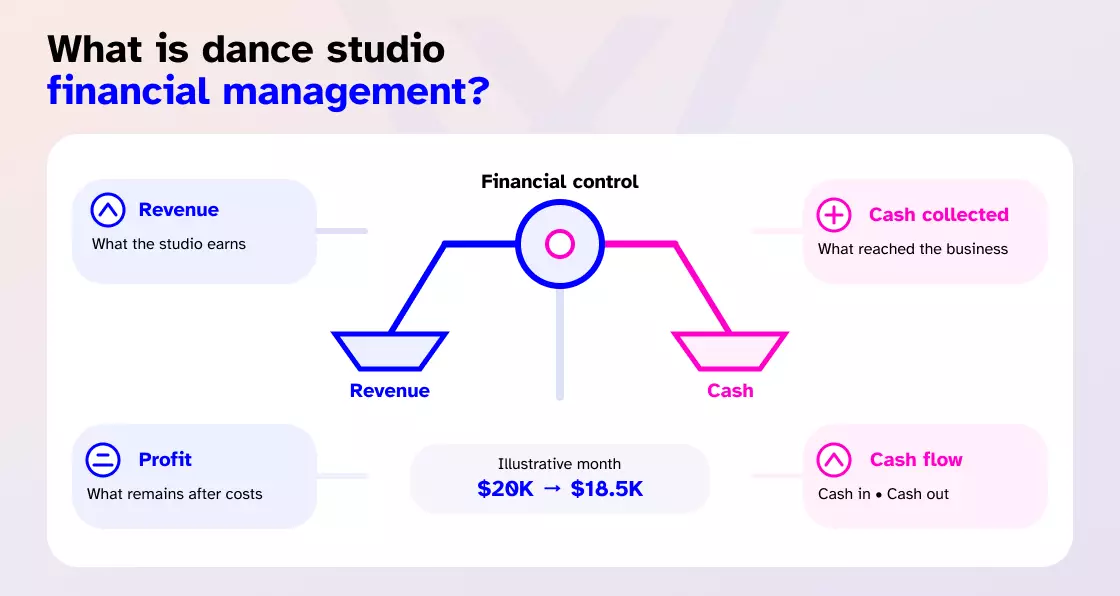
Four numbers matter here.
- Revenue: Money the studio earns from tuition, lessons, programs, merchandise, and other services.
- Cash collected: Money that has actually reached the business.
- Profit: What remains after revenue and expenses are accounted for.
- Cash flow: The movement of actual cash into and out of the studio.
A studio might generate $20,000 in tuition during a month but collect only $18,500 before payroll and rent are due.
Those numbers tell different stories. The revenue report may look healthy. The bank account may be less impressed.
What are the biggest expenses for a dance studio?
The biggest dance studio expenses usually come from the facility, instructors and staff, utilities, insurance, software, administration, payment processing, marketing, supplies, and seasonal activities such as recitals and competitions.

Rather than thinking about them as one long list, group them by how they behave.
Mostly fixed costs
These tend to remain fairly steady even if enrollment changes:
- Rent or lease
- Insurance
- Internet
- Essential software
- Contracted cleaning
- Some administrative expenses
These are the bills that make a quiet month uncomfortable because they generally do not get quieter with it.
Mostly variable costs
These move more with activity:
- Instructor hours
- Payment-processing costs
- Supplies
- Additional staffing
- Some marketing expenses
- Utility consumption
- Music or licensing costs where applicable
Instructor compensation can become a significant commitment as the schedule expands. As a broad national reference rather than a dance-teacher pay benchmark, the U.S. Bureau of Labor Statistics reported median hourly wages of $24.80 for dancers and $26.59 for choreographers. Actual instructor pay can vary considerably by experience, location, role, and employment arrangement.
Seasonal costs
Dance studios also carry expenses tied to the calendar.
- Costumes
- Recital venues
- Competition fees
- Camps and intensives
- Event staffing
- Seasonal marketing
- Props and production costs
Irregular costs
Then there are the bills that do not arrive every month but still belong in the plan:
- Flooring repairs
- Equipment replacement
- Larger maintenance work
- Training
- Permit or license renewals
A useful rule:
If an expense happens every year, it is not really unexpected. It just has an inconvenient date.
How do you create a dance studio budget?
A practical dance studio budget starts with what the studio realistically expects to collect, then maps the expenses it is committed to pay and the costs likely to appear throughout the year. If you are still opening a dance studio, build this budget before launch, not after your first month of classes.
The mistake is treating a budget as a hopeful sales target. It should be a spending plan built around reality.
Start by mapping your revenue
List the income streams that actually apply to your studio:
- Monthly tuition
- Registration fees
- Private lessons
- Workshops
- Camps and intensives
- Recital-related income
- Costume or event fees
- Merchandise
- Studio rentals, where relevant
Then make one distinction that prevents a surprising amount of trouble:
Budget from realistic collections, not optimistic invoices.
Suppose the studio bills $20,000 in a month.
If past collection patterns suggest around $18,500 normally reaches the account within that month, building your spending plan around the full $20,000 gives you $1,500 of spending capacity that may not actually exist yet.
The balance may arrive later. A card may fail. A family may need follow-up. The invoice can look healthy without being spendable.
Separate committed and flexible expenses
Next, identify what the studio has little immediate choice about.
Committed costs may include:
- Rent
- Core payroll
- Insurance
- Essential software
- Contracted services
- Minimum utilities and operating costs
Then separate spending that may offer more flexibility:
- Some marketing campaigns
- Optional equipment purchases
- Nonessential upgrades
- Certain event expenses
- Discretionary supplies
This does not mean flexible expenses are unimportant.
It means that if collections come in below forecast, you know which decisions can actually move.
Build the budget around the real year
Do not take one average month and multiply it by 12.
A dance studio has a rhythm.
Account for:
- Fall enrollment
- Holiday schedule interruptions
- Costume ordering
- Recital season
- Competitions
- Summer changes
- Camps and intensives
- Insurance renewals
- Maintenance
- Planned equipment purchases
Then compare what you expected with what happened.
| Category | Budgeted | Actual | Difference |
| Tuition collected | $18,500 | $17,900 | -$600 |
| Private lessons | $1,200 | $1,350 | +$150 |
| Payroll | $7,000 | $7,300 | +$300 |
| Rent | $3,500 | $3,500 | $0 |
| Marketing | $800 | $650 | -$150 |
| Supplies | $400 | $520 | +$120 |
| Sinking-fund contribution | $500 | $500 | $0 |
These figures are illustrative. The useful part is not simply discovering that payroll was $300 over budget.
Ask why.
- Did enrollment justify more teaching hours?
- Did substitutions increase?
- Did the schedule create unnecessary paid gaps?
Likewise, if tuition is $600 below forecast, find out whether students actually left or whether money simply has not been collected yet.
The difference matters. The reason for the difference matters more.
How do you manage cash flow in a dance studio?
Manage dance studio cash flow by tracking what has actually been collected, comparing that amount with upcoming bills, following up on failed and overdue payments, and forecasting periods when expenses arrive before the income connected with them.
At its simplest:
Cash flow = cash received − cash paid out
For planning ahead:
Opening cash + expected collections − expected payments = projected closing cash
Billed revenue is not available cash
Keep this distinction somewhere visible:
$15,000 billed ≠ $15,000 available
A few things can sit between those two numbers:
- Failed cards
- Late payments
- Refunds
- Chargebacks
- Payment-processing delays
- Outstanding family balances
Take a simple example.
- Opening cash: $12,000
- Expected collections: $7,000
- Expected payments: $10,500
Your projected closing cash is:
$12,000 + $7,000 − $10,500 = $8,500
That calculation alone does not tell you whether the studio is healthy.
But now look at next week.
If payroll and rent total another $7,000 while only $3,000 is expected to arrive, you can see the tight point before you reach it. That is what a cash-flow forecast is for.
Identify cash-flow gaps before they become problems
A cash-flow gap happens when an expense is due before the money connected with it reaches the studio.
Recitals are a good example.
The venue may need a deposit in March.
Costume or production expenses may also land early.
Most ticket income may not arrive until April or May.
The recital could still produce a positive result overall.
The studio still needs enough cash to cover March.
Use a rolling 13-week forecast
A 13-week forecast gives you a practical view of roughly the next three months.
| Cash expected in | Cash expected out |
| Tuition | Payroll |
| Private lessons | Rent |
| Camp deposits | Recital deposits |
| Merchandise | Insurance |
| Event income | Repairs or taxes |
Update it as payments clear and dates change.
The goal is not perfect forecasting.
It is seeing the difficult week while you still have time to do something about it.
Make collections less unpredictable
Recurring payment systems can help reduce some of the timing uncertainty.
That may include:
- Automated tuition billing
- Clear payment dates
- Failed-payment alerts
- Retry workflows
- Parent access to balances and invoices
- Staff visibility into overdue accounts
A good dance studio billing software setup can make those processes easier to manage without relying on someone remembering to chase every account manually.
For a deeper operational view, this UK-focused guide explains how dance studio software can help fix cash-flow problems. The payment methods differ from the U.S., but the underlying principle is relevant: predictable billing and clearer payment visibility make cash easier to manage.
How should a dance studio prepare for seasonal expenses?
Prepare for seasonal expenses by putting known costs on the financial calendar early and setting money aside before their due dates.
Think about what happens during the year.
- Costumes can be payable before recital revenue
- Venue deposits can arrive before ticket sales
- Summer tuition can soften while the lease stays exactly the same
- Camp staffing may begin before every family payment clears
Insurance renewals, equipment replacement, and back-to-school promotion can create their own peaks.
Give predictable costs a sinking fund
A sinking fund is simply money saved gradually toward a known future bill.
For example, if a known expense is expected to cost $6,000 and is 12 months away:
$6,000 ÷ 12 = $500 per month
That is only an illustrative example.
If the bill is six months away, your timeline changes.
The principle also applies across other class-based businesses.
Seasonality becomes risky when predictable expenses are treated like emergencies.
How much cash reserve should a dance studio keep?
There is no single cash-reserve amount that works for every dance studio.
The right level depends on:
- Fixed monthly obligations
- Payroll structure
- Lease commitments
- Enrollment stability
- Seasonal swings
- Debt
- Access to emergency funding
- How quickly expenses could be reduced
- The owner’s comfort with financial risk
It helps to stop thinking about every dollar in the bank as one pile.
| Cash bucket | Purpose |
| Operating cash | Paying normal current bills |
| Seasonal sinking fund | Paying known future costs |
| Emergency reserve | Absorbing unexpected disruption |
An emergency reserve might need to handle:
- A sudden flooring repair
- Equipment failure
- Temporary enrollment decline
- Unexpected staffing costs
- Refunds
- Short-term collection problems
Instead of asking what another studio keeps in reserve, ask:
What expenses would continue if revenue dropped tomorrow?
Then consider how quickly those expenses could realistically be reduced.
That gives you a much more useful reserve target than copying a generic rule.
How do you control dance studio costs without hurting the student experience?
Control dance studio costs by removing waste, inefficient work, duplicate tools, payment leakage, and unnecessary recurring expenses before cutting anything dancers and families genuinely value.
Remove waste, not value.
Reducing teacher quality is not smart cost control.
Neither is neglecting flooring, maintenance, safety, or the parent experience just to make this month’s numbers look better.
Audit software and recurring subscriptions
Start with the expenses that can quietly renew for years.
Check for:
- Duplicate platforms
- Forgotten subscriptions
- Unused features
- Overlapping communication tools
- Old contracts
- Add-ons no one remembers buying
The question is not only:
“What does this software cost?”
Ask:
“What work, tools, or errors does it eliminate?”
That distinction matters. This breakdown of how much fitness studio software can save explores the wider cost equation between software spend and operational work. Treat the examples there as context, not guaranteed savings for every dance studio.
Audit payroll through the schedule
Staffing decisions and scheduling decisions are closely connected.
Look for:
- Unnecessary paid gaps
- Repeated substitutions
- Poorly organized teaching blocks
- Staff sitting idle between classes
- Front-desk time spent fixing preventable scheduling mistakes
Do not automatically cut instructors from quieter classes.
First, understand the reason for the weak slot and whether the class serves a larger purpose.
If scheduling itself is creating unnecessary work, dance studio scheduling software can help organize rooms, instructors, classes, and changes more clearly.
Use what you already pay for
Before committing to additional space, check how effectively existing rooms and time blocks are being used.
A studio paying for three rooms but regularly leaving one unused during valuable hours may have an efficiency problem before it has a space problem.
Review suppliers instead of renewing by habit
Periodically review:
- Cleaning
- Costumes
- Printing
- Supplies
- Internet
- Equipment
- Event vendors
Bulk purchasing can help when the item is genuinely predictable and likely to be used.
But buying 200 units because the unit price is lower does not save money if half of them sit untouched for two years.
Ask:
- What are we paying?
- What are we getting?
- Would we choose this expense again today?
Find the small financial leaks
The big invoices get attention.
Small losses are easier to ignore:
- Failed payments
- Refunds
- Chargebacks
- Old discounts
- Duplicate charges
- Outstanding balances
- Slow-moving inventory
The goal is not to spend less on everything. It is to make sure every dollar has a reason.
Keep studio, owner, and tax funds separate
A healthy bank balance can become misleading when several purposes are mixed together.
Keep business and personal activity separate. Do not treat whatever remains in the operating account as available personal income.
Owner compensation should be planned deliberately, but the correct method depends on the studio’s business structure and tax treatment. Work with the appropriate accountant or tax professional for that decision.
Do the same with expected tax obligations.
Money that needs to be available for tax payments later should not quietly become today’s budget for new equipment.
Clear separation makes the account less exciting. That is a good thing.
Which financial reports should a dance studio review?
Dance studio owners do not need dozens of reports. They need a few financial views that answer useful operating questions.
| Financial view | Question it answers |
| Budget vs. actual | Did reality match the plan? |
| Profit and loss | Did revenue cover expenses? |
| Cash-flow forecast | Will cash be available when bills arrive? |
| Accounts receivable | What money is still outstanding? |
| Reserve balance | How much protected cash remains? |
Accounts receivable is simply money customers still owe the studio.
Your profit-and-loss statement deserves particular attention because it shows how revenue and expenses came together over the period. Review it monthly alongside your cash-flow forecast so profitability and available cash do not get mistaken for the same thing.
Reconcile your invoices, payment records, POS transactions, and bank deposits too.
If the payment system says $4,500 arrived, but the banking records show something different, that gap needs an explanation.
For every report, ask:
What decision does this number help me make?
A report is useful when it changes something. Otherwise, it may just be another dashboard nobody really reads.
Can dance studio software improve financial management?
Yes. Dance studio software can improve financial management by making billing, payment status, memberships, scheduling, attendance, sales, and reporting easier to see together.
It does not replace an accountant.
And it does not decide how much money the owner should spend.
Operational problems often turn into financial problems:
| Operational issue | Financial consequence |
| Failed payment | Delayed cash |
| Manual billing | More collection work |
| Poor scheduling | Avoidable labor cost |
| Disconnected POS | Reconciliation gaps |
| Missing payment records | Unclear cash position |
Software should still earn its place in the budget. A clear view of dance studio software cost, including subscription models, per-student pricing, and add-on fees, makes that judgment much easier.
If you pay for a system but continue chasing payments manually, running duplicate spreadsheets, and piecing reports together from several tools, it is reasonable to ask whether your dance class software is really worth the cost.
A connected dance studio software platform can bring memberships, recurring billing, payments, scheduling, attendance, POS, CRM, and reporting closer together.
For example, integrated payment tools can make recurring collections and failed-payment handling easier to track, while better scheduling can reduce the administrative work surrounding instructors and classes.
The benefit is not simply having more software. It is having fewer blind spots.
What should a dance studio owner review every week, month, and quarter?
Financial management works better when it becomes a rhythm rather than an emergency response.
Every week: protect cash
Check:
- Current cash balance
- Payments received
- Failed payments
- Overdue balances
- Payroll approaching
- Large bills due soon
This is the short-range check. You are looking for anything that could make next week uncomfortable.
Every month: compare reality with the plan
Review:
- Budget vs. actual
- Profit and loss
- Cash-flow forecast
- Payroll
- Subscription costs
- Outstanding balances
- Seasonal-fund contributions
- Reserve position
Do not stop at:
“We were over budget.”
Ask why.
Every quarter: adjust the assumptions
Look further ahead.
Review:
- Upcoming seasonal costs
- Supplier agreements
- Software subscriptions
- Major equipment or maintenance
- Reserve needs
- Enrollment assumptions
- Tax position with the appropriate professional
A simple financial control loop is:
Forecast → Collect → Pay → Compare → Adjust
Forecast what should happen.
Collect and record what actually arrives.
Pay known obligations deliberately.
Compare the result with the plan.
Adjust before the same surprise happens again.
7 dance studio financial management mistakes to avoid
- Treating billed revenue as cash. An invoice cannot cover today’s payroll.
- Building a budget and forgetting it. A plan that never changes eventually stops describing the business.
- Ignoring seasonal expenses. Recitals and renewals are predictable even when they are inconvenient.
- Mixing reserve money with operating cash. One bank balance can hide several commitments.
- Letting failed payments accumulate. Five small balances can become one meaningful cash problem.
- Paying for tools nobody uses. Recurring waste is still waste.
- Using future enrollment to justify current spending. Hoped-for students are not current cash.
Most expensive financial habits do not look dramatic when they begin. That is why they are so easy to keep.
FAQs
How much does it cost to run a dance studio?
There is no single U.S. monthly figure that accurately represents every studio. Costs depend on location, facility size, staffing, utilities, insurance, software, payment fees, program mix, and seasonal activity. Build a studio-specific monthly cost baseline rather than relying on one broad national estimate.
What is the difference between profit and cash flow?
Profit shows whether revenue exceeds expenses over an accounting period. Cash flow shows when actual money enters and leaves the business. A studio can be profitable overall and still face short-term cash pressure if large bills arrive before expected payments.
How often should a dance studio review its finances?
Review immediate cash, failed payments, and upcoming obligations weekly. Compare budget with actual results and review financial statements monthly. Revisit assumptions, reserves, major expenses, and upcoming seasonal pressure quarterly.
Can dance studio software replace accounting software or an accountant?
No. Dance studio software can manage memberships, billing, payments, attendance, scheduling, sales, and related reporting. Accounting software and qualified financial professionals handle broader bookkeeping, financial statements, taxes, and compliance. They may work together, but they solve different problems.
Should a dance studio keep a separate reserve account?
Keeping protected cash separate from everyday operating money can make it easier to avoid spending funds intended for seasonal obligations or emergencies. The right account setup depends on your banking, accounting, and tax arrangements.
Financial control should make the studio calmer
Good financial management is not about staring at spreadsheets until every number behaves.
It is about reducing surprises.
Payroll should have a plan. The recital deposit should already have somewhere to come from. A quiet month should be visible before it becomes a panic. A repair should be something to deal with, not something that threatens the entire month.
The studio still gets to be creative. The finances simply give that creativity firmer ground to stand on.
See your studio finances without chasing the numbers
Good financial decisions get harder when billing sits in one system, schedules in another, and payment records still need checking against spreadsheets.
Wellyx brings your dance studio management into one connected system, with recurring billing, family balances, payments, scheduling, attendance, POS, CRM, and real-time reporting working together.
That means fewer gaps between what was billed, what was paid, and what is happening across the studio, and a clearer picture when it is time to make the next financial decision.