



A gym owner once asked in a Reddit thread about setting up a front-door key card system for a 24-hour boxing gym because he wanted better control over who could enter the strength area.
In another Reddit discussion, a small gym owner with 80 to 100 members had already handled insurance and cameras, but still needed a budget-friendly way to offer 24-hour access.
That is usually how this conversation starts. Not with a huge security strategy. Just a door, an early-morning member, a coach, a shared entry, or a failed payment that slips through.
I have seen gyms buy clean-looking hardware and still struggle because the system itself could not block overdue accounts, freeze memberships, expire guest passes, or sync with gym management software.
So, how much does a gym access control system cost?
For many standard gyms, expect about $1,000 to $5,000 per controlled door. Advanced setups with turnstiles, mobile access, biometrics, CCTV, premium zones, and deeper integration can pass $10,000 per door or lane.
The cheapest quote is not always the cheapest system. The real question is whether the door can follow your gym rules.
Gym access control pricing at a glance
A commercial gym door access system costs $1,000 to $5,000 per door. Kisi’s guide lists installation at $500 to $2,000 per door, software licensing and maintenance at $30 to $200 per month, and replacement credentials at $5 to $50 each.
Oloid’s access control cost guide gives another useful benchmark: hardware at $1,000 to $3,000 per door, installation at $1,000 to $2,500 per door, software at $1,000 to $5,000, and maintenance at $500 to $1,500 per year, per door.
| Setup type | Typical use case | Estimated cost |
| Basic single-door access | Small studio or staff-only door | $1,000–$3,000+ |
| Standard commercial access | 24/7 entrance with RFID or mobile | $2,500–$6,000 per door |
| Multi-zone gym | Entrance, staff areas, premium rooms | $5,000–$25,000+ total |
| Turnstile or speed gate | High-traffic or unstaffed gym | $7,000–$50,000+ per lane |
| Biometric access | Premium or high-security access | $3,000–$10,000+ per point |
Those are planning ranges, not final quotes. Your real cost depends on doors, locks, readers, wiring, software, credentials, labor, support, and expansion.
Why does access control pricing vary so much?
Most owners ask for “the access control price.” But access control is a stack of decisions.
- The reader checks the credential.
- The controller decides whether access is allowed.
- The lock releases the door.
- The software checks membership status.
- The wiring and power keep the system safe.
- The support plan keeps it working when a member is outside at 5 a.m.
For gyms, connection matters because the door is tied to revenue. A one-door yoga studio does not need the same setup as a 24/7 gym with unpaid access blocks, staff roles, class-based room access, and premium recovery zones.
The 8 pricing factors that change your quote
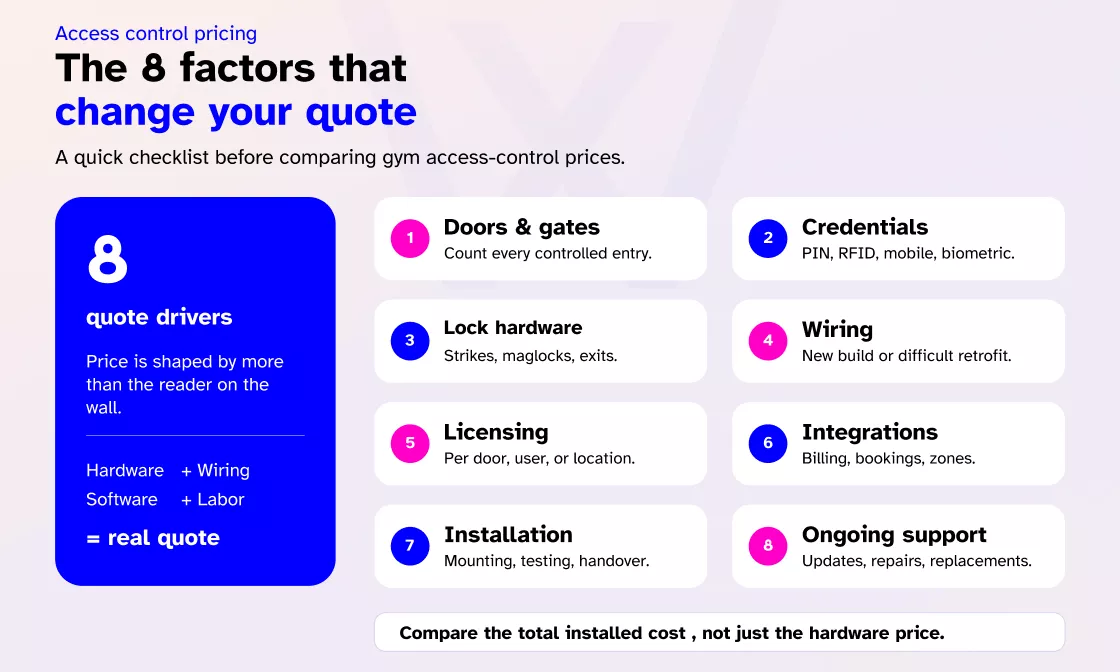
Check these eight factors:
- Number of doors and gates: Count the main entrance, back door, office, storage, staff room, studio rooms, recovery areas, and premium spaces.
- Credential type: PINs are cheap but easy to share. RFID gym access is reliable but needs fob inventory. Mobile access reduces physical stock. Biometric systems cost more but make pass-sharing harder.
- Lock type: Maglocks, electric strikes, crash bars, door closers, and request-to-exit devices all affect access control installation cost.
- Wiring complexity: A clean new build is easier than an older building with concrete walls, awkward frames, or no clear cable path.
- Software licensing: Some vendors charge per door, user, location, mobile credential, or feature tier.
- Integration depth: The price rises when access must follow billing, bookings, memberships, staff permissions, guest passes, and premium zones.
- Installation labor: Low-voltage wiring, mounting, fire safety checks, testing, and handover are often a major part of the quote.
- Ongoing support: Replacement credentials, firmware updates, batteries, service calls, and emergency repairs should sit inside the real budget.
Average hardware costs
Use this table for planning, not final purchasing decisions. Pricing changes by brand, building condition, and scope.
| Component | Typical cost | Notes |
| Commercial keypad | $300–$1,500+ | Lower cost, but codes can be shared |
| RFID reader | $500–$1,500+ | Reliable for busy entrances |
| Mobile access reader | $800–$2,500+ | Good for app-led journeys |
| Door controller | $500–$2,000+ | Decision-making panel |
| Electric strike or maglock setup | $500–$2,500+ installed | Depends on door and safety hardware |
| Key cards or fobs | $5–$50 each | Based on Kisi’s credential range |
| Biometric reader | $1,500–$5,000+ | Stronger identity control |
| Turnstile or speed gate lane | $7,000–$50,000+ | Depends on model and finish |
Turnstiles deserve their own budget line. Hayward Turnstiles says turnstile prices can range from $3,000 to $50,000 per lane or more. FDC says optical turnstiles usually range from $7,000 to $15,000 per lane, with premium models above $20,000. FDC also notes that basic waist-high units may start around $1,500 to $2,500, while RFID or biometric versions can range from $3,000 to $6,000.
That is why gym turnstile cost cannot be compared with a simple reader beside a normal door. They support one-person-at-a-time entry.
Cost by gym size: what should you budget?
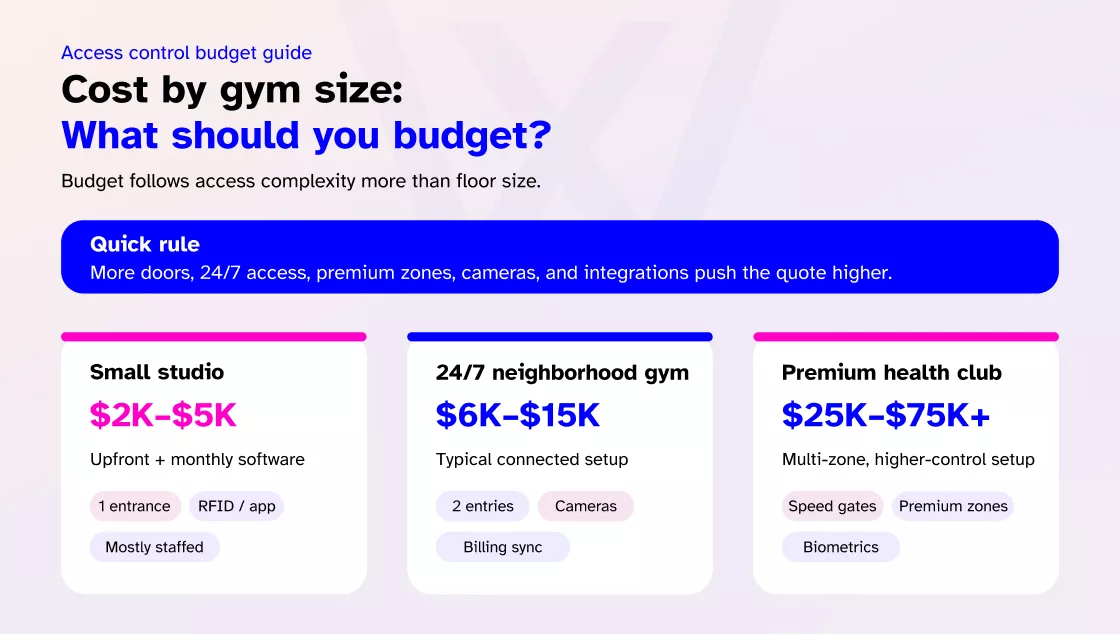
The right budget depends less on the size of your building and more on how your gym operates. Different facilities have different access needs, so before comparing quotes, it helps to see what a typical investment looks like for gyms similar to yours.
Small gym or boutique studio
A small yoga, Pilates, or personal training studio may only need one controlled entrance and simple mobile or RFID access. A practical budget is $2,000 to $5,000 upfront, plus monthly software.
This works best when:
- The space is staffed most of the day.
- Traffic is modest.
- There are no premium internal zones.
- Members are comfortable with mobile access or fobs.
24/7 neighborhood gym
A mid-size 24/7 gym often needs two entrances, RFID access, cameras, billing integration, and staff permissions. A realistic planning range is $6,000 to $15,000 upfront, depending on wiring.
This is where a connected system matters. If failed payments do not block entry automatically, staff end up chasing access manually. If you are fob-heavy, this gym key fob system guide can help you think through credential costs before buying.
Premium health club
A premium health club may need speed gates, biometric access, visitor management, staff permissions, premium-zone rules, and multi-zone reporting. A realistic planning range can be $25,000 to $75,000 or more.
This type of facility usually needs speed gates, member access, premium-zone rules, staff permissions, and stronger reporting.
If you are considering fingerprints or facial recognition, review privacy, consent, and setup issues before choosing biometric access control.
Cost by access type
Each access method has a different cost profile. The right choice depends on member behavior, convenience, and the facility’s security risk.
| Access type | Upfront cost | Maintenance | Security | Best use |
| PIN | Low | Low | Weak | Low-risk internal rooms |
| RFID | Medium | Medium | Good | Standard gyms and 24/7 clubs |
| Mobile | Medium to high | Low to medium | Good | App-led studios and modern clubs |
| Biometric | High | Medium | Strong | Premium or high-security areas |
| Turnstiles | High | Medium to high | Strong | High-traffic or unstaffed gyms |
PIN access is cheap, but codes travel quickly. I would not use shared PINs for 24/7 entry.
RFID is dependable and familiar. It works well for mixed-age memberships and busy entrances, but you still need to manage lost fobs, replacement stock, and possible sharing.
Mobile access fits the way many members already book classes and pay bills. Biometric access is stronger against pass-sharing, but it brings higher cost and privacy responsibility.
Turnstiles work best where one-person-at-a-time entry matters. They cost more, but they help reduce tailgating in high-traffic and unstaffed environments.
Monthly software and support costs
Monthly fees are where many gym owners under-budget. The hardware may be paid once, but cloud access control, support, mobile credentials, and integrations can continue every month.
| Item | Estimated monthly cost | Why it matters |
| Cloud access control software | $30–$200+ | Manages users, permissions, and logs |
| Mobile credentials | Varies by provider | Enables phone-based entry |
| API or integration access | Varies by tier | Connects access to billing |
| Support and maintenance | $50–$300+ | Covers help, updates, and troubleshooting |
| Monitoring or video add-ons | Varies by site | Supports incident review |
| Multi-location management | Higher-tier pricing | Helps manage several sites |
The key is what the fee controls. If the software connects payments, bookings, memberships, freezes, guest passes, and premium room rules, it can save staff time.
Software and integration costs
Hardware controls the door. Software controls the rule.
Integration adds to the software fee, but it removes daily admin. When access follows membership status automatically, staff do not have to update multiple systems. Without integration, someone has to update access manually.
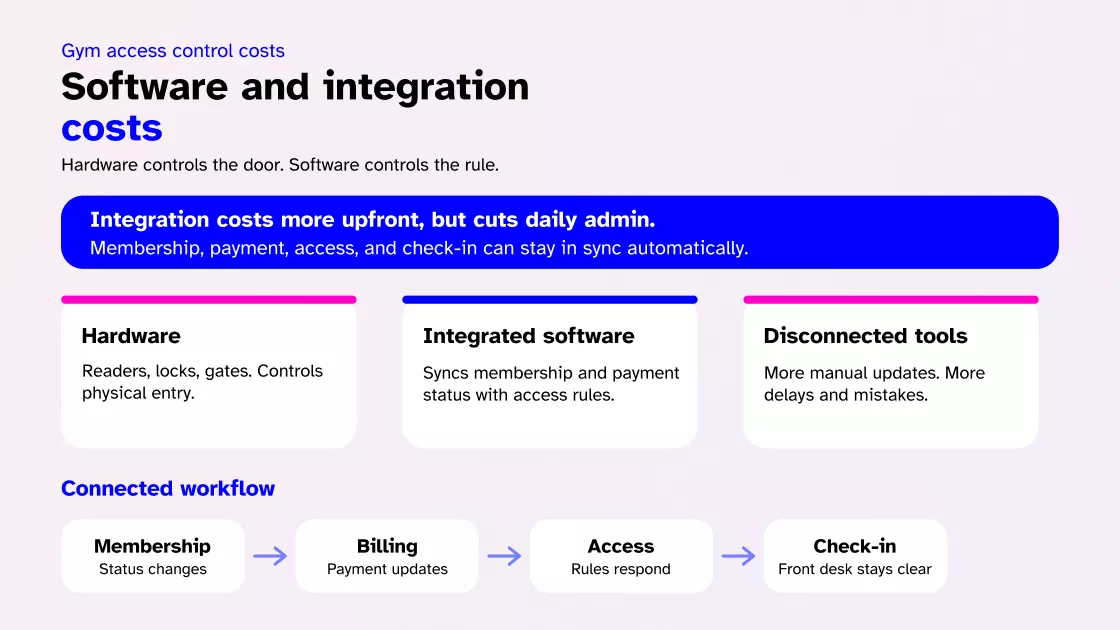
That creates delays, mistakes, and awkward front-desk conversations. For the event-by-event workflow of how these integrations actually work, see the gym access control integrations guide.
This is why gym management software often matters more than the reader brand. If your system connects memberships, payments, bookings, access, and check-ins, you reduce gaps. Wellyx is designed with this in mind, and its gym access control software is one option for owners who want fewer disconnected tools. For front-desk flow, kiosk check-in can also sit beside door access.
Installation and hidden costs
The quote may show one reader and one lock. The building decides the rest.
Installation may include:
- Low-voltage wiring
- Controller placement
- Network setup
- Door-frame work
- Backup power
- Request-to-exit buttons
- Emergency release hardware
- Fire safety coordination
- Reader mounting
- Testing and staff handover
Hidden costs usually include replacement fobs, setup fees, API work, staff training, onboarding, network upgrades, batteries, service calls, locksmith visits, and adding doors later.
The first quote shows the installation cost. Hidden fees reveal what the system costs to operate over time.
Wired vs. wireless access control
Wired systems usually cost more upfront because they need cable work and labor. They are often better for main entrances, turnstiles, and heavy-traffic doors.
Wireless systems are easier to retrofit, especially in older buildings or internal rooms, but you need to plan for batteries, signal reliability, and hardware limits.
A simple rule works well:
- Use wired access where the door is business-critical
- Use wireless access where the space is lower risk or the building is awkward
- Do not use wireless only because it looks cheaper on day one
Is a cheaper access control system worth it?
Sometimes, yes.
A staffed studio may not need speed gates. A simple commercial reader may be enough. But a 24/7 gym should not rely on shared codes or manual updates.
The U.S. Bureau of Labor statistics reported that fitness trainers and instructors earned a median wage of $46,180 in May 2024, with employment projected to grow 12% from 2024 to 2034. That does not mean access control replaces people. It means staff time is valuable and should not be wasted policing doors.
| ROI item | Calculation |
| Unpaid visits lost per week | 5 |
| Estimated value per visit | $15 |
| Monthly leakage | About $300 |
| Annual leakage | About $3,600 |
| Potential savings | Depends on leakage reduction |
This estimate does not include staff time, pass-sharing, premium room misuse, or after-hours coverage.
How to budget before requesting quotes?
Start by walking the site, not the vendor website. Count every access point and decide who needs each door.
Ask yourself:
- Which doors need member access?
- Which doors are staff-only?
- Do cleaners need timed access?
- Do premium rooms need separate rules?
- Will guest passes expire automatically?
- Should failed payments block entry?
- Do you need cameras at the entrance?
Then ask every vendor:
- What is the total installed cost?
- What are the monthly software fees?
- Does it connect with my gym management software?
- Can failed payments block access automatically?
- How are frozen memberships handled?
- What happens if the internet goes down?
- What does support cost?
Do not compare only hardware prices. Compare hardware, installation, software, support, credentials, maintenance, integrations, training, and future expansion.
FAQs
How much does a basic gym access control system cost?
A basic one-door setup may start around $1,000 to $3,000 or more, depending on hardware, software, wiring, and installation. If the door needs extra electrical work, frame changes, or better exit hardware, the cost can rise quickly.
Do gym access control systems have monthly fees?
Many do. Monthly fees may cover cloud access control, mobile credentials, support, monitoring, updates, access logs, and gym software integration. Always ask what is included.
Are key fobs cheaper than mobile access?
Key fobs can be cheaper upfront, but they create inventory and replacement costs. Mobile access may cost more in software, but it reduces physical credential handling and can fit better with app-based member journeys.
Can members share fobs or mobile passes?
Yes, if the system does not prevent it. Anti-passback rules, mobile credentials, video review, tailgating alerts, and biometrics can reduce the risk. A normal door with a reader will not stop someone from holding the door open.
Are residential smart locks good enough for gyms?
No. Residential locks are not built for heavy gym traffic, access logs, fire safety integration, billing sync, emergency exit needs, or 24/7 support. Use commercial access control for a commercial facility.
What happens if the internet goes down?
Many commercial systems can keep working using local controller memory or cached credentials, but behavior depends on the provider and setup. Ask vendors how access works offline before buying.
Budget for the system, not just the door
A gym access control system is not just a reader, lock, or fob. It protects revenue, controls member flow, supports 24/7 access, and keeps staff from manually managing every access decision.
The cheapest quote is not always the cheapest system.
The best investment protects revenue, reduces admin, and still fits the way your gym actually operates.