





A successful gym owner builds a profitable business by focusing on four key areas: member retention, sustainable pricing, efficient operations, and consistent financial tracking. Success does not come from leadership skills or the most advanced equipment or the largest membership list alone. It comes from creating systems that help members stay longer, staff perform better, and the business remain financially healthy.
Growth brings opportunity, but it also adds pressure to everyday operations. More members mean more schedules, payments, questions, and follow-ups to manage. Successful operators need reliable systems that keep the member experience consistent as the business grows.
For gym owners who want to start a gym or become a successful gym owner, the answer is not one single tactic. It is the ability to connect daily decisions with long-term business goals. Owners who reach that point consistently tend to share a recognizable set of qualities and decision-making habits; it’s not just a business plan that looks good on paper.
Pillars of successful gym ownership
Before looking at individual strategies, it helps to understand the four areas that influence most gym businesses:
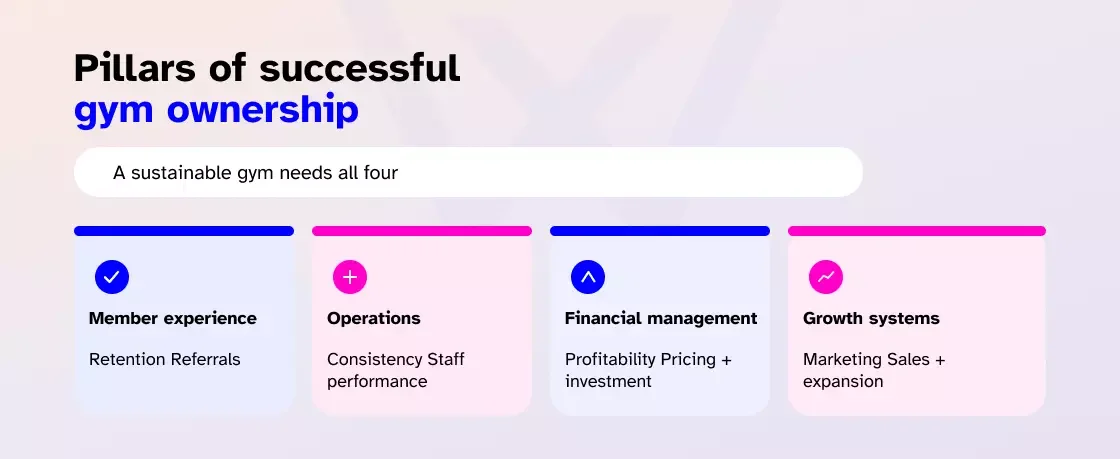
| Business pillar | What it controls |
| Member experience | Retention, referrals, and reputation |
| Operations | Consistency, efficiency, and staff performance |
| Financial management | Profitability, pricing, and investment decisions |
| Growth systems | Marketing, sales, and expansion opportunities |
A gym can attract hundreds of new leads, but without strong retention and operations, growth becomes difficult to sustain. Successful owners build systems around these four areas instead of relying only on motivation or hard work.
1. Design your gym around retention, not just new sign-ups
Many gyms focus heavily on attracting new members, but long-term success depends on keeping the members who already joined. Retention affects nearly every part of the business. When members stay longer, gyms spend less time replacing lost revenue and more time improving the member experience. Retention is not only a customer service responsibility. It is a business strategy.
Building this out usually means combining several gym member retention strategies rather than leaning on any single one. That’s why successful gym owners create structured member journeys from the first interaction, including:
- A clear onboarding process for new members.
- Check-ins during the first few weeks.
- Progress reviews and goal tracking.
- Personal communication when attendance drops.
- Recognition of milestones and achievements.
For example, a member who stops attending twice a week may not need another promotional email. They may need a coach reaching out, a progress conversation, or a reminder of why they joined. If you want to improve your gym business, start with systems that help members feel supported long after their first payment.
2. Price for sustainability, not popularity
Lower prices can attract audience attention, but pricing decisions determine whether your gym can continue investing in quality. A successful gym owner does not ask, “How can I get more members?” They focus on: “Does this membership price support the experience I want to deliver?”

Pricing should account for:
- Rent and operating expenses.
- Trainer payroll.
- Equipment maintenance.
- Software and administrative costs.
- Marketing investment.
- Future improvements.
A gym charging less than its costs may grow membership numbers while creating financial pressure. Running a gym with thin margins can create financial problems for owners.
Consider a simple example. A gym increases memberships through a discounted offer but cannot afford enough trainers during peak hours. Members experience crowded classes, reduced attention, and weaker results. The original pricing decision eventually affects retention. Sustainable pricing supports a better experience because the business has room to invest.
3. Standardize operations before growth creates problems
Many small gyms operate successfully through personal knowledge. The owner knows every member, remembers every process, and solves problems personally. That works until the business grows. A growing gym is a good thing to have, but at a larger scale, informal processes often create missed payments, inconsistent communication, scheduling issues, and staff confusion. Successful gym owners document repeatable systems for:
- Member onboarding.
- Payments and billing.
- Staff responsibilities.
- Class scheduling.
- Cancellations and freezes.
- Customer communication.
A simple test is this: Could a new team member understand how your gym operates without asking the staff every question? Can the gym operate even if the owner is away on vacation? If the answer is no, the business depends too heavily on individuals instead of systems.
One thing that differentiates a successful gym owner from struggling ones is their approach to standardizing gym operations. They often create operational playbooks to keep the business fully operational in their absence.
4. Turn trainers into relationship builders, not just instructors
A good trainer leads workouts. But great trainers do more than that: they connect with members, understand their goals, and support them. Members often remember how a gym made them feel as much as the workout itself. A coach who knows a member’s goals, notices progress, and gives encouragement can become one of the strongest retention drivers in the business. Successful owners hire right employees for their gym who:
- Understand member goals.
- Track progress consistently.
- Communicate outside scheduled sessions.
- Celebrate achievements.
- Identify members who may be losing motivation.
For example, a coach noticing that a new member has missed several sessions can start a conversation before that person silently cancels. The trainer’s role is not only to deliver exercise. It is to help members stay committed. And as a gym owner, if you can train your staff to build relationships with members, you can build a positive and progressive environment.
5. Use technology to reduce friction
As a gym grows, managing everything manually becomes harder. Progressive gym owners use technology and gym automation abilities to simplify repetitive tasks, remove operational dependency on humans, and create better visibility. This reduces reliance on manual processes. Moreover, it is about utilizing smart gym management systems and staff to their best potential. So there are fewer human errors and more accuracy and operational efficiency.
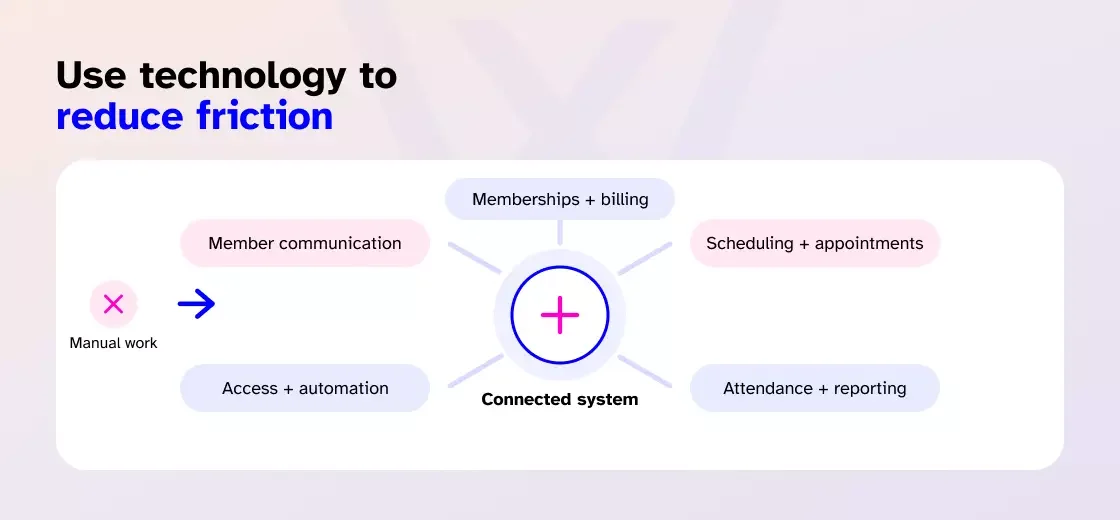
Gym management software can help connect:
- Membership management.
- Billing and payment reminders.
- Class and appointment scheduling.
- 24/7 gym access.
- Member communication.
- Attendance tracking.
- Business reporting.
The goal is not technology for its own sake. The goal is reducing friction so owners and staff can spend more time improving the member experience. For example, automated payment reminders can reduce missed payments, while attendance insights can help identify members who may need additional support.
Well-built gym management software helps gym owners manage these connected workflows through membership management, scheduling, payments, communication, and reporting tools.
6. Build revenue streams beyond memberships
Membership dues are the foundation of most gyms, but relying on a single income source makes the business fragile; one slow sign-up month and margins tighten fast. Successful gym owners have multiple gym revenue streams on top of core memberships, such as:
- Personal training packages and small-group coaching.
- Retail (supplements, apparel, recovery tools).
- Nutrition coaching or meal-prep partnerships.
- Workshops, challenges, or specialty programming.
- Space rental for events or outside instructors.
A gym earning even 20-30% of revenue outside memberships has far more room to absorb a slow season, and better data to decide which programs are worth expanding. The right mix depends on your space, staff, and member base, but the principle stays the same: don’t let one revenue line carry the whole business.
7. Build relationships outside your own four walls
Successful gym owners rarely operate in isolation. They stay connected to other operators, industry groups, and local businesses, not for networking’s sake, but because those relationships surface real, usable information. They learn which vendors are reliable, which pricing moves are working elsewhere, and which mistakes to avoid before making those mistakes themselves.
Ways to build this over time:
- Join local or national fitness business associations.
- Attend industry conferences or regional meetups.
- Build referral relationships with physiotherapists, nutritionists, or sports medicine clinics.
- Stay active in owner-only communities or forums.
Owners who do this consistently tend to catch industry shifts: new compliance requirements, pricing trends, emerging programs, before it shows up in their own numbers.
8. Track the metrics that actually influence decisions
Running a gym without tracking numbers makes decision-making difficult. To make fully well-thought-out decisions, successful gym owners set KPIs to track revenue and monitor key indicators such as:
- Member churn rate.
- Average revenue per member.
- Lead conversion rate.
- Attendance patterns.
- Class utilization.
- Personal training revenue.
- Payment failures.
Successful gym owners treat each metric individually and holistically to track the progress of the gym. A rising churn rate signals that retention and member experience need attention. Poor class utilization can be a sign to revisit the class-to-facility ratio. Similarly, low average revenue per member can indicate a need to expand the gym’s revenue streams. Revenue metrics carry the most weight because they reveal whether operational problems are already affecting the bottom line.
Moreover, growth-mindset-driven gym owners don’t limit tracking to only a quarterly business review. Rather, they keep a clear eye on each and every metric on a weekly, bi-weekly or monthly basis. A gym owner who knows their numbers well can make guided decisions before problems become serious.
9. Adapt before you are forced to
The fitness industry continues to change, and this makes the situation more challenging for gyms that run on old practices. Member expectations, technology, competition, and training preferences evolve constantly. Successful gym owners review their business regularly instead of waiting for declining revenue or membership losses. Adaptation may include:
- Updating programs based on member demand.
- Improving scheduling flexibility.
- Adding digital training options.
- Reviewing pricing regularly.
- Improving internal systems.
But owners don’t need to chase every trend. Great gym owners need to understand which changes improve the experience for their members.
A simple framework for improving your gym business
When evaluating your gym, review these four questions:
1. Are members staying?
Look at retention, attendance, and engagement.
2. Is the business profitable?
Review pricing, costs, and revenue sources.
3. Can the team operate consistently?
Improve systems, training, and communication.
4. Can the business scale without creating chaos?
Use processes and technology that support growth, and have a plan for the gym to thrive in challenging times that come with any period of change.
This framework helps owners focus on the areas that create sustainable improvement.
Final thoughts
Becoming a successful gym owner does not require doing everything yourself. It requires building a business that can consistently deliver value to members.
The strongest gyms combine good coaching with strong systems. They understand their numbers, support their teams, and create experiences that encourage members to stay.
Long-term success comes from making small improvements repeatedly until the business becomes easier to manage, easier to grow, and more valuable to the people it serves.
Frequently Asked Questions
1. What makes a successful gym owner?
A successful gym owner combines strong leadership, financial awareness, operational systems, and a focus on member experience. Growth comes from creating repeatable processes, not relying only on personal effort.
2. How can gym owners increase profitability?
Gym owners can improve profitability by increasing member retention, creating sustainable pricing, controlling operating costs, improving program revenue, and tracking important business metrics.
3. How much do gym owners typically earn?
Gym owner income varies widely based on location, facility size, service mix, and business model. A small single-location studio and a multi-service gym with several revenue streams can post very different numbers, even in the same city. National income data on gym owners salaries gives a useful benchmark, but you can expect it to range between $40,000–$100,000 per year depending heavily on how the business is run.
4. What skills does a gym owner need?
Gym owners need a combination of leadership, sales, marketing, financial management, customer service, and operational skills. Fitness knowledge is important, but running the business effectively is equally important.
5. How do successful gym owners retain members?
Successful gym owners retain members through strong onboarding, consistent communication, quality coaching, progress tracking, and systems that help members stay engaged.
6. Should every gym use management software?
Yes, as a gym grows, management software can help reduce administrative work by connecting memberships, payments, scheduling, communication, and reporting in one place. The right starting point is usually to consider factors when choosing software: cost, ease of onboarding, support, and fit with your current workflow before committing to one platform.